

P0460 on 2017-2019 Nissan Versa Note: Fuel Level Sensor Causes and Fixes
On a 2017-2019 Nissan Versa Note, code P0460 almost always means the fuel level sensor inside the gas tank has failed. Your fuel gauge will become unreliable. A Nissan Technical Service Bulletin (NTB22-026) confirms this common issue, and the sensor can be replaced separately from the more expensive fuel pump assembly for around $200-$230 in parts (OEM).
- P0460 on a 2017-2019 Versa Note is a clear indicator of a failing fuel level sensor.
- Your car is safe to drive, but you must track your mileage manually to avoid running out of gas.
- Save money by replacing only the fuel level sensor (part # 25060-5RL0A or 25060-3AN0A, depending on year), not the whole fuel pump assembly, as advised by Nissan TSB NTB22-026.
- The repair can be done by a confident DIYer and involves accessing the fuel tank via a panel under the rear seat.
- Always replace the fuel pump gasket and take safety precautions when working with the fuel system, such as disconnecting the battery and ensuring good ventilation.
What's Unique About the 2017-2019 Nissan VERSA NOTE
The Nissan Versa Note and its platform-mate, the Nissan Kicks, are particularly prone to this specific failure. Nissan has acknowledged the problem by issuing Technical Service Bulletin NTB22-026, which covers this code and vehicle. The bulletin clarifies that the issue is an erratic sensor signal (slosh) and, importantly, that the fuel level sensor can be replaced on its own without buying the entire fuel pump assembly, which saves a significant amount of money on the repair.
Diagnostic Flowchart
Tap your situation to follow the diagnostic path that matches what you're seeing on this vehicle.
Symptoms You May Notice
- Inaccurate or erratic fuel gauge reading.
- Fuel gauge stuck on full or empty.
- Check Engine Light is on.
- Inaccurate 'Distance to Empty' (DTE) calculation.
- Fuel gauge reading fluctuates or changes rapidly while driving or idling.
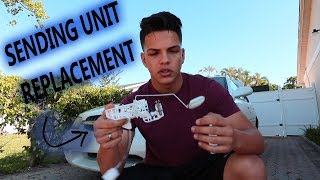
- Replacing the entire fuel pump assembly. The TSB and part availability confirm that only the sensor needs to be replaced 🎬 Watch: An easy walkthrough for replacing just the sending unit, which is much more cost-effective. Nissan explicitly warns dealerships that warranty claims for the full assembly for this issue will be charged back.
Most Likely Causes
- Faulty Fuel Level Sensor (Sending Unit) 🔴 High Probability This is a widely recognized failure point for this platform, as documented by Nissan in TSB NTB22-026. The internal resistor strip on the sensor wears out over time, causing the signal to become erratic or drop out completely.
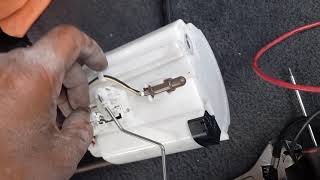
How to confirm: Access the fuel sending unit and test 🎬 See how to access and troubleshoot the fuel sensor problem the sensor's resistance with a multimeter while moving the float arm. The resistance should change smoothly from approximately 4-6 ohms (Full) to 78-82 ohms (Empty). If the reading jumps, is erratic, or shows an open circuit (OL), the sensor is bad.
Typical fix: Replace the fuel level sensor. It is located on the fuel pump module inside the fuel tank and can be replaced as a separate component. It is also best practice to replace the large O-ring/gasket for the fuel pump assembly at the same time to prevent leaks.
Est. part cost: $110-$230 - Damaged Wiring or Corroded Connector ⚪ Low Probability While possible, this is far less common than sensor failure. The connector is located under an access panel under the rear seat, protecting it from most road debris and weather.
How to confirm: Visually inspect the wiring harness and connector going to the fuel pump assembly for any signs of corrosion, breaks, or loose pins. Check for a solid ground connection. A 'wiggle test' on the harness while monitoring live data on a scan tool can reveal intermittent connections.
Typical fix: Repair the damaged section of the wiring harness or clean/replace the connector.
Est. part cost: $5-$50
Rare But Worth Checking
- Faulty Instrument Cluster: This is very uncommon. If the fuel level sensor and wiring test perfectly, the gauge cluster itself could be failing to interpret the signal correctly. This should only be considered after all other possibilities are exhausted.
- Faulty Powertrain Control Module (PCM): This is extremely rare. A PCM failure is a last resort diagnosis and should be confirmed by a professional after ruling out all other potential causes.
Diagnosis Steps
- Scan the vehicle for any other trouble codes. Note any codes related to the fuel level circuit, such as P0461, P0462, or P0463.
- Use a scan tool with live data capability to monitor the fuel level sensor voltage or percentage. Observe if the reading is erratic or does not match the approximate fuel level in the tank. Gently rocking the vehicle may show the value jumping erratically instead of changing smoothly.
- Gain access to the fuel pump assembly. On the Versa Note, this is done by removing the rear seat cushion to expose a metal access panel.
- Disconnect the battery before proceeding.
- Disconnect the electrical connector at the fuel pump assembly and inspect it for corrosion or damage.
- If possible, test the resistance of the fuel level sensor at the connector pins using a multimeter. Compare the reading to the manufacturer's specifications (approx. 4-82 ohms).
- If the external test is inconclusive, remove the fuel pump assembly from the tank. Special Tools: A fuel tank lock ring tool 🎬 Watch: Step-by-step guide to replacing the fuel pump and sensor is recommended to safely remove the plastic ring holding the assembly. Using a hammer and punch is not advised as it can damage the ring.
- With the assembly removed, directly test the fuel level sensor by moving the float arm up and down while measuring resistance. The change should be smooth and linear. If it jumps or reads open, the sensor is faulty.
- If the sensor tests good, the problem lies in the wiring between the sensor and the ECM, or in a rare case, the instrument cluster or ECM itself.
Parts You'll Likely Need
- Fuel Level Sensor
(OEM #25060-5RL0A)— This is the component that fails most often, causing the erratic signal that triggers code P0460. Note: There was a part change during the 2018 model year. Verify VIN before ordering. Earlier models may use 25060-3AN0A.
Trusted brands: Nissan (OEM)
OEM price range: $200-$230
Aftermarket price range: $90-$150 - Fuel Pump O-Ring / Gasket
(OEM #17342-6RR0A)— This seal should always be replaced when the fuel pump assembly is removed from the tank to prevent dangerous fuel leaks and fumes.
Trusted brands: Nissan (OEM)
OEM price range: $15-$25
Aftermarket price range: $5-$15
Related Codes That Often Appear With This One
- P0461 — Relates to 'Fuel Level Sensor Circuit Range/Performance', often triggered by the same erratic sensor.
- P0462 — Relates to 'Fuel Level Sensor Circuit Low Input', indicating the signal voltage is below the expected range.
- P0463 — Relates to 'Fuel Level Sensor Circuit High Input', indicating the signal voltage is above the expected range.
Technical Service Bulletins (TSBs) & Recalls
- NTB22-026: Addresses P0460 (FUEL LEV SEN SLOSH) and confirms that the fuel level sensor can be replaced separately from the entire fuel pump assembly on various Nissan models, including the Versa, Versa Note, and Kicks. It warns dealers that warranty claims for replacing the entire pump assembly for this issue will be rejected.
Platform-Specific Known Issues
- A known issue with the fuel level sensor's reliability is documented in Nissan's Technical Service Bulletin NTB22-026, which specifically mentions the 'slosh' definition for code P0460.
- Owners on forums for related Nissan platforms note that the plastic fuel tank lock ring can be very difficult to remove without a proper tool, sometimes requiring significant force even with a universal 3-arm adjustable tool.
Mechanic-Grade Diagnostic Values
- Fuel Level Sensor Resistance — expected: Approx. 4-6 Ω at Full, 78-82 Ω at Empty, with a smooth sweep between.. Failure: Readings are OL (open circuit), jump erratically, or are significantly outside the specified range.
- Voltage Drop on Sensor Signal Wire — expected: ≤ 0.5V between the sensor connector and the PCM.. Failure: A voltage drop greater than 0.5V indicates excessive resistance in the wiring or connectors, pointing to a wiring fault rather than a sensor failure.
- Sensor Signal Voltage — expected: Typically varies from ~0.5V (Empty) to ~4.5V (Full).. Failure: Voltage is stuck at 0V, 5V, or does not change smoothly as the fuel level changes.
Scan Tool Commands That Help
- Generic OBD-II Scanner or Nissan CONSULT: Live Data Monitoring (Fuel Level Input) — Use this to observe the sensor's reported voltage or percentage in real-time. Gently rocking the vehicle should cause a smooth, corresponding change. An erratic, jumping, or static value while the vehicle is in motion points to a faulty sensor or circuit.
Wiring & Ground Locations
- Fuel Pump / Sensor Connector — Under the rear seat cushion, beneath a metal access panel. On a 2016 Versa Note harness diagram, this connector is at grid location C2.. This is the primary access point for testing the sensor's resistance and voltage without dropping the fuel tank.
- Ground Point M57 — Behind the left end of the dashboard (for 2011 Versa).. A wiring diagram for a similar generation lists this as a ground distribution point that serves multiple components, including the fuel level sensor unit. A poor ground here could potentially cause erratic readings, though it is a less likely cause than sensor failure.
OEM Part Supersession History
25060-3AN0A→25060-5RL0A (for this platform)— Mid-generation part update or change in supplier.
Heads up: Part 25060-3AN0A is listed for the 2014-2019 Versa Note, while 25060-5RL0A is listed for Kicks and Versa models from mid-2018 onwards. The parts may not be interchangeable. It is critical to verify the correct part number with the vehicle's VIN before purchasing to avoid incompatibility.
Model Year Variations Within This Range
- 2017-2019: The OEM part number for the fuel level sensor likely changed during the 2018 model year. 2017 and early 2018 models are more likely to use part number 25060-3AN0A, while late 2018 and 2019 models likely use 25060-5RL0A.
Helpful Videos

Used OEM Parts in Stock


New Aftermarket Parts Available


The information in this article is provided for general reference and educational purposes only. Vehicle specifications, procedures, and part compatibility can vary by production date, trim level, and region. Always consult your vehicle's factory service manual and verify part numbers before purchasing or performing repairs. Safety-critical components such as airbags, seat belts, and braking systems should be installed by a qualified professional.
- Nissan VERSA NOTE:
- 🎬 Helpful Videos
- 🛍️ Shop This Part
- What's Unique About the 2017-2019 Nissan VERSA NOTE
- Diagnostic Flowchart
- Symptoms You May Notice
- Most Likely Causes
- Rare But Worth Checking
- Diagnosis Steps
- Parts You'll Likely Need
- Related Codes That Often Appear With This One
- Technical Service Bulletins (TSBs) & Recalls
- Platform-Specific Known Issues
- Mechanic-Grade Diagnostic Values
- Scan Tool Commands That Help
- Wiring & Ground Locations
- OEM Part Supersession History
- Model Year Variations Within This Range
- 🎟️ Get 5% Off