

P0460 on 2016-2022 Nissan Rogue: Fuel Gauge Problems and Sensor Fixes
On a 2016-2022 Nissan Rogue, code P0460 is almost always caused by a faulty fuel level sensor in the gas tank. This leads to an erratic or incorrect fuel gauge. The sensor can often be replaced separately from the fuel pump assembly, with parts costing around $100-$200. Nissan has acknowledged this is a common problem.
- P0460 on a Nissan Rogue almost always points to a bad fuel level sensor.
- You will not be able to trust your fuel gauge, so track your mileage to avoid running out of gas.
- A Nissan TSB (NTB22-026) confirms this is a known issue and clarifies that you can replace just the sensor, not the entire expensive fuel pump assembly.
- Diagnosis involves testing the sensor's resistance with a multimeter while moving the float arm or rocking the vehicle.
- AWD models have two sensors, which is an important consideration during diagnosis.
What's Unique About the 2016-2022 Nissan ROGUE
For this generation of Nissan Rogue, the P0460 code is a well-documented issue. Nissan has acknowledged the problem in TSB NTB22-026, which points directly to the fuel level sensor as the culprit for this and related codes (P0461, P0462, P0463). 🎬 Watch: Understanding P0460 causes and how to fix them. A key detail for the Rogue is that the bulletin clarifies the fuel level sensor can be replaced separately from the entire fuel pump assembly, which can save a significant amount of money on parts. This is particularly important as some repair shops might default to replacing the entire, more expensive unit. AWD models have two fuel level sensors to account for the driveshaft hump in the tank, which can complicate diagnosis slightly.
Diagnostic Flowchart
Tap your situation to follow the diagnostic path that matches what you're seeing on this vehicle.
Generation note: The 2016-2022 year range covers two generations of the Nissan Rogue: the second generation (T32, 2014-2020) and the third generation (T33, 2021-present). The provided TSB NTB22-026 specifically applies to all 2016-2022 Nissan models, confirming the issue is prevalent across this entire range. The repair process, involving access to the fuel tank under the rear seat, is similar for both generations.
Symptoms You May Notice
- Check Engine Light is on
- Fuel gauge reading is inaccurate (e.g., shows full when it's half-empty)
- Fuel gauge fluctuates rapidly or randomly
- Fuel gauge is stuck on empty or full
- Distance-to-empty (DTE) display is erratic and unreliable
- Low fuel warning light comes on even with a full tank.
- After filling the tank, the gauge doesn't show completely full.
- Replacing the entire fuel pump assembly when only the serviceable fuel level sensor has failed. The TSB for this vehicle specifically advises that the sensor can be replaced on its own.
- Replacing the instrument cluster before properly diagnosing the sensor and its circuit.
Most Likely Causes
- Faulty Fuel Level Sensor 🔴 High Probability This is a known issue acknowledged by Nissan in TSB NTB22-026. The resistive strip on the sensor can wear out or become contaminated over time, causing erratic voltage signals.
How to confirm: Access the fuel pump module (typically under the rear seat). Test the sensor's resistance with a multimeter while manually moving the float arm. The resistance should change smoothly. An open circuit (no reading) or erratic jumps confirm failure. While specific Ohm ranges for the Rogue are not widely published, a typical Nissan sensor might read around 0-90 Ohms (empty-full) or 16-158 Ohms. The key is a smooth, consistent change, not the exact numbers.
Typical fix: Replace the fuel level sensor. The TSB confirms this part can be serviced separately from the main fuel pump assembly. For AWD models, there are two sensors; the secondary sensor is often the culprit.
Est. part cost: $80-$220 - Damaged Wiring or Connectors 🟡 Medium Probability The wiring harness runs underneath the vehicle to the fuel tank, exposing it to potential road debris and corrosion, although this is not a specific known prone point for the Rogue.
How to confirm: Visually inspect the wiring harness leading to the fuel tank for any signs of damage, corrosion, or loose connections. Check for proper voltage and ground at the sensor's connector using a multimeter.
Typical fix: Repair or replace the damaged section of the wiring harness or clean the connectors.
Est. part cost: $10-$50 - Stuck or Damaged Float Arm ⚪ Low Probability
How to confirm: After accessing the fuel level sensor, visually inspect the float and its arm. Check if it moves freely throughout its range of motion without binding or getting stuck. This can sometimes happen if a vehicle sits for a very long time.
Typical fix: If the arm is bent, it may be possible to straighten it. If it is binding or the float is damaged, the entire sensor assembly must be replaced.
Est. part cost: $80-$220
Rare But Worth Checking
- Instrument Cluster Fault: This is rare. Before suspecting the cluster, the sensor and wiring must be thoroughly tested and confirmed to be working correctly. A faulty cluster might also present other gauge-related issues. Some owners in forums for other vehicles have reported this, but it's not a common Rogue complaint for P0460.
- Powertrain Control Module (PCM) Fault: This is extremely rare and should only be considered after all other possibilities, including the sensor, wiring, and instrument cluster, have been definitively ruled out.
Diagnosis Steps
- Read the trouble codes with an OBD-II scanner to confirm P0460 is present and note any other related codes.
- Use the scanner's live data function to monitor the fuel level sensor voltage. Observe if the reading is erratic, stuck, or doesn't match the approximate fuel level.
- Perform a visual inspection of the wiring harness and connectors leading to the fuel tank. Look for any obvious signs of damage, corrosion, or loose pins.
- Gain access to the top of the fuel tank, which is typically under the rear seat cushion. You will likely need to remove the seat bottom.
- Disconnect the fuel level sensor connector. Use a multimeter set to Ohms to test for resistance across the sensor's pins. While moving the float arm up and down (if removed) or rocking the vehicle side-to-side (if installed), watch the resistance reading. It should change smoothly. If it's open (OL), shorted (near zero ohms), or jumps erratically, the sensor is bad.
- If the sensor tests good, check for proper voltage and ground at the harness connector to rule out a wiring issue.
- If both the sensor and wiring are confirmed to be good, the problem may lie with the instrument cluster or PCM, though this is uncommon.
Parts You'll Likely Need
- Fuel Level Sensor
(OEM #25060-6FK0A (Secondary/Left side sensor for some 2.5L models, confirm with VIN))— This is the most common point of failure for the P0460 code on this vehicle, as confirmed by owner experiences and a manufacturer TSB.
Trusted brands: Nissan Genuine, Hitachi, Delphi
OEM price range: $150-$220
Aftermarket price range: $80-$150
Related Codes That Often Appear With This One
- P0461 — This code indicates a range/performance issue with the fuel level sensor circuit, which is closely related to the general malfunction indicated by P0460. TSB NTB22-026 covers this code as well.
- P0462 — This code points to a low input signal from the sensor circuit, often caused by the same failing component that triggers P0460. TSB NTB22-026 covers this code as well.
- P0463 — This code indicates a high input signal from the sensor circuit, which can be caused by a short or a failed sensor, directly related to P0460. TSB NTB22-026 covers this code as well.
Technical Service Bulletins (TSBs) & Recalls
- NTB22-026: Addresses P0460 (FUEL LEV SEN SLOSH) and confirms the fuel level sensor can be replaced separately from the fuel pump assembly on 2016-2022 models.
Platform-Specific Known Issues
- Nissan issued Technical Service Bulletin NTB22-026 for 2016-2022 Nissan models, which directly addresses codes P0460, P0461, P0462, and P0463. It confirms the cause is often the fuel level sensor and explicitly states the sensor can be replaced separately from the entire fuel pump assembly.
- On AWD models, there are two fuel level sensors due to the shape of the fuel tank around the driveshaft. The secondary sensor is often the one that fails.
- Owners on forums like Reddit and Nissanforums.com frequently discuss this issue, confirming that replacing the sending unit/sensor resolves the inaccurate gauge and check engine light.
Mechanic-Grade Diagnostic Values
- Fuel Level Sensor Resistance — expected: Most modern Nissan vehicles use a range similar to 0-90 Ohms or 16-158 Ohms. A smooth, linear change between full and empty is critical.. Failure: An open circuit (OL), a short (near 0 Ohms regardless of float position), or erratic jumps in resistance as the float arm is moved indicate a failed sensor.
Wiring & Ground Locations
- Fuel Pump / Sending Unit Connector — On top of the fuel tank, accessible by removing the rear seat bottom cushion. There are access panels underneath the carpet/insulation for both the primary (right side) and secondary (left side, on AWD) units.. This is the primary connection point for testing the sensor's resistance and checking for voltage/ground from the vehicle's wiring harness. Corrosion or loose pins at this connector can cause P0460.
Real Owner Repair Stories
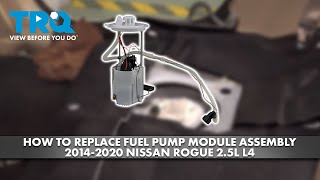
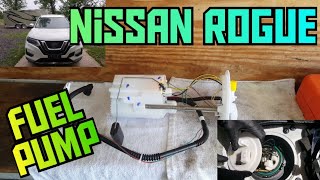
- YouTube video by '1A Auto' (2016 Nissan Rogue SL AWD (T32 generation)) — The video demonstrates a full replacement of the fuel pump and sending unit assembly, which is a common procedure to fix fuel gauge issues.
✅ What actually fixed it The video shows the complete process of accessing the fuel tank under the rear seat and replacing the primary fuel pump module. For a P0460 code, especially on an AWD model, a technician would first test both the primary and secondary sending units to see which one has failed before replacing parts. The video confirms the location and general process for accessing these components.
OEM Part Supersession History
Unknown→25060-6FK0A— This is the current part number for the secondary (left side) fuel level sensor for many 2.5L AWD Rogue models within the 2016-2022 range.
Heads up: This part is described for 'Japan Built' models and is the 'Secondary' sensor. It is crucial to confirm the correct part number with the vehicle's VIN, as there are different parts for FWD vs. AWD and potentially for US-built vs. Japan-built models.Unknown→25060-6FK5A— This is another part number listed for the fuel sending unit assembly for the 2016-2020 Nissan Rogue (non-Sport models).
Heads up: Part fitment can be complex. Always verify with a VIN as this part may be for the primary unit or for a different configuration.
Model Year Variations Within This Range
- 2021-2022: The 2021 model year marked the beginning of the T33 generation, which brought a complete redesign. While the fuel sending unit issue persists per the TSB, it's important to note these are fundamentally different vehicles than the 2016-2020 models.
- 2022: For the 2022 model year, Nissan replaced the 2.5L 4-cylinder engine with a new 1.5L 3-cylinder VC-Turbo engine. This created a significant powertrain difference from the 2021 model, though the underlying fuel system architecture and P0460 issue remained similar.
Helpful Videos


We Have This Part in Stock


The information in this article is provided for general reference and educational purposes only. Vehicle specifications, procedures, and part compatibility can vary by production date, trim level, and region. Always consult your vehicle's factory service manual and verify part numbers before purchasing or performing repairs. Safety-critical components such as airbags, seat belts, and braking systems should be installed by a qualified professional.
- Nissan ROGUE:
- 🎬 Helpful Videos
- 🛍️ Shop This Part
- What's Unique About the 2016-2022 Nissan ROGUE
- Diagnostic Flowchart
- Symptoms You May Notice
- Most Likely Causes
- Rare But Worth Checking
- Diagnosis Steps
- Parts You'll Likely Need
- Related Codes That Often Appear With This One
- Technical Service Bulletins (TSBs) & Recalls
- Platform-Specific Known Issues
- Mechanic-Grade Diagnostic Values
- Wiring & Ground Locations
- Real Owner Repair Stories
- OEM Part Supersession History
- Model Year Variations Within This Range
- 🎟️ Get 5% Off