

P0460 on 2016-2022 Nissan Murano: Fuel Level Sensor Circuit Causes and Fixes
On a 2016-2022 Nissan Murano, code P0460 is almost always caused by a faulty fuel level sensor inside the gas tank. This is a known issue confirmed by Nissan TSB NTB22-026. The sensor, OEM part number 25060-5AA0A or 25060-5AA1A, can be replaced separately from the fuel pump for around $100-$170 in parts. The repair involves removing the rear seat to access the fuel tank service cover.
- P0460 on a 2016-2022 Murano almost certainly means a bad fuel level sensor.
- Nissan TSB NTB22-026 confirms this is a known issue.
- The correct fix is to replace only the sensor (Part # 25060-5AA0A or 25060-5AA1A), not the whole fuel pump assembly.
- The job can be done by a DIYer with moderate skills by accessing the fuel tank through a panel under the rear seat.
- Do not trust your fuel gauge until this is fixed; use your trip meter to track fuel usage.
What's Unique About the 2016-2022 Nissan MURANO
The 2016-2022 Nissan Murano (Z52 generation) is part of a wider group of Nissan vehicles known to have issues with the fuel level sensor. Nissan acknowledged this by issuing Technical Service Bulletin (TSB) NTB22-026 for the Murano, Pathfinder, Maxima, and others. The TSB is significant because it explicitly states that for a P0460 code, technicians should replace only the fuel level sensor, not the entire, more expensive fuel pump assembly. This saves owners money by targeting the specific point of failure.
Diagnostic Flowchart
Tap your situation to follow the diagnostic path that matches what you're seeing on this vehicle.
Symptoms You May Notice
- Check Engine Light is on
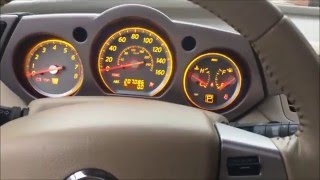
- Fuel gauge behaves erratically (e.g., drops to empty, jumps to full, or doesn't move)
- Fuel gauge is stuck in one position (full, empty, or in between)
- Inaccurate 'Distance to Empty' calculation on the trip computer
- Low fuel warning light illuminates intermittently or at the wrong time
- Replacing the entire fuel pump assembly. The TSB NTB22-026 specifically warns against this, as the fuel level sensor is a separate, serviceable part and Nissan states warranty claims for the full assembly may be charged back.
- Replacing the instrument cluster before properly testing the fuel level sensor and its circuit.
Most Likely Causes
- Faulty Fuel Level Sensor 🔴 High Probability This is a well-documented issue for this platform, as confirmed by Nissan's own Technical Service Bulletin NTB22-026. The sensor's internal variable resistor wears out or gets contaminated, causing it to send erratic voltage signals.
How to confirm: Access the sensor on top of the fuel tank. Use a multimeter to measure the resistance across the sensor's terminals while manually moving the float arm. 🎬 See a mechanic demonstrate how to test sensor resistance The resistance should change smoothly. For similar Nissan models, the specification is approximately 4-6 Ohms when full and 77-83 Ohms when empty. If the resistance jumps, drops out, or reads as an open circuit (OL), the sensor is bad.
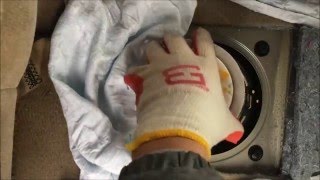
Typical fix: Replace the fuel level sensor. The Murano has two sensors; the primary one is attached to the fuel pump module. The rear seat must be removed to access the service cover. 🎬 Watch: How to access and remove the fuel level sensor
Est. part cost: $100-$170 - Damaged Wiring or Corroded Connectors 🟡 Medium Probability
How to confirm: Visually inspect the wiring harness leading to the fuel pump assembly for any signs of damage, chafing, or corrosion, particularly at the connector on top of the fuel tank. Check for continuity and shorts using a multimeter.
Typical fix: Repair the damaged section of wire or clean/replace the corroded connector.
Est. part cost: $5-$50
Rare But Worth Checking
- Stuck or Damaged Float Arm: The float arm can get bent from improper handling during service or, in rare cases, get stuck due to debris or rust inside the tank, preventing it from moving with the fuel level.
- Faulty Instrument Cluster or BCM: It is very rare for the instrument cluster (the gauge itself) or the Body Control Module (BCM) to fail in a way that generates a P0460 code. All other possibilities, especially the sensor and wiring, should be exhausted before considering this.
- Faulty Powertrain Control Module (ECM): An ECM failure is extremely unlikely to be the cause of this specific code. This should only be considered after all other diagnostic steps have failed to find a fault.
Diagnosis Steps
- Read the trouble codes with an OBD-II scanner to confirm P0460 and check for any other related codes (P0461, P0462, P0463). 🎬 Learn more about diagnosing the P0460 circuit malfunction code
- Use a scan tool with live data capability to monitor the 'Fuel Level' reading. Observe if the reading is erratic, stuck, or doesn't match the approximate fuel level in the tank.
- Inspect the wiring harness and connector at the top of the fuel tank. Look for any visible damage, corrosion, or loose pins.
- If wiring appears okay, gain access to the fuel pump assembly by removing the rear seat cushion and the service panel. This requires removing several bolts and disconnecting harnesses under the seat.
- Disconnect the fuel level sensor connector. With a multimeter set to Ohms (Ω), measure the resistance between the sensor's signal and ground pins.
- Slowly move the float arm by hand from the empty to the full position. The resistance reading should change smoothly and consistently. On similar Nissan platforms, the expected range is ~77-83 Ohms at empty and ~4-6 Ohms at full.
- If the resistance jumps erratically, is out of specification, or shows an open circuit (OL), the fuel level sensor is faulty and must be replaced.
- If the sensor tests good, the fault lies in the wiring or, very rarely, the instrument cluster or ECM.
Parts You'll Likely Need
- Fuel Level Sensor
(OEM #25060-5AA0A or 25060-5AA1A)— This is the most common failure point for the P0460 code on this vehicle, as identified by Nissan's service bulletin. The internal variable resistor wears out, causing incorrect readings. Note: 25060-5AA0A is listed for the right side/primary unit. 25060-5AA1A is listed for the left side/secondary unit.
Trusted brands: Nissan (OEM), Bosch, Delphi, Dorman
OEM price range: $125-$170
Aftermarket price range: $75-$120
Related Codes That Often Appear With This One
- P0461 — This code indicates 'Fuel Level Sensor 'A' Circuit Range/Performance' and is often set along with P0460 as the sensor's signal is both erratic (P0460) and out of its expected performance range (P0461). Both are mentioned in TSB NTB22-026.
- P0462 — This code means 'Fuel Level Sensor 'A' Circuit Low Input,' indicating the signal voltage is below the normal range. This can happen if the sensor's resistor fails or there's a short to ground. It is also listed in TSB NTB22-026.
- P0463 — This code means 'Fuel Level Sensor 'A' Circuit High Input,' indicating the signal voltage is above the normal range, often due to an open circuit or a failed sensor. It is also listed in TSB NTB22-026.
Technical Service Bulletins (TSBs) & Recalls
- NTB22-026: Issued April 5, 2022. Addresses P0460 and related codes, confirming the fuel level sensor is the likely cause and can be replaced separately from the fuel pump assembly. Applies to Murano, Maxima, Pathfinder, and Rogue, among others.
Platform-Specific Known Issues
- Nissan TSB NTB22-026: Issued April 5, 2022, for multiple 2016-2022 models including the Murano, Pathfinder, and Maxima for inaccurate fuel gauges with DTCs P0460, P0461, P0462, or P0463. The bulletin advises replacing only the fuel level sensor, not the entire fuel pump assembly, and warns that warranty claims for replacing the entire pump for this issue will be charged back.
- Owner Repair Experience: A YouTube video by A2z Auto Masters for a 2009 Murano (which has a very similar setup) details the replacement of both fuel level sensors. A commenter on the video notes that reinstalling the lock ring for the fuel pump can be difficult and may be easier with two people: one to press down on the pump assembly while the other turns the ring.
Mechanic-Grade Diagnostic Values
- Fuel Level Sensor Resistance (Pre-2019 Models) — expected: Approximately 77-83 Ohms at Empty and 4-6 Ohms at Full.. Failure: Readings are outside this range, show an open circuit (OL), or jump erratically as the float arm is moved.
- Fuel Level Sensor Resistance (Post-2019 Models, potential variation) — expected: May have changed to a different specification, potentially around 300 Ohms at Empty and 51 Ohms at Full.. Failure: Using the older spec for testing will lead to misdiagnosis. Confirm with a service manual for the specific year.
- Fuel Level Sensor Circuit Voltage Drop — expected: ≤0.5V between the sensor signal wire and the PCM.. Failure: A voltage drop greater than 0.5V indicates excessive resistance in the wiring or connectors, pointing to a harness issue rather than a sensor failure.
Scan Tool Commands That Help
- Advanced OBD-II Scanner (e.g., TOPDON, Autel): Live Data > Fuel Level Sensor Voltage/Percentage — To observe the sensor's reported value in real-time. Rocking the vehicle or adding fuel should cause a smooth change. Erratic jumps or a static value that doesn't match the known fuel level points to a sensor or circuit fault.
- High-End Scan Tool (e.g., TOPDON CR MAX BT): Special Functions > Fuel System > Circuit Test — This automated test can measure voltage drop across the circuit to definitively determine if the fault lies in the wiring harness or the sensor itself, saving diagnostic time.
Wiring & Ground Locations
- Fuel Pump Fuse — In the main fuse box (IPDM) located under the hood on the driver's side. It is typically a 15A fuse.. While a blown fuse is not a typical cause for a P0460 (which indicates a circuit malfunction, not necessarily a total power loss), checking it is a fundamental first step in any fuel system electrical diagnosis.
- Body Control Module (BCM) — Located behind the instrument cluster/speedometer.. The BCM processes the signal from the fuel level sensors before it is displayed on the instrument cluster. A fault in the BCM, though rare, can cause a P0460 code and other seemingly unrelated electrical issues.
- Chassis Grounds (Example from similar models) — Common ground points on Nissan vehicles include B7 (behind the left kick panel) and B116/B20 (behind the rear seats).. The fuel pump and sensor assembly rely on a solid chassis ground to function correctly. A corroded or loose ground connection in the rear of the vehicle can cause erratic resistance readings and trigger a P0460 code.
Real Owner Repair Stories
- Multiple YouTube DIY Videos (e.g., A2z Auto Masters, The Rusted Nut) (2009-2014 Nissan Murano (Z51 generation, but with a nearly identical fuel tank and access procedure)) — Inaccurate fuel gauge, service engine soon light with codes P0463 or similar.
❌ Tried (didn't work) Initial diagnosis often focuses only on the primary fuel pump side, without realizing there is a second sensor on the other side of the saddle tank.
✅ What actually fixed it Replacing both the primary and secondary fuel level sensors resolved the issue. A key mechanic tip shared across multiple videos is that the large plastic lock rings holding the pump assemblies in the tank are extremely difficult to remove and reinstall without the special tool. Technicians often resort to using a brass punch and hammer to carefully tap the ring open and closed. It can be helpful to have a second person press down firmly on the pump assembly to compress the spring while the ring is being tightened.
OEM Part Supersession History
25060-5AA1A→25060-5AA1A (current)— This is the Left (Driver's Side) Primary fuel level sensor, often included with the fuel pump assembly. No supersession found.
Heads up: This is the primary sensor unit.25060-5AA0A→25060-5AA0A (current)— This is the Right (Passenger's Side) Secondary fuel level sensor. No supersession found.
Heads up: This is the secondary sensor unit.
Model Year Variations Within This Range
- 2019-2022: The Murano received a facelift for the 2019 model year which included a new 8-inch touchscreen and updated electronics. While not definitively confirmed for the Murano, the contemporary Nissan Altima changed its fuel level sensor resistance specification in its 2019 redesign. Technicians should be aware that 2019+ Muranos may have a different resistance range (e.g., ~50-300 Ohms) than earlier models (~5-80 Ohms), and should verify the correct spec before diagnosing the sensor.
Helpful Videos

We Have This Part in Stock


The information in this article is provided for general reference and educational purposes only. Vehicle specifications, procedures, and part compatibility can vary by production date, trim level, and region. Always consult your vehicle's factory service manual and verify part numbers before purchasing or performing repairs. Safety-critical components such as airbags, seat belts, and braking systems should be installed by a qualified professional.
- Nissan MURANO:
- 🎬 Helpful Videos
- 🛍️ Shop This Part
- What's Unique About the 2016-2022 Nissan MURANO
- Diagnostic Flowchart
- Symptoms You May Notice
- Most Likely Causes
- Rare But Worth Checking
- Diagnosis Steps
- Parts You'll Likely Need
- Related Codes That Often Appear With This One
- Technical Service Bulletins (TSBs) & Recalls
- Platform-Specific Known Issues
- Mechanic-Grade Diagnostic Values
- Scan Tool Commands That Help
- Wiring & Ground Locations
- Real Owner Repair Stories
- OEM Part Supersession History
- Model Year Variations Within This Range
- 🎟️ Get 5% Off