

OBD-II Code P0459: Evaporative Emission System Purge Control Valve Circuit High
The Ultimate Guide to Diagnosing and Fixing P0459
- Code P0459 indicates the engine computer detects unwanted high voltage in the EVAP purge valve's electrical control circuit, pointing to a short to power rather than a vapor leak.
- Test the purge valve's resistance with a multimeter (typically 15-40 Ohms) before spending $110-$320 on a replacement part.
- Do not replace the gas cap or charcoal canister; P0459 is strictly an electrical circuit fault, not an EVAP system pressure leak.
- For 2005-2014 Subaru models, if the purge valve and wiring test perfectly, the root cause is a burned-out driver circuit inside the ECU, which costs about $90-$200 to repair via mail-in services.
What Does P0459 Mean?

Your car's Powertrain Control Module (PCM) detected an electrical fault in the EVAP system's purge valve control circuit. This valve releases stored fuel vapors into the engine to burn. The PCM expects battery voltage when the valve is off and near-zero voltage when activated. A 'Circuit High' code means the voltage stays high even when the PCM grounds the circuit, indicating a short to power.
Technical definition: The SAE/OBD-II definition is "Evaporative Emission System Purge Control Valve Circuit High". This indicates the Powertrain Control Module (PCM) detects voltage in the purge valve solenoid's control circuit above the specified range when attempting to energize the solenoid. This condition points to a short to voltage (B+) on the control wire, an internally shorted purge valve, or a failed driver circuit within the PCM.
Can I Drive With P0459?
Yes, But With Caution. Yes, you can drive with a P0459 code, as it doesn't cause immediate drivability problems. However, you will fail any emissions test. Your car also releases excess fuel vapors, harming the environment. If the fault causes the purge valve to stick open, it creates a vacuum leak, leading to a rough idle, poor fuel economy, and long-term damage to the catalytic converter—a repair costing $800-$2500.
Common Causes

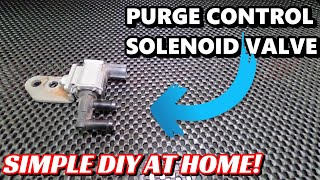
- Faulty EVAP Purge Control Valve/Solenoid (Very Common) — The valve itself is the most frequent culprit. 🎬 See how to test a purge valve without any tools. It fails internally from an electrical short, causing the circuit to report a high voltage condition.
- Wiring or Connector Issue (Short to Power) (Common) — The wires routing to the purge valve can chafe, melt, or short to a power source. A short to B+ (battery voltage) on the control wire is the classic cause for this code.
- Faulty Powertrain Control Module (PCM) / ECU Driver (Uncommon) — The internal driver circuit that grounds the purge valve burns out or shorts, causing it to incorrectly report high voltage. This is a highly documented failure on 2005-2014 Subaru models.
- Blown Fuse or Faulty Relay (Less Common) — A blown EVAP system fuse or a faulty power relay causes erratic voltage readings in the circuit, prompting the PCM to set a P0459.
- Poor Electrical Ground (Rare) — A corroded or damaged ground connection for the EVAP system disrupts the circuit's voltage, causing high voltage readings.
Symptoms

- Check Engine Light is On — The light illuminates as soon as the computer detects the high voltage problem during a system self-test.
- Failed Emissions Test — A P0459 code is an automatic failure for any OBD-II emissions inspection because the EVAP monitor cannot run.
- Rough Idle or Hesitation — If the electrical fault forces the purge valve to stick open, it creates a vacuum leak causing the engine to idle roughly or hesitate.
- Slight Smell of Fuel — You notice a faint gasoline odor around the vehicle because fuel vapors escape instead of routing to the engine.
- Reduced Fuel Economy (also visible on scanner) — Because fuel vapors escape instead of burning for power, gas mileage decreases slightly.
Diagnostic Flowchart
Tap your situation to follow the diagnostic path that matches what you're seeing on this code.
Common Fixes & Costs
- Replace EVAP Purge Control Valve/Solenoid — Parts: $30-$120, Labor: $80-$200, ~0.8 hr book time (DIY)
- Repair Damaged Wiring — Parts: $5-$20, Labor: $150-$400, ~2.5 hr book time (Intermediate)
- Repair Subaru ECU Driver Circuit — Parts: $15-$25, Labor: $100-$250, ~1.5 hr book time (Professional)
- Replace Powertrain Control Module (PCM) — Parts: $500-$1400, Labor: $150-$300, ~1.5 hr book time (Professional)
DIY vs Professional
- Replace EVAP Purge Control Valve/Solenoid — Beginner:
Tools: Basic hand tools (socket set, pliers). - Repair Damaged Wiring — Beginner:
Tools: Multimeter, wiring diagrams, wire strippers, soldering iron, heat shrink tubing. - Repair Subaru ECU Driver Circuit — Beginner:
Tools: Soldering iron, desoldering pump, replacement driver transistor.
Used vs. New Parts: Buying Guide
When a used part is worth it: Buying a used purge valve is never recommended. The low cost of a new aftermarket part ($30-$70) with a warranty makes it the only logical choice.
Donor-vehicle mileage cap: roughly under 50000 miles for the part to have meaningful remaining life.
Donor quality checklist:
- Verify the exact part number.
- Inspect the plastic housing and connector for cracks.
Decision logic:
- If The cost of a new OEM or quality aftermarket part is under $100. → Always buy new. The savings from a used part are minimal and not worth the risk of premature failure.
- If The part is integrated into a larger, more expensive assembly. → Favor a new assembly, as the failure of the used valve requires repeating the entire labor-intensive job.
Warranty tradeoff: Used parts from a salvage yard typically have a 30-day warranty. New aftermarket parts come with a 1-year to limited-lifetime warranty.
Worst-case if a used part fails: $150-$300 if a used part fails after installation, requiring repeat labor costs plus the price of a new part.
What Happens If You Wait — Timeline
- 0-1 month: Code P0459 sets and the Check Engine Light illuminates. The car fails emissions tests immediately, but drives normally. (MPG impact: 0-2%% · Added cost: $0)
- 1-4 months: If the electrical fault forces the valve open, a vacuum leak forms. This causes a rough idle at startup and a measurable decrease in fuel economy. (MPG impact: 2-5%% · Added cost: $25-$75 in wasted fuel)
- 4-12 months: The persistent vacuum leak forces the engine computer to constantly adjust the fuel mixture, causing premature wear on spark plugs and oxygen sensors. (MPG impact: 5-10%% · Added cost: $200-$500 for tune-up parts and O2 sensor replacement)
- 12+ months: A continuous lean or rich condition from the stuck-open valve significantly increases exhaust temperatures, melting the catalytic converter's internal substrate. (MPG impact: 10-15%% · Added cost: $1200-$2800 for catalytic converter replacement)
Cost of Not Fixing It
- 0-1 month: Code P0459 sets and the Check Engine Light illuminates. The car fails emissions tests immediately, but drives normally. (Added cost: $0)
- 1-4 months: If the electrical fault forces the valve open, a vacuum leak forms. This causes a rough idle at startup and a measurable decrease in fuel economy. (Added cost: $25-$75 in wasted fuel)
- 4-12 months: The persistent vacuum leak forces the engine computer to constantly adjust the fuel mixture, causing premature wear on spark plugs and oxygen sensors. (Added cost: $200-$500 for tune-up parts and O2 sensor replacement)
- 12+ months: A continuous lean or rich condition from the stuck-open valve significantly increases exhaust temperatures, melting the catalytic converter's internal substrate. (Added cost: $1200-$2800 for catalytic converter replacement)
Diagnosis Steps

- Check for Technical Service Bulletins (TSBs)
Before starting any diagnosis, check for TSBs related to P0459 for your specific vehicle. Manufacturers release bulletins for known issues, saving significant diagnostic time.
Tools: Internet Access (Beginner) - Visually Inspect Wiring and Connectors
Locate the EVAP purge valve in the engine bay. Inspect its electrical connector and wiring harness for obvious signs of corrosion, melting, or chafing against engine components.
Tools: Flashlight (Beginner) - Test the Purge Valve Solenoid Resistance
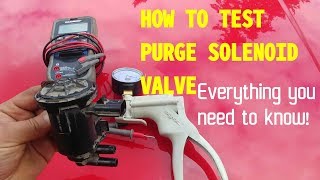
With the valve disconnected, set your multimeter to Ohms (Ω). Measure the resistance across the valve's two electrical pins. A typical range is 15-40 Ohms. An out-of-spec reading, an open circuit (OL), or a shorted circuit (near 0 Ohms) means the valve is electrically faulty and requires replacement.
Tools: Digital Multimeter (Intermediate) - Check for Power at the Purge Valve Connector
Disconnect the electrical connector from the purge valve. With the ignition key 'On' (engine off), use a multimeter to check for power on the supply wire. One pin must have battery voltage (12.0-12.6V). If there is no voltage, you have a power supply issue.
Tools: Digital Multimeter (Intermediate) - Check the Control Circuit for a Short to Power
With the key on and the purge valve disconnected, check for voltage on the control wire (the other pin). It must read 0 volts. If you read battery voltage on this wire, there is a short to power in the wiring harness. This is the definitive cause of a P0459 code.
Tools: Digital Multimeter (Advanced) - Command the Valve with a Bi-Directional Scan Tool
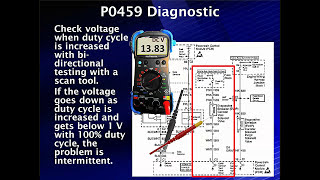
Use a bi-directional scan tool to command the purge valve solenoid on and off. You should hear a distinct click. While monitoring the control circuit voltage with a multimeter, it must drop from battery voltage to near zero (<1V) when commanded on. If voltage stays high, it confirms a wiring short or a bad PCM driver.
Tools: Bi-directional Scan Tool, Digital Multimeter (Advanced) - Pro Tip: Perform a Voltage Drop Test
Connect the positive lead of your multimeter to the positive battery terminal and the negative lead to the power pin on the purge valve connector (while connected and commanded on). A reading above 0.5 volts indicates excessive resistance in the power feed circuit.
Tools: Digital Multimeter, Bi-directional Scan Tool (Professional) - Pro Tip: Analyze the Control Circuit with an Oscilloscope
Back-probe the control wire at the PCM with an oscilloscope. When the scan tool commands the purge valve on, you must see a square wave pattern as the PCM rapidly grounds the circuit. If the signal remains 'high' at battery voltage, it confirms the PCM is not grounding the circuit or the wire is shorted to power.
Tools: Oscilloscope, Bi-directional Scan Tool (Professional)
When This Code Triggers (Freeze-Frame Conditions)
- Engine Coolant Temp: 170-210°F (Engine fully warmed up.)
- Fuel Level: 15-85% (Not full and not empty, allowing for vapor pressure changes.)
- Ambient Air Temp: 40-95°F (EVAP tests do not run in extreme cold or heat.)
- Vehicle Speed: 45-65 mph (Steady-state cruise, as the test runs during highway driving.)
Related Codes
- P0458 — This is the direct opposite: 'Circuit Low'. P0459 (High) is caused by a short to power. P0458 (Low) is caused by an open circuit, a short to ground, or a failed solenoid coil.
- P0443 — This is a general 'Purge Control Valve Circuit Malfunction'. Think of P0458/P0459 as the PCM telling you exactly how the circuit is failing (low/high), while P0443 just says that it is failing.
- P0455 — This means 'EVAP System Gross Leak Detected'. P0455 is a physical leak code diagnosed with a smoke machine. P0459 is an electrical code diagnosed with a multimeter. Fix the P0459 electrical circuit problem first.
Climate & Environmental Factors
- Cold Weather: Extreme cold makes wire insulation brittle, increasing the likelihood of it cracking and exposing bare wire to a short circuit.
- High Humidity and Road Salt: Salt spray kicked up by tires penetrates electrical connectors, causing corrosion that leads to shorts or high resistance faults.
How to Talk to a Mechanic About This Code
Say this: "I have a P0459 code, indicating a 'Circuit High' electrical fault for the EVAP purge valve. Please test the wiring harness for a short to power and measure the valve's resistance before replacing any parts."
This proves you understand P0459 is an electrical code, not a leak. It directs the technician to perform multimeter tests first, preventing them from wasting your money on an unnecessary smoke test.
Avoid saying:
- 'My check engine light is on, can you look at it?'
- 'I think I have an EVAP leak.'
- 'Just replace the purge valve.'
Questions to ask before authorizing the repair:
- Did you test for voltage on the control wire at the purge valve connector with the key on?
- What was the resistance reading of the purge valve solenoid itself?
- If you are recommending a wiring repair, can you show me where the short is?
- What is the warranty on the parts and labor for this repair?
Where to Take It: Dealer vs Independent vs Chain
- Dealer:
Best for: Vehicles under an emissions or powertrain warranty, Known complex issues like the Subaru ECU driver failure, When previous attempts at an independent shop have failed
Downsides: Significantly higher labor rates, May recommend replacing an entire wiring harness instead of repairing a single wire (Typical cost: +50% vs. baseline) - Independent Shop:
Best fit for most P0459 scenarios. A competent independent shop easily diagnoses and repairs the faulty valve or wiring short.
Best for: Most out-of-warranty vehicles, Straightforward part replacements and wiring repairs
Downsides: Diagnostic skill varies; look for ASE-certified technicians specializing in electrical diagnosis. (Typical cost: +0% vs. baseline) - Chain Shop:
AVOID for initial diagnosis of a P0459, as they misdiagnose it as a leak or upsell unrelated services.
Best for: Simple part replacements if you have already diagnosed the issue yourself.
Downsides: Technicians lack the in-depth electrical diagnostic skills needed for a 'Circuit High' code and resort to guessing. (Typical cost: -10% vs. baseline)
When to Walk Away From the Repair
If the estimated repair cost exceeds 50% of your car's private-party value, consider selling or trading it in.
- Car worth $4000, fix is $2200: Walk away. The repair cost is over half the car's value.
- Car worth $12000, fix is $800: Fix it. This repair is well within a reasonable budget for a car of this value.
- Car worth $3000, fix is $1600: Walk away. The repair cost is too high relative to the car's low value.
What Scan Tool You Need for This Code
Minimum: A basic OBD-II code reader that reads and clears codes is enough to start. A multimeter is also essential for testing the circuit.
A basic $20 scanner only tells you the P0459 code exists. It cannot command the purge valve to operate, leaving you guessing whether the problem is the valve, the wiring, or the computer.
Budget: BlueDriver Pro (~$100) — Reads and clears the code, provides freeze-frame data, and offers live data streaming to monitor circuit voltage.
Mid-range: Innova 5610 or Foxwell NT510 Elite (~$330) — Offers bi-directional control to command the purge valve open and closed. Hearing the valve click and watching the voltage drop isolates the problem immediately.
Professional: Autel MaxiCOM MK808 / XTOOL D7 (~$500-800) — Provides full OE-level bidirectional control and graphing capabilities essential for tracking down intermittent wiring shorts or confirming a faulty PCM driver.
How to Clear the Code After You Fix It
- Use an OBD-II scan tool to clear the P0459 code.
- Ensure the fuel tank is between 1/4 and 3/4 full.
- Perform the specific drive cycle for your vehicle to run the EVAP monitor.
Drive cycle (~30 minutes): A general EVAP drive cycle involves a cold start (after sitting 8+ hours), a few minutes of idling, followed by 10-15 minutes of steady highway driving (45-65 mph), and then city stop-and-go driving.
Readiness monitors affected: Evaporative System (EVAP) monitor, Catalyst monitor, O2 sensor monitor
Before emissions retest: drive at least 50 miles to fully set monitors.
Watch out for:
- Clearing the code resets all readiness monitors to 'Not Ready', causing an immediate emissions test failure.
- The EVAP monitor is notoriously slow to complete and requires several cold starts over a few days.
- The code returns immediately if the underlying electrical short was not properly repaired.
Will This Fail Emissions / State Inspection?
Yes — this code typically fails an OBD-II emissions inspection.
- California: A P0459 code is an automatic failure. After repair, the vehicle must complete a full drive cycle to set all readiness monitors to 'Ready' before re-testing.
- New York: An active P0459 code results in an immediate failure. After clearing the code, most monitors must be 'Ready' to pass.
- Texas: A P0459 code causes the vehicle to fail the OBD-II inspection. For 2001 and newer vehicles, only one monitor is allowed to be 'Not Ready' to pass.
Most Commonly Affected Vehicles

- Subaru Impreza, Forester, Outback, Legacy, WRX (2005-2014) — Extremely common on these models, caused by a failed driver component within the Engine Control Unit (ECU). If the valve and wiring test good, the ECU is the primary suspect. Mail-in repair services fix this specific issue for $90-$200.
- Chevrolet / GMC Silverado, Sierra, Tahoe, Suburban (2007-2013) — TSB 09-06-04-028D addresses water intrusion into the EVAP system on these trucks, which corrodes wiring and causes a short to power, triggering a P0459.
- Ford Focus, Fusion, F-150, Escape (2010-2018) — Commonly points to a failed purge valve/solenoid located on or near the engine. The OEM part number AU5Z-9C915-B has been superseded by AU5Z-9C915-E due to high failure rates.
- Hyundai / Kia Elantra, Sonata, Optima, Sorento (2011-2020) — Purge valve failures are a frequent cause. The internal coil shorts out, making the valve the most probable cause. Test the valve first after a quick wiring inspection.
- Volkswagen / Audi Passat, Jetta, Golf, A4, A6 (2012-2017) — These brands have a higher-than-average failure rate for the N80 purge valve solenoid, making it the primary suspect when a P0459 code appears.
Manufacturer-Specific Notes
- Subaru: On 2005-2014 models, P0459 is frequently caused by a failed driver circuit inside the main engine computer (ECU), not the purge valve itself. Special mail-in services repair the ECU board for a fraction of the cost of a new unit.
- General Motors (Chevrolet/GMC): TSB 09-06-04-028D points to issues where the EVAP canister vent solenoid wiring harness suffers water intrusion. The resulting harness corrosion causes a short to power, triggering a P0459.
- Volkswagen/Audi: These German brands have a high failure rate for the purge valve solenoid (the N80 valve), making the part itself the root cause in the vast majority of P0459 cases.
Real Owner Stories
2009 Subaru Forester with 115K miles
Check Engine Light with P0459 appeared with no other symptoms. The vehicle ran perfectly fine.
What they tried:
- Replaced the EVAP purge solenoid, but the code returned immediately.
- Thoroughly checked the wiring harness for shorts or damage and found nothing.
Outcome: Sent the ECU to a mail-in repair service specializing in this specific Subaru issue for $90. After reinstalling the repaired ECU, the code cleared permanently.
Lesson: On 2005-2014 Subaru models, if the purge valve and wiring test good, the root cause is a failed driver in the ECU. A mail-in repair service is the most cost-effective solution.
2013 Ford F-150 at 85K miles
P0459 code appeared, accompanied by a slight decrease in fuel economy and occasional rough idle after refueling.
What they tried:
- Tested the purge valve solenoid and found its resistance was out of the manufacturer's specified range.
Outcome: Replaced the purge valve solenoid with a new Motorcraft part for $50. The replacement took 15 minutes. The code cleared and has not returned.
Lesson: Testing the valve's resistance with a multimeter is a quick and definitive way to confirm if it is the culprit before spending money on other parts.
2009 Buick Enclave with P0459
The vehicle had a P0459 code and had previously experienced hard starting after getting gas.
What they tried:
- The owner had already replaced the purge valve a few months prior.
- Inspected the wiring near the solenoid but found no visible damage.
Outcome: A forum expert suggested the control wire breaks inside the insulation near the fuel tank on these GM vehicles. The owner tugged on the control wire, and it stretched, revealing internal damage. Repairing the wire fixed the code.
Lesson: A 'Circuit High' code points to an electrical fault. Wires break internally without visible external damage, requiring physical checks or continuity tests to find the fault.
How to Prevent This Code From Triggering
- Apply Dielectric Grease to Connectors (During any repair involving electrical connectors) — Applying non-conductive dielectric grease to the connector's weather seal keeps out moisture, preventing the corrosion that causes electrical shorts.
- Secure Wiring Harnesses (During any under-hood maintenance) — Ensure all wiring harnesses are secured in their clips. Engine vibration causes loose harnesses to rub through their insulation, leading to a short circuit.
- Wash the Vehicle's Undercarriage (Seasonally, especially after winter in salt-belt regions) — Road salt accumulates on underbody wiring and connectors, accelerating corrosion. Washing the undercarriage removes these corrosive agents.
Frequently Asked Questions
What is the most common misdiagnosis for a P0459 code?
The most common mistake is immediately replacing the purge valve without testing the circuit. P0459 is a 'Circuit High' code, strongly suggesting an electrical short to power. If the control wire is shorted, a new purge valve will not fix the issue and the code returns instantly.
I replaced the purge valve, but the P0459 code came back. What now?
If a new valve didn't fix it, the problem lies in the wiring or the PCM. Meticulously inspect the wiring harness between the purge valve and the PCM for a short to a 12V power source. If the wiring is perfect, the PCM's internal driver has likely failed.
Can a loose gas cap cause a P0459 code?
No, a loose gas cap causes a pressure leak (codes P0455 or P0456), not an electrical fault. P0459 specifically flags a high-voltage electrical circuit problem. Do not replace the gas cap to fix a P0459 code.
How much does it cost to fix a P0459 code?
Replacing the purge valve typically costs between $110 and $320 for parts and labor. Repairing a wiring short costs $150 to $400, depending on the short's location. In rare cases requiring a new PCM, expect to pay $650 to $1700.
Where is the EVAP purge valve located?
The purge valve is almost always located in the engine bay. It is a small, cylinder-shaped solenoid mounted on or near the intake manifold. It features an electrical connector and two vacuum hoses.
Can I fix the P0459 code myself?
Replacing an easy-to-access purge valve is a highly DIY-friendly repair requiring basic hand tools. However, diagnosing a wiring short or a bad computer requires a multimeter, wiring diagrams, and electrical troubleshooting experience. If you lack electrical diagnostic skills, take the vehicle to a professional.
Can I clean an EVAP purge valve to fix P0459?
No, cleaning the valve will not resolve a P0459 code. This code indicates an electrical failure ('Circuit High'), not a mechanical blockage or carbon buildup. Replacement is the only reliable solution for an internally shorted valve.
What is the difference between a purge valve and a vent valve?
The purge valve sits in the engine bay and controls vapor flow into the engine. The vent valve sits near the charcoal canister and controls fresh air flow into the EVAP system. P0459 specifically refers to an electrical fault in the engine-bay purge valve circuit.
Key Takeaways
- Code P0459 indicates the engine computer detects unwanted high voltage in the EVAP purge valve's electrical control circuit, pointing to a short to power rather than a vapor leak.
- Test the purge valve's resistance with a multimeter (typically 15-40 Ohms) before spending $110-$320 on a replacement part.
- Do not replace the gas cap or charcoal canister; P0459 is strictly an electrical circuit fault, not an EVAP system pressure leak.
- For 2005-2014 Subaru models, if the purge valve and wiring test perfectly, the root cause is a burned-out driver circuit inside the ECU, which costs about $90-$200 to repair via mail-in services.
Helpful Videos

The information in this article is provided for general reference and educational purposes only. Vehicle specifications, procedures, and part compatibility can vary by production date, trim level, and region. Always consult your vehicle's factory service manual and verify part numbers before purchasing or performing repairs. Safety-critical components such as airbags, seat belts, and braking systems should be installed by a qualified professional.
- 🎬 Helpful Videos
- What Does P0459 Mean?
- Can I Drive With P0459?
- Common Causes
- Symptoms
- Diagnostic Flowchart
- Common Fixes & Costs
- DIY vs Professional
- Used vs. New Parts: Buying Guide
- What Happens If You Wait — Timeline
- Cost of Not Fixing It
- Diagnosis Steps
- When This Code Triggers (Freeze-Frame Conditions)
- Related Codes
- Climate & Environmental Factors
- How to Talk to a Mechanic About This Code
- Where to Take It: Dealer vs Independent vs Chain
- When to Walk Away From the Repair
- What Scan Tool You Need for This Code
- How to Clear the Code After You Fix It
- Will This Fail Emissions / State Inspection?
- Most Commonly Affected Vehicles
- Manufacturer-Specific Notes
- Real Owner Stories
- 2009 Subaru Forester with 115K miles
- 2013 Ford F-150 at 85K miles
- 2009 Buick Enclave with P0459
- How to Prevent This Code From Triggering
- Frequently Asked Questions
- What is the most common misdiagnosis for a P0459 code?
- I replaced the purge valve, but the P0459 code came back. What now?
- Can a loose gas cap cause a P0459 code?
- How much does it cost to fix a P0459 code?
- Where is the EVAP purge valve located?
- Can I fix the P0459 code myself?
- Can I clean an EVAP purge valve to fix P0459?
- What is the difference between a purge valve and a vent valve?
- Key Takeaways
- 🎟️ Get 5% Off