

P0456 on 2016-2023 Volkswagen Jetta: Causes and Fixes for a Small EVAP Leak
For a 2016-2023 VW Jetta, code P0456 most often points to a faulty gas cap or a failing EVAP purge valve (N80). Always check that the gas cap is tight and its seal is intact before replacing any parts. A new OEM gas cap (p/n 5Q0201550L) is under $40, while a purge valve (Bosch p/n 0280142507 or VW p/n 04E906517) can range from $30 to $100.
- Always start with the simplest fix: check that your gas cap is tight and its seal is not cracked.
- The EVAP purge valve (N80) is a very common failure point for this code on a VW Jetta.
- If the gas cap and purge valve are good, a smoke test is the most reliable way to find the leak, which is often a small crack in a plastic hose.
- For newer models (especially 2022), be aware that a simple software update at the dealership might be the required fix. [TSB V0125042078029_1]
What's Unique About the 2016-2023 Volkswagen JETTA

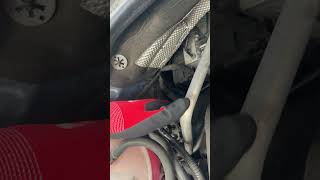
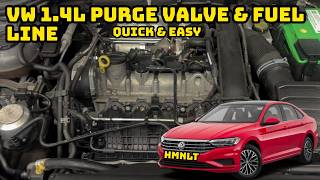
The 2016-2023 Jetta spans two generations (A6 and A7), but the common causes for P0456 remain consistent. A key issue for this platform is the potential for the ECM's software to be overly sensitive, which is addressed by a manufacturer TSB (V0125042078029_1) recommending a software update for some 2022 models. Additionally, cracked plastic hoses connected to the purge valve (N80) are a frequent point of failure, sometimes requiring the replacement of a whole hose assembly rather than just the valve itself. On the 1.4T engine specifically, the N80 valve is notoriously difficult to access as it is located under the intake manifold, 🎬 See this walkthrough for removing the intake manifold and N80. turning a simple part swap into a more labor-intensive job.
Diagnostic Flowchart

Tap your situation to follow the diagnostic path that matches what you're seeing on this vehicle.
Generation note: This range covers the end of the Jetta A6 generation (2016-2018) and the beginning of the A7 generation (2019-2023). While the underlying EVAP system principles are the same, some part numbers and the location of components like the purge valve may differ slightly. For example, on 1.4T engines in both generations, the purge valve is harder to access under the intake manifold. A technical tip from VW (TT 01-19-06) also specifies different diagnostic tools for 2013-2018 and 2019+ models.
Symptoms You May Notice
- Check Engine Light is on.
- A faint smell of gasoline, especially after filling up or near the fuel cap area.
- Difficulty starting the engine right after refueling (long crank time).
- Slightly rough or unstable idle.
- A subtle decrease in fuel economy over time.
- Loud clicking or ticking sound from the N80 purge valve in the engine bay.
- Replacing the oxygen sensor, as this is unrelated to the EVAP system.
- Replacing the charcoal canister when the actual problem is a small, inexpensive cracked hose nearby or a faulty gas cap.
- Immediately replacing the N80 valve without testing it first, when the gas cap is the true culprit.
Most Likely Causes

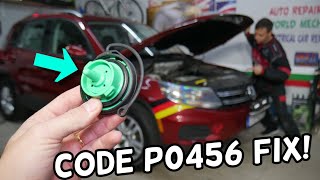
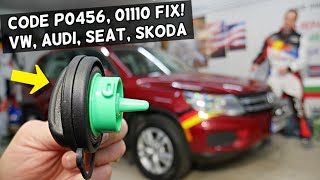
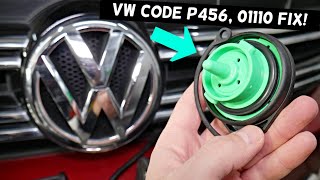
- Loose or Faulty Gas Cap 🔴 High Probability The gas cap seal is a simple rubber O-ring that can crack, dry out, or get damaged over time, preventing a proper seal. It's the most common and easiest-to-fix cause for any EVAP leak code. Even leaving the cap slightly loose after refueling can trigger the code.
How to confirm: Ensure the cap is tightened until it clicks multiple times. Remove the cap and inspect the rubber seal for any visible cracks, stiffness, or damage. The tether can also get caught under the cap, preventing a seal.
Typical fix: Tighten the cap. If the seal is damaged, replace the entire gas cap with a new OEM or quality aftermarket part. An OEM part is often recommended as some aftermarket caps may not seal correctly.
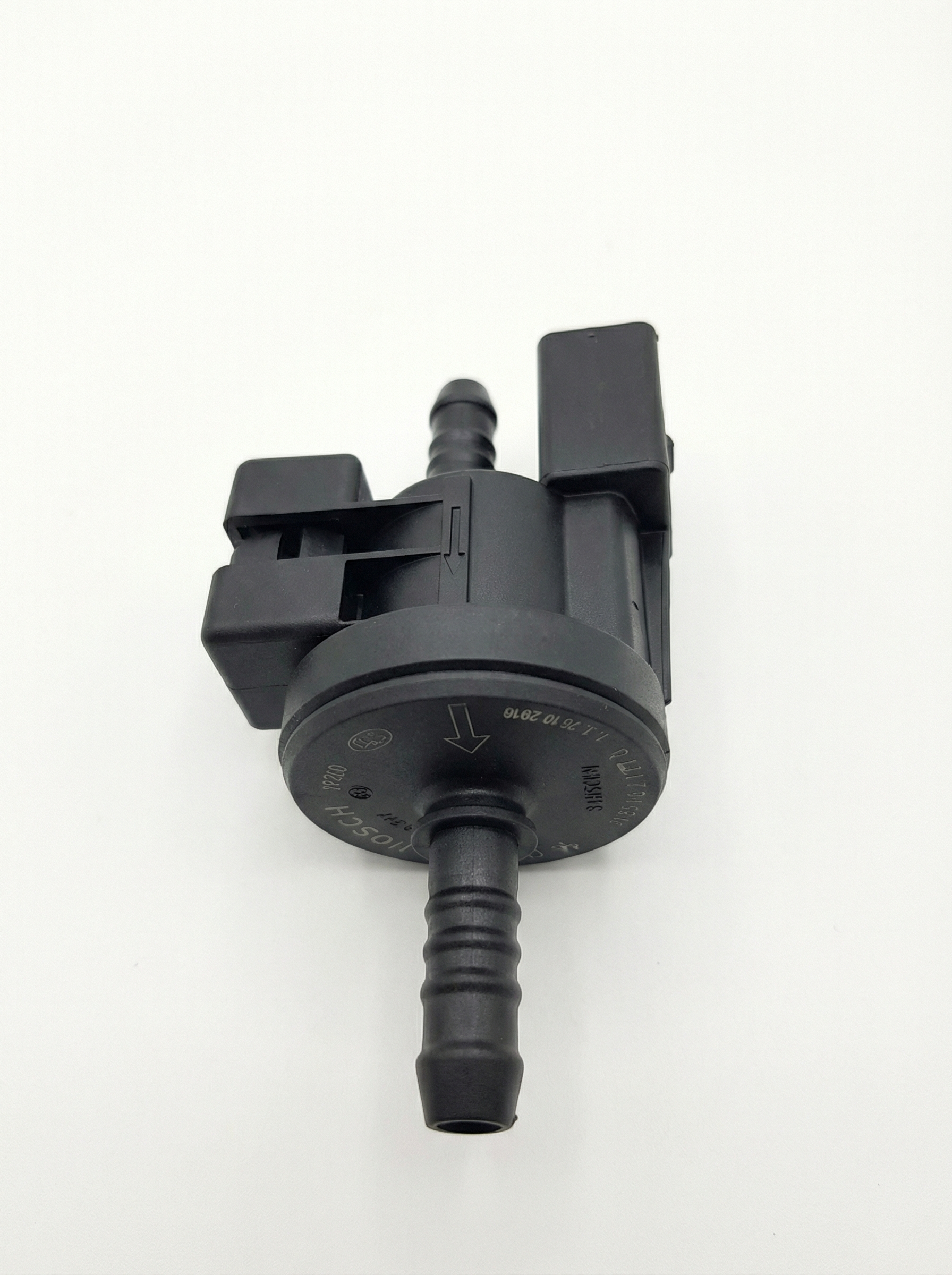
Est. part cost: $15-$40 - Failing EVAP Purge Valve (N80 Valve) 🔴 High Probability This solenoid valve cycles thousands of times and is a known common failure point on VW models. It can get stuck open or fail to seal completely, creating a small leak path that the system detects.
How to confirm: With the engine off, remove the valve and try to blow through it in the direction of flow indicated by the arrow. If any air passes through, it is faulty. A technician can use a hand vacuum pump to confirm it doesn't hold vacuum. Tapping the valve on a white paper towel to check for black charcoal granules can also indicate a failing charcoal canister is damaging the valve.
Typical fix: Replace the N80 purge valve. On many Jetta engines, this is a straightforward DIY job, but on 1.4T models, it is located under the intake manifold, making replacement more difficult and costly.
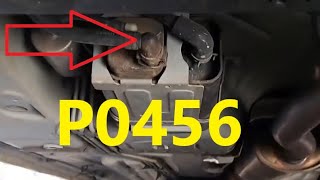
Est. part cost: $30-$100 - Cracked EVAP System Hose 🟡 Medium Probability The plastic or rubber hoses connected to the EVAP system, particularly the corrugated line near the purge valve, can become brittle from engine heat and develop small, hard-to-see cracks.
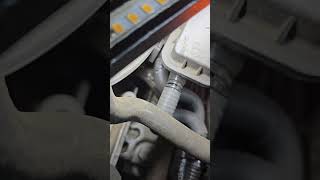
How to confirm: The most effective method is a smoke test. A mechanic injects low-pressure smoke into the EVAP system, and the smoke will visibly escape from any cracks or leaks. A YouTube video shows this exact failure on a 2019 Jetta.
Typical fix: Replace the cracked hose. In some cases, the hose is part of a larger assembly (like p/n 04E133366CQ) that must be replaced as a single unit, which can be expensive.
Est. part cost: $20-$200 - Engine Control Module (ECM) Software Update Needed ⚪ Low Probability A VW Technical Service Bulletin (V0125042078029_1) specifically mentions DTC P0456 for 2022 Jettas and calls for a programming update to the ECM, suggesting the original software may be too sensitive in its leak detection parameters.
How to confirm: A Volkswagen dealership or a qualified independent shop with access to VW's ODIS diagnostic system can check if your vehicle's VIN has an open campaign or requires this software update.
Typical fix: The ECM needs to be reprogrammed with the updated software by a dealer or qualified technician.
Est. part cost: $0 if covered by warranty/campaign, otherwise labor costs apply (approx. $100-$200).
Rare But Worth Checking
- Failing Leak Detection Pump (LDP): The LDP, located near the charcoal canister in the rear passenger wheel well, pressurizes the system for the leak test. While not as common as the purge valve, its internal seals can fail or its filter can become clogged, causing EVAP codes. A Reddit user on r/Volkswagen described smoke escaping from the LDP inlet filter during a smoke test, pointing to it as the leak source.
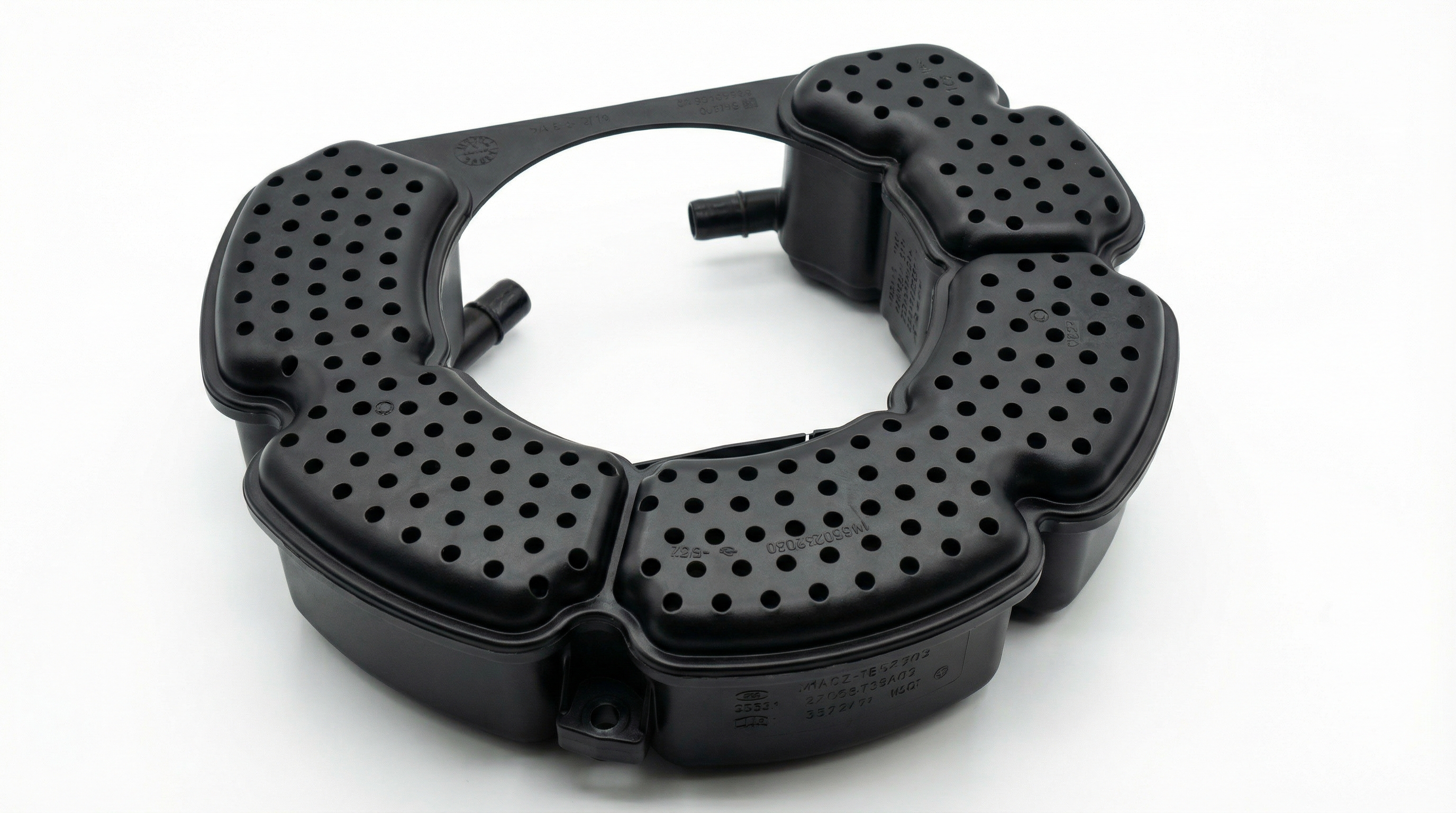
- Cracked Charcoal Canister: The charcoal canister itself can develop hairline cracks from age or physical impact, leading to a small leak. This is less common than hose or valve failures but is often found during a smoke test if other components check out. Sometimes the canister can also fail internally, releasing charcoal granules that clog the N80 valve.
Diagnosis Steps
- Check the Gas Cap: Ensure it is tight and clicks several times. Remove it and inspect the rubber O-ring for cracks, dirt, or damage. Check that the tether isn't caught underneath it.
- Clear the Code: Use an OBD-II scanner to clear the P0456 code and drive for a few days to see if it returns. Sometimes a loose cap is the only issue. Note that the EVAP monitor typically only runs when the fuel level is between 15% and 85%.
- Visual Inspection: Visually inspect the EVAP purge valve (N80) and any accessible hoses connected to it, especially the corrugated plastic lines, for obvious cracks or damage.
- Test the Purge Valve (N80): Disconnect the valve. With the engine off, it should be closed. Try to blow through it or use a hand vacuum pump; if any air passes or it doesn't hold vacuum, it is faulty and must be replaced.
- Perform a Smoke Test: If the cause is still not apparent, a smoke test is the definitive diagnostic step. This involves injecting low-pressure smoke into the EVAP system (often through the service port or a disconnected line) to pinpoint the exact location of the leak. This is the best way to find cracked hoses, a faulty canister, or a leaking LDP.
- Check for TSBs: Contact a VW dealer with your VIN to see if TSB #V0125042078029_1 (ECM update) or any other relevant service actions apply to your vehicle.
Parts You'll Likely Need
- Fuel Cap
(OEM #5Q0201550L (supersedes 5Q0201550AK, 5WA201550K))— This is the most frequent and simplest cause of a P0456 code. The seal degrades over time, causing a leak.
Trusted brands: Volkswagen OE, Blau, Gates
OEM price range: $25-$40
Aftermarket price range: $15-$30 - EVAP Purge Valve (N80 Valve)
(OEM #04E906517 (for 1.4T EA211) or 06J133781CE (for some 2.0T))— A very common failure item on VWs that gets stuck open, causing a persistent small leak. Bosch is a primary OEM supplier.
Trusted brands: Bosch, Volkswagen OE, Febi
OEM price range: $60-$110
Aftermarket price range: $30-$70 - EVAP Hose Assembly
(OEM #04E133366CQ)— The plastic hoses connected to the purge valve are prone to cracking. A smoke test often reveals a tiny crack in this assembly, which includes the hose and valve connections.
Trusted brands: Volkswagen OE
OEM price range: $150-$200
Related Codes That Often Appear With This One
- P0442 — P0442 indicates a 'medium' EVAP leak. It often appears with P0456 because the root cause (like a failing purge valve or loose gas cap) can be interpreted differently by the ECM during separate tests, or the leak may be on the borderline between 'small' and 'medium'.
- P0441 — P0441 indicates 'Incorrect Purge Flow,' which is often caused by a faulty N80 purge valve that is either stuck open or closed. A valve that doesn't seal properly can cause both a flow error (P0441) and a leak error (P0456).
Technical Service Bulletins (TSBs) & Recalls

- V0125042078029_1: Addresses an overly sensitive ECM on some 2022 models, requiring a software update for P0456.
- VIN4APIN20230824: A general information bulletin that lists P0456 and P0442 as common MIL-on faults, grouping them with other potential customer complaints.
- TT 01-19-06: A technical tip for technicians regarding diagnosis of the hard-to-reach purge valve on certain 1.4T engines.
Platform-Specific Known Issues
- A Technical Service Bulletin (V0125042078029_1) exists for some 2022 models that may require an ECM software update to correct an overly sensitive leak detection threshold.
- Another TSB (VIN4APIN20230824) acknowledges that P0456 can appear alongside P0442 (medium leak), pointing to common causes like the purge valve or gas cap.
- On 1.4T engines, the purge valve (N80) can be difficult to access as it is located under the intake manifold, significantly increasing labor time for what is usually a simple repair.
Mechanic-Grade Diagnostic Values
- N80 Purge Valve Coil Resistance — expected: 15 - 35 Ohms. Failure: An open circuit (infinite resistance) or a reading significantly outside the expected range indicates a failed coil.
- N80 Purge Valve Connector Voltage (Key On, Engine Off) — expected: Pin 1 should show battery voltage (~12V). Pin 2 is the ground controlled by the ECM.. Failure: No voltage on Pin 1 suggests a wiring or fuse issue. A constant ground on Pin 2 with the engine off could indicate a short or failed ECM driver.
- VCDS Basic Settings Group 071 (EVAP Leak Test) — expected: The test status should cycle and end with 'Syst. OK'.. Failure: The test ending in 'Syst. Not OK', 'Small leak', or 'Large leak' confirms a leak in the system.
Hidden / Shadow Codes Worth Checking
- Mode 6, Test ID $81 / $84: This refers to the non-continuous monitor for the EVAP system leak test (0.5mm / 0.020"). A failing value here can indicate a pending problem before the P0456 code is officially set and the MIL is illuminated. (see via An advanced OBD-II scanner capable of displaying Mode 6 data.)
Scan Tool Commands That Help
- VCDS or OBDeleven: Basic Settings - Group 071 (or IDE00744 for UDS controllers) — This command manually initiates the EVAP system's leak detection test. It's used to verify if a leak exists after a repair or to confirm the system's integrity without waiting for the automatic drive cycle monitor to run.
- VCDS or OBDeleven: Output Tests - EVAP Canister Purge Valve (N80) — This allows the user to manually cycle the N80 valve. You should hear an audible clicking sound, which confirms the solenoid is receiving a signal and is not mechanically seized. This is a quick functional check before performing more detailed tests.
Wiring & Ground Locations
- N80 Valve Connector — On the N80 valve itself, which is under the intake manifold on 1.4T engines or more accessible on others.. The N80 valve has a two-pin connector. Pin 1 receives switched 12V+ power from a fuse in the engine bay fuse box. Pin 2 is a pulse-width modulated ground signal from the ECM. Loss of power or a bad ground will prevent the valve from operating, though a leak code is more often caused by a mechanically failed valve rather than an electrical one.
- Engine Block/Frame Rail Ground — A primary engine ground point is typically located on the left (driver's side in US) frame rail in the engine bay, near the battery or under the battery tray.. While not a direct cause of P0456, a poor engine ground can cause erratic behavior in various sensors and solenoids controlled by the ECM, potentially leading to incorrect diagnostic results. Ensuring this ground is clean and tight is a good practice during any electrical diagnosis.
Real Owner Repair Stories
- Reddit user comment (2017 Jetta 1.4T) — P0456 code returned after replacing gas cap and N80 purge valve.
❌ Tried (didn't work) Replacing the gas cap, Replacing the N80 purge valve
✅ What actually fixed it The user cut off the brittle, cracked corrugated pipe from the quick-connect fitting and the N80 valve, then replaced it with a section of 3/8" emissions hose. This resolved the code and allowed the car to pass an emissions test. - YouTube video by Nax's Garage (2017 Volkswagen Jetta S 1.4T) — Intermittent P0456 code.
❌ Tried (didn't work) Initial visual inspection showed no obvious faults.
✅ What actually fixed it A smoke test revealed a small crack in the corrugated hose that is part of the EVAP hose assembly (p/n 04E133366CQ). The video shows smoke escaping from the cracked line, confirming it as the source of the leak. - Reddit user comment (2019 Jetta) — P0456 code came back two days after a smoke test at a German car specialist found no leaks.
❌ Tried (didn't work) Replacing the gas cap, Performing a professional smoke test
✅ What actually fixed it The user did not post a final fix, but the scenario of a clean smoke test with a returning code points towards an intermittent issue or a problem with a component that a static smoke test doesn't check, like the Leak Detection Pump (LDP) functionality.
"I Checked Everything" — The Actual Cause
- A faulty Leak Detection Pump (LDP) can be the cause even if a smoke test passes. The smoke test checks for physical leaks in the hoses and components by pressurizing the system. However, if the LDP's internal motor is weak or its filter is clogged, it may fail to build the required pressure during the ECM's self-test, triggering a P0456 code without there being an actual leak for the smoke to escape from.
- A failing N80 purge valve that only leaks intermittently under specific vacuum or temperature conditions might seal perfectly during a static, engine-off smoke test. A VW Technical Tip (01-19-06) outlines a specific procedure to test a leaking N80 by applying vacuum with the engine running to see if it improperly pulls a vacuum, which would identify a faulty valve that a smoke test might miss.
OEM Part Supersession History
5Q0201550AK, 5WA201550K→5Q0201550L— Updated design to improve sealing and durability of the O-ring.
Model Year Variations Within This Range
- 2019+: The A7 generation Jetta (2019-2023) uses the MQB platform. While many EVAP components are conceptually similar to the previous A6 generation, their specific locations and part numbers may differ. VW Tech Tip 01-19-06 specifies different diagnostic adapter tools for testing the N80 valve on 2019+ Jettas (KLI 9210/57) versus 2013-2018 models (VAG1318 kit).
- 2022: As per TSB #V0125042078029_1, some 2022 models may trigger P0456 due to overly sensitive ECM software parameters, not a physical leak. The fix is a software update performed by a dealer, not a part replacement.
Helpful Videos
Used OEM Parts in Stock
New Aftermarket Parts Available


The information in this article is provided for general reference and educational purposes only. Vehicle specifications, procedures, and part compatibility can vary by production date, trim level, and region. Always consult your vehicle's factory service manual and verify part numbers before purchasing or performing repairs. Safety-critical components such as airbags, seat belts, and braking systems should be installed by a qualified professional.
- Volkswagen JETTA:
- 🎬 Helpful Videos
- 🛍️ Shop This Part
- What's Unique About the 2016-2023 Volkswagen JETTA
- Diagnostic Flowchart
- Symptoms You May Notice
- Most Likely Causes
- Rare But Worth Checking
- Diagnosis Steps
- Parts You'll Likely Need
- Related Codes That Often Appear With This One
- Technical Service Bulletins (TSBs) & Recalls
- Platform-Specific Known Issues
- Mechanic-Grade Diagnostic Values
- Hidden / Shadow Codes Worth Checking
- Scan Tool Commands That Help
- Wiring & Ground Locations
- Real Owner Repair Stories
- "I Checked Everything" — The Actual Cause
- OEM Part Supersession History
- Model Year Variations Within This Range
- 🎟️ Get 5% Off