

P0456 on 2014-2020 Ram 3500 6.4L HEMI: Causes and Fixes for Small EVAP Leaks
On a gas-powered 2014-2020 Ram 3500, P0456 is most often caused by a loose or faulty gas cap (on 2014-2018 models), a bad EVAP purge valve in the engine bay, or a failed EVAP leak detection pump (ESIM) on the charcoal canister. Start by checking the gas cap and always prefer OEM Mopar parts for best results. In some cases, particularly on 2019+ models, a PCM software update is the required fix per TSBs.
- This code only applies to the 6.4L HEMI V8 engine, not the Cummins diesel.
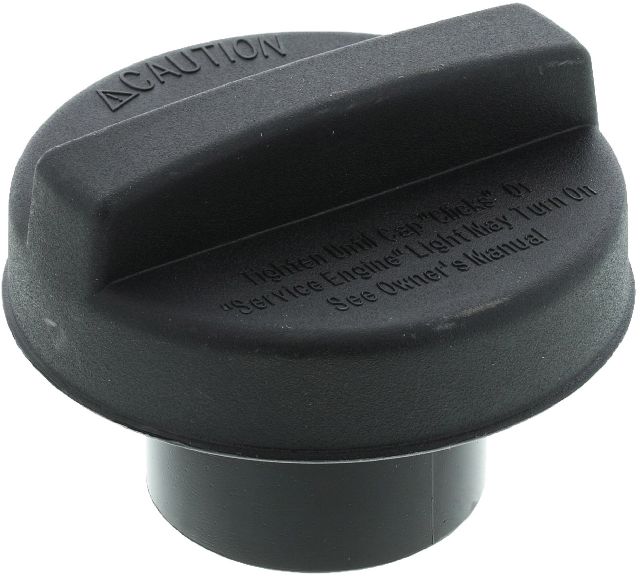
- For 2014-2018 models, always check or replace the gas cap with an OEM Mopar part first. For 2019-2020 models, clean the capless fuel filler seal.
- The two most common failing parts beyond the cap are the EVAP purge valve (in the engine bay) and the ESIM/leak detection pump (by the fuel tank). Both are relatively inexpensive and simple to replace.
- If P0456 appears with unrelated codes like P0335 or P2610, the problem may be your truck's software, requiring a dealer visit for a PCM update as specified in TSBs.
- If simple part swaps don't work, a professional smoke test is the definitive way to find the exact source of the leak without guessing.
What's Unique About the 2014-2020 Ram 3500

On this Ram platform, P0456 is frequently caused by one of two specific, high-failure parts: the EVAP purge valve in the hot engine bay and the Evaporative System Integrity Monitor (ESIM) mounted to the canister under the truck. A unique aspect documented in several Technical Service Bulletins is that this EVAP code can appear alongside unrelated powertrain codes like P0335 (Crankshaft Position Sensor), suggesting the true cause may be a PCM software glitch requiring a dealer update, not a physical leak. Finally, owners on forums frequently report that persistent leaks are often traced to rodent damage on the EVAP lines that run across the top of the fuel tank, an area that is very difficult to inspect without a smoke test or lowering the tank.
Diagnostic Flowchart

Tap your situation to follow the diagnostic path that matches what you're seeing on this vehicle.
Generation note: This range covers the end of the Fourth Generation (2014-2018) and the beginning of the Fifth Generation (2019-2020) Ram 3500. A key difference for this code is that 2014-2018 models use a traditional gas cap, which is a primary failure point. The 2019-2020 models use a capless fuel filler system, so the cause is more likely to be debris in the seal, the purge valve, or the ESIM. TSB #18-056-19 REV. A specifically applies to 2019 models, where a PCM flash can fix the code and associated hesitation symptoms.
Symptoms You May Notice
- Check Engine Light is on
- A faint fuel smell, particularly after parking the truck
- Remote start feature is disabled
- Vehicle hesitation or surge at low speeds, or when turning the steering wheel to its end stop (specifically noted in TSB #18-056-19 REV. A for 2019 models)
- Long crank or difficulty starting after the vehicle has been sitting for a few hours (often points to a stuck-open purge valve)
- Inability to pass an emissions inspection
- A "Check Fuel Cap" or "Gas Cap Loose" message may appear on the dashboard
- Replacing the entire charcoal canister assembly when only the much cheaper, separately-sold ESIM has failed.
- Repeatedly replacing the gas cap or ESIM with aftermarket versions that fail to seal correctly, leading to the code's return.
- Firing the 'parts cannon' at the ESIM and purge valve when the actual cause is a hard-to-see chewed or cracked hose on top of the fuel tank.
Most Likely Causes

- Loose or Faulty Gas Cap / Capless Filler Neck Seal 🔴 High Probability On 2014-2018 models, the rubber O-ring on the gas cap wears out, cracks, or gets dirty, preventing a proper seal. On 2019+ models, debris can contaminate the capless system's spring-loaded seal. Aftermarket caps are a notorious cause of this code returning.
How to confirm: For 2014-2018, ensure the cap is tightened until it clicks multiple times. Inspect the rubber O-ring for cracks or stiffness. For 2019+, inspect the capless fuel filler neck for any debris and clean the seal. A "Check Fuel Cap" message may also be present.
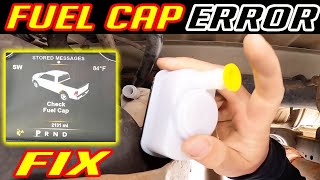
Typical fix: Replace the gas cap. 🎬 Watch: How to fix a loose gas cap error code. It is highly recommended to use an OEM Mopar cap, as forum members report some aftermarket caps do not seal correctly. For capless systems, clean the seal with a rag.
Est. part cost: $15-$35 - Faulty EVAP Purge Valve/Solenoid 🔴 High Probability Located on the passenger side of the engine, this solenoid is prone to failure from heat and constant cycling. It can get stuck open or develop an internal leak, which the PCM detects as a system leak.
How to confirm: With the engine off, disconnect the valve and try to blow through it; if air passes, it's stuck open and faulty. A key symptom is a long crank time after refueling. A smoke test will definitively show smoke passing through a faulty valve. A hand vacuum pump can also be used to see if the valve holds vacuum when de-energized; if it doesn't, it's faulty.
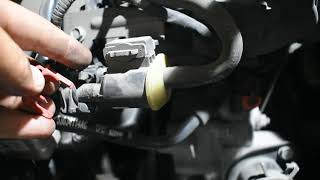
Typical fix: Replace the EVAP purge valve. This is a simple DIY job located on the engine, often taking less than 30 minutes. 🎬 See this walkthrough on locating and replacing the purge valve. It is recommended to replace the adjoining plastic hose as well, as it can become brittle.
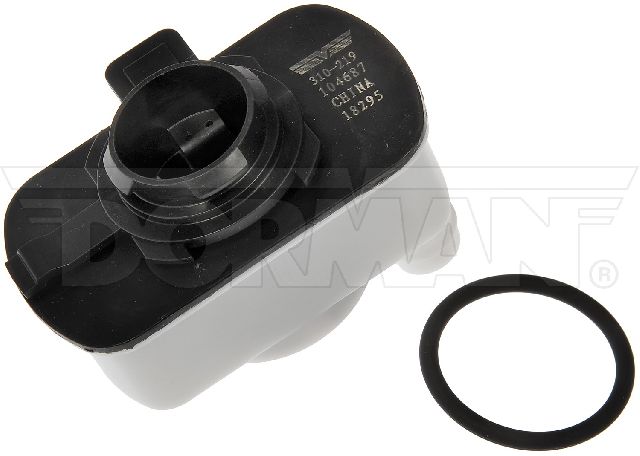
Est. part cost: $25-$60 - Failed EVAP Leak Detection Pump (ESIM) 🟡 Medium Probability This component is a known high-failure item on many FCA vehicles (Jeep, Dodge, Ram). It is exposed to the elements under the truck, mounted to the charcoal canister, and its internal switch or diaphragm can fail, or the housing can crack.
How to confirm: The part is located on the charcoal canister near the fuel tank. A common sign of failure is a rattling sound when the part is removed and shaken, indicating broken internal components. Also, ensure it is installed in the correct vertical orientation, as incorrect installation can cause a false code.
Typical fix: Replace the ESIM switch on the charcoal canister. It is typically a simple quarter-turn release after depressing a locking tab. It is recommended to also replace the O-ring seal.
Est. part cost: $25-$50 - Cracked or Disconnected EVAP Hoses ⚪ Low Probability Plastic and rubber EVAP lines can become brittle and crack from age and heat, especially lines near the engine or on top of the fuel tank. Rodent damage is also a surprisingly common cause, with squirrels and mice chewing on the lines.
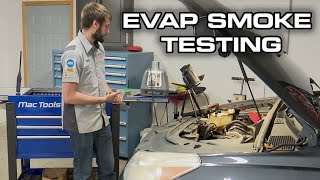
How to confirm: A visual inspection may reveal obvious cracks. However, small or hidden leaks (especially on top of the fuel tank) require a professional smoke test to locate definitively. Smoke is introduced into the system at the purge solenoid connection point.
Typical fix: Replace the cracked section of hose. In many cases, a small piece of fuel-rated rubber hose and clamps can be used to splice the damaged section. Finding the leak is the most difficult part.
Est. part cost: $10-$50
Rare But Worth Checking
- Faulty Powertrain Control Module (PCM) Software: As per TSBs #1810822REVA, #1810722REVA, and #18-056-19 REV. A, this code can appear with other unrelated DTCs. The official fix is not a part replacement but a PCM software update performed by a dealer. TSB #18-056-19 REV. A for 2019 models specifically notes this code can cause hesitation and surging, which is fixed by a reflash.
- Cracked Charcoal Canister: While the canister itself is durable, a physical impact from road debris can cause it to crack and create a leak. Habitually 'topping off' the fuel tank can also force liquid fuel into the canister, saturating the charcoal and causing damage.
- Leaking Fuel Tank Gasket: The seal for the fuel pump module on top of the tank can degrade and fail, causing a vapor leak that is difficult to find without a smoke test.
Diagnosis Steps

- For 2014-2018 models, inspect and tighten the gas cap. Ensure it clicks multiple times. If the seal looks worn or cracked, replace it with an OEM Mopar cap.
- For 2019-2020 models, inspect the capless fuel filler neck for any debris and clean the seal.
- Clear the code with a scanner and drive for a few days. The EVAP monitor requires specific conditions to run (e.g., fuel level between 15% and 85%) and may take several drive cycles to complete its self-test.
- If the code returns, visually inspect the EVAP purge valve on the engine and all accessible hoses for obvious cracks or disconnections.
- Consider replacing the EVAP purge valve, as it is a high-failure, low-cost part that is a common cause.
- If the code persists, the next most likely cause is the ESIM on the charcoal canister. Inspect it for cracks and proper installation orientation.
- For stubborn leaks, a professional smoke test is the most effective method to find the source without replacing unnecessary parts.
Parts You'll Likely Need
- Gas Cap (2014-2018 models)
(OEM #52030377AB, 52124512AA)— The seal is a primary wear item and the most common cause of a P0456 code. Using an OEM cap is highly recommended for a proper seal.
Trusted brands: Mopar
OEM price range: $20-$35
Aftermarket price range: $15-$25 - EVAP Purge Valve / Solenoid
(OEM #4627694AB, 68498111AA)— This valve is a common failure point due to heat exposure in the engine bay, causing it to stick open and create a leak. It is often the true culprit even after other parts have been replaced.
Trusted brands: Mopar, Standard Motor Products, Dorman
OEM price range: $30-$60
Aftermarket price range: $20-$45 - EVAP Leak Detection Pump (ESIM)
(OEM #4861962AA, 4861962AD, 4861959AD)— A known weak point on many FCA vehicles, this switch is exposed to the elements and its internal mechanism fails, causing a leak detection fault.
Trusted brands: Mopar, Dorman, Standard Motor Products
OEM price range: $35-$75
Aftermarket price range: $25-$50
Related Codes That Often Appear With This One
- P0457 — Indicates a large EVAP leak, such as a very loose or missing gas cap. It can appear with P0456 if the leak is intermittent or borderline.
- P0441 — Indicates incorrect purge flow, which can be caused by a faulty purge valve—a common root cause for P0456.
- P0335 - Crankshaft Position Sensor Circuit — Its appearance with P0456 is noted in TSBs #1810822REVA and #1810722REVA and may point to a broader PCM software issue requiring an update, rather than two separate hardware problems.
- P2610 - PCM Internal Engine Off Timer Performance — Like P0335, its presence with P0456 is mentioned in TSBs and suggests a potential PCM software problem is the true root cause.
Technical Service Bulletins (TSBs) & Recalls

- 1807123: Notes P0456 can be set and advises using wiTECH Small Leak Verification test. [Bulletin #1807123]
- 1810822REVA: Links P0456 with P0335 and P2610, suggesting a potential software issue. [Bulletin #1810822REVA]
- 1810722REVA: Also links P0456 with P0335, P2610, and misfire codes, pointing to software. [Bulletin #1810722REVA]
- 1804823: Mentions the wiTECH Small Leak Verification Test (SLVT) for P0456. [Bulletin #1804823]
- 18-056-19 REV. A: Connects P0456 with hesitation/surge symptoms and points to a potential PCM software fix. [Bulletin #18-056-19 REV. A]
Platform-Specific Known Issues
- TSB #18-056-19 REV. A specifically links P0456 to vehicle hesitation or surging at low speeds on 2019 models and advises a PCM software update as a potential fix.
- TSBs #1810822REVA and #1810722REVA document instances where P0456 appears with unrelated codes like P0335 (Crankshaft Sensor) and P2610 (PCM Timer), suggesting a PCM software update may be the correct fix instead of chasing a physical leak.
- Rodent Damage: A recurring theme in owner forums is rodents chewing through the plastic EVAP lines located on top of the fuel tank, which are difficult to see without lowering the tank or using a borescope.
Mechanic-Grade Diagnostic Values
- EVAP Purge Solenoid Resistance — expected: 15 - 30 Ohms. Failure: A reading significantly outside this range, or infinite (open circuit), indicates a bad internal coil.
- Fuel Tank Pressure (FTP) Sensor Voltage (Key On, Engine Off, Gas Cap Off) — expected: ~2.3V to 2.6V. Failure: A voltage significantly outside this range (e.g., stuck at 5V or 0V) when the system is open to atmosphere indicates a faulty sensor or wiring.
- ESIM Switch Signal Voltage — expected: 5.0V or 12.0V (switch open), dropping to 0V (switch closed). Failure: When applying vacuum to the canister side of the ESIM, the voltage should drop to zero. If it does not, the switch is faulty.
Hidden / Shadow Codes Worth Checking
- Mode 6, Test ID $80: This is not a separate trouble code but the onboard diagnostic monitor that tests for small EVAP leaks. The PCM seals the system after the engine is off and monitors for a change in fuel tank vapor temperature/pressure. If the ESIM switch does not close within a calibrated time, the PCM calculates a small leak of 0.02" and sets P0456. (see via Advanced OBD-II scanner capable of displaying Mode 6 test results.)
Scan Tool Commands That Help
- wiTECH (Chrysler/FCA Dealer Tool): Small Leak Verification Test (SLVT) — This is the manufacturer-specified diagnostic test to run when a P0456 is present. It uses the Fuel Tank Pressure (FTP) sensor to monitor vacuum decay over a period of time to confirm if a leak actually exists before replacing parts. It should be run again after a repair to verify the fix.
Wiring & Ground Locations
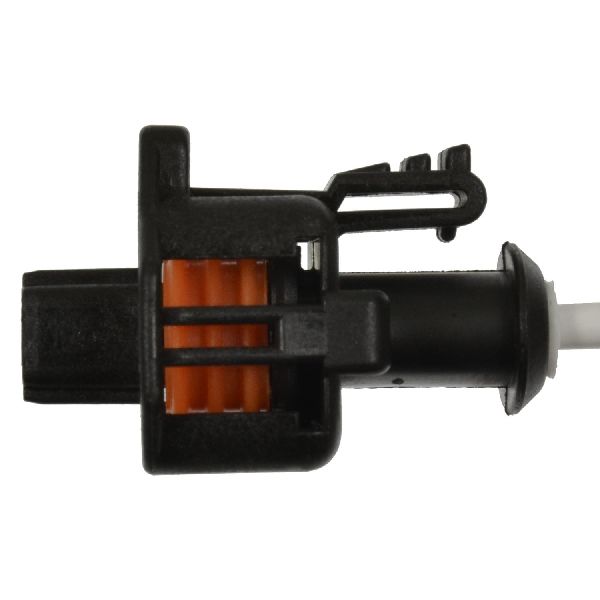
- ESIM / LDP Connector — On the ESIM/LDP unit itself, which is mounted to the charcoal canister near the fuel tank.. A poor connection or damaged wires at this connector can prevent the ESIM from operating correctly, mimicking a system leak. On some Ram models, the wires are: White/Green (power), Orange (switch signal), and Black/Purple (ground).
- G304 — Center Body.. This is a major ground point for various body components. While not directly tied to the EVAP system in all diagrams, a poor ground here can cause unpredictable electrical issues that could potentially affect sensor readings.
Real Owner Repair Stories
- RamForum.com user 'Gwerner74' (2018 Ram 2500 6.4L HEMI) — Check Gas Cap message, P0455 and P0456 codes.
❌ Tried (didn't work) Replacing the gas cap., Replacing the ESIM/Leak Detection Valve with three different Dorman brand parts. This cleared the codes but introduced a new problem: the fuel tank could not be filled without the pump constantly shutting off.
✅ What actually fixed it Replacing the ESIM with a Duralast brand part. The user noted the Duralast part had an internal design that was an exact match to the original Mopar valve, whereas the Dorman part was different. This fixed both the EVAP codes and the refueling issue. - RamForum.com user '62Blazer' (2018 Ram 6.4L) — P0456 (small evap code)
❌ Tried (didn't work) Replacing a generic aftermarket gas cap with a new Mopar factory gas cap.
✅ What actually fixed it Replacing the purge valve solenoid under the hood for $17. Another user in the thread confirmed that dealers see this as a very common problem on the 6.4L HEMI. - YouTube channel 'Encore Automotive Diagnostics and Repair' (2014 Dodge Ram) — P0455 and P0456 codes.
❌ Tried (didn't work) The technician immediately proceeded to a smoke test rather than replacing the gas cap.
✅ What actually fixed it A smoke test revealed a vent hose on top of the fuel tank was completely disconnected. The technician noted it was likely left disconnected during a recent transmission installation.
"I Checked Everything" — The Actual Cause
- According to some technicians, the dealer-level wiTECH Small Leak Verification Test (SLVT) is more accurate than a generic smoke test because it uses vacuum and the vehicle's own FTP sensor to check for leaks, which is how the code is set in the first place.
- An internal failure within the charcoal canister can reportedly cause a P0456 code while still passing a standard smoke test.
When the Usual Fixes Don't Work
- While replacing the ESIM is a common fix, a real-world repair story from a 2018 Ram 2500 owner highlights a significant pitfall: using an aftermarket ESIM from Dorman fixed the P0456 code but made it impossible to refuel the truck. The fix required finding a different aftermarket brand (Duralast) that had the same internal valve design as the Mopar original. This shows that not all aftermarket parts are created equal for this specific component, and simply replacing the part may introduce new problems if the wrong brand is chosen.
OEM Part Supersession History
4861962AA, 4861962AB, 4861962AC→04861962AD— Standard part evolution and revision by the manufacturer.
Heads up: While multiple aftermarket brands exist, some (like certain Dorman revisions) have a different internal design that can cause refueling issues (fuel pump clicks off) even if they resolve the P0456 code. It is critical to use an OEM part or an aftermarket part that explicitly matches the OEM internal design.
Model Year Variations Within This Range
- 2014-2018: These models use a traditional, screw-on gas cap. A worn or loose cap is a primary and very common cause for P0456.
- 2019-2020: These models use a capless fuel filler system. The cause is never a 'loose cap' but can be debris on the filler neck's spring-loaded seal. TSB #18-056-19 REV. A also points to a PCM software glitch on 2019 models that can cause P0456 with hesitation, fixed by a dealer reflash.
Helpful Videos

Used OEM Parts in Stock


New Aftermarket Parts Available


The information in this article is provided for general reference and educational purposes only. Vehicle specifications, procedures, and part compatibility can vary by production date, trim level, and region. Always consult your vehicle's factory service manual and verify part numbers before purchasing or performing repairs. Safety-critical components such as airbags, seat belts, and braking systems should be installed by a qualified professional.
- Ram 3500:
- 🎬 Helpful Videos
- 🛍️ Shop This Part
- What's Unique About the 2014-2020 Ram 3500
- Diagnostic Flowchart
- Symptoms You May Notice
- Most Likely Causes
- Rare But Worth Checking
- Diagnosis Steps
- Parts You'll Likely Need
- Related Codes That Often Appear With This One
- Technical Service Bulletins (TSBs) & Recalls
- Platform-Specific Known Issues
- Mechanic-Grade Diagnostic Values
- Hidden / Shadow Codes Worth Checking
- Scan Tool Commands That Help
- Wiring & Ground Locations
- Real Owner Repair Stories
- "I Checked Everything" — The Actual Cause
- When the Usual Fixes Don't Work
- OEM Part Supersession History
- Model Year Variations Within This Range
- 🎟️ Get 5% Off