

P0456 on 2013-2020 Ram 1500: Causes and Fixes for EVAP System Small Leak
On 2013-2020 Ram 1500s, code P0456 is most often caused by a faulty gas cap (on older models) or a failed Evaporative System Integrity Monitor (ESIM) pump located on the charcoal canister. Replacing the ESIM is a common, inexpensive DIY fix costing around $25-$50. For 5th-gen (2019+) models with capless fillers, attention should turn to the purge valve or the ESIM itself.
- P0456 means your truck has a small fuel vapor leak. It is not a serious mechanical issue but will cause a failed emissions test.
- For 2013-2018 models, always check that the gas cap is tight and its seal is intact before starting other repairs.
- The most likely part to have failed is the Evaporative System Integrity Monitor (ESIM), a small pump on the charcoal canister. It's an inexpensive and common DIY replacement.
- The second most likely culprit is the EVAP purge valve located in the engine bay, which can be tested with simple tools.
- If simple fixes don't work, a professional smoke test is the best way to find the exact location of the leak without guessing.
What's Unique About the 2013-2020 Ram 1500

The 2013-2020 Ram 1500 range spans two generations, but both are known for a specific weak point in the EVAP system: the Evaporative System Integrity Monitor (ESIM), also called a leak detection pump. This component, which is mounted directly on the charcoal canister, frequently fails and is a top cause for the P0456 code on these trucks. While a loose gas cap is a common cause on many vehicles, the ESIM is a particularly notorious part for this generation of Ram and related Chrysler products. The 2019 and newer 5th-gen models also use a capless fuel filler, eliminating the traditional gas cap as a potential cause and shifting focus to other components like the purge valve or ESIM.
Diagnostic Flowchart

Tap your situation to follow the diagnostic path that matches what you're seeing on this vehicle.
Generation note: This range covers the end of the 4th Generation (2013-2018, and 2019+ as 'Classic') and the beginning of the 5th Generation (2019-2020). The most significant difference regarding this code is that 4th-gen trucks have a traditional gas cap, while 5th-gen trucks have a capless system. However, the underlying EVAP system components, particularly the failure-prone ESIM pump and purge valve, are similar and common failure points on both.
Symptoms You May Notice
- Check Engine Light is on
- A faint smell of gasoline, particularly around the rear of the truck.
- On 4th-gen models, a "Check Fuel Cap" message may appear on the dash.
- Slight decrease in fuel efficiency due to escaping fuel vapors.
- Replacing the entire charcoal canister when only the inexpensive ESIM pump has failed.
- Immediately assuming a major leak when the issue is just a loose or faulty gas cap (on applicable models).
- Repeatedly replacing the ESIM with aftermarket parts. Some owners report the code returning until a genuine Mopar ESIM is installed.
Most Likely Causes

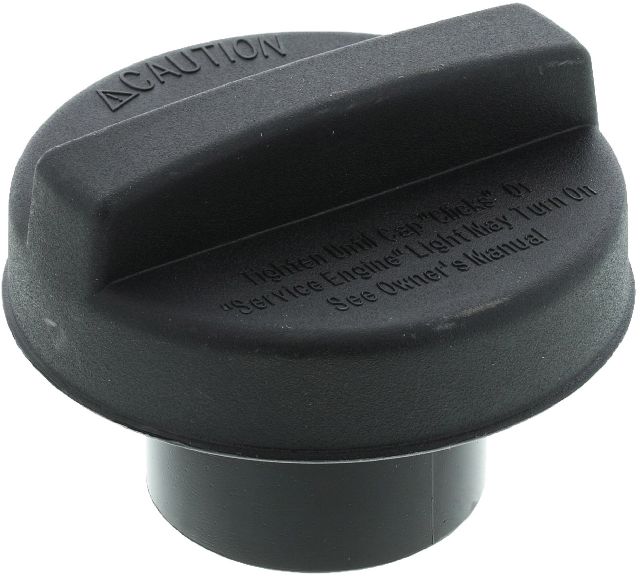
- Faulty or Loose Gas Cap (2013-2018 & Classic models) 🔴 High Probability The gas cap seal can degrade, crack, or get dirty over time, preventing a proper seal. Aftermarket caps are a frequent source of sealing issues, with many owners reporting that only an OEM Mopar cap will resolve the code.
How to confirm: Inspect the rubber seal on the gas cap for cracks, stiffness, or debris. Ensure it is tightened until it clicks at least once. If the cap is old or an aftermarket brand, replacing it with an OEM Mopar cap (Part # 52030377AB) is a cheap and effective first step.
Typical fix: Clean the existing cap and filler neck sealing surfaces or replace the gas cap with a genuine Mopar part.
Est. part cost: $20-$35 - Faulty Evaporative System Integrity Monitor (ESIM) / Leak Detection Pump 🔴 High Probability This is a widely documented, high-failure item on Ram trucks and many other Chrysler, Dodge, and Jeep products. The internal switch can fail, or the plastic housing can crack, causing a leak. Some owners report going through multiple aftermarket ESIMs before an OEM part permanently fixes the issue.
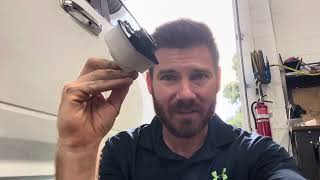
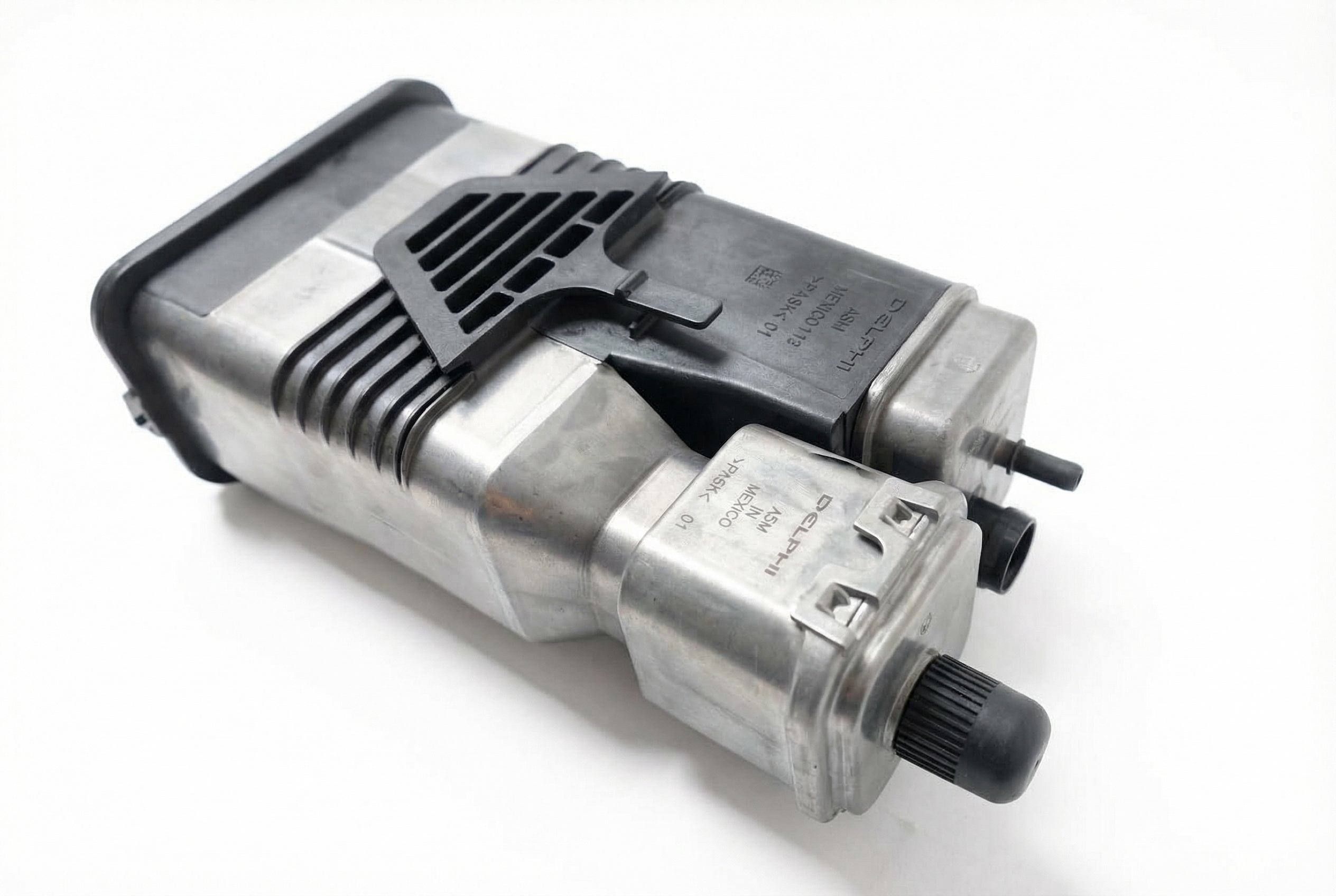
How to confirm: The ESIM is located on the charcoal canister near the fuel tank. A smoke test is the definitive way to confirm a leak from the ESIM housing. However, given its high failure rate and low cost, many owners choose to replace it proactively after checking the gas cap. The part can be removed with a simple quarter-turn counter-clockwise after depressing a locking tab. 🎬 Watch this quick walkthrough on replacing the ESIM pump.
Typical fix: Replace the ESIM pump. This involves reaching the part on the charcoal canister, disconnecting the electrical plug and hose, depressing a tab, giving it a quarter-turn to release, and installing the new one. Ensure the new O-ring is seated correctly.
Est. part cost: $25-$50 - Faulty EVAP Purge Valve/Solenoid 🟡 Medium Probability The purge valve, located in the engine bay, can get stuck open or fail to seal properly, creating a constant vacuum leak within the EVAP system. This is a common failure point, especially on 5th-gen models where the gas cap is not a factor.
How to confirm: With the engine off, disconnect the valve and try to blow through it; it should be closed and not allow air to pass. Alternatively, a hand vacuum pump can be used to see if it holds a vacuum; if the vacuum bleeds off, the valve is faulty. A long crank time after refueling can also point to a leaking purge valve. Many owners on forums for 5th-gen trucks report successfully fixing P0456 by replacing this part.
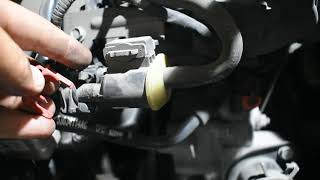
Typical fix: Replace the purge valve. It is typically located on the passenger side of the engine and is held in by a simple bracket and two hose connections. 🎬 See how to locate and swap the purge valve.
Est. part cost: $20-$50 - Cracked or Disconnected EVAP Hoses ⚪ Low Probability Rubber and plastic lines can become brittle and crack over time due to heat and age. In some cases, rodents have been known to chew through the plastic lines on top of the fuel tank. In other instances, hoses have been found disconnected after previous service, like a transmission replacement.
How to confirm: Perform a thorough visual inspection of all accessible EVAP lines. A professional smoke test is the most effective way to find a small crack in a hose. The smoke is injected into the system, and the technician looks for where it escapes.
Typical fix: Replace the cracked section of hose or splice the damaged area.
Est. part cost: $10-$50
Rare But Worth Checking
- Cracked Charcoal Canister: The canister itself can develop cracks, especially if impacted by road debris. This is a more expensive repair, so it should be confirmed with a smoke test after other common causes are ruled out.
- Leaking Fuel Filler Neck / Capless Fuel Filler Seal: On 4th-gen trucks, rust or damage to the metal filler neck can prevent a proper seal. On 5th-gen capless systems, debris like dirt or even a blade of grass can get stuck in the seal, preventing it from closing fully and triggering the code.
- Incorrectly Installed ESIM: The ESIM is gravity-fed and must be installed in the correct vertical orientation to function. If the part was recently replaced and the code returned, verify its installation. Shaking the old unit may produce a rattle, indicating failure.
- Damaged ESIM Wiring Harness: In at least one documented case, the signal wire for the ESIM was found crushed and broken in the wiring harness near the driver-side exhaust manifold, preventing the PCM from seeing the 'closed' signal from the ESIM.
Diagnosis Steps

- Check the Gas Cap (2013-2018 & Classic): Tighten the gas cap until it clicks. Inspect the seal for cracks or wear. Clean any dirt from the seal and filler neck. If in doubt, replace it with a Mopar OEM cap (P/N: 52030377AB). For 2019+ capless models, inspect the filler neck flap for debris and ensure it moves freely.
- Visual Inspection: Carefully inspect all visible EVAP hoses in the engine bay and underneath the truck near the fuel tank and charcoal canister for obvious cracks, disconnections, or damage. Pay special attention to lines near the engine and on top of the fuel tank.
- Test the Purge Valve: Locate the purge valve in the engine bay (passenger side on the 5.7L Hemi). With the engine off, disconnect it and try to blow air through it; it should be sealed. A hand vacuum pump can also be used to verify it holds vacuum.
- Inspect/Replace the ESIM: Given its high failure rate, replacing the ESIM is a common and cost-effective next step. It is located on the charcoal canister and is replaced with a simple twist-off, twist-on motion after depressing a lock tab. Ensure the new O-ring is properly lubricated and seated.
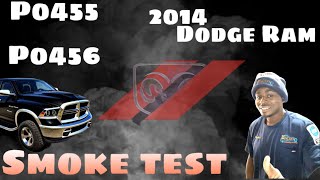
- Perform a Smoke Test: If the above steps do not resolve the issue, the most reliable way to find the leak is with an automotive smoke machine. This involves feeding low-pressure smoke into the EVAP system's service port (often near the purge valve) and watching where it escapes. 🎬 Watch a smoke test in action to find hidden leaks. This can pinpoint leaks in hoses, the canister, the filler neck, or the fuel tank itself.
- Use OEM Scan Tool: As mentioned in multiple TSBs, a dealer or well-equipped shop can use the 'wiTECH Small Leak Verification Test (SLVT)' to professionally diagnose the system. [Bulletin #1804823, #1807022, #18-076-20 REV. A, 17] Some advanced consumer scan tools may also offer a similar forced test function.
- Check for Software Updates: TSB 18-033-25 REV. A notes that for some 2019 models with the 3.6L eTorque engine, a PCM software update is available to address a list of DTCs that includes P0456. [Bulletin #18-033-25 REV. A]
Parts You'll Likely Need

- Evaporative System Integrity Monitor (ESIM) / Leak Detection Pump
(OEM #4861962AD) - Gas Cap (4th Gen)
(OEM #52030377AB) - EVAP Purge Valve / Solenoid
Related Codes That Often Appear With This One
- P0457 — P0457 indicates a leak detected, often specifically interpreted by the system as a loose or missing fuel cap. It frequently appears alongside P0456 as the root cause could be the same.
- P0455 — This code indicates a large EVAP leak. While P0456 is for a small leak, a component failure can sometimes be interpreted differently by the PCM on separate tests, or a small leak can worsen, triggering both codes at different times.
Technical Service Bulletins (TSBs) & Recalls
- Bulletin #18-033-25 REV. A: For 2019 Ram 1500 with 3.6L eTorque, a PCM software update is available to address several DTCs, including P0456.
- Bulletin #1804823, #1807022, #18-076-20 REV. A: These TSBs instruct technicians to use the wiTECH Small Leak Verification Test (SLVT) to diagnose a P0456 code, confirming it's a standard dealer diagnostic procedure.
Platform-Specific Known Issues
- Aftermarket Parts Syndrome: A recurring theme in owner forums is the experience of replacing a part like the ESIM or gas cap with an aftermarket version, only for the P0456 code to return a month or two later. The issue is often permanently resolved only after a genuine Mopar OEM part is used.
- Capless Filler Debris: For 2019+ models, owners have reported that something as simple as a piece of dirt or a blade of grass can prevent the spring-loaded capless filler door from sealing completely, which is enough to trigger the P0456 code. Cleaning the seal is a necessary diagnostic step.
- Rodent Damage: In at least one owner account, the P0456 code was caused by a squirrel chewing through the plastic EVAP lines on top of the fuel tank. The owner fixed it by splicing the line and covering it with braided stainless sheathing to prevent future damage.
Mechanic-Grade Diagnostic Values
- ESIM (Evaporative System Integrity Monitor) Switch State — expected: During an engine-off cold soak, as the system cools and pulls a natural vacuum, the switch should close when the vacuum exceeds approximately 1 inch of H2O. The PCM signal wire should drop from its reference voltage (5V or 12V) to near 0V.. Failure: If the switch does not close (voltage does not drop) during a system self-test or a forced scan tool test, the ESIM has likely failed.
- EVAP Purge Valve Seal Test — expected: With the valve disconnected and engine off, it should be fully closed. A hand vacuum pump connected to the canister side port should hold vacuum steadily. Alternatively, you should not be able to blow air through it by mouth.. Failure: If the vacuum gauge on the hand pump drops, or if you can blow air through the valve, it is stuck open and faulty.
Scan Tool Commands That Help
- wiTECH (Dealer Tool): Small Leak Verification Test (SLVT) — Mandated by FCA/Stellantis TSBs for diagnosing P0456. It is used to confirm a leak exists before replacing parts and to verify the repair is successful afterward, as a normal drive cycle test can take days.
- Advanced Consumer Scan Tool (e.g., Innova 5160): ESIM Forced Test / EVAP System Test — To manually command the EVAP system test and monitor the live data of the ESIM switch state (Open/Closed). This allows a technician or advanced DIYer to confirm if the ESIM switch is closing as expected within the first minute of the test.
Wiring & Ground Locations
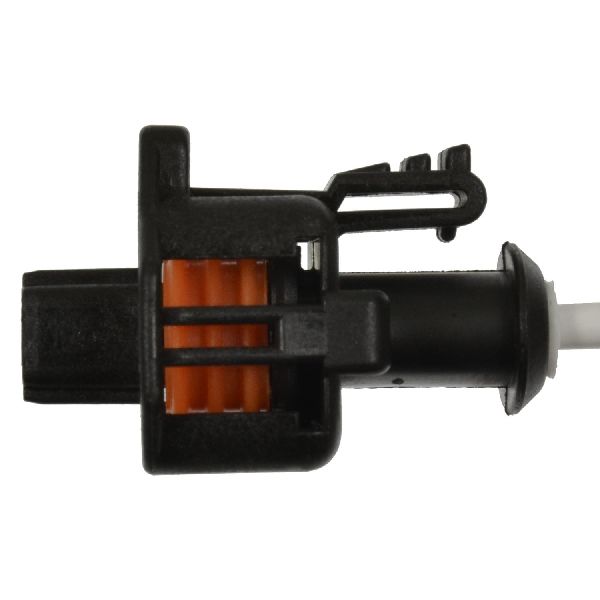
- Switch-Evap System Monitor Connector — Located on the ESIM itself, which is mounted directly to the charcoal canister. The canister is typically found near the fuel tank, often towards the center of the truck.. This is the electrical connection for the most common failure part. Checking for a secure connection and undamaged wires here is a key diagnostic step.
Real Owner Repair Stories
- RamForum.com user (2016 Ram 2500 6.4 Hemi with ~60k miles) — Recurring P0456 code and check engine light.
❌ Tried (didn't work) Replaced the ESIM with an AutoZone house brand part; light returned after a month., Replaced the ESIM again under warranty with another aftermarket part; light returned again., Replaced the ESIM with a different, 'better' aftermarket part; light still returned.
✅ What actually fixed it Replacing the ESIM with a genuine OEM Mopar part from the dealership finally resolved the issue permanently. - RamForum.com user (2016 Ram 2500 with 80k miles) — Persistent P0456 code.
❌ Tried (didn't work) A smoke test performed by a dealer found no leaks in the lines, canister, or gas cap.
✅ What actually fixed it The dealer determined that a non-serviceable component on top of the gas tank was cracked or broken, requiring a full fuel tank replacement to fix the leak. - 5thGenRams.com user (2019+ Ram 1500 (5th Gen) with 40,000 miles) — P0456 code that returned after being reset three times.
❌ Tried (didn't work) Resetting the code with a scanner.
✅ What actually fixed it Replaced the EVAP purge valve. The fix cost $30 and took 15 minutes.
"I Checked Everything" — The Actual Cause
- In one documented case, a smoke test at a dealership came back clean, but the P0456 code persisted. The actual cause was determined to be a crack in a non-serviceable part on top of the fuel tank, which required replacing the entire tank to resolve.
- Another owner found the cause after visual inspection; the EVAP return line coming from the purge valve had rubbed against another hose near the firewall, creating a small hole that was difficult to see and might be missed by a smoke test if not positioned correctly.
When the Usual Fixes Don't Work
- While the ESIM is the most common failure part, multiple owners have reported that replacing it with aftermarket versions did not fix the problem. The code only disappeared after a genuine Mopar OEM part was installed, suggesting a potential quality or calibration difference in aftermarket units. Furthermore, in cases where a smoke test passes, the cause can be more complex, such as a faulty Fuel Tank Pressure sensor giving false readings or a hairline crack on the top of the fuel tank itself, which is a non-serviceable part requiring a full tank replacement.
OEM Part Supersession History
4861962AA, 4861962AB, 4861962AC, 4891685AA, 4891685AB→4861962AD— Standard part evolution and revision by the manufacturer.
Heads up: While multiple aftermarket versions exist, owner reports suggest that using the genuine Mopar OEM part (4861962AD) is the most reliable way to prevent the code from returning.
Model Year Variations Within This Range
- 2018-2020 (4th Gen 'Classic' & 5th Gen): The vapor canister part number is different depending on the fuel tank size. Trucks with the standard 26-gallon tank use a different canister than trucks with the optional 32 or 33-gallon tank. The parts are not interchangeable, and installing the wrong one will cause persistent EVAP codes.
- 2019-2020 (5th Gen): These models feature a capless fuel filler system, eliminating the traditional gas cap as a cause. Diagnosis should focus more heavily on the purge valve and ESIM. Debris in the capless filler's seal can also be a cause.
Helpful Videos

Used OEM Parts in Stock


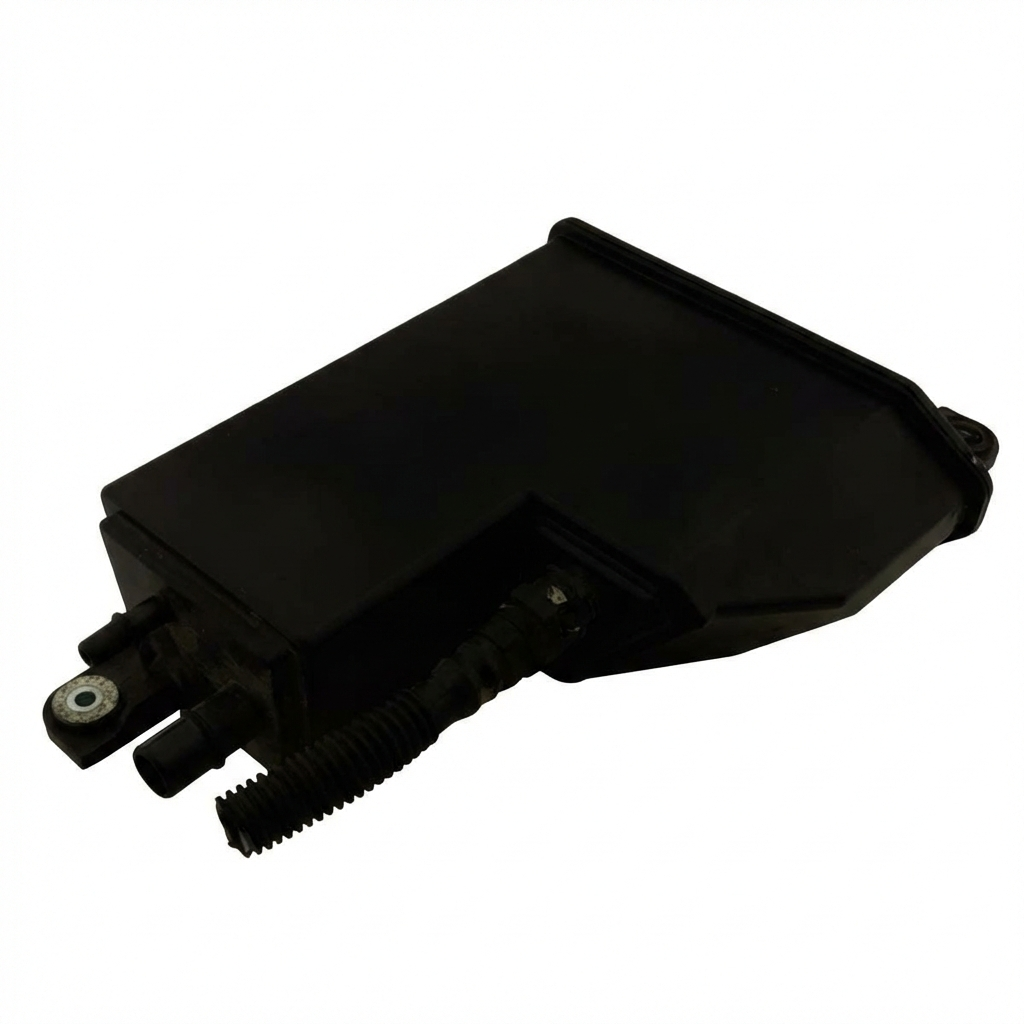

New Aftermarket Parts Available


The information in this article is provided for general reference and educational purposes only. Vehicle specifications, procedures, and part compatibility can vary by production date, trim level, and region. Always consult your vehicle's factory service manual and verify part numbers before purchasing or performing repairs. Safety-critical components such as airbags, seat belts, and braking systems should be installed by a qualified professional.
- Ram 1500:
- 🎬 Helpful Videos
- 🛍️ Shop This Part
- What's Unique About the 2013-2020 Ram 1500
- Diagnostic Flowchart
- Symptoms You May Notice
- Most Likely Causes
- Rare But Worth Checking
- Diagnosis Steps
- Parts You'll Likely Need
- Related Codes That Often Appear With This One
- Technical Service Bulletins (TSBs) & Recalls
- Platform-Specific Known Issues
- Mechanic-Grade Diagnostic Values
- Scan Tool Commands That Help
- Wiring & Ground Locations
- Real Owner Repair Stories
- "I Checked Everything" — The Actual Cause
- When the Usual Fixes Don't Work
- OEM Part Supersession History
- Model Year Variations Within This Range
- 🎟️ Get 5% Off