

P0456 on 2012-2016 Honda Pilot: EVAP Small Leak Causes and Fixes
For a 2012-2016 Honda Pilot, code P0456 is most often caused by a loose or faulty gas cap (2012-2015 models) or a faulty capless fuel filler neck (2016 model). If not the gas cap, check the canister purge valve or vent valve. A new OEM gas cap is about $25-$40, while the capless filler neck repair kit is over $200.
- For 2012-2015 Pilots, always start by inspecting and likely replacing the gas cap with an OEM part.
- For 2016 Pilots, the capless fuel filler neck is a known weak point; inspect it for debris or damage before pursuing more complex diagnostics.
- A smoke test is the most reliable way to find the leak if it's not the gas cap or filler neck.
- Honda has issued specific service bulletins for this exact problem on these vehicles, making diagnosis more straightforward.
What's Unique About the 2012-2016 Honda PILOT

For this generation of Honda Pilot, the P0456 code is frequently linked to specific components beyond just a loose gas cap. Honda has issued Technical Service Bulletins (TSBs) pointing directly to issues. For 2012-2014 models, TSB 13-097 addresses a faulty fuel fill cap gasket that creates too much friction and prevents a proper seal. For the 2016 model, which features a capless design, TSB ATS170206 advises technicians to replace specific parts like the 'mis-fuel inhibit device' and 'main flap unit' rather than the entire fuel filler pipe, indicating a known design weakness.
Diagnostic Flowchart

Tap your situation to follow the diagnostic path that matches what you're seeing on this vehicle.
Generation note: This year range covers two generations: the end of the second generation (2012-2015) and the first year of the third generation (2016). The second generation uses a traditional gas cap, which is a very common failure point addressed by TSB 13-097. The third generation (2016) introduced a capless fuel filler system, and TSB ATS170206 specifically addresses leak issues with the flap and sealing mechanism in this design.
Symptoms You May Notice
- Check Engine Light is on
- A faint fuel smell, particularly near the rear of the vehicle (less common).
- A loose or 'stick-slip' feeling when tightening the gas cap (on 2012-2015 models) [⭐ MANUFACTURER TSB — highest authority] Bulletin #13-097.
- Message on the dash such as "Emissions System Problem".
- Replacing the entire fuel filler pipe on a 2016 model when only the internal flap components are faulty, as warned against in TSB #ATS170206.
- Replacing other EVAP components before properly checking and cleaning the capless fuel filler mechanism on 2016 models.
- Using a cheap aftermarket gas cap that doesn't seal correctly, causing the code to persist.
Most Likely Causes

- Loose or Faulty Gas Cap 🔴 High Probability This is the most common cause for any EVAP leak code. For 2012-2014 Pilots, Honda issued TSB 13-097 related to gas caps where the gasket material causes a poor seal, sometimes with a 'stick-slip' sensation when tightened. [⭐ MANUFACTURER TSB — highest authority] Bulletin #13-097. Aftermarket caps are also notorious for not sealing correctly.
How to confirm: Ensure the cap is tightened until it clicks at least three times. Inspect the rubber seal on the cap for cracks, stiffness, or debris. If the seal is compromised, the cap needs replacement. The TSB notes the original faulty caps had a black gasket, while the updated ones have a brown gasket.
Typical fix: Replace the gas cap with a new OEM part (Part No. 17670-T3W-A01). Aftermarket caps can sometimes cause sealing issues.
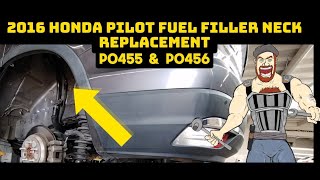
Est. part cost: $25-$40 - Faulty Fuel Filler Neck Components (Capless System) 🔴 High Probability Specific to 2016 models, Honda TSB #ATS170206 directly identifies the 'mis-fuel inhibit device and the main flap unit' in the filler neck as the source of P0456, explicitly warning against replacing the entire fuel fill pipe. [⭐ MANUFACTURER TSB — highest authority] Bulletin #ATS170206. Debris can also get lodged in the flap, preventing a seal.
How to confirm: Visually inspect the fuel filler opening for debris holding the flap open. Cleaning the sealing surface with a rag and some solvent can sometimes resolve the issue. A definitive diagnosis requires a smoke test to see if smoke escapes from the filler neck area.
Typical fix: First, try cleaning the sealing area. If that fails, replace the specific components of the fuel filler neck assembly using the kit indicated by the TSB 🎬 Watch: Step-by-step guide to replacing the fuel filler neck components. (Part No. 06160-TG7-A12). This is more involved than a simple cap replacement.
Est. part cost: $200-$290 - EVAP Canister Purge Valve Failure 🟡 Medium Probability The purge valve is a solenoid that can get stuck slightly open, creating a small leak path. It's a common failure point on many vehicles, including Hondas. It is located in the engine bay and is relatively easy to access and replace.
How to confirm: When removed from the vehicle and unpowered, you should not be able to blow air through the valve. If you can, it is faulty. A mechanic can also command it open and closed with a scan tool to test its function. Some owners report feeling a slight vacuum at the valve's port during a cold start, indicating it's stuck open.
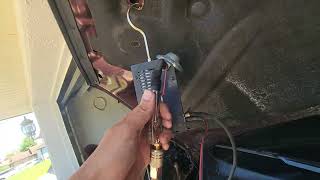
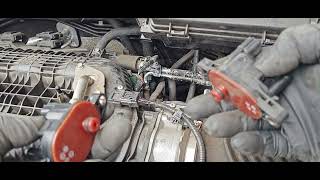
Typical fix: Replace the canister purge valve. 🎬 See this walkthrough on how to replace the purge valve. It is typically located on top of the engine near the intake manifold.
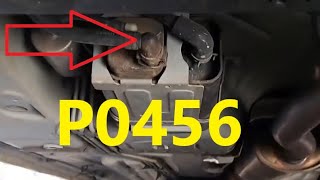
Est. part cost: $50-$90 - EVAP Canister Vent Valve/Solenoid Failure 🟡 Medium Probability The canister vent valve (or vent solenoid) is located near the charcoal canister under the vehicle. It is normally open and closes to seal the system for pressure testing. It can fail by getting stuck closed (often causing other codes) or, more relevant to P0456, failing to seal completely when commanded closed due to internal failure or debris.
How to confirm: Diagnosis requires a bidirectional scan tool to command the valve closed during a smoke test. If the valve is commanded shut but smoke still escapes from the vent port, the valve is bad. The O-ring seal where the valve mounts to the canister can also fail.
Typical fix: Replace the canister vent valve assembly. It is located under the vehicle, near the spare tire, attached to the charcoal canister.
Est. part cost: $70-$100 - Cracked or Disconnected EVAP Hoses ⚪ Low Probability Rubber hoses can become brittle and crack over time due to age and heat cycles. The connections to the charcoal canister, purge valve, or fuel tank can also become loose.
How to confirm: A visual inspection may reveal obvious cracks, but a definitive diagnosis requires a smoke test. A mechanic will introduce smoke into the EVAP system and look for where it escapes.
Typical fix: Replace the damaged section of hose or reconnect it securely.
Est. part cost: $10-$50
Rare But Worth Checking
- Leaking EVAP Canister: The charcoal canister itself can develop hairline cracks, especially if the vehicle has been subjected to impacts from road debris. This is usually found only with a smoke test.
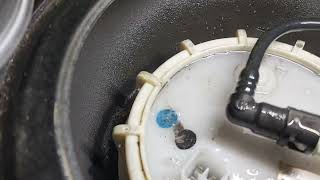
- Loose Fuel Pump Lock Ring: One owner of a 2016 Pilot reported that the large lock ring securing the fuel pump assembly to the top of the gas tank was not properly sealed, causing both P0455 and P0456 codes. This was found via a smoke test and fixed by properly tightening the lock ring. 🎬 Watch: How a loose fuel pump lock ring causes these codes.
Diagnosis Steps
- Check the gas cap (2012-2015 models). Remove it, inspect the seal for damage (cracks, stiffness), and retighten it until it clicks several times. Clear the code and drive for a few days to see if it returns.
- For 2016 models, inspect the capless fuel filler opening. Use a clean cloth to wipe the metal flap and the surrounding seal to remove any dirt or fuel residue that might prevent a seal.
- Perform a thorough visual inspection of all accessible EVAP hoses in the engine bay and under the vehicle, looking for obvious cracks, disconnections, or deterioration.
- Test the Purge Valve. The valve is located in the engine bay, usually on top of the engine. With the vehicle off, disconnect the valve and try to blow through it. If air passes through, the valve is stuck open and must be replaced.
- If no obvious issues are found, the most effective diagnostic step is a smoke test. A mechanic will inject pressurized smoke into the EVAP system's service port. The smoke will escape from the location of the leak, making it easy to pinpoint.
- During the smoke test, use a bidirectional scan tool to command the canister vent valve (located under the car near the spare tire) to close. Smoke should not escape from the vent valve when it is commanded shut. If it does, the valve is faulty.
- While the smoke test is running, pay close attention to the gas cap/filler neck area, the EVAP canister, the purge valve, and all hose connections.
- If a leak is traced to the fuel tank area, inspect the fuel pump lock ring for proper sealing, as this has been a documented, though rare, cause.
Parts You'll Likely Need

- Fuel Tank Cap (2012-2015)
(OEM #17670-T3W-A01)— This is the most frequent and simplest fix for P0456 on models with a traditional cap. The seal wears out or was faulty from the factory, as noted in TSB 13-097. [⭐ MANUFACTURER TSB — highest authority] Bulletin #13-097.
Related Codes That Often Appear With This One
- P0455 — This code indicates a large EVAP leak. It can appear with P0456 if the leak is intermittent or on the borderline between small and large. Both codes were cited in the same TSBs for the Pilot. [⭐ MANUFACTURER TSB — highest authority] Bulletin #ATS170206, [⭐ MANUFACTURER TSB — highest authority] Bulletin #13-097.
- P145C — This is a Honda-specific code that can relate to issues in the EVAP system, sometimes pointing towards the canister vent valve or related components.
- P0497 — This code indicates 'EVAP System Low Purge Flow' and often points directly to a faulty EVAP canister purge valve, a common cause for P0456 as well.
Technical Service Bulletins (TSBs) & Recalls
- ATS170206: For 2016 Pilot and 2017 Ridgeline. Advises against replacing the entire fuel fill pipe for P0455/P0456, instead instructing to replace the 'mis-fuel inhibit device and the main flap unit' using a specific kit.
- 13-097: For 2012-2014 Pilot (and other Honda/Acura models). Addresses P0455/P0456 caused by a fuel fill cap gasket that provides improper sealing. The fix is to replace the cap with an updated version.
Platform-Specific Known Issues
- A Technical Service Bulletin (#Service Bulletin) was issued for 2012 Pilots regarding a loose or 'stick-slip' feeling gas cap that can cause P0455 and P0456 codes. [⭐ MANUFACTURER TSB — highest authority] Bulletin #Service Bulletin
- A Technical Service Bulletin (#ATS170206) was issued for 2016 Pilots instructing technicians to replace the 'mis-fuel inhibit device and the main flap unit' for P0455/P0456 codes related to the filler neck, instead of the entire pipe. [⭐ MANUFACTURER TSB — highest authority] Bulletin #ATS170206
- An owner of a 2016 Pilot filed a complaint with the NHTSA (ODI #11387318) after being diagnosed with a P0456 code, indicating this is a known issue experienced by owners. [ OWNER COMPLAINT] NHTSA ODI #11387318
Mechanic-Grade Diagnostic Values
- EVAP Canister Purge Valve Resistance — expected: 30 to 38 ohms (when engine is cool). Failure: A reading outside this range indicates a faulty valve coil.
- EVAP Canister Vent Solenoid Resistance — expected: 48 to 65 ohms. Failure: A reading outside this range suggests the solenoid coil is bad.
- Fuel Tank Pressure (FTP) Sensor with Scan Tool — expected: Pressure should hold steady when the EVAP system is sealed (purge valve off, vent valve commanded closed).. Failure: A steady drop in pressure (vacuum increases) indicates a leak somewhere in the system. If this happens with the purge valve commanded off, the valve itself is likely leaking internally.
Hidden / Shadow Codes Worth Checking
- Mode $06, TID $81: This is the onboard diagnostic test ID for the 'Tank leak test: Pinhole leak (0.5 mm)'. A failure of this specific monitor test is what directly triggers the P0456 DTC. (see via A scan tool capable of reading Mode $06 data. Select Monitor ID for the EVAP system (e.g., $3B) and look for the results of Test ID $81.)
Scan Tool Commands That Help
- Honda HDS or equivalent bidirectional scanner: EVAP System Function Test — This command initiates the same self-test the PCM runs automatically. It can be used to verify a fix or to check system integrity after a repair without waiting for the normal drive cycle conditions to be met.
- Bidirectional Scanner: EVAP Purge Valve On/Off — Used during a smoke test or while monitoring fuel tank pressure. Commanding the valve 'On' should allow smoke/vacuum to pass through; commanding it 'Off' should seal it. If smoke passes when commanded 'Off', the valve is faulty.
- Bidirectional Scanner: EVAP Vent Valve On/Off (Close/Open) — This is critical for sealing the EVAP system during a smoke test. The vent valve is normally open, so it must be commanded 'On' (closed) to pressurize the system. If smoke escapes from the vent port with the valve commanded closed, the valve is bad.
Wiring & Ground Locations
- EVAP Canister Purge Valve Connector — In the engine bay, typically mounted on or near the intake manifold. It is a 2-pin connector.. A corroded or loose connector can prevent the purge valve from operating correctly, potentially causing it to remain slightly open or not respond to PCM commands. The pigtail connector part number is referenced as 6189-7036.
- EVAP Canister Vent Solenoid Connector — Under the vehicle near the rear axle, attached to the EVAP charcoal canister. It is a 2-pin connector.. This connector provides power to close the vent valve to seal the system for a leak test. Corrosion or damage here can prevent the valve from closing, leading the PCM to interpret the open vent as a system leak.
- Fuse #6 (FUEL PUMP) — In the passenger compartment fuse box (Fuse Box A), located under the dashboard on the driver's side.. While not directly for an EVAP component, this 20A fuse powers the fuel pump. A related owner complaint for P0456 involved a loose fuel pump lock ring, indicating work may have been done in this area. Ensuring related circuits are functioning is part of a holistic diagnosis.
Real Owner Repair Stories
- YouTube user 'Irfan Chaudhry' (2016 Honda Pilot) — Check Engine Light with codes P0455 (large leak) and P0456 (small leak).
❌ Tried (didn't work) Initial smoke test of the purge valve showed it was okay.
✅ What actually fixed it A smoke test with the vent valve closed revealed bubbles and smoke coming from the top of the fuel pump assembly. The large plastic lock ring securing the fuel pump was found to be loose. The technician loosened it further, reseated the seal properly, and then fully tightened the lock ring, which resolved the leak. - YouTube user 'Take-a-Chance' (2016 Honda Pilot) — Check Engine Light with P0456 and an "Emissions System Problem" message on the dash.
❌ Tried (didn't work) Performed a smoke test on the entire system from the rear canister and found no leaks., Checked all hoses under the vehicle and near the gas tank., Verified the canister vent solenoid was working correctly with a bidirectional scan tool.
✅ What actually fixed it The issue was a faulty EVAP purge valve solenoid in the engine bay. Even though it passed a smoke test when unpowered, using a bidirectional scan tool to cycle it on and off while smoke was applied showed it was intermittently leaking. Replacing the purge valve fixed the problem.
"I Checked Everything" — The Actual Cause
- In one documented case on a 2016 Pilot, a full system smoke test from the rear of the vehicle showed no leaks. The technician verified the vent solenoid was closing properly. The ultimate cause was a faulty purge valve solenoid in the engine bay that was intermittently failing to seal completely, which was only found by cycling the valve with a scan tool while applying smoke directly to it.
OEM Part Supersession History
17670-SJA-A02, 17670-SNA-A02, 17670-TR0-A11→17670-T3W-A01— Updated design to improve sealing, addressing issues noted in TSBs for earlier models.06160-TG7-A10, 06160-TG7-A11→06160-TG7-A12— Updated kit for the capless fuel filler neck assembly, likely to address the sealing issues identified in TSB ATS170206.
Heads up: These parts are specific to the 2016+ capless system and are not compatible with 2012-2015 models.
Model Year Variations Within This Range
- 2012-2015: Uses a traditional screw-on gas cap (PN 17670-T3W-A01). The primary failure point is the cap's seal.
- 2016: Introduced a capless fuel filler system. The common failure point is the internal flap and seal mechanism within the filler neck, addressed by a specific repair kit (PN 06160-TG7-A12) per TSB ATS170206.
Helpful Videos
We Have This Part in Stock


The information in this article is provided for general reference and educational purposes only. Vehicle specifications, procedures, and part compatibility can vary by production date, trim level, and region. Always consult your vehicle's factory service manual and verify part numbers before purchasing or performing repairs. Safety-critical components such as airbags, seat belts, and braking systems should be installed by a qualified professional.
- Honda PILOT:
- 🎬 Helpful Videos
- 🛍️ Shop This Part
- What's Unique About the 2012-2016 Honda PILOT
- Diagnostic Flowchart
- Symptoms You May Notice
- Most Likely Causes
- Rare But Worth Checking
- Diagnosis Steps
- Parts You'll Likely Need
- Related Codes That Often Appear With This One
- Technical Service Bulletins (TSBs) & Recalls
- Platform-Specific Known Issues
- Mechanic-Grade Diagnostic Values
- Hidden / Shadow Codes Worth Checking
- Scan Tool Commands That Help
- Wiring & Ground Locations
- Real Owner Repair Stories
- "I Checked Everything" — The Actual Cause
- OEM Part Supersession History
- Model Year Variations Within This Range
- 🎟️ Get 5% Off