

P0456 on 2013-2017 Ford C-MAX: EVAP Small Leak Causes and Fixes
For a 2013-2017 Ford C-MAX, a P0456 code is most often caused by a faulty canister purge valve, an issue documented by Ford in a Technical Service Bulletin (TSB 19-2207). Replacing this valve is a common, relatively inexpensive DIY fix. The second most likely cause is a poor seal at the capless fuel filler neck, which can be resolved with cleaning. The official Ford repair also includes a PCM software update.
- For a P0456 on a 2013-2017 C-MAX, the canister purge valve is the most likely cause, per Ford TSB 19-2207.
- Before buying parts, inspect and clean the capless fuel filler neck seal, as a dirty seal is a common and free fix.
- The canister purge valve is an affordable part (around $30-$60) and is accessible in the engine bay, making it a simple DIY replacement.
- The official Ford repair includes a PCM software update after replacing the purge valve, which may require a trip to a dealer.
- This issue is also common on the 2013-2017 Ford Fusion Hybrid/Energi and Lincoln MKZ Hybrid.
What's Unique About the 2013-2017 Ford C-MAX

The 2013-2017 Ford C-MAX, along with its platform-mates the Fusion and MKZ Hybrid, is specifically known for triggering EVAP codes like P0456 due to a faulty canister purge valve. Ford issued Technical Service Bulletin (TSB) 19-2207 acknowledging that the valve's sealing capability can degrade over time, making it the primary suspect for this code on this specific vehicle. The official repair procedure involves both replacing the valve and updating the PCM software. Another common point of failure is the seal on the capless fuel filler neck, which can get dirty or worn, preventing a proper seal.
Diagnostic Flowchart
Tap your situation to follow the diagnostic path that matches what you're seeing on this vehicle.
Symptoms You May Notice
- Check Engine Light is on
- A faint fuel smell (in rare cases).
- Slightly rough idle (reported by some owners)
- Difficulty refueling (gas pump clicks off repeatedly), though this is more common with a clogged canister than a small leak.
- Remote start functionality may be disabled.
- Replacing the charcoal canister when the actual fault is the much cheaper and easier-to-replace canister purge valve.
- Replacing the fuel filler neck when it only needs to be cleaned.
- Performing a smoke test incorrectly by pinching off the vent valve hose, which can mask a leak at the vent valve itself.
Most Likely Causes


- Faulty Canister Purge Valve 🔴 High Probability Ford TSB 19-2207 specifically identifies a faulty canister purge valve as the likely cause for P0456 and related codes on this vehicle. The valve, which is normally closed, can get stuck slightly open due to internal corrosion or debris, creating a small, constant leak.
How to confirm: The valve is normally closed when no power is applied. Remove the valve (located in the engine bay, held by two 8mm bolts) and try to blow through it. If any air passes through, it is stuck open and has failed. A mechanic can also use a scan tool to command the valve open and closed to test its function and listen for a clicking sound.
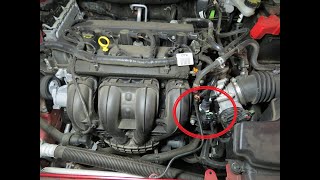
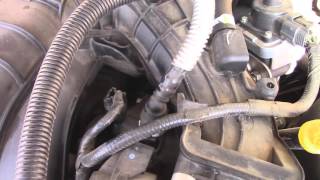
Typical fix: Replace the canister purge valve and, if possible, have the PCM updated per TSB 19-2207. The replacement is a simple DIY job involving removing two bolts and two connectors. 🎬 Watch: Step-by-step guide to replacing the canister purge valve.
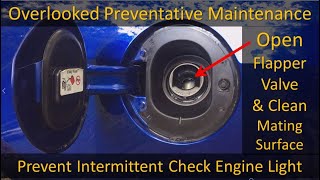
Est. part cost: $30-$60 - Poorly Sealing Capless Fuel Filler Neck 🟡 Medium Probability Instead of a traditional gas cap, the C-MAX uses a capless system with a spring-loaded door and an O-ring seal. Dirt, dust, and debris can accumulate on the seal, preventing it from closing tightly and causing a small leak.
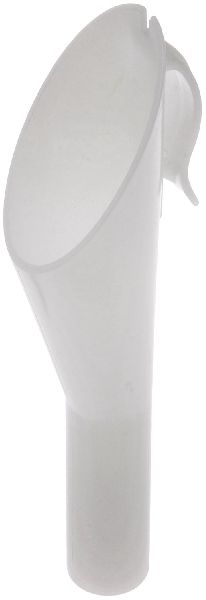
How to confirm: Visually inspect the fuel filler opening for any debris, dirt, or damage to the seal. Use the emergency funnel provided with the vehicle (usually located with the spare tire kit) to cycle the flap open and closed 15-20 times to dislodge any debris.
Typical fix: Clean the sealing area with a rag and a light solvent like WD-40 or isopropyl alcohol. Spraying a small amount of lubricant while cycling the flap with the funnel can help restore the seal. 🎬 See how to properly clean your capless fuel filler neck. If the seal is damaged, the entire fuel filler neck assembly may need to be replaced.
Est. part cost: $0 for cleaning, $100-$200 for filler neck replacement - Cracked or Disconnected EVAP Hoses ⚪ Low Probability The rubber and plastic hoses in the EVAP system can become brittle and crack over time due to heat and age. A small crack in any of these lines, especially at connection points, can cause a P0456 code.
How to confirm: Visually inspect all accessible EVAP hoses in the engine bay and under the vehicle near the charcoal canister. Pay close attention to the lines connecting to the purge valve and the charcoal canister. A smoke test is the most effective way to find a leak that isn't obvious.
Typical fix: Replace the cracked section of hose or secure a loose connection.
Est. part cost: $5-$25
Rare But Worth Checking
- Faulty EVAP Vent Valve/Solenoid: This valve, located near the charcoal canister, is normally open and closes to seal the system for testing. If it fails to close completely, it can cause a leak. This can be missed during a smoke test if the technician manually blocks the vent line.
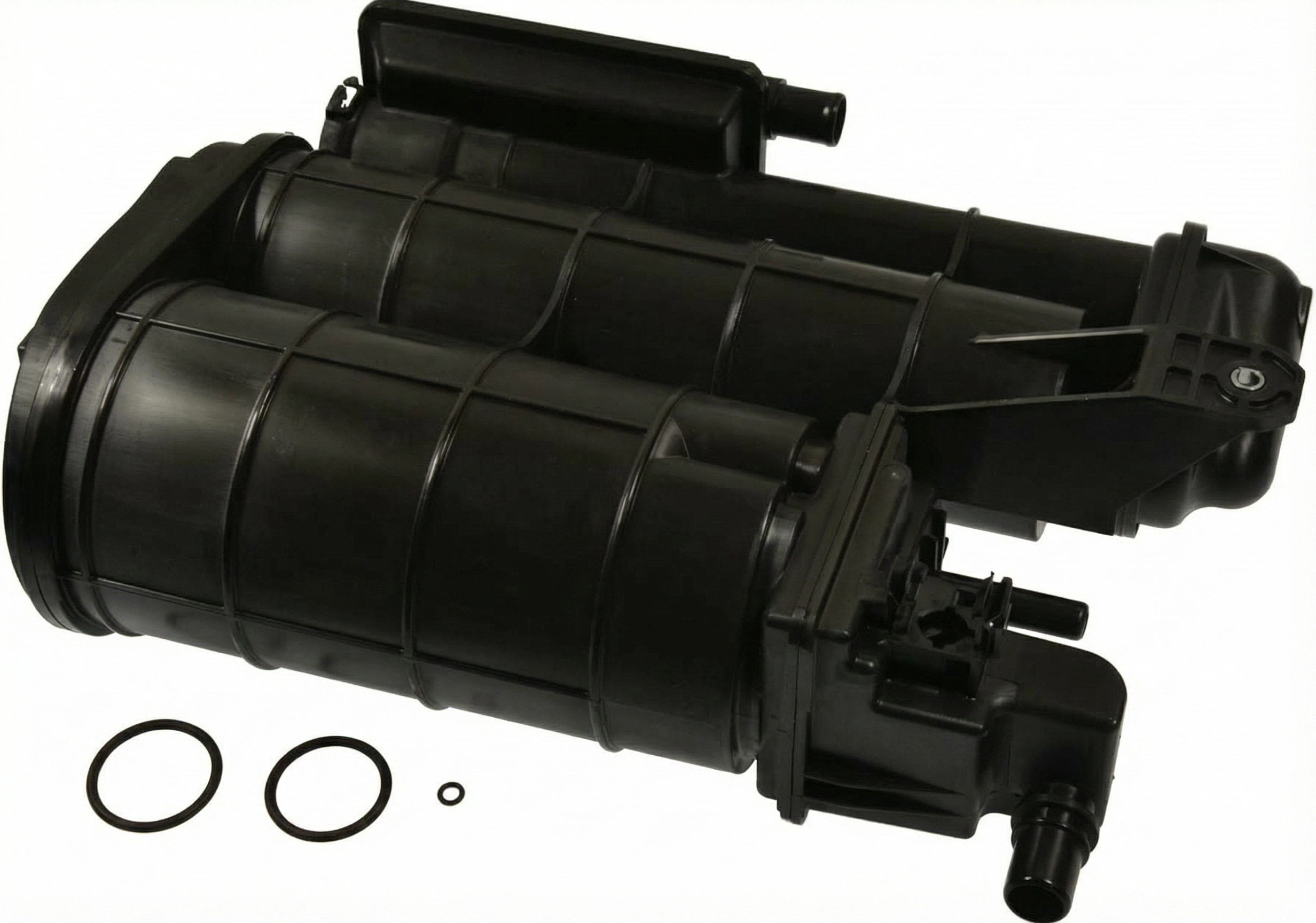
- Cracked Charcoal Canister: Physical damage to the plastic housing of the charcoal canister can cause a leak. This is usually the result of an impact or road debris. It's important to differentiate between Hybrid and Energi models as their canisters are not interchangeable.
- Faulty Fuel Tank Pressure Sensor: This sensor reports the pressure within the EVAP system to the PCM. If the sensor provides incorrect data, it can trick the computer into thinking there is a leak when there isn't one.
Diagnosis Steps

- Inspect the capless fuel filler neck for debris. Use the vehicle's emergency funnel to work the flap open and closed, then clean the sealing surface with a cloth and a light lubricant like WD-40. Clear the code and drive for a few days to see if it returns.
- If the code returns, locate the canister purge valve in the engine bay. Visually inspect its connected hoses for obvious cracks or disconnection.
- Test the canister purge valve. Disconnect the electrical connector and hoses. Try to blow air through the valve. If air passes, the valve is faulty and must be replaced. This is the most likely failure point according to Ford's TSB.
- If the purge valve is good and the fuel filler neck is clean, perform a thorough visual inspection of all other accessible EVAP hoses running from the engine to the fuel tank.
- If no visible leaks are found, the most reliable way to find the source of the small leak is to have a professional smoke test performed. This involves injecting vaporized smoke into the EVAP system and looking for where it escapes. 🎬 Watch: Professional diagnostic tips for finding small EVAP leaks. Ensure the technician tests the entire system, including the vent valve function.
Parts You'll Likely Need

- Canister Purge Valve
(OEM #AU5Z-9C915-E (replaces AU5Z-9C915-D))— This is the most common failure part for code P0456 on this vehicle, as identified by Ford in TSB 19-2207. The part number AU5Z-9C915-D was superseded by AU5Z-9C915-E. The service part number may be labeled CX-2695.
Trusted brands: Motorcraft, Dorman
OEM price range: $40-$60
Aftermarket price range: $25-$45 - Fuel Filler Neck
(OEM #FV6Z-9034-D (for Hybrid, non-plug-in))— If the seal on the capless fuel filler system is damaged and cannot be fixed by cleaning, the entire assembly may need replacement to ensure a proper seal. This part number fits 2013-2015 Hybrid models.
Trusted brands: Motorcraft
OEM price range: $150-$230
Aftermarket price range: $100-$150
Related Codes That Often Appear With This One
- P1450 — Stands for 'Unable to Bleed Up Fuel Tank Vacuum'. This code is frequently seen with P0456 and is also listed in TSB 19-2207 as being caused by the same faulty purge valve.
- P0457 — 'Evaporative Emission System Leak Detected (Fuel Cap Loose/Off)'. This code can also be triggered by the faulty purge valve or a bad seal on the capless filler neck.
- P04EE — This is another EVAP system code that is specifically mentioned in TSB 19-2207 alongside P0456, pointing towards the purge valve.
- P04EF — Also mentioned in TSB 19-2207, indicating a fault within the EVAP system, often related to the purge valve.
Technical Service Bulletins (TSBs) & Recalls
- TSB 19-2207: Addresses an illuminated MIL with DTCs P1450, P0456, P0457, P04EE, and/or P04EF due to a faulty canister purge valve on 2013-2017 C-Max, Fusion Hybrid/Energi, and MKZ Hybrid. The fix requires replacing the valve and reprogramming the PCM.
Platform-Specific Known Issues
- TSB 19-2207: Ford identified that the canister purge valve's sealing capability can degrade, causing P0456 and other related EVAP codes (P1450, P0457, P04EE, P04EF). The official repair is to replace the valve (Part No. AU5Z-9C915-D, now AU5Z-9C915-E) and update the PCM software.
Mechanic-Grade Diagnostic Values
- Fuel Tank Pressure (FTP) Sensor Reference Voltage — expected: ~5.0 Volts DC. Failure: Significantly lower or no voltage indicates a wiring or PCM issue.
- Fuel Tank Pressure (FTP) Sensor Signal Voltage (Key On, Engine Off, atmospheric pressure) — expected: ~2.5 Volts DC. Failure: Voltage stuck high (near 5V) or low (near 0V), or not changing when vacuum is applied.
- EVAP System Test Target Vacuum — expected: Approximately -8.0 in. H2O. Failure: Failure to achieve this target vacuum during the PCM's self-test indicates a large leak (P0455), while slow decay from this vacuum indicates a small leak (P0456).
Hidden / Shadow Codes Worth Checking
- Mode $06, Test ID $82 (example): Ford uses Mode $06 data to track the results of non-continuous monitor tests, including the EVAP leak test. A failing value for the 0.020" leak test (which triggers P0456) will be recorded here before a pending or permanent DTC is set. Technicians can view this data with an advanced scan tool to see if the system is on the verge of failing. (see via Advanced OBD-II scan tool capable of displaying Mode $06 data.)
Scan Tool Commands That Help
- Ford IDS (or equivalent advanced scanner like Thinkdiag): EVAP System Test — This is a comprehensive, PCM-initiated test that seals the system and checks for large and small leaks, providing a pass/fail result. It's the dealer-level method to verify a repair is successful without waiting for a full drive cycle.
- Ford IDS (or equivalent advanced scanner like Thinkdiag): Actuation Test: Canister Purge Valve Duty Cycle — This bidirectional command allows a technician to manually open and close the purge valve by a set percentage while the engine is off. It is used to confirm if the solenoid is mechanically functioning (clicking) and to seal the system for a smoke or vacuum test.
Wiring & Ground Locations
- Powertrain Control Module (PCM) — Front of the left front wheelwell.. The PCM controls and monitors the entire EVAP system, including the purge valve and FTP sensor. All related wiring terminates here.
- G105 — Left side of the engine compartment.. This is a key ground point for engine-area components. A poor connection here could potentially affect the operation of the canister purge valve or other sensors.
- G104 — Rear of the transmission.. A chassis ground point that could be part of the circuit for rear-mounted EVAP components.
Real Owner Repair Stories
- Reddit user in r/cmaxhybrid (2015 Ford C-MAX Energi) — Recurring P0456 code.
❌ Tried (didn't work) Clearing the code., Cleaning the capless fuel filler seal.
✅ What actually fixed it Replaced the canister purge valve (Motorcraft part CX-2695). - YouTube video on a 2016 Ford Fusion (platform mate) (2016 Ford Fusion) — Check Engine Light with confirmed, pending, and permanent P0456 codes.
❌ Tried (didn't work) Inspecting the capless fuel filler neck, which was found to be sealing correctly.
✅ What actually fixed it Tested the canister purge valve with a hand vacuum pump and found it would not hold vacuum. Replacing the valve fixed the issue. A teardown of the old part revealed corrosion on the internal plunger causing it to stick open. - YouTube video on a 2014 Ford Explorer (similar EVAP design) (2014 Ford Explorer) — P0456 code.
❌ Tried (didn't work) Inspecting the gas cap fill area, which was clean.
✅ What actually fixed it The owner found the original purge valve was leaking internally due to dirt. He disassembled the valve, cleaned the internal components, and sealed it back together with JB Weld. He noted that a cheap aftermarket replacement part failed after only 6 months, and he reinstalled his repaired OEM valve.
"I Checked Everything" — The Actual Cause
- A smoke test may show no leaks, but the P0456 code can still be caused by a faulty canister purge valve. If the valve is stuck slightly open, it will leak vacuum internally into the engine's intake manifold. The PCM detects this as a leak because the system cannot hold vacuum, but a smoke test may not show any smoke escaping to the atmosphere, leading to a misdiagnosis.
When the Usual Fixes Don't Work
- While the canister purge valve is the most common cause, multiple owners have fixed their P0456 code only after addressing other issues. One owner on a Ford C-MAX forum fixed the code by replacing a cracked EVAP hose that was not immediately obvious. Another resolved the issue by thoroughly cleaning the capless fuel filler mechanism with a solvent and cycling it multiple times with the emergency funnel after a simple wipe-down failed to work, indicating that stubborn debris can be the sole cause.
OEM Part Supersession History
AU5Z-9C915-A, AU5Z-9C915-B, AU5Z-9C915-C, AU5Z-9C915-D→AU5Z-9C915-E— Component revision and improvement to address sealing capability issues outlined in TSB 19-2207.
Heads up: The service part number is often labeled CX-2695. All previous versions are replaced by AU5Z-9C915-E.
Model Year Variations Within This Range
- 2013-2017: The vapor canister (charcoal canister) is different between the standard C-MAX Hybrid and the C-MAX Energi (Plug-in Hybrid) models and they are not interchangeable. The standard Hybrid uses part number FV6Z-9D653-K, while the Energi uses a different part. Ordering the wrong one will lead to fitment issues and continued EVAP problems.
Helpful Videos
Used OEM Parts in Stock
New Aftermarket Parts Available


The information in this article is provided for general reference and educational purposes only. Vehicle specifications, procedures, and part compatibility can vary by production date, trim level, and region. Always consult your vehicle's factory service manual and verify part numbers before purchasing or performing repairs. Safety-critical components such as airbags, seat belts, and braking systems should be installed by a qualified professional.
- Ford C-MAX:
- 🎬 Helpful Videos
- 🛍️ Shop This Part
- What's Unique About the 2013-2017 Ford C-MAX
- Diagnostic Flowchart
- Symptoms You May Notice
- Most Likely Causes
- Rare But Worth Checking
- Diagnosis Steps
- Parts You'll Likely Need
- Related Codes That Often Appear With This One
- Technical Service Bulletins (TSBs) & Recalls
- Platform-Specific Known Issues
- Mechanic-Grade Diagnostic Values
- Hidden / Shadow Codes Worth Checking
- Scan Tool Commands That Help
- Wiring & Ground Locations
- Real Owner Repair Stories
- "I Checked Everything" — The Actual Cause
- When the Usual Fixes Don't Work
- OEM Part Supersession History
- Model Year Variations Within This Range
- 🎟️ Get 5% Off