

P0455 on 2010-2014 GMC Yukon Denali: EVAP Large Leak Causes and Fixes
P0455 on a 2010-2014 Yukon Denali indicates a large leak in the EVAP system. The most common causes are a loose or faulty gas cap, a faulty EVAP purge valve on the engine, or a bad EVAP vent solenoid near the spare tire. Start by checking the gas cap, then inspect the purge and vent valves. A smoke test is the best way to find less obvious leaks.
- P0455 signifies a large leak in the EVAP emissions system.
- Always check the gas cap first; it's the most common and cheapest fix.
- The next most likely culprits are the purge valve (on the engine) and the vent solenoid (by the spare tire).
- If you smell fuel, pay close attention to the fuel filler neck area for cracks, as noted in a GM service bulletin.
- The vehicle is safe to drive, but the issue should be fixed to pass emissions testing and reduce pollution.
What's Unique About the 2010-2014 Gmc YUKON DENALI

For the third-generation (2007-2014) GMC Yukon Denali and its platform mates (Tahoe, Escalade), the P0455 code is frequently traced to one of three main components: the gas cap, the engine-mounted purge valve, or the vent solenoid located near the spare tire. While these are common EVAP failure points on many vehicles, GM issued a Technical Service Bulletin (TSB #15-NA-019) specifically for these trucks regarding a fractured fuel filler neck vent hose connector, which can also cause this code along with a strong fuel odor. This makes a visual inspection of the filler neck area particularly important on this platform.
Diagnostic Flowchart
Tap your situation to follow the diagnostic path that matches what you're seeing on this vehicle.
Symptoms You May Notice
- Check Engine Light is on
- A noticeable smell of gasoline, especially after refueling, when idling, or around the vehicle.
- A "Tighten Gas Cap" message may appear on the driver information center.
- Difficulty filling the fuel tank, with the pump clicking off repeatedly (if the vent path is blocked).
- Replacing the charcoal canister when the vent solenoid is the actual problem. The vent solenoid is often attached to the canister but can usually be replaced separately.
- Immediately assuming a major, hard-to-find leak when the issue is just a loose or faulty gas cap.
- Replacing EVAP components without performing a smoke test, which can quickly pinpoint the exact location of a physical leak in a hose or at a connection.
Most Likely Causes

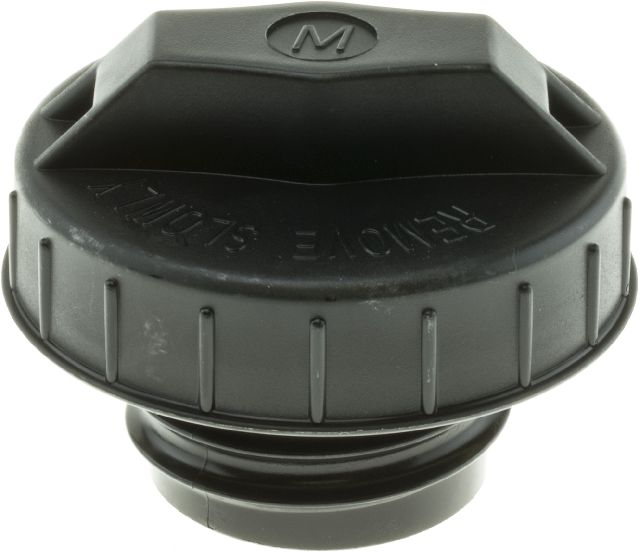
- Loose or Faulty Gas Cap 🔴 High Probability This is the most common cause for any P0455 code. The cap's seal can wear out, crack, or get dirty over time, or it may simply not have been tightened correctly after refueling.
How to confirm: Ensure the gas cap is tightened until it clicks at least three times. Inspect the rubber O-ring on the cap for cracks, dirt, or signs of wear. If you hear a whoosh of pressure when removing the cap, the seal is likely good.
Typical fix: Clean the cap and filler neck sealing surfaces. If the seal is damaged, replace the gas cap with a quality OEM part to ensure a proper seal.
Est. part cost: $15-$40 - Faulty EVAP Purge Valve Solenoid 🟡 Medium Probability The purge valve, located on the intake manifold of the engine, can get stuck open, creating a constant vacuum leak that the ECM interprets as a large system leak.
How to confirm: With the engine running, disconnect the electrical connector and the EVAP line from the valve. Place your finger over the port on the valve; if you feel suction, the valve is stuck open and needs to be replaced. A properly functioning purge valve should be closed (no suction) when no power is applied.
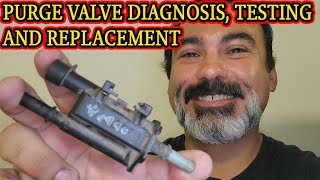
Typical fix: Replace the purge valve solenoid. It is held on by a small 8mm bolt and is easily accessible after removing the plastic engine cover. 🎬 Watch: How to test and replace the purge valve solenoid.
Est. part cost: $25-$60 - Faulty EVAP Vent Solenoid/Valve 🟡 Medium Probability This valve, located near the charcoal canister and spare tire, is normally open and closes to seal the system for testing. Its location makes it highly susceptible to getting clogged with dirt and dust, causing it to get stuck open and preventing the system from sealing.
How to confirm: Remove the valve and apply 12 volts to its terminals. A healthy valve will make an audible click as it closes. If it doesn't click, or if shaking it releases a lot of dust, it has failed. A smoke test will show smoke exiting this valve if it's stuck open.
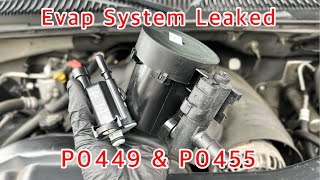
Typical fix: Replace the vent solenoid. Accessing it requires lowering the spare tire. 🎬 See this walkthrough for replacing the vent and purge valves. Many owners opt for an updated GM part (ACDelco #214-2324 / GM #25932571) that includes a relocation kit for the filter to move it to a cleaner, less exposed location.
Est. part cost: $30-$75 - Cracked Fuel Tank Filler Vent Hose Connector ⚪ Low Probability As identified in TSB #15-NA-019, the filler neck's plastic recirculation line connector can become brittle and fracture, causing a fuel odor and a P0455 or P0442 code.
How to confirm: Visually inspect the fuel filler neck and its associated hoses, particularly the smaller vent hose connector, for cracks or damage. This may require raising the vehicle for a clear view.
Typical fix: If the connector is found to be fractured, the entire fuel tank filler vent hose assembly must be replaced. The part number for the Yukon/Tahoe is specified in the TSB.
Est. part cost: $50-$100
Rare But Worth Checking
- Cracked or Damaged EVAP Hoses: Over time, the rubber and plastic hoses that connect the EVAP system components can become brittle and crack, creating a leak. A thorough visual inspection or a smoke test is the most effective way to find such leaks.
- Damaged Charcoal Canister: The charcoal canister itself can develop cracks from road debris impacts. More rarely, it can become saturated with fuel from overfilling the gas tank, causing blockages.
- Leaking Fuel Tank Gasket: The gasket for the fuel pump module on top of the fuel tank can fail, causing a large leak that will trigger P0455. This is often accompanied by a strong fuel smell and may be more noticeable with a full tank of gas.
- Cracked PCV Vacuum Hose/Elbow: A cracked vacuum line on the engine, such as the elbow for the PCV valve, can create a significant vacuum leak. While not part of the EVAP system, the ECM can misinterpret this as an EVAP gross leak during the test cycle. This was confirmed by an owner on a forum who found the fix after a smoke test.
Diagnosis Steps

- Check for a "Tighten Gas Cap" message on the dash.
- Inspect the gas cap for damage and ensure it is tightened properly (at least 3 clicks). Clean the seal and filler neck. Clear the code and drive for a few days to see if it returns.
- If the code returns, locate the EVAP purge valve on the driver's side of the engine's intake manifold. With the engine running, disconnect the valve's electrical connector and the line coming from the canister. Place your finger over the valve's port. If suction is present, the valve is stuck open and must be replaced.
- If the purge valve is good, raise the vehicle and lower the spare tire to access the EVAP vent solenoid, which is mounted near the charcoal canister.
- Visually inspect the vent solenoid and surrounding hoses for cracks or damage. Check for heavy dirt/dust accumulation, a common sign of failure.
- Test the vent solenoid by applying 12V power and ground to its terminals. It should click closed. If it doesn't, or if it's visibly clogged with debris, it's faulty.
- While under the vehicle, inspect the fuel filler neck and its smaller vent hose for any visible cracks, as noted in TSB #15-NA-019.
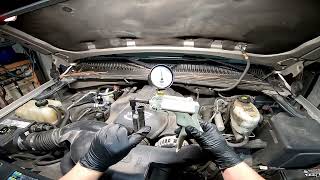
- If no obvious faults are found, perform a smoke test. This involves introducing smoke into the system via the purge line service port (often a green cap near the purge valve) and looking for where it escapes. This is the most effective way to find cracked hoses, leaking gaskets, or a faulty vent valve.
Parts You'll Likely Need

- Gas Cap
(OEM #ACDelco GT350)— This is the simplest and most frequent cause of a P0455 code due to a worn seal or improper tightening. Using an OEM cap is recommended to ensure a proper seal. - EVAP Vent Solenoid Valve (with optional relocation kit)
(OEM #ACDelco 214-2324 or GM 25932571)— The original valve is prone to clogging from road dust. The updated part includes a hose to relocate the filter to a cleaner location, which is a highly recommended upgrade for this platform. - EVAP Purge Valve Solenoid
(OEM #ACDelco 214-1680)— This valve, located on the engine, can get stuck open or closed, causing the system to fail its leak test.
Related Codes That Often Appear With This One
- P0442 — This code indicates a small EVAP leak. It can appear alongside P0455 if the leak size is borderline or if multiple leaks are present. TSB #15-NA-019 and #21-NA-124 both mention P0442 and P0455 occurring for the same reasons.
- P0449 — This code specifically points to a malfunction in the EVAP Vent Solenoid Control Circuit. If you have P0455 and P0449 together, it strongly suggests the vent solenoid or its wiring is the root cause.
- P0496 — This code indicates 'EVAP Flow During a Non-Purge Condition,' which almost always points to a purge valve that is stuck open. If the purge valve is stuck open, it will also cause the system to fail the large leak test, triggering P0455.
Technical Service Bulletins (TSBs) & Recalls
- 15-NA-019 — Fuel Odor During Fuel Filling or During Idle, Possible P0442 or P0455 DTCs Set — This TSB identifies a fractured gasoline filler neck recirculation line connector as a potential cause for P0455 and/or P0442 codes, often accompanied by a fuel smell. It instructs technicians to inspect the connector and replace the fuel tank filler vent hose assembly if it is damaged. (2015-12-01)
- 21-NA-124 — Diagnostic Tip/Steps on Testing for Possible EVAP Leaks — A general diagnostic bulletin providing tips for technicians on how to properly test the EVAP system for leaks that could cause P0442 or P0455, reinforcing standard diagnostic procedures like smoke testing. (2022-12-14)
Platform-Specific Known Issues
- TSB #15-NA-019 points to a potential fracture in the fuel tank filler vent hose connector (Part #22802074 for Yukon/Tahoe), causing a P0455 code and a fuel odor.
- The placement of the EVAP vent solenoid above the rear axle area makes it extremely prone to contamination from road dust and dirt, leading to premature failure.
Mechanic-Grade Diagnostic Values
- Fuel Tank Pressure (FTP) Sensor Voltage — expected: ~1.4-1.5 Volts with key on, engine off, and gas cap removed (system at atmospheric pressure).. Failure: A reading of 0V or 5V indicates a faulty sensor or a wiring issue. A reading that does not change when the system is sealed and a vacuum is applied indicates a sensor failure or a massive leak.
- EVAP Vent Solenoid Coil Resistance — expected: 14 - 30 Ohms. Failure: A reading outside this range indicates a failed solenoid coil.
Scan Tool Commands That Help
- GM Tech2 / GDS2 or equivalent professional scanner: EVAP Service Bay Test — This is an automated test that runs the entire EVAP leak test sequence on demand, sealing the system and monitoring pressure drop, providing a pass/fail result without needing to wait for a drive cycle.
- GM Tech2 / GDS2 or equivalent professional scanner: EVAP Purge/Seal — This command manually closes the vent solenoid and allows the technician to incrementally open the purge solenoid (e.g., 0% to 100%) while watching the Fuel Tank Pressure sensor data to see if the system builds and holds a vacuum.
- GM Tech2 / GDS2 or equivalent professional scanner: Vent Solenoid Command (On/Off or Open/Close) — Used to directly test the function of the vent solenoid. A technician can command it closed and listen for the click or use a smoke machine to confirm it has sealed the system.
Wiring & Ground Locations
- G401 — On the left rear body mount/frame rail, near the rear of the vehicle.. This is a primary ground point for the rear chassis harness, which includes the wiring for the EVAP vent solenoid and the fuel tank pressure sensor. Corrosion or a loose connection at G401 can cause intermittent or total failure of these components, leading to P0455 or other EVAP codes.
- Underhood Fuse Block — On the driver's side of the engine bay.. The EVAP system components receive power from fuses in this block. Specifically, fuses #4 (15A) and #5 have been identified as being related to the EVAP system on these trucks. A blown fuse will cause a component to be inoperative.
- G103 — On the front of the passenger side cylinder head.. This ground point serves multiple engine sensors. While not the primary ground for the EVAP system, poor engine grounds can cause a variety of unpredictable electrical issues and codes. Checking major engine and body grounds is a good practice for hard-to-diagnose electrical faults.
Real Owner Repair Stories
- Forum user on gm-trucks.com (2008 Chevy Silverado (GMT900 platform)) — Persistent P0455 code.
❌ Tried (didn't work) Replaced gas cap, Replaced EVAP vent solenoid, Performed a smoke test which showed no leaks
✅ What actually fixed it The Fuel Tank Pressure (FTP) sensor was faulty. Even though the system had no physical leak, the sensor was not reporting pressure changes correctly to the ECM, causing the leak test to fail. Replacing the FTP sensor resolved the code. - Forum user on tahoeyukonforum.com (2005 Tahoe (similar PCV system design)) — P0455 code and "tighten gas cap" message.
❌ Tried (didn't work) Inspecting common EVAP components like filler neck, gas cap, and solenoids.
✅ What actually fixed it A smoke test revealed no leaks in the EVAP system itself. The actual cause was a cracked and leaking vacuum elbow for the PCV valve on the engine's intake. This large vacuum leak was being misinterpreted by the ECM as an EVAP system leak during the diagnostic cycle. Replacing the cracked rubber PCV hose elbow fixed the P0455 code.
"I Checked Everything" — The Actual Cause
- A known case involved a persistent P0455 where a smoke test repeatedly came back clean. The root cause was a faulty Fuel Tank Pressure (FTP) sensor. The system was perfectly sealed, but the sensor failed to report the vacuum being pulled by the purge valve, leading the ECM to incorrectly conclude there was a massive leak.
- In another instance, a smoke test passed, but the code was eventually traced to a cracked PCV vacuum hose elbow on the intake manifold. The unmetered air from this significant vacuum leak was confusing the engine computer during the EVAP self-test, causing it to flag a P0455 even though the fuel vapor system itself was not leaking.
OEM Part Supersession History
ACDelco 214-2149 (or GM 10382105)→ACDelco 214-2324 (or GM 25932571)— The original EVAP Vent Solenoid design had a filter that was integral to the valve body and located near the spare tire, making it highly susceptible to clogging with road dust and dirt. The superseded part is a kit that includes a new valve, a long rubber hose, and a separate filter box.
Heads up: The new kit's purpose is to relocate the filter to a cleaner location, such as higher up in the frame rail or near the fuel filler neck, to prevent future clogging. It is a direct-fit replacement and highly recommended over replacing with the original design.
Helpful Videos
Used OEM Parts in Stock

New Aftermarket Parts Available


The information in this article is provided for general reference and educational purposes only. Vehicle specifications, procedures, and part compatibility can vary by production date, trim level, and region. Always consult your vehicle's factory service manual and verify part numbers before purchasing or performing repairs. Safety-critical components such as airbags, seat belts, and braking systems should be installed by a qualified professional.
- Gmc YUKON DENALI:
- 🎬 Helpful Videos
- 🛍️ Shop This Part
- What's Unique About the 2010-2014 Gmc YUKON DENALI
- Diagnostic Flowchart
- Symptoms You May Notice
- Most Likely Causes
- Rare But Worth Checking
- Diagnosis Steps
- Parts You'll Likely Need
- Related Codes That Often Appear With This One
- Technical Service Bulletins (TSBs) & Recalls
- Platform-Specific Known Issues
- Mechanic-Grade Diagnostic Values
- Scan Tool Commands That Help
- Wiring & Ground Locations
- Real Owner Repair Stories
- "I Checked Everything" — The Actual Cause
- OEM Part Supersession History
- 🎟️ Get 5% Off