

P0455 on 2017-2021 Ford Escape: EVAP Gross Leak Causes and Fixes
For a 2017-2021 Ford Escape, P0455 most often means the canister purge valve has failed or there's a problem with the capless fuel filler inlet. Check the fuel inlet for debris first, but expect to replace the purge valve assembly. A DIY replacement costs around $100-$180. Always check for applicable TSBs for your specific model year, as a software update may be the required fix.
- P0455 indicates a large leak in the EVAP (fuel vapor) system.
- Always check the capless fuel filler inlet for debris first; it's a free and easy check.
- The most common part to fail is the canister purge valve, but Ford warns against replacing it without performing a proper leak test.
- The cause can differ by model year; 2017 models are prone to loose hoses, while 2020 models have specific TSBs for canister damage and software updates.
- A smoke test is the most definitive way to locate a leak if a visual inspection doesn't reveal the cause.
What's Unique About the 2017-2021 Ford ESCAPE

The 2017-2021 Ford Escape spans two different generations (3rd gen: 2017-2019; 4th gen: 2020-2021), and Ford has issued multiple Technical Service Bulletins (TSBs) for P0455 across this range. Issues vary from loose hoses on early models to potential canister damage and software calibration problems on later ones. This means the cause of P0455 on a 2017 Escape can be different from that on a 2020 model, making a careful diagnosis important. The issue is also common on platform mates like the Lincoln MKC and Corsair. [TSB #SSM 46525, TSB #SSM 49313]
Diagnostic Flowchart

Tap your situation to follow the diagnostic path that matches what you're seeing on this vehicle.
Generation note: This range covers the end of the 3rd generation (2017-2019) and the beginning of the 4th generation (2020-2021). The EVAP system components, particularly the purge valve and associated hoses, differ between these generations, and some TSBs are specific to certain model years. The 3rd gen shares its platform with the Lincoln MKC, while the 4th gen shares its platform with the Lincoln Corsair and Ford Bronco Sport, all of which can experience similar P0455 issues. The 2020 model year marked a complete redesign with a new chassis, different engine options, and updated interior/exterior styling.
Symptoms You May Notice

- Check Engine Light is on
- A 'Check Fuel Fill Inlet' message may appear on the dashboard.
- Slightly rough idle, especially after refueling. [TSB #SSM 46525]
- Difficulty starting the engine right after getting gas.
- Noticeable fuel smell near the vehicle.
- Slow fuel fill concern. [TSB #SSM 46525]
- For some 2020 models, the fuel gauge may not read full after refueling. [TSB #TSB 21-2020]
- Audible hissing or sucking sound from the engine bay if the purge valve is stuck open.
- Replacing the EVAP canister purge valve without proper diagnosis. TSB SSM 50306 warns that Ford has tested many returned purge valves and found them to be fully functional, suggesting other system leaks were the actual problem. A full EVAP system leak test (smoke test) is recommended before replacement. [TSB #SSM 50306]
Most Likely Causes

- Faulty Canister Purge Valve 🔴 High Probability This is a very common failure point on many Ford vehicles, including the Escape. The valve can get stuck open or closed, or fail to operate correctly. Forum users frequently report this as the fix for P0455.
How to confirm: With the engine off and electrical connector unplugged, the valve should be closed and hold a vacuum (no air should pass through). You can test this by trying to blow through it; if air passes, it's bad. A handheld vacuum pump can also be used to test it. A scan tool can command the valve to open and close to check for response. A stuck-open valve may cause a hissing sound from the engine bay.
Typical fix: Replacement of the canister purge valve. On many Escapes, the valve is sold as an assembly with molded hoses.
Est. part cost: $80-$180 - Debris in Capless Fuel Filler Inlet or Failed Filler Neck 🟡 Medium Probability The capless system can allow dirt or debris to get lodged in the seal, preventing it from closing properly and creating a large leak. In some cases, the internal spring mechanism of the filler neck itself fails, requiring replacement of the entire assembly.
How to confirm: Visually inspect the fuel filler opening for any dirt, rust, or obstructions around the spring-loaded flap. Ensure the flap moves freely and seals completely.
Typical fix: Clean the fuel filler inlet carefully with a clean rag and the special funnel that came with the vehicle to dislodge debris. If cleaning does not resolve the issue 🎬 See how to clean the capless fuel inlet yourself or the seal is damaged, the entire fuel filler neck assembly must be replaced.
Est. part cost: $0 for cleaning, $80-$200 for a replacement filler neck assembly. - Loose or Cracked EVAP Hose 🟡 Medium Probability TSB 16-0132 specifically calls out a disconnected or loose EVAP hose under the vehicle for 2017 models. Hoses can also become brittle and crack over time due to heat and age.
How to confirm: Visually inspect all accessible EVAP lines from the engine bay to the charcoal canister near the fuel tank. A smoke test is the most effective way to find a leak that isn't obvious.
Typical fix: Reconnect any loose hoses or replace cracked sections of tubing.
Est. part cost: $10-$50 - Faulty EVAP Canister Vent Solenoid ⚪ Low Probability The vent solenoid, usually located near the charcoal canister, can get stuck open, preventing the system from sealing for its pressure test.
How to confirm: A scan tool can command the valve to close. When closed, it should seal the system. It can also be removed and tested for proper operation with applied voltage; it should click when power is applied.
Typical fix: Replace the vent solenoid.
Est. part cost: $40-$90
Rare But Worth Checking
- Damaged Carbon Canister: For 2020 models, TSB SSM 49313 notes that the carbon canister may have been damaged during vehicle transportation, leading to EVAP leak codes P0442, P0455, and P0456.
- Powertrain Control Module (PCM) Calibration: For some 2020 models built before March 20, 2020, TSB 21-2020 states that a PCM software update is required to fix an issue causing P0455 and an inaccurate fuel gauge.
- Chafed Wiring to Fuel Tank Pressure Sensor: In at least one documented case on a 2017 Escape, the wiring harness to the fuel tank pressure sensor chafed against the transmission, causing an open circuit and triggering a P0455 code.
- Spider Nests in EVAP Vent Hose: Some species of spiders are attracted to the smell of gasoline vapors and can build nests inside the EVAP canister vent hose. This blockage can prevent the system from venting properly, leading to various EVAP codes, including P0455, and can also cause slow-filling issues at the gas pump.
Diagnosis Steps

- Read the code with an OBD-II scanner and check for any other related codes.
- Inspect the capless fuel filler inlet. Use the white plastic funnel that came with the vehicle to open the flap and inspect for debris, dirt, or damage to the seal. Clean thoroughly.
- Clear the code, drive the vehicle for a few days, and see if the code returns. If it doesn't, the issue was likely the fuel inlet seal.
- If the code returns, perform a thorough visual inspection of all EVAP hoses and lines, especially under the vehicle near the fuel tank as per TSB 16-0132 for 2017 models.
- Locate the canister purge valve in the engine bay. With the engine off, disconnect the hose leading to the intake manifold and check if it holds vacuum with a handheld pump. If it doesn't, it's stuck open and needs replacement.
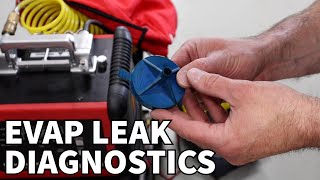
- If the purge valve seems okay, the next step is to perform a smoke test. This involves feeding low-pressure smoke into the EVAP system 🎬 Watch: How to find leaks using a smoke machine and looking for where it escapes. This is the most reliable way to find cracks in hoses, the canister, or a bad seal. A professional smoke test typically costs between $100 and $200.
- If you have a 2020 model, check with a Ford dealer by VIN to see if TSB 21-2020 (PCM reflash) or SSM 49313 (canister inspection) applies to your vehicle.
Parts You'll Likely Need
- Vapor Canister Purge Valve / Solenoid
(OEM #GV6Z-9D289-E (for 2.0L/2.5L), F2GZ-9D289-A (for 1.5L/1.6L). Verify by VIN.)— This is the most frequent point of failure for P0455 on the Escape. It often gets stuck open or fails to operate correctly. The part number varies by engine and year.
Trusted brands: Motorcraft, Dorman
OEM price range: $120-$180
Aftermarket price range: $80-$150 - Fuel Filler Neck / Housing — If the internal seal of the capless system fails, the entire neck assembly needs to be replaced to fix the leak. Cleaning will not fix a mechanically failed part.
Trusted brands: Genuine Ford, Dorman, SKP
OEM price range: $150-$250
Aftermarket price range: $70-$150 - EVAP Charcoal Canister
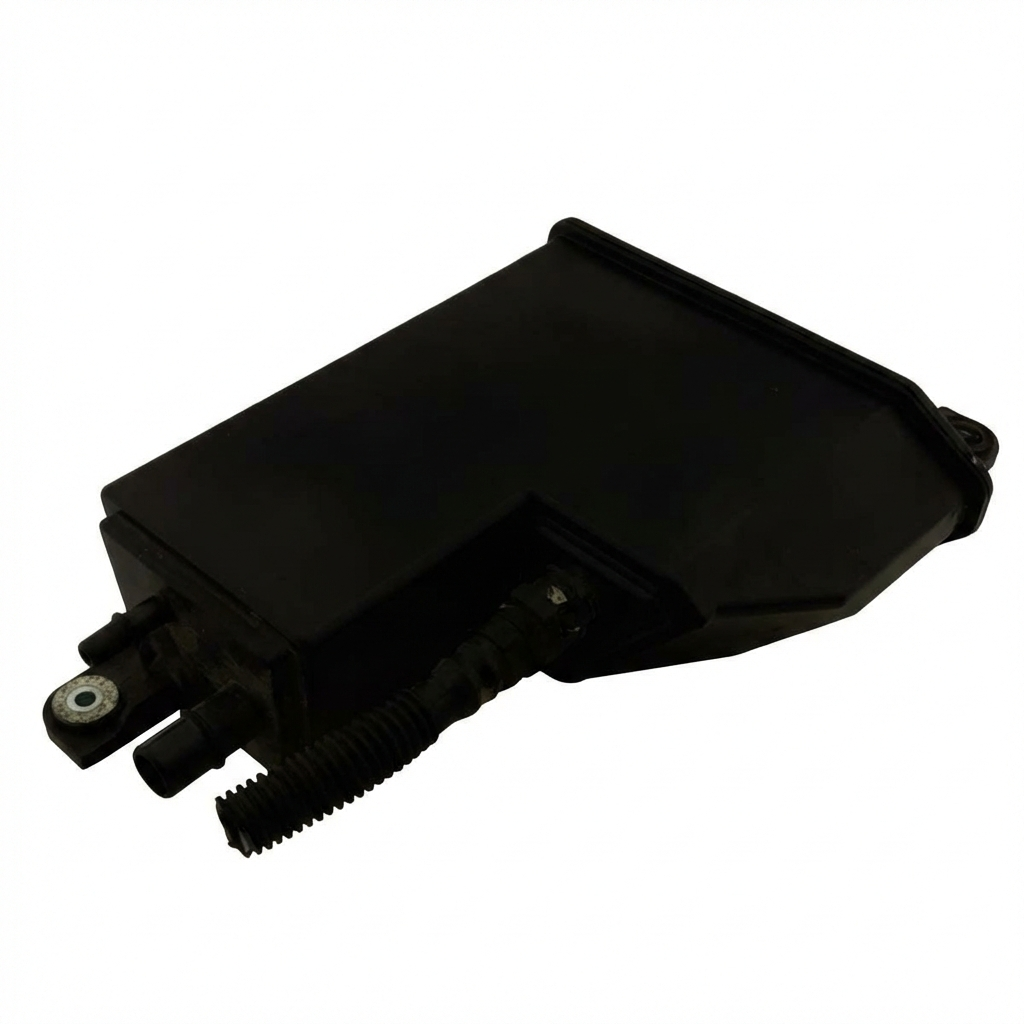
(OEM #LX6Z-9D653-F (for 2020+ models, verify by VIN))— Can crack or be damaged, causing a large leak. TSB SSM 49313 specifically mentions this as a possibility on 2020 models due to shipping damage.
Trusted brands: Motorcraft
OEM price range: $150-$250
Aftermarket price range: $100-$200
Related Codes That Often Appear With This One
- P0456 — Indicates a small EVAP leak. It can appear alongside P0455 if the system has multiple issues or the leak size is borderline. [TSB #SSM 50306]
- P144C — A Ford-specific code often related to the EVAP system check, particularly on 2017 models. [TSB #SSM 46525, TSB #TSB 16-0132]
- P1450 — Indicates an inability to bleed up fuel tank vacuum, often pointing to a restriction or a stuck valve in the EVAP system. [TSB #SSM 46525]
- P0496 — Indicates high purge flow, often caused by a purge valve that is stuck open. [TSB #SSM 50306]
- P0442 — Indicates a medium-sized EVAP leak. [TSB #SSM 49313]
Technical Service Bulletins (TSBs) & Recalls
- SSM 50306: EVAP codes P0496, P0456, P0455, P04F0, P0451 may not be caused by a faulty purge valve; proper diagnosis is required.
- SSM 46525: Notes P0455 can be accompanied by rough idle and slow fuel fill on 2017 models.
- TSB 21-2020: A PCM reflash may be needed for P0455 on certain 2020 models.
- TSB 16-0132: Points to a loose EVAP hose under the vehicle as a cause for P0455 on some 2017 models.
- SSM 49313: Suggests possible carbon canister damage on 2020 models.
Platform-Specific Known Issues
- TSB 16-0132: Some 2017 models with the 2.0L GTDI engine built before June 9, 2016, may have a disconnected or loose EVAP hose under the vehicle, directly causing a P0455.
- TSB SSM 46525: Some 2017 models (1.5L, 2.0L, 2.3L) may exhibit P0455 along with a rough idle and slow fuel fill concern, often pointing to a faulty purge valve.
- TSB SSM 49313: Some 2020 Escape/Corsair models may have a damaged carbon canister from vehicle transport, causing various EVAP leak codes.
Mechanic-Grade Diagnostic Values
- Fuel Tank Pressure (FTP) Sensor Voltage (Key On, Engine Off) — expected: 2.6V - 2.65V (at atmospheric pressure). Failure: A significant deviation from this range could indicate a biased sensor. A drop in voltage after starting the vehicle could indicate a purge valve stuck open.
- Canister Purge Valve/Solenoid Resistance — expected: 12 to 130 ohms (general range for many vehicles). Failure: A reading outside the specified range for the specific part indicates a faulty internal coil.
- Canister Vent Valve/Solenoid Resistance — expected: 20 to 50 ohms (common range). Failure: A reading outside this range suggests the solenoid winding is damaged.
- EVAP System Test Target Vacuum (during PCM self-test) — expected: Approximately -8.0 in-H2O. Failure: If the system fails to achieve this target vacuum, the PCM will set a P0455 code.
Scan Tool Commands That Help
- Ford IDS (Integrated Diagnostic System): Manual EVAP System Test — Allows a technician to manually command the purge and vent solenoids to close and seal the system, then monitor the Fuel Tank Pressure (FTP) sensor to verify the system can hold pressure or pull a vacuum. This can be used to diagnose leaks even when the fuel tank level is outside the 15-85% range required for the automatic self-test.
- Ford IDS (or advanced bidirectional scanner): Vapor Management Valve (Purge Valve) Duty Cycle Command — Used to manually command the purge valve open by a certain percentage (e.g., 100%) while monitoring the FTP sensor. A slow drop in pressure when the valve is commanded fully open can indicate a partially clogged or failing purge valve, even if it's not completely stuck.
- Ford IDS (or advanced bidirectional scanner): Canister Vent (CV) Solenoid On/Off Command — Used to command the vent valve closed to seal the EVAP system. After closing it, a technician can watch the FTP sensor; pressure should rise slightly as fuel vaporizes in the sealed tank. If it doesn't, or if it doesn't hold pressure during a smoke test, the vent valve may be faulty.
Wiring & Ground Locations
- Fuel Tank Pressure (FTP) Transducer — On the EVAP emission canister assembly, located at the center rear of the vehicle.. This sensor is what the PCM uses to detect the pressure change that indicates a large leak. Faulty wiring or a bad connection to this sensor can mimic the symptoms of a leak.
- Fuel Pump Driver Module — Under the rear seat cushion, beneath the carpet, typically on the right (passenger) side for 2017+ models.. While not a direct cause of P0455, wiring to the fuel pump and its control module runs in the same general area as EVAP components. A wiring issue, such as a corroded connector on the driver module, can sometimes be related to other system faults in the vicinity.
- Fuse F35 (Battery Junction Box) — In the under-hood fuse box (Battery Junction Box).. On a 2017 1.5L model, this fuse supplies power to the EVAP Purge, Blocking, and Vent valves. A short in the circuit for any of these components could blow the fuse, disabling the system and potentially causing codes.
Real Owner Repair Stories
- YouTube channel South Main Auto Repair (Ford Escape (year not specified, but 4-cylinder engine)) — P0455 for gross leak / no flow.
❌ Tried (didn't work) Initial diagnosis pointed towards a large leak, but a bidirectional scan tool test revealed a different issue.
✅ What actually fixed it The canister purge valve was not opening fully when commanded by the scan tool, causing a 'no flow' condition that also triggers P0455. Even though it wasn't stuck open (a more common failure), its inability to open properly was the root cause. Replacing the purge valve resolved the code. - Reddit user in r/fordescape (2017 Ford Escape) — P0455 code.
❌ Tried (didn't work) Not specified.
✅ What actually fixed it The user confirmed the canister purge valve was stuck open and needed replacement. They described the simple test: disconnect the hose and electrical connector, start the car, and feel for vacuum suction at the valve's port. Since vacuum was present when it should have been closed, it confirmed the failure.
"I Checked Everything" — The Actual Cause
- In a documented repair on a Ford Escape with P0455, the code was for 'gross leak or no flow'. While a smoke test would typically be used to find a leak, the technician used a bidirectional scanner first. They commanded the purge valve to open 100% but observed that the fuel tank pressure dropped very slowly, indicating a flow restriction. The purge valve was not opening all the way, causing the 'no flow' condition. This is a case where a smoke test would have passed (as there was no leak), but the component was still faulty and causing the P0455 code.
OEM Part Supersession History
GV6Z-9D289-A→GV6Z-9D289-E— Part revision by manufacturer. The new part is the current service replacement.
Model Year Variations Within This Range
- 2017-2019 (3rd Generation): These models use a different chassis and have slightly different engine configurations and EVAP component layouts compared to the 2020+ models. TSBs like #SSM 46525 and #TSB 16-0132 are specific to this generation, pointing to issues like loose underbody hoses and specific purge valve problems. [TSB #SSM 46525, TSB #TSB 16-0132]
- 2020-2021 (4th Generation): This was a complete redesign. The vehicle is built on a new platform, is lighter, and has different styling. For the EVAP system, TSBs like #SSM 49313 and #TSB 21-2020 are specific to these years, indicating unique issues such as carbon canisters damaged during shipping and PCM calibration problems that weren't prevalent in the previous generation. [TSB #SSM 49313, TSB #TSB 21-2020]
Helpful Videos

Used OEM Parts in Stock
New Aftermarket Parts Available


The information in this article is provided for general reference and educational purposes only. Vehicle specifications, procedures, and part compatibility can vary by production date, trim level, and region. Always consult your vehicle's factory service manual and verify part numbers before purchasing or performing repairs. Safety-critical components such as airbags, seat belts, and braking systems should be installed by a qualified professional.
- Ford ESCAPE:
- 🎬 Helpful Videos
- 🛍️ Shop This Part
- What's Unique About the 2017-2021 Ford ESCAPE
- Diagnostic Flowchart
- Symptoms You May Notice
- Most Likely Causes
- Rare But Worth Checking
- Diagnosis Steps
- Parts You'll Likely Need
- Related Codes That Often Appear With This One
- Technical Service Bulletins (TSBs) & Recalls
- Platform-Specific Known Issues
- Mechanic-Grade Diagnostic Values
- Scan Tool Commands That Help
- Wiring & Ground Locations
- Real Owner Repair Stories
- "I Checked Everything" — The Actual Cause
- OEM Part Supersession History
- Model Year Variations Within This Range
- 🎟️ Get 5% Off