

P0455 on 2005-2007 Buick Rendezvous: EVAP Large Leak Causes and Fixes
For a 2005-2007 Buick Rendezvous, a P0455 code is most often caused by a loose or faulty gas cap. If tightening or replacing the cap doesn't fix it, the next most likely culprits are a failed EVAP vent solenoid near the fuel tank, a cracked EVAP purge valve in the engine bay, or a rusted fuel filler neck preventing a proper seal.
- P0455 indicates a large leak in the EVAP emissions system.
- Always start by checking the gas cap; it's the most common and cheapest fix.
- If the gas cap isn't the issue, the most likely culprits are the purge valve (in the engine bay) or the vent valve (near the fuel tank).
- While you can drive with this code, you will not pass an emissions test until it is resolved.
- A smoke test is the most effective diagnostic tool to pinpoint the exact location of the leak if it's not obvious.
What's Unique About the 2005-2007 Buick RENDEZVOUS
The Buick Rendezvous, like many GM vehicles from this era including its platform-mate the Pontiac Aztek, has common failure points in its EVAP system that lead to a P0455 code. The primary culprits are often the gas cap, the vent solenoid located near the fuel tank, and the purge valve in the engine bay. A manufacturer's technical service bulletin (TSB #21-NA-124) was issued for the 2005 model year to help technicians diagnose EVAP leaks related to codes P0455 and P0442, indicating this is a recognized issue on the platform.
Diagnostic Flowchart
Tap your situation to follow the diagnostic path that matches what you're seeing on this vehicle.
Symptoms You May Notice
- Check Engine Light is on
- A noticeable smell of fuel, especially around the rear of the vehicle or after parking.
- A loose, missing, or damaged gas cap.
- The vehicle will fail an emissions test.
- Slightly reduced fuel economy.
- Difficulty starting immediately after refueling, which can point to a stuck-open purge valve flooding the engine with vapors.
- Replacing the purge valve when the vent valve is the actual problem, or vice-versa. A proper diagnosis with a smoke test or by following the TSB-recommended diagnostic order can prevent replacing the wrong part.
- Replacing an EVAP solenoid when the actual fault is a small, cracked rubber hose connected to it. One owner on a GM forum found a split molded hose at the purge solenoid was the true cause.
Most Likely Causes
- Loose, Damaged, or Incorrect Gas Cap 🔴 High Probability The gas cap is the most frequently handled part of the EVAP system, and its seal can wear out, get lost, or simply not be tightened correctly after refueling. This is the most common cause of P0455 across all vehicles.
How to confirm: Inspect the gas cap for cracks or damage to the rubber seal. Ensure it is tightened until it clicks at least once. If the seal is worn or damaged, replacement is the best and cheapest first step.
Typical fix: Tighten or replace the gas cap.
Est. part cost: $10-$30 - Failed EVAP Vent Solenoid 🟡 Medium Probability This solenoid is located near the fuel tank, exposing it to road salt, water, and debris, which can cause corrosion and lead to failure. When it fails, it often gets stuck open, creating a large leak that the system detects.
How to confirm: The valve can be tested with a scan tool that can command it to close. A definitive diagnosis often requires a smoke test to see if smoke escapes from the valve when it should be sealed. You can also apply 12V directly to the solenoid terminals; a healthy solenoid will make an audible click.
Typical fix: Replace the EVAP vent solenoid. On the Rendezvous, this part is located near the fuel tank and may require lowering the tank for access.
Est. part cost: $25-$55 - Failed EVAP Purge Valve/Solenoid 🟡 Medium Probability This valve is a common failure item on many GM vehicles of this era. It can become stuck open due to age or contamination, creating a constant vacuum leak that the system detects as a large leak.
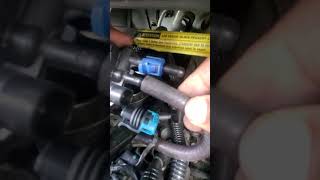
How to confirm: Remove the valve, which is located in the engine bay near the intake manifold. 🎬 Watch: This walkthrough shows you how to replace the purge valve. With the engine off and the valve disconnected electrically, try to blow through it. If air passes through, the valve is stuck open and needs to be replaced.
Typical fix: Replace the purge valve.
Est. part cost: $25-$105 - Rusted or Damaged Fuel Filler Neck ⚪ Low Probability The metal filler neck where the gas cap seals is prone to rust in regions with road salt. This corrosion creates an uneven surface that prevents a proper seal, even with a brand-new gas cap.
How to confirm: Remove the gas cap and carefully inspect the metal lip of the filler neck for rust, pitting, or deformities. A smoke test will show smoke billowing out from the gas cap area if the neck is the source of the leak.
Typical fix: Replace the fuel filler neck. This is a more involved repair but is a definitive fix for this issue.
Est. part cost: $60-$150 - Cracked or Disconnected EVAP Hoses ⚪ Low Probability Over time, the rubber and plastic hoses in the EVAP system can become brittle and crack, especially the lines connected to the purge valve or charcoal canister. A user on a GM forum reported solving their P0455 by replacing a small, cracked molded hose at the purge solenoid.
How to confirm: Visually inspect all accessible EVAP lines for obvious cracks or disconnections. A smoke test is the most effective way to find a leak in a hose.
Typical fix: Replace the damaged section of hose.
Est. part cost: $5-$50
Rare But Worth Checking
- Cracked Charcoal Canister: The charcoal canister itself can develop cracks, especially from road debris impact or age. This is less common than valve failures but will create a large leak. A smoke test is the best way to confirm a cracked canister.
Diagnosis Steps
- Check the gas cap. Ensure it is tight and clicks. Inspect the rubber O-ring for cracks or wear. If in doubt, it's an inexpensive first part to replace. This solves the problem in many cases.
- Clear the code with a scanner and drive the vehicle for a few days to see if the light returns. Sometimes the code is triggered by not tightening the cap properly after fueling.
- If the light returns, perform a visual inspection of the fuel filler neck for rust or damage where the cap seals.
- Visually inspect all accessible EVAP hoses in the engine bay, particularly around the purge solenoid, looking for obvious cracks or disconnections.
- Locate the purge solenoid on the intake manifold. Disconnect it electrically and try to blow through it. If air passes, it has failed and needs to be replaced.
- If the gas cap, filler neck, and purge valve are good, the leak is likely elsewhere. The most reliable method for finding the leak is to have a smoke test performed. This involves injecting pressurized smoke into the EVAP system and looking for where it escapes.
- During the smoke test, pay close attention to the EVAP vent solenoid (near the fuel tank), the charcoal canister, and the full length of all EVAP lines.
Parts You'll Likely Need
- Fuel Tank Cap (Gas Cap) — This is the most common cause of P0455 due to wear on the seal or improper tightening.
Trusted brands: ACDelco, Stant
OEM price range: $20-$35
Aftermarket price range: $10-$25 - Vapor Canister Purge Valve/Solenoid
(OEM #12592015 (Superseded by 12735400))— This valve is located in the engine bay and frequently fails by sticking open, causing a constant leak.
Trusted brands: ACDelco, Dorman, Standard Motor Products
OEM price range: $30-$60
Aftermarket price range: $25-$50 - Vapor Canister Vent Solenoid/Valve
(OEM #25932571 (ACDelco Professional PN: 214-2149))— Located near the fuel tank, this valve is exposed to the elements and can fail, getting stuck open.
Trusted brands: ACDelco, Dorman
OEM price range: $40-$60
Aftermarket price range: $25-$55 - Fuel Tank Filler Neck — Prone to rusting, which prevents the gas cap from creating a proper seal, leading to a persistent large leak code even with a new cap.
Trusted brands: Dorman, Spectra Premium
OEM price range: $100-$180
Aftermarket price range: $60-$150
Related Codes That Often Appear With This One
- P0442 — This code indicates a small EVAP leak. It can appear alongside P0455 if the system has multiple leaks of different sizes or if a leak is intermittent. TSB 21-NA-124 specifically addresses both P0442 and P0455.
- P0496 — This code indicates 'EVAP Flow During a Non-Purge Condition,' which almost always points directly to a purge valve that is stuck open. If the purge valve is stuck open, it can also be detected as a large leak, triggering P0455.
Technical Service Bulletins (TSBs) & Recalls
- 21-NA-124: Provides diagnostic tips for EVAP system leaks causing DTCs P0442 and/or P0455. It advises checking lines, then the vent valve, then the purge valve.
Platform-Specific Known Issues
- TSB Diagnostic Guidance: Per TSB #21-NA-124, GM has provided specific diagnostic advice for dealers regarding P0455 and P0442 codes. The recommended procedure is to first inspect all EVAP lines for proper installation and damage, then test the vent valve for being stuck open, and finally investigate the purge valve.
- Vent Solenoid Access: Accessing the EVAP vent solenoid on the Rendezvous can be difficult, sometimes requiring the fuel tank to be partially or fully lowered for replacement.
- Owner Repair Story: Cracked Hose: A Buick owner on GMForum.com solved their P0455 code by replacing a short, cracked molded hose connected to the purge solenoid.
Mechanic-Grade Diagnostic Values
- EVAP Purge & Vent Solenoid Resistance — expected: 15 to 30 Ohms across the two pins.. Failure: A reading of infinite resistance (OL) indicates an open coil, while a reading near zero indicates a shorted coil. Either requires replacement of the solenoid.
- Fuel Tank Pressure (FTP) Sensor Voltage — expected: Approximately 1.5 Volts with the key on, engine off, and the gas cap removed (system at atmospheric pressure).. Failure: A voltage stuck high (e.g., near 5.0V) or low (e.g., near 0.1V) regardless of actual pressure, or a voltage that does not change when a vacuum is applied during a system test, points to a faulty sensor or wiring issue.
- EVAP Vent Solenoid Control Wire Voltage — expected: Approximately 12V (battery voltage) with the key on, solenoid connected, and no command from the PCM. The PCM grounds this circuit to energize the solenoid (close the valve).. Failure: A reading of 0V when it should be 12V indicates an open circuit in the wiring between the PCM and the solenoid, or a faulty PCM driver.
Hidden / Shadow Codes Worth Checking
- Mode $06, Test ID $39: This is not a hidden code, but rather a specific data set within a standard OBD-II scan tool. It shows the raw test results from the onboard EVAP large leak monitor. It displays a test value and compares it against minimum/maximum thresholds set by the manufacturer. A value outside the threshold indicates a test failure, confirming the P0455. (see via A professional scan tool or an advanced consumer OBD-II scanner with Mode $06 capabilities.)
Scan Tool Commands That Help
- Tech 2 / GDS2 (or equivalent professional scanner): EVAP System Seal — This command energizes the vent solenoid, closing it to seal the EVAP system. This is the first step in a smoke test or a vacuum decay test to see if the system can hold pressure/vacuum.
- Tech 2 / GDS2 (or equivalent professional scanner): EVAP Purge/Seal — This function allows the technician to command the purge solenoid to open by a specific percentage while the vent solenoid is sealed. By monitoring the FTP sensor voltage, a technician can verify the purge valve is working and that the system can pull a vacuum.
- Tech 2 / GDS2 (or equivalent professional scanner): EVAP Vent Solenoid Test — Allows the technician to toggle the vent solenoid on and off to confirm its operation. While commanding it closed, the FTP sensor voltage should remain stable if the rest of the system is sealed. When commanded open, the voltage should return to its baseline (~1.5V).
Wiring & Ground Locations
- G401 — Located on the left side of the vehicle, under the rear side window area, between the wheel well and the endgate.. This is a major body ground point for rear-mounted components. Corrosion at this ground can cause intermittent or total failure of the EVAP vent solenoid and fuel pump module, which can mimic component failure.
- EVAP Vent Solenoid Connector — Under the vehicle, near the charcoal canister by the fuel tank.. This connector is exposed to the elements. The two wires are typically a pink wire (12V ignition power) and a control wire (often white) that is grounded by the PCM. A lack of 12V power at the pink wire (from the VENT SOL fuse) will prevent the solenoid from closing, creating a permanent large leak.
- EVAP Purge Solenoid Connector — On the top right rear of the engine, near the throttle body.. This connector provides power and control to the purge valve. While less exposed than the vent solenoid, checking for good connection and voltage here is a key step in diagnosing a stuck-open purge valve.
Real Owner Repair Stories
- Pontiac Aztek Forum (platform mate) (Pontiac Aztek (year not specified)) — P0455 and P0442 codes
❌ Tried (didn't work) Replaced gas cap, Replaced purge valve, Replaced vent valve
✅ What actually fixed it A smoke test finally revealed a small crack in the fuel filler neck, right on the lip where the gas cap O-ring is supposed to seal. Replacing the entire fuel filler neck resolved the codes. - buickforums.com (2006 Buick Rendezvous) — P0455 code
❌ Tried (didn't work) Replaced gas cap, Replaced purge solenoid
✅ What actually fixed it The final repair was replacing the EVAP vent solenoid located near the fuel tank. The owner noted that accessing it was difficult and required lowering the fuel tank.
"I Checked Everything" — The Actual Cause
- A common scenario is an intermittent failure of the EVAP vent solenoid. The solenoid may function correctly when cold (during a typical smoke test in a shop) but fail to seal properly once it heats up from vehicle operation or ambient temperature. This leads to a P0455 code setting during a drive cycle even though the system passed a smoke test. The fix is to replace the vent solenoid despite it passing the initial test.
OEM Part Supersession History
10382105, 15750484→25932571 (often sold as ACDelco 214-2149)— Part redesign and consolidation for the EVAP Vent Solenoid.
Heads up: Some replacement vent solenoids may come with a new pigtail harness adapter because the electrical connector design was updated. It is important to confirm if the new part requires splicing in the new connector.
Model Year Variations Within This Range
- 2005-2007: In 2005, the standard engine was the 3.4L V6, with the 3.6L V6 (LY7) available. For 2006-2007, the base engine became the 3.5L V6 (LX9), with the 3.6L V6 remaining an option. The physical location of the EVAP purge valve differs slightly between the 3.5L and 3.6L engines, though its function is identical. On the 3.5L, it is near the intake connected by a hose, while on the 3.6L it may be mounted directly to the intake manifold.
Helpful Videos
We Have This Part in Stock


The information in this article is provided for general reference and educational purposes only. Vehicle specifications, procedures, and part compatibility can vary by production date, trim level, and region. Always consult your vehicle's factory service manual and verify part numbers before purchasing or performing repairs. Safety-critical components such as airbags, seat belts, and braking systems should be installed by a qualified professional.
- Buick RENDEZVOUS:
- 🎬 Helpful Videos
- 🛍️ Shop This Part
- What's Unique About the 2005-2007 Buick RENDEZVOUS
- Diagnostic Flowchart
- Symptoms You May Notice
- Most Likely Causes
- Rare But Worth Checking
- Diagnosis Steps
- Parts You'll Likely Need
- Related Codes That Often Appear With This One
- Technical Service Bulletins (TSBs) & Recalls
- Platform-Specific Known Issues
- Mechanic-Grade Diagnostic Values
- Hidden / Shadow Codes Worth Checking
- Scan Tool Commands That Help
- Wiring & Ground Locations
- Real Owner Repair Stories
- "I Checked Everything" — The Actual Cause
- OEM Part Supersession History
- Model Year Variations Within This Range
- 🎟️ Get 5% Off