

P0452 on 2020-2024 Dodge Durango: Causes and Fixes for EVAP Pressure Switch/Sensor Low
On a 2020-2024 Dodge Durango, code P0452 almost always points to a faulty Fuel Tank Pressure Sensor. The sensor provides an incorrect low voltage signal to the vehicle's computer. This issue is also common on its platform-mate, the Jeep Grand Cherokee (WK2). Replacing the sensor, which is located on the fuel tank and often requires lowering it for access, is the most common fix.
- P0452 on a 2020-2024 Durango specifically means the EVAP pressure sensor circuit is reading low, or "stuck closed".
- The most likely culprit is a failed Fuel Tank Pressure Sensor (OEM Part #68525698AA) located on the fuel tank.
- This is also a common problem on the Jeep Grand Cherokee (WK2), which shares the same platform.
- While you can continue to drive the vehicle, the issue must be fixed to pass an emissions test.
- A known TSB for the 3.6L V6 model suggests the code can appear after long idles and may involve cleaning a vapor line and installing a heat shield.
- Do not automatically replace the gas cap; it is an unlikely cause for this specific circuit code.
What's Unique About the 2020-2024 Dodge DURANGO

The third-generation Dodge Durango (WD) shares its platform with the Jeep Grand Cherokee (WK2), and its EVAP system is well-documented. For the 2020-2024 models, particularly those with the 3.6L V6 engine, Dodge has issued a TSB that acknowledges this specific code. The bulletin notes that the check engine light for P0452 may appear after long idle times or short trip driving, suggesting a potential pattern related to heat or condensation within the EVAP lines. This shared architecture means that repair experiences from Grand Cherokee owners are often directly applicable to the Durango.
Diagnostic Flowchart
Tap your situation to follow the diagnostic path that matches what you're seeing on this vehicle.
Symptoms You May Notice

- Check Engine Light (Malfunction Indicator Lamp) is on.
- Possible faint fuel smell (rare).
- Inability to pass an emissions/smog test.
- Remote start may be disabled or shut off immediately after starting (reported on platform mates).
- Replacing the gas cap. While a loose or faulty gas cap can cause other EVAP codes (like P0455 or P0457 for leaks), it is not a typical cause for P0452, which specifically points to a sensor circuit low/stuck closed electrical fault.
Most Likely Causes

- Faulty Fuel Tank Pressure (FTP) Sensor 🔴 High Probability The sensor itself can fail internally, causing it to send a continuous low voltage signal. This is the most cited cause across multiple sources and is directly implicated by the code's definition. This failure is common across both the Durango and its platform-mate, the Jeep Grand Cherokee.
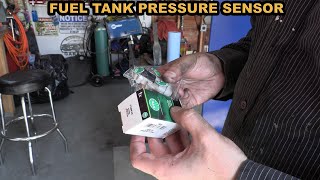
How to confirm: Use a scan tool to monitor the FTP sensor voltage. With the engine off and gas cap removed, the voltage should be at a baseline (typically around 2.5V). If it reads near zero or doesn't change, the sensor is likely bad. You can also test the sensor's 5V reference voltage and ground circuits at the connector. Jumping the 5V reference to the signal wire on the harness side should make the scan tool read ~5V, confirming the wiring is good and the sensor is the fault. 🎬 Watch: How to test and replace the fuel tank pressure sensor
Typical fix: Replace the Fuel Tank Pressure Sensor. This sensor is typically located on top of the fuel tank or fuel pump module, requiring the fuel tank to be partially or fully lowered for access. The Mopar part is often listed as a 'Fuel Vapor Sensor'.
Est. part cost: $50-$150 - Wiring Harness or Connector Issue 🟡 Medium Probability The wiring to the fuel tank is exposed to the elements, making it susceptible to corrosion, damage from road debris, or shorting to ground.
How to confirm: Visually inspect the wiring harness and connector leading to the FTP sensor for any signs of damage, corrosion, or loose pins. Test for continuity, a short to ground on the signal wire, and proper power/ground at the connector.
Typical fix: Repair the damaged section of the wiring harness or clean/replace the connector.
Est. part cost: $5-$50 - Blocked EVAP Vapor Line ⚪ Low Probability A TSB for the 3.6L engine suggests that condensation can accumulate in the vapor purge line, potentially causing a blockage that could affect pressure readings, especially after long idles or short trips.
How to confirm: This is difficult to confirm without following the specific TSB diagnostic procedure. If standard diagnostics for the sensor and wiring find no faults, this becomes the next likely cause.
Typical fix: Clean out the vapor purge line as per TSB #14-003-25. The procedure involves disconnecting the vapor line at the EVAP canister and the purge solenoid, using low-pressure air to clear condensation, and installing an upper heat shield on the fuel tank, which requires dropping the tank.
Est. part cost: $0-$50 (for a heat shield if needed)
Rare But Worth Checking
- Faulty Powertrain Control Module (PCM): This is extremely rare. The PCM's internal circuit for reading the sensor could fail, but all other possibilities should be exhausted before considering PCM replacement.
Diagnosis Steps
- Connect an OBD-II scanner to verify that P0452 is the only code present. If other EVAP codes exist, they may need to be diagnosed first.
- Using the scanner's live data function, monitor the Fuel Tank Pressure sensor voltage or pressure reading.
- With the engine off, remove the gas cap. Observe the sensor reading on the scanner. A healthy sensor should show a change in pressure/voltage. If the reading remains stuck at a very low value (e.g., near 0 volts), it points towards a faulty sensor or a circuit issue.
- Gain access to the Fuel Tank Pressure sensor, which is on top of the fuel tank. This will likely require lowering the tank. Some owners on related vehicles have managed to replace it by reaching over the tank, but it is very difficult.
- Visually inspect the sensor's connector and wiring for any signs of corrosion, damage, or loose connections.
- With the key on and engine off, use a multimeter to test the sensor's electrical connector. Verify you have a 5-volt reference signal and a good ground.
- If power and ground are present, and the signal wire is not shorted to ground, the Fuel Tank Pressure sensor is faulty and should be replaced.
- If diagnostics do not point to a faulty sensor or wiring, and the vehicle is a 3.6L model, consider the procedure in TSB #14-003-25, which involves clearing the vapor line and installing a heat shield.
- After the repair, clear the code and perform a drive cycle to ensure the Check Engine Light does not return.
Parts You'll Likely Need

- Fuel Tank Pressure Sensor
(OEM #68525698AA (supersedes 4593949AA, 4593949AB))— This sensor is the most common failure point for code P0452, as it can fail internally and send a persistent low voltage signal. It is also referred to as a 'Fuel Vapor Sensor' in Mopar parts catalogs.
Trusted brands: Mopar, Bosch, NTK, Dorman
OEM price range: $60-$90
Aftermarket price range: $40-$80
Technical Service Bulletins (TSBs) & Recalls

- Bulletin #14-003-25 / Z14 FSAR-TSB-4516: Addresses MIL illumination for P0452 - EVAP Pressure Switch Stuck Closed, potentially caused by a manufacturing issue leading to condensation in the purge line.
Platform-Specific Known Issues

- A Technical Service Bulletin (TSB #14-003-25, also listed as Z14 FSAR-TSB-4516) exists for 2020-2024 Durango models with the 3.6L engine. It addresses P0452 appearing after long idles or short trips. 🎬 See this walkthrough for solving common Durango EVAP codes The fix involves checking for condensation in the vapor purge line and, if none is found by normal diagnostics, potentially installing a heat shield on the fuel tank, a repair which takes approximately 1.9 hours.
Mechanic-Grade Diagnostic Values
- FTP Sensor Signal Voltage (Key On, Engine Off, Fuel Cap Off) — expected: ~2.5 Volts. Failure: Voltage is stuck low, typically below 0.5V, and does not change. A reading below 0.22V for more than a few seconds will trigger the code.
- FTP Sensor Connector - 5V Reference Pin — expected: 5.0 Volts. Failure: Significantly less than 5.0V indicates a wiring issue or a problem with the PCM's 5V reference circuit.
- FTP Sensor Connector - Ground Circuit — expected: Near 0 Volts / Good continuity to chassis ground.. Failure: Voltage present on the ground wire or high resistance to ground indicates a bad ground connection.
- FTP Sensor Signal Wire (Jumping 5V reference to signal wire) — expected: ~5.0 Volts (on scan tool). Failure: If the scan tool does not read ~5.0V, it indicates a problem in the wiring harness or PCM, not the sensor.
Scan Tool Commands That Help

- wiTECH (or equivalent high-level scanner): EVAP System Test — This function can be used to command the purge and vent solenoids to seal the system and monitor pressure bleed-off. While not a direct test for a P0452 circuit fault, it can help verify if other components are contributing to the issue or if the sensor is responding to pressure changes at all.
Wiring & Ground Locations

- FTP Sensor Connector — On top of the fuel tank, connected to the fuel tank pressure sensor/ESIM assembly.. This is the primary connection point to test for 5V reference, ground, and the signal wire voltage to diagnose a P0452 fault.
- G901A — Left rear of the engine compartment.. This is a major ground distribution point for various engine and chassis components. While not directly for the FTP sensor, a poor ground here can cause widespread electrical issues.
- G916 / G916A — Left front of the cargo area.. This ground point is physically closer to the fuel tank and EVAP system components and could be related to the FTP sensor's ground circuit.
Real Owner Repair Stories
- YouTube video by 'JaVyS KnOw HoWs' (2005 Dodge Durango 4.7L (earlier generation, but same code principle)) — Check Engine Light with code P0452.
❌ Tried (didn't work) The owner did research and directly targeted the most likely cause.
✅ What actually fixed it The owner replaced the 'EVAP leak detection pump' located on the charcoal canister behind the spare tire. This part contains the pressure sensor, and replacing it resolved the code. - YouTube video by 'Gearmo Auto' (2019 Dodge Durango 5.7L) — Check Engine Light with codes P0440 (EVAP System) and P0456 (Small Leak).
❌ Tried (didn't work) The mechanic skipped a smoke test due to high confidence in the common failure part.
✅ What actually fixed it Replaced the EVAP leak detection pump (ESIM) located in the left rear fender well. The mechanic stated this is a very common failure item on Dodge products that can cause various EVAP codes.
"I Checked Everything" — The Actual Cause
- In many cases involving Chrysler/Dodge vehicles, a smoke test for EVAP leaks will come back clean (no leaks found), yet EVAP codes like P0452, P0456, or P0440 persist. The actual cause is often a faulty EVAP System Integrity Module (ESIM), also known as the leak detection pump. This component contains the pressure sensor and a small diaphragm that can fail, leading the computer to believe there is a leak or a pressure sensor fault when the lines themselves are sealed.
OEM Part Supersession History
4593949AA, 4593949AB→68525698AA— Part has been updated by the manufacturer over time.
Heads up: On some older models (approx. 2017-2018), replacing the fuel line and sensor may require a new connector pigtail (Part # 68137864AC) to be spliced into the vehicle harness due to a change in connector design.
Helpful Videos
We Have This Part in Stock



The information in this article is provided for general reference and educational purposes only. Vehicle specifications, procedures, and part compatibility can vary by production date, trim level, and region. Always consult your vehicle's factory service manual and verify part numbers before purchasing or performing repairs. Safety-critical components such as airbags, seat belts, and braking systems should be installed by a qualified professional.
- Dodge DURANGO:
- 🎬 Helpful Videos
- 🛍️ Shop This Part
- What's Unique About the 2020-2024 Dodge DURANGO
- Diagnostic Flowchart
- Symptoms You May Notice
- Most Likely Causes
- Rare But Worth Checking
- Diagnosis Steps
- Parts You'll Likely Need
- Technical Service Bulletins (TSBs) & Recalls
- Platform-Specific Known Issues
- Mechanic-Grade Diagnostic Values
- Scan Tool Commands That Help
- Wiring & Ground Locations
- Real Owner Repair Stories
- "I Checked Everything" — The Actual Cause
- OEM Part Supersession History
- 🎟️ Get 5% Off