

P0452 on 2020 Chrysler 300: EVAP Pressure Switch Stuck Closed Causes & Fixes
This code indicates the EVAP Fuel Tank Pressure Sensor signal is lower than expected. The most common cause is a faulty sensor itself, which is located near the driver's side rear wheel area. A less common but notable issue on some 2020 3.6L models built between May and June 2020 is a kinked EVAP hose from the factory, which also triggers a P0441 code.
- P0452 on a 2020 Chrysler 300 almost always points to a faulty Fuel Tank Pressure (FTP) sensor or its wiring.
- Do not mistake this for a gas cap issue; this is an electrical circuit code, not a leak code.
- If you also have a P0441 code and your car is a 3.6L V6 model built between May and June 2020, inspect the EVAP lines near the brake booster for kinks before buying parts, as per TSB #25-003-20.
- Diagnosis involves checking the sensor's voltage with a scan tool (should be near 0V with the fault) and verifying the 5V reference and ground at the sensor connector with a multimeter.
- Replacing the sensor is a relatively easy DIY job as it is typically located behind the driver's side rear wheel well liner, not inside the fuel tank.
What's Unique About the 2020-2020 Chrysler 300
For the 2020 Chrysler 300 (and its Dodge siblings, the Charger and Challenger), the P0452 code is very frequently a direct indicator of a failed Fuel Tank Pressure (FTP) sensor. While wiring or other component failures are possible, the sensor itself is the primary suspect. A specific factory assembly issue exists for some 3.6L V6 models built between May 19, 2020, and June 22, 2020, where a kinked EVAP purge line can cause this code, often accompanied by P0441.
Diagnostic Flowchart
Tap your situation to follow the diagnostic path that matches what you're seeing on this vehicle.
Symptoms You May Notice
- Check Engine Light is on.
- Possible faint fuel smell.
- Failure to pass an emissions/smog test.
- Remote start may be disabled by the system.
- In rare cases, difficulty refueling where the pump clicks off frequently.
- Replacing the gas cap. A P0452 code is for a sensor circuit low voltage, not a system leak which would be indicated by codes like P0455, P0456, or P0457.
- Replacing the EVAP purge valve or vent solenoid without diagnosis. While these can be related to other EVAP codes, they are not the primary cause for a P0452 circuit low code, unless P0441 is also present on a 2020 model covered by TSB #25-003-20.
Most Likely Causes
- Faulty Fuel Tank Pressure (FTP) Sensor 🔴 High Probability This is the most common failure point for this specific code on this platform, indicating an internal electrical fault in the sensor.
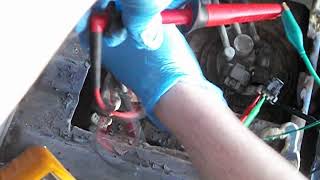
How to confirm: Using a scan tool, observe the FTP sensor voltage. It will likely read very low (near 0 volts) and not change when the gas cap is removed. A healthy sensor should read around 2.5V with the cap off. You can also test the sensor's 5V reference, ground, and signal wires with a multimeter. A definitive test is to jump the 5V reference wire to the signal wire on the harness side; the scan tool should then read ~5V, confirming the wiring is good and the sensor is faulty. 🎬 Watch: How to test the fuel tank pressure sensor with a multimeter.
Typical fix: Replace the Fuel Tank Pressure Sensor. On this platform, the sensor is often part of a vapor tube assembly located near the fuel filler neck, accessible by removing the driver's side rear wheel and wheel well liner.
Est. part cost: $70-$110 - Wiring or Connector Issue 🟡 Medium Probability Wiring near the fuel tank and wheel wells is exposed to the elements, making it susceptible to corrosion, moisture intrusion, or physical damage from road debris.
How to confirm: Visually inspect the wiring harness and connector going to the FTP sensor for any signs of corrosion, breaks, or chafing. Test for 5V reference and good ground at the connector with a multimeter. Wiggle the harness while monitoring voltage to check for intermittent connections.
Typical fix: Repair the damaged section of the wiring harness or clean/replace the connector. Ensure a weatherproof seal on any repairs.
Est. part cost: $5-$50 - Kinked EVAP Purge Line (Specific 2020 V6 Models) ⚪ Low Probability A known factory assembly issue affects some 3.6L V6 models built between May 19, 2020, and June 22, 2020, as documented in TSB #25-003-20.
How to confirm: Visually inspect the EVAP purge line near the brake booster in the engine bay for kinks or improper routing. This issue will almost always set a P0441 code as well.
Typical fix: Replace the EVAP purge valve assembly and ensure the new line is routed correctly behind the brake booster tube to prevent kinking, as per the TSB instructions.
Est. part cost: $50-$100
Rare But Worth Checking
- Faulty Powertrain Control Module (PCM): This is extremely rare. The PCM should only be considered after all other possibilities, including the sensor and its entire circuit, have been exhaustively tested and ruled out. A PCM failure is not a typical cause for this code.
Diagnosis Steps
- Use an OBD-II scanner to confirm P0452 is the primary code. Check for any other related EVAP codes like P0441, P0455, or P0456.
- Check for relevant Technical Service Bulletins (TSBs). TSB #25-003-20 is known for this vehicle and code, specifically for 3.6L models built between May 19, 2020, and June 22, 2020.
- Using the scanner's live data function, monitor the Fuel Tank Pressure sensor voltage. A reading consistently below 0.5V that doesn't change when the gas cap is removed points towards a sensor or wiring issue. A healthy sensor should read approx. 2.5V with the system open.
- Locate the FTP sensor. On this platform, it is typically located near the fuel filler neck/driver's side rear wheel area, accessible after removing the wheel and splash shield.
- Inspect the sensor's electrical connector and wiring for any visible damage, corrosion, or loose connections.
- Using a multimeter, back-probe the connector to verify it has a 5-volt reference signal and a solid ground connection.
- If power and ground are good, jump the 5V reference pin to the signal wire pin on the harness side of the connector. A functional circuit will cause the scan tool's live data to jump to ~5V. If it does, the sensor is bad. If it does not, there is a break in the signal wire to the PCM.
- If the wiring and connections are confirmed to be good, the Fuel Tank Pressure sensor is the failed component and should be replaced.
- After repair, clear the codes and perform a drive cycle to ensure the fix was successful.
Parts You'll Likely Need
- Fuel Vapor Tube Assembly (includes FTP Sensor)
(OEM #68410852AA)— This sensor is the most frequent point of failure for a P0452 code. The sensor is often integrated into this vapor tube assembly.
Trusted brands: Mopar, Duralast Gold
OEM price range: $70-$90
Aftermarket price range: $45-$80
Related Codes That Often Appear With This One
- P0441 — As noted in TSB #25-003-20, a P0441 (EVAP Purge System Performance) code can appear alongside P0452, especially in cases involving a kinked EVAP line on specific 2020 3.6L models.
- P0456 / P0455 — A failing pressure sensor can give incorrect readings to the PCM, causing it to mistakenly flag a small (P0456) or large (P0455) EVAP leak when one doesn't exist. If you have a circuit code like P0452 plus a leak code, the sensor is the primary suspect.
Technical Service Bulletins (TSBs) & Recalls
- 25-003-20: Addresses P0452 (EVAP Pressure Switch Stuck Closed) and P0441, caused by a kinked EVAP line on specific 2020 models with the 3.6L engine built between 05/19/2020 and 06/22/2020.
Platform-Specific Known Issues
- TSB #25-003-20: Kinked EVAP Purge Line: For 2020 Chrysler 300 models with the 3.6L engine built between May 19, 2020, and June 22, 2020, a kinked EVAP purge line from the factory can cause P0452, often accompanied by P0441. The fix is to inspect and, if necessary, replace the purge line assembly and route it correctly behind the brake booster tube.
Mechanic-Grade Diagnostic Values
- Fuel Tank Pressure (FTP) Sensor Voltage (KOEO) — expected: ~2.5 Volts (with gas cap off, system at atmospheric pressure). Failure: Consistently below 0.5V, often near 0V.
Scan Tool Commands That Help
- wiTECH (or equivalent professional scanner): EVAP Active Test Function — To view all relevant EVAP system PIDs (sensor voltage, purge command, etc.) on one screen to analyze system behavior during diagnosis.
- wiTECH (or equivalent professional scanner): EVAP System Leak Test — While primarily for leak codes (P0455/P0456), running this test can help verify the FTP sensor's response to pressure changes commanded by the scan tool, helping to confirm if the sensor is stuck at a low reading.
Wiring & Ground Locations
- FTP Sensor Connector — On the Fuel Vapor Tube Assembly, near the fuel filler neck inside the driver's side rear wheel well.. This is the primary connection point to test for 5V reference, ground, and the signal wire. Based on the sister Dodge Challenger platform, the pinout is likely: Pin 1 = Signal, Pin 2 = Ground, Pin 3 = 5V Reference. Wire colors may vary.
- G304 (Example) — Chassis frame rail near the fuel tank area.. This is a likely ground point for the FTP sensor circuit. A corroded or loose ground at this location can cause a low voltage reading and trigger P0452 even with a good sensor.
- EVAP System Fuses — Underhood Fuse Box: Fuses F31, F34, F35, F37. Trunk Fuse Box: Check fuses and relays related to the PCM and fuel system.. A blown fuse can cut power to the EVAP system components, including the 5V reference circuit for the FTP sensor. Specifically, fuse F31 in the underhood box is one to check for the EVAP system.
- EVAP System Relays — Underhood Fuse Box: Relay 63. Trunk Fuse Box: Relay 29 and possibly Relay 14.. A faulty relay can prevent the EVAP system from powering up correctly, which could affect sensor readings.
OEM Part Supersession History
68410852AA→N/A— This part number appears to be current for 2020-2023 models.
Heads up: No supersession or incompatibility noted in available data.
Helpful Videos

We Have This Part in Stock



The information in this article is provided for general reference and educational purposes only. Vehicle specifications, procedures, and part compatibility can vary by production date, trim level, and region. Always consult your vehicle's factory service manual and verify part numbers before purchasing or performing repairs. Safety-critical components such as airbags, seat belts, and braking systems should be installed by a qualified professional.
- Chrysler 300:
- 🎬 Helpful Videos
- 🛍️ Shop This Part
- What's Unique About the 2020-2020 Chrysler 300
- Diagnostic Flowchart
- Symptoms You May Notice
- Most Likely Causes
- Rare But Worth Checking
- Diagnosis Steps
- Parts You'll Likely Need
- Related Codes That Often Appear With This One
- Technical Service Bulletins (TSBs) & Recalls
- Platform-Specific Known Issues
- Mechanic-Grade Diagnostic Values
- Scan Tool Commands That Help
- Wiring & Ground Locations
- OEM Part Supersession History
- 🎟️ Get 5% Off