

Ultimate Guide to OBD-II Code P0450: Evaporative Emission System Pressure Sensor/Switch Malfunction
The most comprehensive P0450 resource for outranking the competition. What it means, why it happens, and exactly how to fix it.
- Code P0450 indicates an electrical fault in the fuel tank pressure sensor circuit, causing an automatic state emissions test failure.
- Test the sensor's 5-volt reference and ground pins with a multimeter before replacing it to rule out broken wires or corroded connectors.
- Expect to pay between $190 and $450 for a professional sensor replacement, with labor accounting for up to 70% of the cost if the fuel tank requires dropping.
- You can safely drive with this code, but ignoring it for over 6 months risks permanent $500+ damage to a saturated charcoal canister.
What Does P0450 Mean?

The Powertrain Control Module (PCM) detected a malfunction in the fuel tank pressure sensor circuit. This sensor monitors the Evaporative Emission (EVAP) system to prevent gasoline vapors from escaping. Code P0450 triggers when the sensor's voltage signal stays outside the expected 0.5V to 4.8V range for a set duration, indicating a failed sensor, broken wiring, or a stuck EVAP valve.
Technical definition: Evaporative Emission System Pressure Sensor/Switch Malfunction.
Can I Drive With P0450?
Yes, But With Caution. Yes, you can continue to drive. This code does not affect engine performance or vehicle safety. However, you will fail an emissions test, experience a 1-5% drop in fuel economy, and notice a fuel smell. Ignoring the Check Engine Light prevents alerts for severe issues that cause catalytic converter damage.
Common Causes

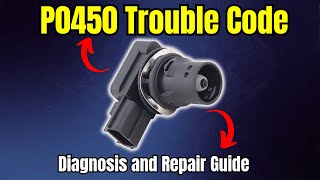
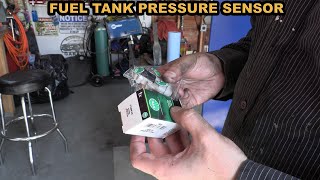
- Faulty EVAP (Fuel Tank) Pressure Sensor (Very Common) — The sensor's internal diaphragm or electronics fail from age, wear, or corrosion, sending incorrect or dead voltage signals to the PCM. 🎬 See how to test and replace the EVAP pressure sensor.
- Damaged Wiring or Electrical Connector (Common) — Wires fray, short out, or suffer rodent damage. Connectors loosen or corrode from moisture intrusion, completely disrupting the 5V signal.
- Faulty or Stuck EVAP Vent or Purge Valve (Common) — A stuck-open or stuck-closed vent/purge valve causes abnormal pressure conditions that the PCM misinterprets as a sensor fault. This is the most frequent point of misdiagnosis.
- Cracked or Saturated Charcoal Canister (Less Common) — Habitually overfilling the gas tank saturates the canister with liquid fuel. The charcoal media breaks down, clogs EVAP lines, and causes erratic pressure readings.
- Cracked or Disconnected EVAP Hoses (Less Common) — A vacuum or vapor hose leak near the pressure sensor skews readings outside the expected range, tricking the computer into flagging the sensor.
- Loose or Faulty Gas Cap (Uncommon) — Usually triggers a large leak code (P0455), but a severely compromised gas cap seal occasionally causes erratic pressure readings flagged as a circuit fault.
- Faulty Powertrain Control Module (PCM) (Rare) — The car's main computer fails to interpret a good signal. Consider this only after exhaustively testing all wiring and components.
Symptoms
- Check Engine Light is On — The primary and often only noticeable symptom.
- Fuel Smell — A faint gasoline odor around the rear of the vehicle due to unpurged vapors.
- Slight Decrease in Fuel Economy — A 1-5% drop in MPG because fuel vapors escape into the atmosphere instead of burning in the engine.
- Failed Emissions Test (scan-tool only — no driver-felt sign) — Automatic failure due to the active code and incomplete EVAP monitor.
Diagnostic Flowchart

Tap your situation to follow the diagnostic path that matches what you're seeing on this code.
Common Fixes & Costs
- Replace Fuel Tank Pressure Sensor — Parts: $40-$150, Labor: $150-$300, ~2.5 hr book time (Intermediate)
- Repair Damaged Wiring or Connector — Parts: $10-$30, Labor: $125-$250, ~1.5 hr book time (Professional)
- Replace EVAP Hoses — Parts: $20-$75, Labor: $100-$250, ~1.2 hr book time (Intermediate)
- Replace Charcoal Canister — Parts: $200-$500, Labor: $125-$250, ~1.8 hr book time (Professional)
- Replace Gas Cap — Parts: $15-$60, Labor: $0, ~0.1 hr book time (DIY)
Used vs. New Parts: Buying Guide
When a used part is worth it: Never buy a used standalone pressure sensor. The $30 savings do not justify the labor required to drop the fuel tank twice if it fails. Used parts only make sense when buying an entire fuel pump module assembly from a verified low-mileage donor.
Donor-vehicle mileage cap: roughly under 50000 miles for the part to have meaningful remaining life.
Donor quality checklist:
- Verify the exact OEM part number matches perfectly.
- Reject parts from rust-belt states due to inevitable connector pin corrosion.
- Ensure the donor vehicle was not scrapped for electrical issues.
Decision logic:
- If The sensor costs less than $150 new. → Buy new (OEM or reputable aftermarket) for the warranty and peace of mind.
- If The sensor is integrated into a $600+ fuel pump assembly on a 10+ year old car. → Buy a used assembly from a low-mileage donor.
- If Replacing the part requires dropping the fuel tank. → Always install a new part. The labor risk outweighs any used-part savings.
Warranty tradeoff: Used parts carry a 30-90 day warranty. New aftermarket parts offer 1-year to lifetime warranties. New OEM parts offer a 1-year/12,000-mile warranty.
Worst-case if a used part fails: $300-$600 to pay for labor a second time if a used sensor fails.
What Happens If You Wait — Timeline
- 0-1 month: Check Engine Light illuminates. The vehicle fails emissions tests. No drivability symptoms. (MPG impact: 0-2%% · Added cost: $0)
- 1-6 months: A faint fuel smell develops. Fuel economy drops slightly as vapors escape. (MPG impact: 2-5%% · Added cost: $20-$50 in wasted fuel)
- 6-12 months: If caused by overfilling, the saturated charcoal canister breaks down permanently, disabling the EVAP system. (MPG impact: 5-10%% · Added cost: $200-$500 for canister replacement)
- 12+ months: The persistent Check Engine Light masks new, severe problems like engine misfires. (MPG impact: 10%+% · Added cost: $1200-$3000 for catalytic converter failure)
Cost of Not Fixing It
- 0-3 months: Guaranteed failure of state emissions inspections. A 1-5% decrease in fuel economy and a noticeable fuel smell. (Added cost: $20-$50 in wasted fuel.)
- 3-12 months: If caused by overfilling the tank, liquid fuel permanently ruins the charcoal canister, disabling the entire EVAP system. (Added cost: $200-$500 to replace the charcoal canister.)
- 12+ months: A constantly illuminated Check Engine Light masks new, severe codes. An unnoticed misfire destroys the catalytic converter. (Added cost: $1200-$2800 for catalytic converter replacement.)
Diagnosis Steps
- Read Code & Freeze Frame Data
Use an OBD-II scanner to confirm P0450. Analyze freeze-frame data to identify the exact engine temperature, fuel level, and speed when the code triggered.
Tools: OBD-II Scanner (Beginner) - Inspect Gas Cap & EVAP Components Visually
Ensure the gas cap clicks tightly and the O-ring is intact. Inspect the fuel tank pressure sensor, wiring harness, and accessible EVAP hoses for chewed wires, corroded pins, or cracked rubber.
Tools: Flashlight, Safety Glasses (Beginner) - Check Sensor Voltage with Scanner
Monitor the EVAP pressure sensor voltage via live data (key on, engine off). Normal voltage sits around 2.5V-3.2V. A stuck reading of 0V or 5V confirms a hard circuit or sensor fault.
Tools: Advanced OBD-II Scanner (Intermediate) - Test Sensor Circuit with Multimeter
Disconnect the sensor. With the key on, test the harness. Verify a 5-volt reference from the PCM and a solid ground (less than 0.1 Ω). If either is missing, repair the wiring. If both exist, the sensor is faulty.
Tools: Digital Multimeter, Vehicle-Specific Wiring Diagram (Advanced) - Test Sensor Response with Vacuum Pump
Reconnect the sensor and back-probe the signal wire. Apply 5-10 inHg with a hand vacuum pump. The voltage must decrease smoothly (e.g., 2.5V down to 1.0V). Erratic jumps or no change means the sensor is dead.
Tools: Digital Multimeter, Back-Probe Kit, Hand-Held Vacuum Pump (Advanced) - Perform a Smoke Test
Pump UV-dyed smoke into the EVAP system. Smoke escaping from hoses, the canister, or valve seals reveals physical leaks causing implausible sensor readings.
Tools: EVAP Smoke Machine, UV Light (Advanced)
When This Code Triggers (Freeze-Frame Conditions)
- Fuel Level: 15-85% (The EVAP monitor aborts the test if the tank is too full or nearly empty.)
- Engine Coolant Temp: 40-90°F (at startup) (Requires a 'cold soak' where engine temperature matches ambient air temperature.)
- Vehicle Speed: 40-65 mph (Triggers during steady-state cruising when the EVAP monitor performs its leak test.)
- Engine Load: 20-60% (Occurs under light to moderate, steady throttle.)
Related Codes
- P0451 — P0450 is a hard electrical fault (open/short). P0451 is a performance fault meaning the sensor works but reads erratically during purge cycles.
- P0452 — A specific subset of P0450 indicating the circuit voltage is stuck low. Points directly to a short to ground or internally shorted sensor.
- P0453 — A specific subset of P0450 indicating the circuit voltage is stuck high (5V). Points directly to an open wire or lost ground connection.
- P0455 — Indicates a massive physical leak (like a missing gas cap). Fix P0455 first, as massive leaks cause rapid pressure drops that trick the PCM into throwing a P0450 sensor code.
Climate & Environmental Factors
- High Humidity / Road Salt: Moisture penetrates weather seals on connectors, causing pin corrosion and circuit malfunctions. This is the leading cause of P0450 on Honda and GM vehicles in the rust belt.
- Cold Weather: Temperature-induced contraction of plastic and rubber components creates temporary marginal seals that the system flags as a fault.
- Dusty Environments: Operating on unpaved roads clogs the EVAP vent solenoid filter. The resulting abnormal pressure buildup tricks the PCM into flagging the pressure sensor.
How to Talk to a Mechanic About This Code
Say this: "I have a P0450 code. Please verify the sensor's 5-volt reference and ground at the connector, and check the live voltage reading before replacing any parts. If the circuit is good, I authorize a smoke test to rule out stuck valves or leaks."
Signals you understand P0450 is a circuit code. It forces the technician to perform a logical electrical diagnosis rather than blindly replacing the sensor.
Avoid saying:
- 'Just fix my check engine light.'
- 'I think I need a new gas cap.'
- 'Replace my fuel tank pressure sensor.'
Questions to ask before authorizing the repair:
- What was the sensor's live voltage reading with the key on, engine off?
- Did you confirm a solid ground and 5-volt reference at the connector?
- How did you rule out a faulty vent or purge valve?
- What is the warranty on parts and labor?
Where to Take It: Dealer vs Independent vs Chain
- Dealer:
Use only if under warranty or dealing with a highly specific European EVAP system.
Best for: Vehicles under emissions or powertrain warranty., Complex systems like BMW's DMTL pump., Issues covered by a known Technical Service Bulletin (TSB).
Downsides: Labor rates are 50-100% higher than independent shops., Tendency to replace entire expensive assemblies rather than individual components. (Typical cost: +50% vs. baseline) - Independent Shop:
The best choice. A reputable independent shop has the multimeters and smoke machines required to diagnose P0450 cost-effectively.
Best for: Out-of-warranty vehicles., Standard electrical diagnostics and smoke testing.
Downsides: Diagnostic capabilities vary; ensure they have ASE-certified technicians. (Typical cost: +0% vs. baseline) - Chain Shop:
Avoid. P0450 requires circuit testing, which chain shops frequently misdiagnose.
Best for: Simple gas cap replacements.
Downsides: Technicians often lack advanced electrical diagnostic skills., High pressure to upsell unnecessary parts. (Typical cost: -10% vs. baseline)
When to Walk Away From the Repair
If the total repair estimate exceeds 40% of the vehicle's private-party value, consider selling the car as-is.
- Car worth $4000, fix is $450: Fix it. The cost is well below the threshold and restores full value.
- Car worth $3000, fix is $1200: Walk away. The repair approaches half the car's value.
- Car worth $1500, fix is $800: Walk away. The repair is uneconomical.
What Scan Tool You Need for This Code

Minimum: A scanner that reads live data, specifically the EVAP System Pressure Sensor voltage.
A $20 code reader only shows the P0450 code. It cannot display live sensor voltage, which is mandatory to determine if the sensor is stuck, shorted (0V), or open (5V).
Budget: BlueDriver Pro Scan Tool (~$100) — Connects via Bluetooth to display live EVAP pressure sensor data and freeze-frame context.
Mid-range: Foxwell NT510 Elite (~$180) — Offers bidirectional controls to manually command EVAP purge and vent solenoids open and closed, isolating the exact faulty component.
Professional: Autel MaxiCOM MK808 (~$450) — Provides OE-level diagnostics, extensive live data graphing, and system-wide EVAP leak tests.
Rent vs buy: Buy the BlueDriver. Auto parts stores loan basic code readers, but you need live data to diagnose P0450 properly.
How to Clear the Code After You Fix It
- Use an OBD-II scan tool to clear the code.
- Ensure the fuel tank is between 1/4 and 3/4 full.
- Perform a complete drive cycle to run the EVAP readiness monitor.
Drive cycle (~20 minutes): 1) Cold start after sitting 8+ hours. 2) Idle for 3 minutes. 3) Drive at mixed city speeds (25-45 mph) for 5 minutes. 4) Drive at a steady highway speed (55-65 mph) for 10 minutes. 5) Coast down without braking. Repeat over 2-3 days.
Readiness monitors affected: EVAP System Monitor, Catalyst Monitor, O2 Sensor Monitor
Before emissions retest: drive at least 50 miles to fully set monitors.
Watch out for:
- Disconnecting the battery clears the code but resets all readiness monitors, guaranteeing an emissions test failure.
- The EVAP monitor refuses to run if the fuel level is outside the 15-85% range.
- The code returns immediately if the underlying electrical fault remains unfixed.
Will This Fail Emissions / State Inspection?
Yes — this code typically fails an OBD-II emissions inspection.
- California: Automatic smog check failure. All readiness monitors must be complete. Disconnecting the battery requires a full, multi-day drive cycle before re-testing.
- New York: Active P0450 codes trigger an immediate failure during the OBD-II scan portion of the NYS inspection.
- Texas: Fails the OBD portion of the annual inspection in the 17 emissions-testing counties. The EVAP readiness monitor must read 'Ready'.
Most Commonly Affected Vehicles
- Chevrolet/GMC Silverado, Sierra, Tahoe (2004-2014) — Faulty sensors and stuck vent valve solenoids are rampant. The sensor sits on top of the fuel pump module, requiring tank removal.
- Nissan Altima, Frontier, Pickup (1996-2015) — Pre-2005 charcoal canisters break down internally, sending pellets through the lines and clogging the sensor.
- Hyundai/Kia Sonata, Elantra, Sorento (2011-2018) — Highly susceptible to purge control valve failures that trigger P0450 despite a perfectly functional sensor.
- Subaru Outback, Forester (2005-2014) — Severe rust in the fuel filler neck area damages nearby EVAP hoses and valves, skewing pressure readings.
- Honda Accord, Civic, CR-V (2008-2024) — Prone to corroded wiring connectors at the sensor, especially in states using heavy road salt.
- Ford F-150, Focus, Fusion (2009-2024) — Frequently linked to a malfunctioning canister purge valve located in the engine bay.
Manufacturer-Specific Notes
- Toyota: The pressure sensor is integrated into a complex canister pump module. TSB T-SB-0035-11 requires inspecting this entire module and its wiring harness.
- Ford: TSB 19-2369 addresses F-150s where a faulty Canister Purge Valve (CPV) triggers P0450. Always test the CPV before dropping the tank to replace the sensor.
- BMW: Uses a Diagnostic Module Tank Leakage (DMTL) pump. P0450 equivalents usually mean the DMTL pump failed its internal self-test. BMW extended warranties on these pumps to 10 years/120k miles.
- General Motors (GM): Early-2000s trucks suffer from dust clogging the EVAP vent solenoid. TSB 02-06-04-037 requires replacing the valve and installing a filter relocation kit.
Real Owner Stories
2016 Honda HR-V with intermittent P0450
Check Engine Light cycled on and off every few days with no drivability symptoms.
Outcome: A mechanic found the sensor reading stuck above 3.62 volts. Replacing the failing sensor resolved the issue permanently.
Lesson: Intermittent EVAP codes indicate a sensor in the early stages of failure. Address it before it becomes a hard fault.
Dodge Journey misdiagnosis
Needed to pass emissions but had an active P0450 code.
Outcome: A proper diagnostic revealed a clogged EVAP canister vent valve. Replacing the valve fixed the pressure issue and cleared the code.
Lesson: Never blindly replace parts. A circuit code points to a symptom, but the root cause is often a different stuck valve in the system.
2018 Hyundai Sonata after a rainstorm
Check Engine Light triggered immediately after driving through heavy rain.
Outcome: Water intruded into the sensor's electrical connector, causing a short. Drying the connector and packing it with dielectric grease fixed the code for $0 in parts.
Lesson: If the code appears after a car wash or storm, moisture intrusion in the wiring is the primary suspect.
How to Prevent This Code From Triggering
- Avoid overfilling the fuel tank (Every fill-up) — Stopping at the first click prevents liquid fuel from saturating and ruining the $300 charcoal canister.
- Inspect and clean the gas cap seal (Annually) — Wiping dirt from the seal and filler neck ensures the EVAP system holds pressure.
- Use dielectric grease on connectors (During any EVAP repair) — Prevents moisture intrusion and pin corrosion, the leading cause of circuit codes.
Frequently Asked Questions
What is the most common mistake when diagnosing P0450?
Replacing the fuel tank pressure sensor without testing the electrical circuit. Technicians frequently find the true cause is a corroded connector or broken wire. Always verify the 5V reference and ground before buying parts.
Can overfilling my gas tank cause a P0450 code?
Yes. Consistently topping off the tank forces liquid gasoline into the vapor-only charcoal canister. This saturates the charcoal, blocks vapor lines, and ruins the pressure sensor.
How much does it cost to fix P0450?
Repair costs range from $20 for a gas cap to $450 for a professional sensor replacement. A standard diagnostic fee adds $100 to $150. Replacing a saturated charcoal canister exceeds $500.
Can I fix P0450 myself?
Basic visual inspections and gas cap replacements are beginner-friendly. Replacing the pressure sensor is an advanced DIY job because it often requires safely dropping the heavy fuel tank. Stop and visit a shop if you lack a floor jack, transmission jack, or multimeter.
Will a P0450 code clear itself?
If a loose gas cap caused the code, it clears automatically after 3 to 5 drive cycles once tightened. For hardware or electrical faults, the code remains active until repaired and manually cleared with a scanner.
Where is the fuel tank pressure sensor located?
The sensor is typically mounted directly on top of the fuel tank as part of the fuel pump module. On some vehicles, it sits on the charcoal canister near the rear bumper or inside the engine bay. Consult a vehicle-specific repair manual for the exact location.
What's the difference between P0450 and a leak code like P0455?
P0450 is an electrical circuit code indicating the PCM lost communication with the pressure sensor. P0455 is a system integrity code meaning the sensor works but detected a massive physical vapor leak. Always diagnose and fix leak codes like P0455 before addressing sensor codes.
Key Takeaways
- Code P0450 indicates an electrical fault in the fuel tank pressure sensor circuit, causing an automatic state emissions test failure.
- Test the sensor's 5-volt reference and ground pins with a multimeter before replacing it to rule out broken wires or corroded connectors.
- Expect to pay between $190 and $450 for a professional sensor replacement, with labor accounting for up to 70% of the cost if the fuel tank requires dropping.
- You can safely drive with this code, but ignoring it for over 6 months risks permanent $500+ damage to a saturated charcoal canister.
Helpful Videos


The information in this article is provided for general reference and educational purposes only. Vehicle specifications, procedures, and part compatibility can vary by production date, trim level, and region. Always consult your vehicle's factory service manual and verify part numbers before purchasing or performing repairs. Safety-critical components such as airbags, seat belts, and braking systems should be installed by a qualified professional.
- 🎬 Helpful Videos
- What Does P0450 Mean?
- Can I Drive With P0450?
- Common Causes
- Symptoms
- Diagnostic Flowchart
- Common Fixes & Costs
- Used vs. New Parts: Buying Guide
- What Happens If You Wait — Timeline
- Cost of Not Fixing It
- Diagnosis Steps
- When This Code Triggers (Freeze-Frame Conditions)
- Related Codes
- Climate & Environmental Factors
- How to Talk to a Mechanic About This Code
- Where to Take It: Dealer vs Independent vs Chain
- When to Walk Away From the Repair
- What Scan Tool You Need for This Code
- How to Clear the Code After You Fix It
- Will This Fail Emissions / State Inspection?
- Most Commonly Affected Vehicles
- Manufacturer-Specific Notes
- Real Owner Stories
- 2016 Honda HR-V with intermittent P0450
- Dodge Journey misdiagnosis
- 2018 Hyundai Sonata after a rainstorm
- How to Prevent This Code From Triggering
- Frequently Asked Questions
- What is the most common mistake when diagnosing P0450?
- Can overfilling my gas tank cause a P0450 code?
- How much does it cost to fix P0450?
- Can I fix P0450 myself?
- Will a P0450 code clear itself?
- Where is the fuel tank pressure sensor located?
- What's the difference between P0450 and a leak code like P0455?
- Key Takeaways
- 🎟️ Get 5% Off