

P0449 on 2011-2015 Chevrolet Silverado 2500: EVAP Vent Solenoid Fixes
On a 2011-2015 Silverado 2500, code P0449 is almost always caused by a failed EVAP canister vent solenoid or its wiring. This part is exposed to the elements under the truck and commonly fails from corrosion or a broken ground wire at the connector. Expect to pay $30-$80 for a replacement part and spend about an hour on this straightforward DIY fix.
- P0449 on a Silverado 2500 points specifically to an electrical fault in the EVAP vent solenoid circuit, not an EVAP leak.
- The most likely cause is a failed vent solenoid located on the frame rail near the fuel tank.
- Before replacing the solenoid, always inspect the wiring and connector for damage, as this is also a common point of failure.
- A top symptom, besides the Check Engine Light, is the gas pump repeatedly clicking off during refueling.
- This is a highly common and very DIY-friendly repair that can be done in about an hour with basic tools.
What's Unique About the 2011-2015 Chevrolet SILVERADO 2500
On this generation of Silverado, the EVAP vent solenoid is notoriously prone to failure. It is mounted on the driver's side frame rail near the fuel tank, where it is exposed to road debris, moisture, and corrosion. This location is a primary contributor to the high failure rate of both the solenoid itself and its electrical connector, making P0449 a very common code for these trucks. The ground wire at the connector is a known weak point and can corrode and break completely, causing an open circuit.
Diagnostic Flowchart
Tap your situation to follow the diagnostic path that matches what you're seeing on this vehicle.
Generation note: The 2011-2015 year range covers the end of the 2nd Gen (GMT900, 2007-2014) and the start of the 3rd Gen (K2XX, 2015). While the P0449 code has the same meaning, the specific vent solenoid part number and its design may differ. The 2011-2014 models often use an older design that requires an updated wiring harness adapter (GM Part #19257603) when replacing it with the newer, more robust style part. Always verify the part with your truck's VIN. The K2XX models (2015+) use a different fuse (F57 in the under-hood fuse box) for this circuit.
🎬 Watch: A step-by-step repair guide for newer Silverado models.Symptoms You May Notice
- Check Engine Light is on.
- Difficulty filling the fuel tank (gas pump nozzle clicks off repeatedly).
- A faint fuel smell near the rear of the truck.
- Vehicle will fail an emissions test.
- In some cases, a service StabiliTrak light may also illuminate as a secondary effect of the rough idle caused by the EVAP issue.
- Replacing the gas cap. A bad gas cap typically causes a leak code (like P0455 or P0457), not a circuit malfunction code like P0449.
- Replacing the EVAP Purge Solenoid. The purge solenoid is located in the engine bay and controls vapor flow to the engine. P0449 specifically refers to the vent solenoid circuit, which is located near the fuel tank.
Most Likely Causes
- Failed EVAP Canister Vent Solenoid 🔴 High Probability The solenoid is located under the truck, exposed to road salt, water, and dirt, which causes the internal coil to fail or the valve mechanism to stick. The plastic or metal body of the solenoid can also develop hairline cracks from corrosion and stress, allowing moisture intrusion.
How to confirm: Locate the solenoid on the driver's side frame rail near the fuel tank. Use a scan tool to command the solenoid on and off; a lack of an audible click suggests failure. You can also apply 12V directly to the solenoid pins to test for a click. Test the solenoid's internal resistance with a multimeter; a reading between 10-30 ohms is typical, while an open circuit (OL) or zero ohms indicates failure.
Typical fix: Replace the EVAP canister vent solenoid. This is a common DIY repair that often takes less than an hour.
Est. part cost: $30-$80 - Damaged Wiring or Corroded Connector 🟡 Medium Probability The wiring harness leading to the vent solenoid is in a vulnerable location. The ground wire (often white) is particularly known to corrode and break right at the connector, creating an open circuit. This is a very common point of failure for P0449 on this platform.
How to confirm: Visually inspect the two wires (often a red/light green power wire and a white control/ground wire) and the connector at the vent solenoid for any breaks, chafing, or green/white corrosion. Use a test light connected across the two pins of the unplugged harness connector; it should illuminate when a scan tool commands the solenoid on. If the light doesn't turn on, you have a wiring issue.
Typical fix: Repair the broken wire(s) or replace the connector pigtail. The common replacement pigtail is ACDelco part #PT2160.
Est. part cost: $10-$25 - Blown Fuse ⚪ Low Probability
How to confirm: Check the fuses related to the emissions system in the under-hood fuse box. For 2015+ K2XX models, this is often fuse F57 (15A). For earlier models, it may be labeled 'EMISSIONS' or 'TCM BATT' (10A). A short in the vent solenoid circuit can cause the fuse to blow.
Typical fix: Replace the blown fuse after diagnosing the short circuit that caused it to blow. Simply replacing the fuse will likely result in it blowing again.
Est. part cost: $1-$5
Rare But Worth Checking
- Faulty Powertrain Control Module (PCM): This is extremely rare and should only be considered after all other possibilities, including the solenoid and its entire circuit, have been thoroughly tested and ruled out.
- Clogged Vent Hoses or Canister: While this usually triggers a flow code like P0446, a severe clog from dirt, debris, or insects in the vent lines or the canister itself can sometimes be misread by the PCM as a circuit fault. A visual inspection of the hoses is warranted during solenoid replacement.
Diagnosis Steps
- Confirm P0449 is the active code using an OBD-II scanner.
- Locate the EVAP vent solenoid under the truck, on the driver's side frame rail, near the fuel tank.
- Visually inspect the electrical connector and the two wires leading to it. Peel back the protective loom and look for obvious signs of damage, corrosion, or breaks, paying close attention to the white ground wire right at the connector.
- If wiring appears intact, use a scan tool with bidirectional controls to command the vent solenoid ON and OFF. Listen for an audible click from the solenoid.
- If no click is heard, disconnect the electrical connector. Use a test light or multimeter to verify that one pin (often red or red/green) receives ~12-volt power with the key on. The other wire (often white) is the ground control from the PCM.
- If power is present at the connector but the solenoid doesn't click, the solenoid has failed.
- If no power is present, check the relevant fuse (e.g., F57 on 2015+ models) and trace the power wire for a break.
- Test the solenoid's internal resistance with a multimeter. A reading between 10-30 ohms is generally considered good. An open circuit (OL) or a short (near 0 ohms) confirms a failed solenoid.
- If the solenoid and wiring test okay, check the vent hoses connected to it for clogs from dirt, debris, or insects.
Parts You'll Likely Need
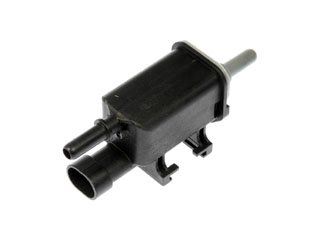
- EVAP Vapor Canister Vent Solenoid
(OEM #23481275)— This is the most common failure point for code P0449 due to its exposed location and electrical/mechanical failure over time. This part number is a widely used replacement that supersedes many older numbers.
Trusted brands: ACDelco, Dorman, Standard Motor Products (SMP)
OEM price range: $50-$90
Aftermarket price range: $30-$75 - EVAP Vent Solenoid Connector Pigtail
(OEM #ACDelco PT2160)— If the wiring is corroded or broken right at the connector, replacing the pigtail is the most effective repair. This is a common failure point.
Trusted brands: ACDelco, Dorman
OEM price range: $20-$40
Aftermarket price range: $10-$25 - EVAP Vent Solenoid Jumper Harness
(OEM #19257603)— Required on many 2007-2014 models when replacing the original vent solenoid with the updated, newer style part, as the electrical connectors are different.
Trusted brands: ACDelco (GM Genuine)
OEM price range: $30-$50
Aftermarket price range: $15-$30
Related Codes That Often Appear With This One
- P0446 — This code indicates a restriction in the vent control system. A stuck-closed vent solenoid or a clogged vent hose can cause both P0449 (circuit fault) and P0446 (flow fault).
- P0455 — This code indicates a large EVAP leak. If the vent solenoid fails in the open position or has a cracked housing, the system cannot seal for its leak test, triggering a large leak code alongside the P0449 circuit code.
- P0442 — This indicates a small EVAP leak. Similar to P0455, a vent solenoid that isn't sealing perfectly can be detected as a small leak. The NHTSA TSB #15-06-04-002 confirms these codes often appear together.
Technical Service Bulletins (TSBs) & Recalls
- 15-06-04-002: Addresses customer concern of the Malfunction Indicator Lamp (MIL) being on, difficulty filling the fuel tank, and DTCs P0442, P0446, P0455, or P0449 being set. It recommends installing a revised design EVAP valve with a remote filter.
Platform-Specific Known Issues
- NHTSA Technical Service Bulletin #15-06-04-002 notes that P0449 can occur along with codes P0442, P0446, or P0455, and may be accompanied by a customer concern of the fuel tank being hard to fill. The bulletin describes replacing the original EVAP valve with a revised, sealed design that uses a remote pre-filter to prevent dust and water intrusion.
- Owner Experience: Many owners on forums report successfully fixing the P0449 code themselves in under an hour. A common story involves finding the ground wire broken right at the solenoid connector, which is a simpler fix than replacing the entire solenoid if the solenoid itself still tests good.
- Repair Story: A user on ChevroletForum noted the repair on a 2500 was a 10-minute job, located between the bumper and spare tire. They paid $45 for the part at a local auto parts store.
Mechanic-Grade Diagnostic Values
- EVAP Vent Valve Solenoid Coil Resistance — expected: 10 - 30 Ohms. Failure: A reading of infinite resistance (OL) indicates an open coil. A reading near 0 Ohms indicates a shorted coil.
- Voltage at Vent Solenoid Connector Power Wire (Key On) — expected: ~12 Volts (Battery Voltage). Failure: A reading of 0 Volts indicates a blown fuse or a break in the power wire (often Red or Red/Green) from the fuse block.
- Voltage/Continuity at Vent Solenoid Connector Ground Wire — expected: The PCM supplies ground to this wire (often White) to activate the solenoid. A test light connected between the power and ground pins should light up when the solenoid is commanded on via a scan tool.. Failure: If the test light does not illuminate despite having 12V power, it indicates a break in the ground wire or a faulty PCM driver.
Scan Tool Commands That Help
- GDS2 / Tech2 / Professional Aftermarket Scanners: EVAP Vent Solenoid Bidirectional Control — This is a primary diagnostic step after checking for power. It allows the technician to command the solenoid to close (energize) and open (de-energize) to audibly verify its mechanical operation (listen for a 'click') and electrically test the PCM's ability to provide ground to the circuit.
- GDS2 (GM Dealer Software): EVAP Vent Solenoid Circuit Status PID — While not a command, this live data parameter provides the PCM's interpretation of the circuit's state (e.g., 'OK', 'Open', 'Short to Ground'), which can help confirm an electrical fault before physical inspection.
Wiring & Ground Locations
- EVAP Vent Solenoid Connector — Under the truck on the driver's side, attached to the EVAP vent solenoid, which is mounted near the charcoal canister or on the frame rail.. This is the most common point of physical failure. The connector itself and the wires leading to it, especially the white ground wire, are prone to corrosion and breaking.
- EVAP Fuse (e.g., F57 or 'EMISSIONS') — In the main under-hood fuse block on the driver's side of the engine bay.. This fuse provides the 12V power to the EVAP vent solenoid. If this fuse is blown, the solenoid will have no power, directly causing a P0449 circuit code.
- Solenoid Power Wire (Pin A) — Typically a Red with Light Green stripe wire running from the under-hood fuse block along the frame rail to the solenoid connector.. This wire should have constant battery voltage with the key on. A break anywhere along this wire will cut power and trigger the code.
- Solenoid Control Wire (Pin B) — Typically a White wire running from the solenoid connector back to the Powertrain Control Module (PCM).. The PCM provides a ground on this wire to energize the solenoid. This wire is notoriously prone to breaking right at the connector, causing an open circuit.
Real Owner Repair Stories
- YouTube channel 'All Things Mechanical' (2018 Silverado 1500 (similar architecture and failure mode)) — P0449 control circuit code appeared one year after replacing the vent solenoid with an OEM part.
❌ Tried (didn't work) The owner initially suspected the 1-year-old solenoid had failed again.
✅ What actually fixed it Diagnosis revealed 12V power was present at the connector, but the ground was bad. A visual inspection of the harness showed the white ground wire had corroded and broken completely inside the insulation, right at the connector. The fix was to cut off the old connector and splice in a new pigtail (ACDelco PT2160). The solenoid itself tested good with 20 ohms of resistance and did not need replacement.
"I Checked Everything" — The Actual Cause
- P0449 is an electrical circuit code, not a leak code. Performing a smoke test is an incorrect diagnostic step for an isolated P0449. The system will almost always pass a smoke test (show no leaks) because the fault is not a physical hole but rather the PCM's inability to electrically control the vent valve. The actual cause is the electrical failure (bad solenoid coil, broken wire, blown fuse) which a smoke machine cannot detect.
OEM Part Supersession History
Multiple, including 10382080, 15893884, 20995471, 25932566, 25966403→23481275— GM regularly updates service parts to integrate new materials and technologies, often to improve durability and prevent common failures like dust/water intrusion.
Heads up: Some older vehicles require a jumper harness (e.g., GM #19257603 or ACDelco #PT2160) to adapt the new style connector on part #23481275 to the original vehicle harness.
Model Year Variations Within This Range
- 2011-2014 (GMT900): These models are more likely to have the older style vent solenoid and require the 19257603 adapter harness when upgrading to the current part (23481275). The fuse for the circuit may be a 10A fuse labeled 'EMISSIONS' or 'TCM BATT'.
- 2015 (K2XX): The 2015 model uses the newer K2XX platform. The fuse for the vent solenoid circuit is typically the 15A F57 fuse in the under-hood fuse block. The part design is generally the updated style from the factory.
Helpful Videos

Used OEM Parts in Stock
New Aftermarket Parts Available


The information in this article is provided for general reference and educational purposes only. Vehicle specifications, procedures, and part compatibility can vary by production date, trim level, and region. Always consult your vehicle's factory service manual and verify part numbers before purchasing or performing repairs. Safety-critical components such as airbags, seat belts, and braking systems should be installed by a qualified professional.
- Chevrolet SILVERADO 2500:
- 🎬 Helpful Videos
- 🛍️ Shop This Part
- What's Unique About the 2011-2015 Chevrolet SILVERADO 2500
- Diagnostic Flowchart
- Symptoms You May Notice
- Most Likely Causes
- Rare But Worth Checking
- Diagnosis Steps
- Parts You'll Likely Need
- Related Codes That Often Appear With This One
- Technical Service Bulletins (TSBs) & Recalls
- Platform-Specific Known Issues
- Mechanic-Grade Diagnostic Values
- Scan Tool Commands That Help
- Wiring & Ground Locations
- Real Owner Repair Stories
- "I Checked Everything" — The Actual Cause
- OEM Part Supersession History
- Model Year Variations Within This Range
- 🎟️ Get 5% Off