

P0449 on 2011-2018 Chevrolet Silverado 1500: EVAP Vent Solenoid Fixes
On a 2011-2018 Silverado, code P0449 is almost always caused by a failed EVAP canister vent solenoid or its wiring. The most common failure is the solenoid itself or a broken/corroded ground wire at the connector. Expect to pay $30-$75 for the part and spend about an hour replacing it. It's a very common and straightforward DIY fix.
- P0449 on your Silverado almost always points to the EVAP vent solenoid or its wiring.
- Before buying parts, get under the truck and inspect the wires at the solenoid connector for breaks or corrosion—this is a common issue and a cheap fix.
- This is a great DIY job. The part is located on the driver's side frame rail and is accessible with basic tools.
- Make sure you buy the correct part for your truck's generation (2011-2013 is different from 2014-2018).
- If you also have trouble filling your gas tank, a faulty vent solenoid is the most likely culprit.
What's Unique About the 2011-2018 Chevrolet SILVERADO 1500
On this generation of Silverado, the EVAP vent solenoid is notoriously prone to failure due to its location under the truck, where it's exposed to road grime, moisture, and dust. GM has issued multiple Technical Service Bulletins (TSBs) over the years for this exact issue on its trucks. For vehicles operated in dusty environments, dust can get into the system and clog the solenoid and canister. The wiring harness leading to the solenoid is also a known weak point, with wires (especially the white ground wire) often corroding and breaking right at the connector, sometimes inside the insulation.
Diagnostic Flowchart
Tap your situation to follow the diagnostic path that matches what you're seeing on this vehicle.
Generation note: This range covers two Silverado 1500 generations: the end of the 2nd Gen (GMT900, 2011-2013) and the 3rd Gen (K2XX, 2014-2018). While the P0449 code has the same meaning and common causes for both, the specific vent solenoid part number is different. The K2XX models use an updated part design. The earlier GMT900 models often use part number 214-2149, while the K2XX models use 23481275.
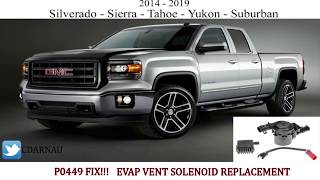
🎬 See how to replace the solenoid on 2014-2019 trucks.Symptoms You May Notice
- Check Engine Light is on.
- Difficulty filling the fuel tank (gas pump nozzle clicks off repeatedly). This is a classic symptom directly linked to a stuck-closed or restricted vent path.
- Possible faint fuel odor, especially near the driver's side by the tank.
- May be accompanied by a gas cap warning message on the dash, though this is less common for a circuit code.
- Replacing the gas cap. A loose or faulty gas cap will typically cause an EVAP leak code (like P0455 or P0442), not a circuit code like P0449.
- Replacing the EVAP Purge Solenoid. The purge solenoid is located in the engine bay, while the P0449 code refers to the vent solenoid located under the truck by the tank. Don't confuse the two parts.
Most Likely Causes

- Failed EVAP Canister Vent Solenoid 🔴 High Probability The solenoid is mounted under the truck, exposed to the elements. The internal coil can fail electrically, or the valve mechanism can get stuck from dirt and dust intrusion. The plastic housing is also known to crack from age and corrosion of internal metal parts, which is a visually obvious failure. [15, 19, Bulletin #23-NA-073]
How to confirm: With a capable scan tool, command the vent solenoid to open and close; you should hear an audible click from the part 🎬 Watch this video to see a P0449 diagnostic and repair. under the truck. If it doesn't click but has power and ground, the solenoid is bad. You can also remove it and test its resistance with a multimeter; a good solenoid should read between 20-30 ohms. By default, it should be open (air passes through) and should close when 12V is applied.
Typical fix: Replace the EVAP canister vent solenoid. It is located on the driver's side, mounted to a crossmember near the fuel tank or directly on the charcoal canister.
Est. part cost: $30-$75 - Broken or Corroded Wiring/Connector 🟡 Medium Probability The wiring harness leading to the vent solenoid is highly susceptible to damage. Wires, particularly the white ground wire, can corrode and break inside the insulation, often right at the connector where moisture collects. This break may not be visible without peeling back the loom and carefully inspecting the wires.
How to confirm: Visually inspect the wiring harness going to the vent solenoid. Peel back any loom or tape near the connector and check for green corrosion ('green crusties') or broken wires. Tug gently on each wire at the connector to see if it stretches or breaks. Use a multimeter to check for 12V power (key on, typically a red or orange wire) and a good ground (typically a white wire) at the connector.
Typical fix: If a wire is broken, the best fix is to splice in a new connector pigtail (ACDelco PT2160 is a common part) using waterproof heat-shrink butt connectors. Simply taping a broken wire is a temporary fix at best.
Est. part cost: $10-$25 - Clogged EVAP Canister or Vent Filter/Hose ⚪ Low Probability For trucks used in dusty conditions (farms, dirt roads, construction sites), dust can be pulled into the EVAP system's fresh air intake, clogging the canister and vent lines. [Bulletin #23-NA-073, 6]
How to confirm: After removing the vent solenoid, inspect the attached hoses and the port on the charcoal canister for significant amounts of dirt, dust, or debris. If the solenoid is full of dirt, the canister is likely compromised and the source of the fresh air needs to be addressed.
Typical fix: Replace the charcoal canister and the vent solenoid. To prevent recurrence, GM issued TSB #23-NA-073 which details retrofitting a remote air filter into the vent line. This is considered a customer-pay alteration, not a warranty repair. The filter then becomes a periodic maintenance item.
Est. part cost: $150-$400 - Blown Fuse ⚪ Low Probability
How to confirm: Check the fuse box diagrams in your owner's manual for any fuses related to the emissions or EVAP system. On some models, this may be a 10A fuse labeled 'EMISSIONS' or similar in the underhood fuse box. Pull the fuse and visually inspect it.
Typical fix: Replace the blown fuse. If it blows again, there is a short circuit in the system (e.g., melted wiring, shorted solenoid) that needs to be diagnosed.
Est. part cost: $1-$5
Rare But Worth Checking
- Faulty Powertrain Control Module (PCM): This is extremely rare. The PCM should only be considered after all other possibilities, including the entire wiring harness between the PCM and the solenoid, have been exhaustively tested and ruled out.
Diagnosis Steps
- Read the code with an OBD-II scanner to confirm P0449 is present.
- Check the emissions-related fuses (e.g., Fuse 34, 10A on some models) in the underhood fuse box.
- Locate the EVAP vent solenoid under the truck, on the driver's side frame rail, near the fuel tank.
- Carefully inspect the electrical connector and the wires leading to it. Peel back the plastic loom and look for any signs of corrosion (green crust) or broken wires, paying close attention to the white ground wire.
- If wiring looks good, use a scan tool to command the solenoid on and off. Listen for a click.
- If it does not click, disconnect the connector. Use a multimeter to verify you have 12-volt power on one pin (usually red or orange wire) with the key on.
- Check the solenoid's internal resistance across its two pins. A good reading is typically between 20 and 30 ohms. An open circuit (infinite resistance) or short (very low resistance) indicates a failed solenoid.
- If power is present at the connector and the solenoid resistance is good, but it doesn't click, the problem is likely in the ground control wire (usually white) leading back to the PCM. Check this wire for continuity.
- If power or ground is missing at the connector, the wiring between the connector and the fuse box/PCM is faulty and needs to be repaired. The ground wire breaking at the connector is the most common wiring failure.
- If the old solenoid is full of dirt upon removal, the charcoal canister is likely contaminated and should also be replaced. Consider performing the filter relocation modification described in TSB #23-NA-073 to prevent a repeat failure.
Parts You'll Likely Need
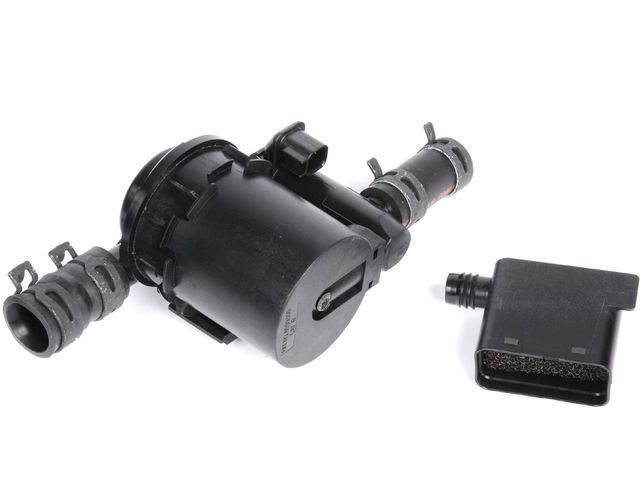
- EVAP Canister Vent Solenoid
(OEM #23481275)
Related Codes That Often Appear With This One
- P0455 — EVAP System Leak Detected (Large Leak). A vent solenoid that is stuck open, has a cracked housing, or has a broken seal will be detected by the PCM as a large leak.
- P0446 — EVAP Vent System Performance/Restricted. This code can appear if the vent solenoid is stuck closed or the vent path is clogged with dust or debris, which is a common cause of the 'hard to fill fuel tank' symptom.
Technical Service Bulletins (TSBs) & Recalls
- 23-NA-073: Addresses DTC P0449 caused by dust intrusion into the EVAP canister and vent solenoid on trucks used in dusty environments. Recommends a customer-pay filter relocation.
- 15-06-04-002: Mentions P0449 in relation to customer complaints of the Malfunction Indicator Lamp being on and the fuel tank being hard to fill.
- 09-06-04-028D: An earlier TSB that also details the replacement of the EVAP vent control solenoid with an updated part and relocating the filter to avoid contamination.
Platform-Specific Known Issues
- TSB #23-NA-073 notes that trucks in dusty environments can ingest dust, clogging the EVAP canister and vent solenoid, causing a P0449 code. The official fix is a customer-pay filter relocation modification.
- TSB #15-06-04-002 links code P0449 with the symptom of the fuel tank being hard to fill due to dirt/water intrusion into the vent system.
- TSB #09-06-04-028D also outlines replacing the solenoid with an updated valve assembly and relocating the filter to prevent water and dirt contamination.
Mechanic-Grade Diagnostic Values
- EVAP Vent Solenoid Coil Resistance — expected: 20 to 30 Ohms. Failure: Infinite resistance (open) or near-zero resistance (short).
- Voltage at Solenoid Connector (Key On, Engine Off) — expected: 12V on the power wire (typically Red) and 0V on the control wire (typically White) when disconnected. When connected, the control wire may also show 12V if the circuit is open downstream.. Failure: 0V on the power wire indicates a blown fuse or open power wire. 12V on the control wire with the solenoid connected and commanded OFF suggests an open in the control wire back to the PCM.
Scan Tool Commands That Help
- GDS2 / Professional Scan Tool: EVAP Vent Solenoid Output Control — Use this bidirectional command to manually turn the solenoid on and off with the key on, engine off. This allows you to listen for an audible click from the solenoid and test for power and ground at the connector without running a full drive cycle.
Wiring & Ground Locations

- EVAP Vent Solenoid Connector — Under the truck on the driver's side, attached to the EVAP vent solenoid near the fuel tank/charcoal canister.. This is the most common point of failure. The power wire (often Red) should have 12V+ with the key on. The control wire (often White) is grounded by the PCM to activate the solenoid. This white wire frequently corrodes and breaks inside the insulation right at the connector.
- Underhood Fuse Block - 'EMISSIONS' Fuse — In the main fuse box in the engine bay, on the driver's side. On some models, this is Fuse 34 (10A).. This fuse provides the 12V power to the EVAP vent solenoid. If this fuse is blown, the solenoid will have no power, triggering a P0449. If it blows repeatedly, there is a short circuit in the harness or solenoid.
Real Owner Repair Stories
- YouTube - '2018 Silverado: P0449 repair' by Chaotic Junktion (2018 Chevrolet Silverado 1500) — P0449 Check Engine Light returned one year after replacing the vent solenoid.
❌ Tried (didn't work) The previously replaced vent solenoid was still good.
✅ What actually fixed it The white ground wire was found to be completely corroded and broken inside the insulation, right at the connector. The final fix was cutting off the old connector and splicing in a new pigtail (ACDelco PT2160). - YouTube - 'GMC / CHEVY Truck - DTC P0449' by South Main Auto LLC (GMC Sierra (similar platform)) — P0449 Check Engine Light.
❌ Tried (didn't work) Checking the fuse, which was good., Commanding the solenoid with a scan tool, which produced no click.
✅ What actually fixed it Diagnosis revealed 12V at the fuse but 0V at the solenoid connector. The technician found an open in the red power wire somewhere between the fuse box and the solenoid. The repair involved running a new power wire to the solenoid.
"I Checked Everything" — The Actual Cause
- P0449 is a circuit code, not a leak code, so a smoke test is not the primary diagnostic step and is expected to pass if P0449 is the only code present. A common trap occurs when a leak code (like P0455) is also present due to a physically cracked solenoid housing. A technician might perform a smoke test, see the crack, replace the solenoid to fix the leak, but fail to verify the electrical repair. If the wiring connector was the original cause of the P0449, the code will return even with the new solenoid installed.
When the Usual Fixes Don't Work
- While the vast majority of P0449 codes on these trucks are fixed by replacing the vent solenoid or the connector pigtail due to a broken ground wire, there are documented cases where this does not solve the problem. In one instance, the fault was an open circuit in the 12V+ power supply wire (red wire) somewhere along the frame rail between the underhood fuse box and the solenoid. This required tracing the entire length of the wire to find the break, a significantly more time-consuming diagnosis than the common pigtail replacement.
OEM Part Supersession History
Various (e.g., 25932571)→ACDelco 214-2149— Standard replacement part for the earlier generation.
Heads up: This part is for the GMT900 platform and is not compatible with 2014+ K2XX trucks.Multiple (10382080, 15893884, 20995471, 25932566, etc.)→GM 23481275— Multiple design revisions and consolidations by the manufacturer.
Heads up: This is the correct part for the newer generation. Some early replacements may have required a new harness connector, but current kits are typically direct fit.
Model Year Variations Within This Range
- 2011-2013 (GMT900): The vent solenoid is typically mounted on a bracket on the driver's side frame rail, separate from the charcoal canister. It uses part number 214-2149 or equivalent.
- 2014-2018 (K2XX): The vent solenoid has a different design and is mounted directly onto the charcoal canister assembly. It uses part number 23481275.
- 2014-2019: The K2XX generation has three fuse boxes (underhood, driver dash, passenger dash). The fuse for the EVAP system is located in the underhood fuse box.
Helpful Videos

Used OEM Parts in Stock
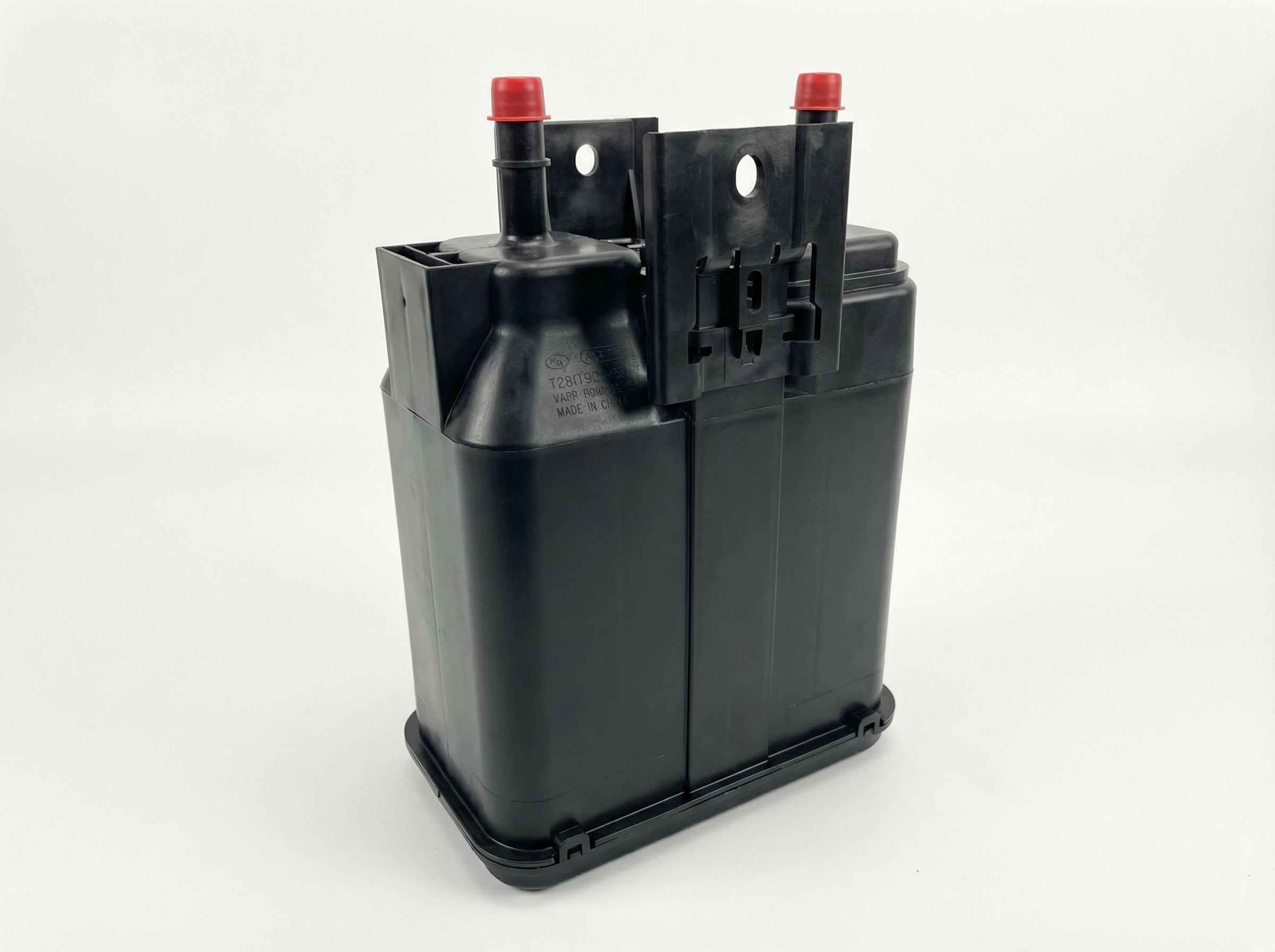


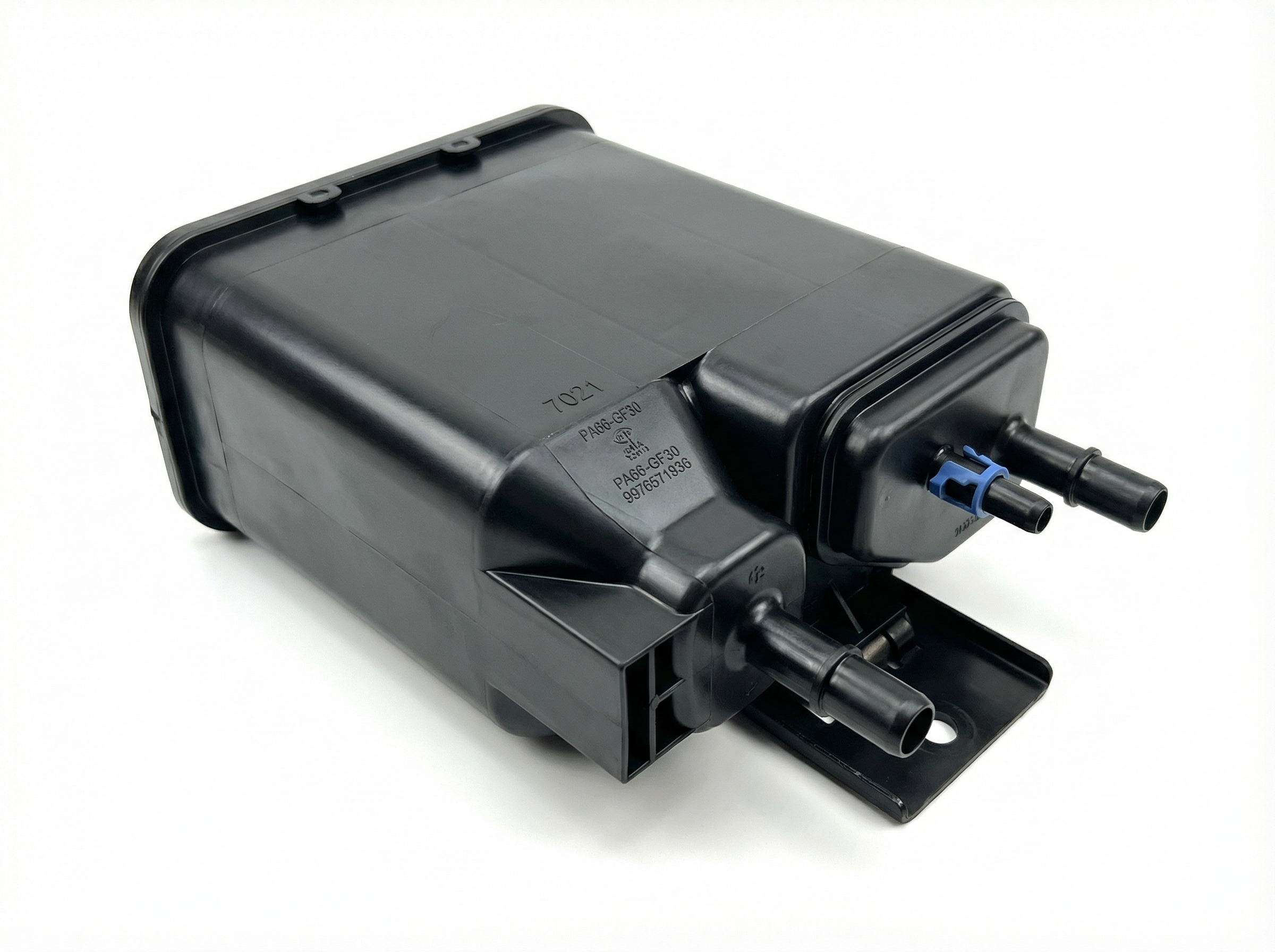

New Aftermarket Parts Available



The information in this article is provided for general reference and educational purposes only. Vehicle specifications, procedures, and part compatibility can vary by production date, trim level, and region. Always consult your vehicle's factory service manual and verify part numbers before purchasing or performing repairs. Safety-critical components such as airbags, seat belts, and braking systems should be installed by a qualified professional.
- Chevrolet SILVERADO 1500:
- 🎬 Helpful Videos
- 🛍️ Shop This Part
- What's Unique About the 2011-2018 Chevrolet SILVERADO 1500
- Diagnostic Flowchart
- Symptoms You May Notice
- Most Likely Causes
- Rare But Worth Checking
- Diagnosis Steps
- Parts You'll Likely Need
- Related Codes That Often Appear With This One
- Technical Service Bulletins (TSBs) & Recalls
- Platform-Specific Known Issues
- Mechanic-Grade Diagnostic Values
- Scan Tool Commands That Help
- Wiring & Ground Locations
- Real Owner Repair Stories
- "I Checked Everything" — The Actual Cause
- When the Usual Fixes Don't Work
- OEM Part Supersession History
- Model Year Variations Within This Range
- 🎟️ Get 5% Off