

P0442 on 2004-2010 Mazda MAZDA3: EVAP Leak Causes and Fixes
On a 2004-2010 Mazda3, code P0442 is often caused by a cracked fuel pump lock ring under the rear seat or a faulty gas cap. Check the gas cap first (tighten or replace). Then, lift the rear seat and smell for gas near the fuel pump access panel; a strong odor strongly suggests the common cracked lock ring issue before you replace any other parts.
- Always start with the simplest fix: inspect and tighten the gas cap.
- For the 2004-2010 Mazda3, the second most likely cause is a cracked fuel pump lock ring, accessible under the rear seat.
- A strong fuel smell around the rear of the car is a major clue that the leak is more than just a bad gas cap.
- If you experience long cranking times after filling your gas tank, the purge solenoid valve in the engine bay is a likely culprit.
- If simpler checks don't find the issue, a professional smoke test is the most reliable way to locate the small leak.
What's Unique About the 2004-2010 Mazda MAZDA3
While many cars get P0442 from a loose gas cap, the first-generation Mazda3 (2004-2009) is particularly known for a brittle plastic fuel pump lock ring. This ring, located on top of the fuel tank, is prone to cracking over time, causing a small fuel vapor leak that perfectly matches the P0442 criteria. This issue is so common that it should be one of the primary suspects after checking the gas cap, a fact supported by numerous owner complaints and detailed forum threads.
Diagnostic Flowchart
Tap your situation to follow the diagnostic path that matches what you're seeing on this vehicle.
Generation note: This range covers the entire first generation (BK, 2004-2009) and the first year of the second generation (BL, 2010). The cracked fuel pump lock ring is a very common issue on the first generation. While the EVAP system components are similar, the lock ring failure is less frequently reported for the 2010 model year, though other EVAP components like purge and vent valves can still fail.
Symptoms You May Notice
- Check Engine Light is on
- A faint to strong smell of gasoline, especially around the rear of the car, inside the cabin, or after filling the tank.
- Difficulty starting the engine immediately after refueling (long crank time), which can point to a faulty purge valve stuck open.
- Visible fuel dripping from the top of the gas tank after a fill-up, a sure sign of a cracked lock ring or seal failure.
- Replacing the purge or vent valve when the actual problem is the fuel pump lock ring. Many owners and shops may not be aware of this specific Mazda3 issue and will start with more conventional EVAP parts, only to have the code return.
Most Likely Causes
- Loose or Faulty Gas Cap 🔴 High Probability This is the most common cause for any vehicle. The cap's rubber O-ring seal can degrade, crack, or get dirty over time, preventing a proper seal.
How to confirm: Ensure the cap is tightened until it clicks at least once. Inspect the rubber O-ring for cracks, stiffness, or wear. An OEM cap is recommended for best fitment.
Typical fix: Tighten or replace the gas cap. An OEM cap for the 2004-2009 Mazda3 is part number BNYF-42-250. Clear the code and drive for a few days.
Est. part cost: $20-$40 - Cracked Fuel Pump Lock Ring 🔴 High Probability The first-generation Mazda3 uses a plastic lock ring on top of the fuel tank that becomes brittle with age and heat cycles, leading to cracks that break the EVAP system seal. This is a well-documented, widespread issue for this specific model.
How to confirm: Lift the rear seat bottom (it pulls up). Remove the four screws on the metal access plate. Visually inspect the large black plastic ring for any hairline cracks. A strong fuel smell in this area is a major clue, even without a visible crack. You may also see fuel residue or dirt collected in the cracked area. This was cited in NHTSA complaint #11439442 for a 2009 model.
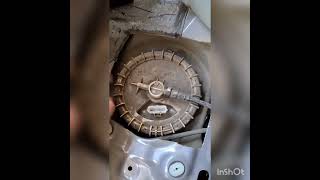
Typical fix: The fuel tank must be partially dropped to gain enough clearance to remove and replace the cracked lock ring and its corresponding O-ring seal. Some owners have opted to cut a larger access hole in the sheet metal under the seat to avoid dropping the tank, as shown in a YouTube repair. 🎬 Watch: How to replace the lock ring by cutting an access hole.
Est. part cost: $30-$60 - Faulty EVAP Purge Solenoid Valve 🟡 Medium Probability This valve is frequently cycled by the engine computer and can wear out, either failing to open or, more commonly for this code, getting stuck partially open, creating a leak.
How to confirm: The valve is located in the engine bay, on the passenger side, near the intake manifold. When disconnected and de-energized, it should be closed. Remove it and try to blow through it; if any air passes, it is faulty and needs replacement.
Typical fix: Replace the purge solenoid valve. It is typically mounted near the intake manifold. Dorman part 911-701 is a common aftermarket replacement for the valve itself.
Est. part cost: $30-$130 - Cracked or Disconnected EVAP Hoses ⚪ Low Probability
How to confirm: Visually inspect all accessible EVAP lines in the engine bay and under the car near the canister for brittleness, cracks, or loose connections. A smoke test is the most effective method for finding small cracks in hoses that are not visually obvious.
Typical fix: Replace the damaged section of hose.
Est. part cost: $10-$30
Rare But Worth Checking
- Leaking Charcoal Canister: The plastic housing of the canister itself can develop hairline cracks over time, but this is less common than valve or hose failures.
- Faulty EVAP Canister Vent Solenoid: Located at the rear of the car near the charcoal canister, this valve is normally open and closes to seal the system for testing. If it fails to close completely, it can cause a P0442. It can be tested by applying 12V to see if it actuates and holds a seal. Replacement often requires lowering the rear subframe for access.
Diagnosis Steps
- Step 1: Check the Gas Cap. Remove it, inspect the seal for damage, and reinstall it, ensuring it clicks several times. Clear the code and drive for a few days to see if it returns. If in doubt, replace it with an OEM cap (Part # BNYF-42-250).
- Step 2: Inspect the Fuel Pump Lock Ring. Lift the rear seat cushion and remove the fuel pump access cover. Use a flashlight and your nose. A strong fuel smell is the key indicator. Carefully inspect the large plastic lock ring for any visible cracks or fuel residue.
- Step 3: Inspect the Purge Solenoid Valve. Locate the valve in the engine bay near the intake manifold. Disconnect the electrical connector and hoses. Attempt to blow air through it. If air passes, the valve is stuck open and must be replaced.
- Step 4: Visually Inspect EVAP Hoses. Check all visible EVAP system hoses for obvious cracks, brittleness, or loose connections, particularly around the engine bay and near the rear canister.
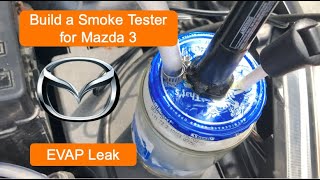
- Step 5: Perform a Smoke Test. If the leak source is still not found, a smoke test is the definitive diagnostic procedure. A technician will inject pressurized smoke into the EVAP system to reveal the precise location of any small leaks 🎬 Watch: How to build a smoke tester and find leaks. from hoses, the canister, or valves.
Parts You'll Likely Need
- Fuel Pump Lock Ring and Seal
(OEM #BN8F-42-167 (Ring), BN8F-42-166 (Seal))— This is a very common failure point on the 2004-2009 Mazda3, causing a small EVAP leak from the top of the fuel tank.
Trusted brands: Mazda OE, Dorman (P/N: 579-204)
OEM price range: $30-$60
Aftermarket price range: $20-$40 - Gas Cap
(OEM #BNYF-42-250)— The simplest and most common cause of a P0442 code. The seal wears out over time.
Trusted brands: Mazda OE, Stant, Gates (P/N: 31857)
OEM price range: $25-$40
Aftermarket price range: $10-$25 - Vapor Canister Purge Solenoid Valve
(OEM #PE01-18-751 (Note: verify by VIN, multiple parts exist))— A common failure that can get stuck open, causing a leak and sometimes hard starting after refueling.
Trusted brands: Dorman (P/N: 911-701), Bosch, Mazda OE
OEM price range: $100-$150
Aftermarket price range: $30-$100
Related Codes That Often Appear With This One
- P0455 — A large EVAP leak. Sometimes a crack in the fuel pump lock ring can be large enough to trigger both P0442 and P0455, as seen in NHTSA complaint #11439442.
- P0456 — A very small EVAP leak. This code can appear along with P0442 if the leak size is on the borderline between the two thresholds.
Technical Service Bulletins (TSBs) & Recalls
- Bulletin #01-002-18-3417: MULTI-MODEL - DETERMINING EVAPORATIVE SYSTEM LEAK LOCATION FOR DTCs P0441 / P0442 / P0455 / P0456
Platform-Specific Known Issues
- NHTSA Owner Complaint ODI #11439442 for a 2009 Mazdaspeed3 explicitly links codes P0442 and P0455 to a failed fuel pump lock ring, accompanied by a strong gasoline smell.
- Mazda issued TSB #01-002-18-3417, which provides a detailed procedure for dealerships to diagnose EVAP leaks causing codes P0441, P0442, P0455, or P0456, acknowledging the complexity of finding these leaks on models including the 2004-2010 Mazda3.
Mechanic-Grade Diagnostic Values
- Purge Solenoid Coil Resistance — expected: 20-38 Ohms at room temperature. A good reading of 36 Ohms was reported at ~60°F.. Failure: An infinite reading (open circuit) or zero Ohms (short circuit) indicates a failed solenoid.
- Fuel Tank Pressure (FTP) Sensor Voltage — expected: Approximately 2.5V with the gas cap off (at atmospheric pressure). Voltage should decrease towards ~1.5V as light vacuum is applied.. Failure: A reading stuck at 0V, 5V, or a value that does not change when vacuum is applied indicates a faulty sensor.
Scan Tool Commands That Help
- Mazda Modular Diagnostic System (M-MDS): EVAP test (KOEO) — For 2004-2009 models, this is the dealer-level automated test to seal the EVAP system and check for pressure loss without a smoke machine. This function was discontinued for the 2010 model year.
- Advanced OBD2 Scanner (e.g., XTOOL, Snap-on): EVAP Canister Vent Valve Control — Use this bidirectional command to manually close the canister vent solenoid. This seals the rear of the system, allowing you to isolate and test for leaks in the tank, hoses, and purge valve.
Wiring & Ground Locations
- G6 — Left rear of engine.. A poor ground connection for engine-mounted sensors or the PCM could potentially affect EVAP system sensor readings.
- G11 — Below driver's seat.. This ground point is in the vicinity of the fuel tank and fuel pump module, and could be relevant for the fuel tank pressure sensor or other nearby components.
- G12 — Below center console.. Provides a grounding point for various interior and chassis electronics; a fault here could cause erratic behavior in multiple systems.
- Purge Solenoid Connector — Engine bay, on the passenger side, near the intake manifold.. This is a 2-terminal female connector. Knowing the pinout is required for resistance and voltage tests directly at the solenoid.
- EVAP Leak Detection Pump — Under the rear of the vehicle, near the charcoal canister.. This is the location of the vent solenoid and charcoal canister, common sources of EVAP leaks.
"I Checked Everything" — The Actual Cause
- In some cases, a smoke test may pass with no visible leaks, yet the P0442 code persists. The root cause can be a faulty Fuel Tank Pressure (FTP) sensor. The sensor itself provides incorrect pressure readings to the ECU, tricking the computer into thinking there is a leak when the system is actually sealed. The fix is to test the sensor's voltage output directly, rather than continuing to search for a non-existent physical leak.
OEM Part Supersession History
GP9A-42-167→BN8F-42-167— Part revision or supplier change for the fuel pump lock ring.Dorman 911-700 (Valve with Hose)→Dorman 911-701 (Valve Only)— Cost-saving alternative.
Heads up: A common trap is that parts catalogs may incorrectly list the Dorman 911-702 (for Mazda 6) or the expensive 911-700 assembly for the Mazda 3. For a first-generation Mazda 3, the correct and much cheaper valve-only replacement is Dorman 911-701, which fits the original housing and hose.
Model Year Variations Within This Range
- 2004-2009 (BK Generation): This generation was heavily based on the Ford C1 platform and is widely known for the brittle fuel pump lock ring failure. It also used the M-MDS dealer scan tool's automated EVAP test function.
- 2010 (BL Generation Start): The official Mazda diagnostic procedure changed. The automated 'EVAP test (KOEO)' function in the M-MDS was discontinued for the 2010 model year and replaced with a procedure that requires the use of an external EVAP leak tester (smoke machine). This marks a significant shift in how dealerships were instructed to find leaks.
Helpful Videos
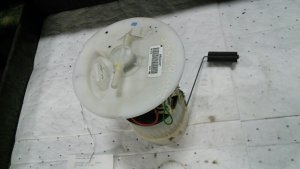
Used OEM Parts in Stock




New Aftermarket Parts Available


The information in this article is provided for general reference and educational purposes only. Vehicle specifications, procedures, and part compatibility can vary by production date, trim level, and region. Always consult your vehicle's factory service manual and verify part numbers before purchasing or performing repairs. Safety-critical components such as airbags, seat belts, and braking systems should be installed by a qualified professional.
- Mazda MAZDA3:
- 🎬 Helpful Videos
- 🛍️ Shop This Part
- What's Unique About the 2004-2010 Mazda MAZDA3
- Diagnostic Flowchart
- Symptoms You May Notice
- Most Likely Causes
- Rare But Worth Checking
- Diagnosis Steps
- Parts You'll Likely Need
- Related Codes That Often Appear With This One
- Technical Service Bulletins (TSBs) & Recalls
- Platform-Specific Known Issues
- Mechanic-Grade Diagnostic Values
- Scan Tool Commands That Help
- Wiring & Ground Locations
- "I Checked Everything" — The Actual Cause
- OEM Part Supersession History
- Model Year Variations Within This Range
- 🎟️ Get 5% Off