

P0442 on 2010-2014 Chevrolet Express: EVAP Small Leak Causes and Fixes
For a 2010-2014 Chevy Express, a P0442 code is most often caused by a loose or faulty gas cap, sometimes due to the tether getting in the way. If the cap is good, the next most likely culprit is a failed EVAP vent solenoid located near the fuel tank. A new gas cap is about $15-$30, while a vent solenoid is around $30-$60.
- Always check the gas cap first for a P0442 code. Make sure it's tight and the tether isn't in the way.
- If the gas cap isn't the issue, the EVAP vent solenoid, located near the fuel tank, is the next most likely part to have failed.
- You can safely drive with this code, but you will not pass an emissions inspection until the leak is fixed.
- A smoke test is the fastest and most accurate way to find the leak if it's not the gas cap.
What's Unique About the 2010-2014 Chevrolet EXPRESS
On this generation of Chevrolet Express, a known issue is the fuel cap tether binding, which can prevent the cap from sealing correctly and directly cause a P0442 code, as noted in a GM Technical Service Bulletin (TSB). Additionally, like many GM trucks and vans, the EVAP vent solenoid is mounted under the vehicle where it's exposed to road grime and moisture, making it a very common failure point leading to this specific leak code. A GM TSB also notes that vans used in dusty environments are prone to clogged vapor canister vent solenoids.
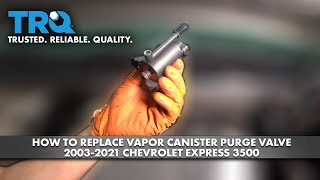
🎬 Watch: How to replace the vent solenoid on an Express van.Diagnostic Flowchart
Tap your situation to follow the diagnostic path that matches what you're seeing on this vehicle.
Symptoms You May Notice
- Check Engine Light is on
- A faint smell of fuel, particularly around the rear of the vehicle
- Difficulty starting immediately after refueling (less common with P0442, but possible)
- Replacing the purge valve when the gas cap or vent valve is the actual problem. The gas cap is the most common and cheapest fix and should always be checked first.
Most Likely Causes


- Loose or Faulty Gas Cap 🔴 High Probability A GM Technical Service Bulletin (PI0873) specifically mentions the fuel cap tether binding and preventing a proper seal on these vehicles.
How to confirm: Remove the gas cap and inspect the rubber seal for cracks or damage. Check that the tether isn't caught under the cap. Reinstall the cap, ensuring it clicks several times. Clear the code and see if it returns.
Typical fix: Replace the gas cap with a new OEM or equivalent part.
Est. part cost: $15-$30 - Failed EVAP Vent Solenoid 🟡 Medium Probability The vent solenoid is located under the van near the fuel tank, where it is exposed to road salt, water, and debris, causing it to fail by sticking open or closed.
How to confirm: The solenoid can be tested with a capable scan tool to command it open and closed. A more definitive test is to use a smoke machine to see if smoke escapes from the vent solenoid when it is commanded closed.
Typical fix: Replace the EVAP vent solenoid. It is typically mounted on or near the charcoal canister.
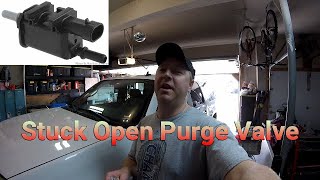
Est. part cost: $30-$60 - Failed EVAP Purge Valve/Solenoid ⚪ Low Probability The purge valve, located on the engine, can fail by not closing completely, creating a small leak path. While less common for a small leak code than the vent solenoid, it is a frequent failure point in the EVAP system.
How to confirm: With the engine off, disconnect the hose leading from the purge valve to the intake manifold and apply vacuum with a hand pump. If it doesn't hold vacuum, it's leaking and needs to be replaced.
Typical fix: Replace the purge valve. This part is easily accessible on top of the engine.
Est. part cost: $25-$55 - Cracked or Disconnected EVAP Hoses ⚪ Low Probability Over time, the rubber and plastic hoses in the EVAP system can become brittle and crack, especially in areas with extreme temperatures.
How to confirm: A visual inspection may reveal obvious cracks, but the best method is to introduce smoke into the EVAP system with a smoke machine and look for where the smoke escapes.
Typical fix: Replace the damaged section of hose.
Est. part cost: $10-$50
Rare But Worth Checking
- Leaking Charcoal Canister: The plastic housing of the charcoal canister itself can develop small cracks over time, creating a leak. This is usually found with a smoke test after all other common components have been checked.
- Faulty Fuel Tank Pressure (FTP) Sensor: In rare cases, the sensor that measures the pressure in the EVAP system can provide a false reading to the computer, causing it to set a leak code when no leak exists.
Diagnosis Steps

- Visually inspect the gas cap for damage and ensure it is tightened until it clicks at least three times. Pay close attention to the tether to ensure it is not preventing a good seal, as noted in TSB PI0873.
- If the gas cap is old or worn, replace it, clear the code, and drive for a few days to see if the light returns. This is the most common and inexpensive fix.
- If the code returns, visually inspect all accessible EVAP hoses between the engine, charcoal canister, and fuel tank for obvious cracks or disconnections.
- Locate the EVAP purge valve on the engine. With the engine off, disconnect it and test if it holds vacuum. If it leaks, it needs replacement.
- Locate the EVAP vent solenoid near the fuel tank. Inspect it and its connector for damage or corrosion.
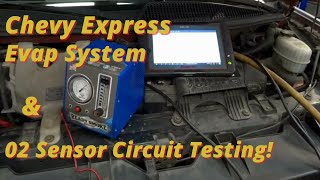
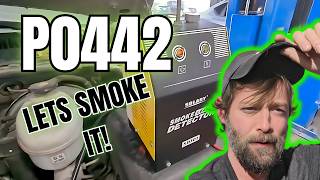
- The most definitive diagnostic step is to use an automotive smoke machine. Connect the machine to the EVAP service port and gently fill the system with smoke. Look for smoke leaking from the gas cap, any hoses, the purge valve, the vent solenoid, or the charcoal canister to pinpoint the exact source of the leak.
Parts You'll Likely Need

- Fuel Cap — This is the most common cause of a P0442 code. A GM TSB specifically notes that the tether can interfere with proper sealing on these vans.
Trusted brands: ACDelco, Stant
OEM price range: $20-$35
Aftermarket price range: $15-$25 - EVAP Vapor Canister Vent Solenoid
(OEM #25932571)— A very common failure item due to its exposed location under the vehicle. It often gets stuck, creating a small leak.
Trusted brands: ACDelco, Dorman
OEM price range: $40-$60
Aftermarket price range: $25-$45 - EVAP Vapor Canister Purge Valve
(OEM #214-1105)— While less likely to cause a small leak than the vent valve, this part is a common failure point in the EVAP system and can get stuck slightly open.
Trusted brands: ACDelco, Dorman, Standard Motor Products
OEM price range: $45-$65
Aftermarket price range: $25-$55
Related Codes That Often Appear With This One
- P0455 — This code indicates a large EVAP leak. Seeing it with P0442 can suggest an intermittent, significant leak, such as a vent solenoid that is sticking open. The TSBs for the Express van often list P0442 and P0455 together.
- P0449 — This code points specifically to a fault in the EVAP vent solenoid's electrical circuit. If you have P0442 and P0449 together, the vent solenoid or its wiring is almost certainly the problem.
Technical Service Bulletins (TSBs) & Recalls
- PI0873: Addresses a binding fuel cap tether causing EVAP codes P0442/P0455.
- 21-NA-124: Provides diagnostic tips for EVAP system leaks that set codes P0442 and/or P0455.
- PIT4943D: Directs technicians to a specific Techlink article for using an EVAP system tester to diagnose code P0442.
Platform-Specific Known Issues
- Technical Service Bulletin PI0873 specifically calls out an issue where the fuel cap tether can get caught, preventing the cap from sealing and causing P0442 and/or P0455 codes.
- Technical Service Bulletin 21-NA-124 provides general diagnostic advice for finding EVAP leaks related to code P0442, confirming it's a known issue requiring careful diagnosis.
Mechanic-Grade Diagnostic Values
- Fuel Tank Pressure (FTP) Sensor Voltage — expected: Approximately 1.5V with the gas cap off (atmospheric pressure). Range of 1.3V to 1.7V is acceptable.. Failure: A reading stuck high near 4.8V-5.0V, or very low near 0V, indicates a sensor or wiring fault.
- EVAP Vent Solenoid Control Wire Voltage — expected: Approximately 12V (battery voltage) when the solenoid is commanded OFF (de-energized).. Failure: Near 0V when commanded OFF indicates a short to ground. Reading 12V when commanded ON indicates an open in the control wire or a bad solenoid.
Scan Tool Commands That Help
- GDS2 / Tech2 / Professional Scan Tool: EVAP Purge/Seal Test — This is a guided diagnostic function that commands the purge and vent solenoids to seal the system, then monitors the FTP sensor to see if vacuum/pressure holds, confirming a leak is present.
- GDS2 / Tech2 / Professional Scan Tool: EVAP Vent Solenoid Command — Used to manually close the normally-open vent solenoid. This is required to seal the system before performing a smoke test to find the physical location of a leak.
- GDS2 / Tech2 / Professional Scan Tool: EVAP Purge Solenoid Command — Used to manually command the normally-closed purge solenoid open and closed to check for mechanical function (audible click) or to isolate parts of the system during diagnosis.
Wiring & Ground Locations
- G400 — On the inner left rear frame rail.. This is a primary ground point for components located at the rear of the vehicle, including the fuel tank and EVAP system components like the vent solenoid. A corroded or loose G400 can cause intermittent electrical issues for the EVAP system.
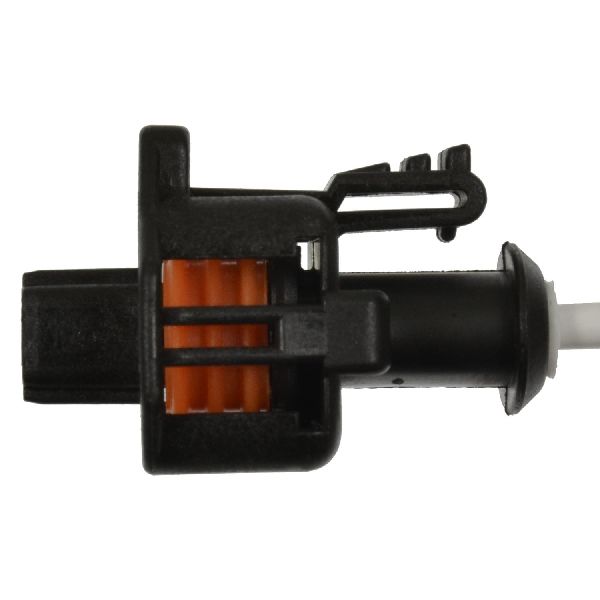
- EVAP Canister Vent Solenoid Connector — Near the front of the fuel tank, connected to the vent solenoid.. This connector is exposed to the elements under the van. Corrosion or broken wires within this connector are a common failure point that can set codes like P0449 and mimic a failed solenoid.
- G103 — On the left rear of the engine.. This is one of the main engine grounds. While less likely to be the sole cause for a P0442, a poor ground here can affect the Engine Control Module's (ECM) reference and sensor readings.
Real Owner Repair Stories
- 2CarPros Forum (2000-2005 Mitsubishi Eclipse (similar principle applies to steel filler necks on vans)) — Persistent P0442 code that could not be identified through normal testing.
❌ Tried (didn't work) Unspecified, but implied standard checks did not find the leak.
✅ What actually fixed it The owner noticed a fuel leak from the filler neck area only while actively pumping gas. The cause was a completely rusted-out metal fuel filler neck. Replacing the filler neck resolved both the fuel leak and the P0442 code.
"I Checked Everything" — The Actual Cause
- In some cases, a smoke test may not reveal a leak, but the code persists. This can happen if the EVAP purge valve on the engine is not sealing completely under vacuum, but appears closed during a static smoke test. Testing the purge valve separately with a hand vacuum pump can reveal if it's leaking.
- A faulty Fuel Tank Pressure (FTP) sensor can send incorrect readings to the computer, making it believe there is a leak when the system is perfectly sealed. If a thorough smoke test reveals no leaks, testing the FTP sensor's voltage output is the next step.
OEM Part Supersession History
10382105, 15750484, 22728634→25932571— Part consolidation and redesign for the EVAP Vapor Canister Vent Solenoid.
Heads up: Some parts suppliers warn that the redesigned part (25932571) may not be a direct fit for all vehicles it's listed for and recommend verifying with a VIN before purchase.
Helpful Videos
Used OEM Parts in Stock
New Aftermarket Parts Available



The information in this article is provided for general reference and educational purposes only. Vehicle specifications, procedures, and part compatibility can vary by production date, trim level, and region. Always consult your vehicle's factory service manual and verify part numbers before purchasing or performing repairs. Safety-critical components such as airbags, seat belts, and braking systems should be installed by a qualified professional.
- Chevrolet EXPRESS:
- 🎬 Helpful Videos
- 🛍️ Shop This Part
- What's Unique About the 2010-2014 Chevrolet EXPRESS
- Diagnostic Flowchart
- Symptoms You May Notice
- Most Likely Causes
- Rare But Worth Checking
- Diagnosis Steps
- Parts You'll Likely Need
- Related Codes That Often Appear With This One
- Technical Service Bulletins (TSBs) & Recalls
- Platform-Specific Known Issues
- Mechanic-Grade Diagnostic Values
- Scan Tool Commands That Help
- Wiring & Ground Locations
- Real Owner Repair Stories
- "I Checked Everything" — The Actual Cause
- OEM Part Supersession History
- 🎟️ Get 5% Off