

P0441 on 2017-2022 Honda CR-V: EVAP Purge Flow Malfunction Causes and Fixes
On a 2017-2022 Honda CR-V, code P0441 is almost always caused by a faulty canister purge valve. It's a well-known issue confirmed by Honda TSBs and is a simple 15-20 minute DIY replacement costing between $50 and $150 for the part.
- P0441 on a 2017-2022 CR-V is a very common, well-documented problem.
- The most likely cause is a faulty canister purge valve, which is an inexpensive and easy part to replace yourself.
- Always check that the gas cap is tight first, as it's a simple and free check.
- If a new purge valve doesn't fix the code, the cause may be a unique radio interference issue that Honda addressed with a special wiring harness (TSB A21-081).
- Do not ignore the code, as it will cause you to fail an emissions inspection.
What's Unique About the 2017-2022 Honda CR-V

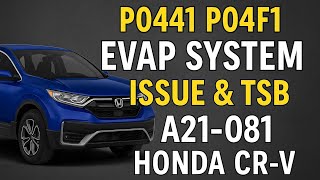
The 5th generation Honda CR-V (2017-2022) with the 1.5L Turbo engine is particularly known for this issue. The problem is so prevalent that Honda issued Technical Service Bulletin (TSB) A21-081, which addresses P0441 and the related code P04F1. 🎬 Watch: Understanding the P0441 code and what it means While a faulty purge valve is the most common culprit, the TSB also identifies a unique potential cause for specific VIN ranges of 2017 models: radio frequency interference requiring a special wiring sub-harness (noise filter) to be installed.
Diagnostic Flowchart

Tap your situation to follow the diagnostic path that matches what you're seeing on this vehicle.
Symptoms You May Notice
- Check Engine Light (Malfunction Indicator Lamp) is on
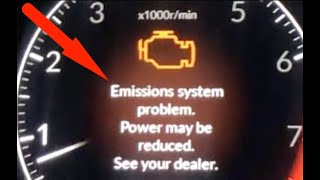
- "Emissions System Error" message on the dash.
- Slightly reduced fuel economy.
- Rough or sputtering idle, especially on a cold start.
- Difficulty starting the engine immediately after refueling.
- A faint smell of fuel around the vehicle (less common).
- Replacing the oxygen (O2) sensors. O2 sensors are not related to the EVAP system's purge flow.
- Replacing the fuel tank pressure sensor without proper diagnosis. While part of the EVAP system, it is a less common failure point for this specific code than the purge valve.
Most Likely Causes

- Faulty Canister Purge Valve (Solenoid) 🔴 High Probability This is a widely documented failure item for this CR-V generation, as confirmed by Honda's own Technical Service Bulletins. Forum users and YouTube mechanics state that this single part is the cause in approximately 90% of cases for this vehicle.
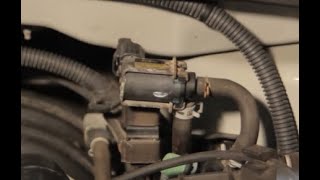
How to confirm: The valve is located right on top of the engine, making it easy to access. With the engine off, disconnect the valve's electrical connector and hoses. Try to blow through it. If air passes, the valve is stuck open and is faulty. Given the high failure rate and low part cost, many owners opt to replace it as the first step.
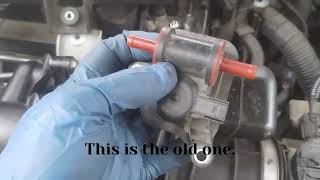
Typical fix: Replacement of the canister purge valve assembly. This is a simple DIY job that typically takes 15-20 minutes with a 10mm socket and pliers. 🎬 Watch: Step-by-step guide to replacing the purge valve solenoid
Est. part cost: $50-$150 - Radio Frequency Interference 🟡 Medium Probability Honda TSB A21-081 specifically identifies that external radio waves can interfere with sensor signals in the wiring harness, causing the ECU to incorrectly set codes P0441 and P04F1. This primarily affects certain 2017 model year CR-Vs within specific VIN ranges.
How to confirm: This is difficult for a DIYer to confirm. A Honda dealer must check the vehicle's VIN against the ranges listed in TSB A21-081. If replacing the purge valve does not solve the code, this becomes the next likely cause, especially on a 2017 model.
Typical fix: Installation of a wiring sub-cord (noise filter harness), part number 32107-TLC-A00, as detailed in TSB A21-081. The TSB provides instructions for installing the harness at the driver's and/or passenger's side kick panel connectors.
Est. part cost: $60-$80 - Loose or Defective Gas Cap ⚪ Low Probability
How to confirm: Ensure the gas cap is tightened until it clicks multiple times. Inspect the cap's seal for any cracks or damage. A code for a large leak (like P0455) is more common for a bad gas cap, but it's an easy first check that is recommended by many mechanics.
Typical fix: Tighten or replace the gas cap. It is recommended to use an OEM gas cap, as some aftermarket caps do not seal properly.
Est. part cost: $15-$40 - Cracked or Disconnected EVAP Hoses ⚪ Low Probability
How to confirm: Visually inspect the rubber hoses connected to the purge valve on the engine and around the charcoal canister for any visible cracks, brittleness, or loose connections. Even a small pinhole leak can trigger the code.
Typical fix: Replace the damaged section of hose.
Est. part cost: $10-$30
Rare But Worth Checking
- Saturated or Faulty Charcoal Canister: This can happen if you habitually 'top off' your fuel tank after the pump automatically shuts off. Liquid fuel can be forced into the canister, ruining the charcoal media and causing a blockage.
- Faulty EVAP Vent Solenoid or Fuel Tank Pressure Sensor: While less common for triggering P0441 specifically, other components in the EVAP system can fail and cause flow issues. These are typically diagnosed after the purge valve and hoses have been ruled out.
Diagnosis Steps
- Read the code with an OBD-II scanner to confirm P0441 and see if any other codes, like P04F1 or P0497, are present.
- Check the gas cap. Ensure it is tight and the seal is not cracked or worn. Reseat it, clear the codes, and drive to see if they return.
- Locate the canister purge valve on the 1.5L engine. It is mounted directly on top of the engine and is easily accessible.
- Inspect the vacuum hoses connected to and surrounding the purge valve for any obvious cracks, splits, or disconnections.
- With the engine off, disconnect the electrical connector and hoses from the purge valve. Attempt to blow through it. If air passes through, the valve is stuck open and is faulty.
- If the valve is not stuck open, consider replacing it anyway due to the high probability of it being the cause on this vehicle. It is the most common fix and a relatively inexpensive part.
- If a new purge valve does not resolve the issue, the problem may be the radio interference issue described in TSB A21-081. Check the vehicle's VIN against the TSB. If it applies, install the sub-harness (part #32107-TLC-A00).
- As a final measure, a smoke test can be performed on the EVAP system by a professional to find any hard-to-see leaks in hoses or the charcoal canister.
Parts You'll Likely Need
- Canister Purge Valve Assembly
(OEM #36162-5AA-A01 (may be superseded by 17310-TBA-A01))— This is the most frequent failure point for code P0441 on this generation of CR-V, as documented by owner complaints and Honda's own service bulletins.
Trusted brands: Honda (OEM), Dorman, Standard Motor Products (SMP), Bosch
OEM price range: $75-$120
Aftermarket price range: $40-$90 - Wiring Sub-Cord (Noise Filter)
(OEM #32107-TLC-A00)— This part is the specific fix called for in TSB A21-081 for vehicles where radio interference is causing the code, primarily affecting certain 2017 models.
Trusted brands: Honda (OEM)
OEM price range: $60-$80
Related Codes That Often Appear With This One
- P04F1 — This code for 'EVAP System Low Purge Flow Detected' is a more specific version of P0441. Honda's TSB A21-081 lists both codes together as having the same causes and fixes.
- P0497 — This code also indicates 'EVAP System Low Purge Flow' and is often triggered by the same faulty purge valve.
Technical Service Bulletins (TSBs) & Recalls

- A21-081: 'The MIL comes on with DTCs P0441 (EVAP System Purge Flow Malfunction) P04F1 (EVAP System Low Purge Flow Detected).' This TSB, updated several times, covers 2017-2022 CR-Vs and provides two corrective actions: replacing the purge valve or installing a wiring sub-cord for specific VINs affected by radio wave interference.
- APaS02152021908: Notes that Honda was actively searching for 2018 CR-Vs with P0441 to better understand the cause of the condition, highlighting that it was a known issue under investigation.
Platform-Specific Known Issues
- A known issue documented in Honda TSB #A21-081 where the check engine light comes on with DTC P0441 and/or P04F1. The cause is either a faulty purge valve or, for specific 2017 VINs, radio wave interference affecting the wiring harness.
- An owner of a 2018 CR-V reported an "Emissions System Error" with code P0441, which they attributed to a canister purge valve malfunction leading to increased fuel consumption.
- A Reddit user with an '18 CR-V reported getting code P0441 repeatedly. They replaced the battery, purge valve, and even installed the TSB sub-harness and cleaned the canister, but the issue persisted, highlighting that diagnosis can sometimes be complex.
Mechanic-Grade Diagnostic Values
- Canister Purge Valve Solenoid Resistance — expected: 20 - 30 Ohms. Failure: A reading near infinity (open circuit) or zero (short circuit) indicates a faulty solenoid.
- Fuel Tank Pressure Sensor Voltage (Key On, Engine Off) — expected: 1,500 - 3,500 millivolts (1.5 - 3.5V). Failure: Voltage outside this range can indicate a faulty sensor, which may indirectly contribute to or be misdiagnosed as a P0441.
Hidden / Shadow Codes Worth Checking
- Mode 6, TID $93: This refers to a non-continuous monitor test ID for the purge flow monitor. A value out of range on this test can indicate an issue with the fuel tank pressure sensor's reading during the EVAP test, which is how the ECU determines if purge flow is correct. (see via A more advanced OBD-II scanner capable of reading Mode $06 data. Some scanners may translate this into a more verbose message pointing to the Fuel Pressure sensor.)
Scan Tool Commands That Help
- Professional OBD2 Scanner (e.g., Honda HDS, XTOOL, Autel): EVAP System Test / Purge Valve Active Test — This bidirectional command allows a technician to manually open and close the purge valve while the engine is running. By commanding the valve open, you can check for a change in short-term fuel trims or oxygen sensor readings. If there is no change, it indicates a blockage in the line or a purge valve that is not opening.
Wiring & Ground Locations
- Main Engine/Transmission Ground — A primary ground cable runs from the battery's negative terminal to a mounting point on the transmission housing. This often requires removing the air filter box for access.. A poor engine ground can cause a variety of electrical issues and incorrect sensor readings. While not a direct cause of P0441, ensuring the main engine ground is clean and tight is a crucial step in diagnosing any electrical fault.
- Chassis/Fender Ground — A secondary, smaller ground wire often branches off the main negative cable and bolts to the chassis/fender in the engine bay, near the battery.. This ground ensures all vehicle electronics have a proper return path. Corrosion at this point can lead to floating grounds and unpredictable behavior in various systems, including the PCM that controls the EVAP system.
- G101 — Located at the left rear of the engine.. This is a shared ground point for multiple engine components and sensors, including the PCM. A fault at G101 could disrupt the PCM's ability to correctly command and monitor the purge valve solenoid.
Real Owner Repair Stories
- KBB.com user comment (Honda Accord (similar EVAP system)) — Persistent P0441 code.
❌ Tried (didn't work) Initial diagnosis was inconclusive.
✅ What actually fixed it The owner noticed a Mode 6 value (TID $93) was out of range, which a more advanced scanner identified as a Fuel Pressure sensor issue. Replacing the fuel tank pressure sensor resolved the P0441 code.
OEM Part Supersession History
36162-5AA-A01→17310-TBA-A01— Part number consolidation and potential design revision. The new part number is listed for a very wide range of Honda models and years.
Heads up: While 17310-TBA-A01 is often cited as the replacement, some parts suppliers still list 36162-5AA-A01 as the primary part for the 2017-2022 CR-V. It is crucial to verify the correct part number with a VIN at a Honda dealership to avoid compatibility issues, as the names 'Purge Valve', 'Vent Valve', and 'Canister Valve' are sometimes used interchangeably in catalogs.
Model Year Variations Within This Range
- 2017: Certain 2017 models are uniquely susceptible to radio frequency interference that can trigger P0441. The fix is not a replacement part but the addition of a special wiring sub-harness (noise filter), part number 32107-TLC-A00, as specified in TSB A21-081.
Helpful Videos

Used OEM Parts in Stock
New Aftermarket Parts Available


The information in this article is provided for general reference and educational purposes only. Vehicle specifications, procedures, and part compatibility can vary by production date, trim level, and region. Always consult your vehicle's factory service manual and verify part numbers before purchasing or performing repairs. Safety-critical components such as airbags, seat belts, and braking systems should be installed by a qualified professional.
- Honda CR-V:
- 🎬 Helpful Videos
- 🛍️ Shop This Part
- What's Unique About the 2017-2022 Honda CR-V
- Diagnostic Flowchart
- Symptoms You May Notice
- Most Likely Causes
- Rare But Worth Checking
- Diagnosis Steps
- Parts You'll Likely Need
- Related Codes That Often Appear With This One
- Technical Service Bulletins (TSBs) & Recalls
- Platform-Specific Known Issues
- Mechanic-Grade Diagnostic Values
- Hidden / Shadow Codes Worth Checking
- Scan Tool Commands That Help
- Wiring & Ground Locations
- Real Owner Repair Stories
- OEM Part Supersession History
- Model Year Variations Within This Range
- 🎟️ Get 5% Off