

P0440 on 2003-2008 Subaru Forester: EVAP System Malfunction Causes and Fixes
For a 2003-2008 Subaru Forester, code P0440 is most often caused by a loose gas cap or a rusted fuel filler neck. Always check the gas cap first, but be prepared to inspect and likely replace the filler neck, a very common failure on these vehicles, especially in rust-prone areas. A smoke test is the definitive method for locating the leak if it's not visually obvious.
- Always check the gas cap first. Ensure it is tight and the seal is in good condition.
- The most likely cause for P0440 on a 2003-2008 Forester, after the gas cap, is a rusted-out fuel filler neck.
- A visual inspection of the filler neck (behind the driver's rear wheel) is a critical diagnostic step.
- A smoke test is the best method to find the exact location of a leak if it's not visually obvious.
- Do not replace expensive parts like the charcoal canister without confirming the location of the leak first.
What's Unique About the 2003-2008 Subaru Forester
Like many Subarus from this era, the second-generation (SG) Forester is highly susceptible to rust, particularly around the fuel filler neck and its associated vent pipes located in the driver's side rear wheel well. This is by far the most common cause of a P0440 code after the gas cap has been ruled out. The metal pipes corrode, creating holes that allow fuel vapor to escape, which the system immediately detects as a major leak. This issue is so prevalent that it should be the primary focus of any diagnosis on a 2003-2008 Forester, a sentiment echoed in numerous owner forums.
Symptoms You May Notice
- Check Engine Light is on
- A faint to strong smell of fuel, particularly around the rear of the vehicle near the driver's side wheel well
- Difficulty filling the gas tank (the pump clicks off repeatedly), which can indicate a blocked vent line often associated with filler neck issues or a clogged canister/vent valve
- Cruise control may be disabled as a fail-safe when an emissions-related check engine light is active.
- Replacing the charcoal canister when the leak is actually in the fuel filler neck. A smoke test should be performed before replacing expensive components like the canister.
- Replacing the gas cap with a cheap aftermarket version that doesn't seal properly, leading the technician to search for other, non-existent leaks.
Most Likely Causes
- Loose or Worn Gas Cap 🔴 High Probability This is the most common cause for an EVAP code on any vehicle. The cap's rubber O-ring seal degrades over time, becoming cracked and brittle, losing its ability to hold pressure.
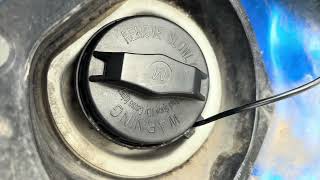
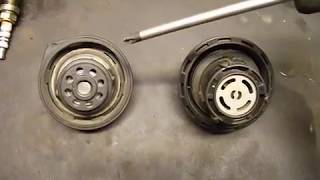
How to confirm: Ensure the cap is tightened until it clicks at least once. Inspect the rubber seal for cracks, stiffness, or damage. Also, inspect the lip of the filler neck for rust or debris that could prevent a good seal. Some owners report success by applying a thin layer of Vaseline to the O-ring as a temporary measure to improve the seal.
Typical fix: Tighten or replace the gas cap. It is highly recommended to use an OEM Subaru cap, as some aftermarket caps are known to cause sealing issues.
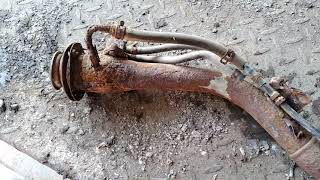
Est. part cost: $25-$40 - Rusted Fuel Filler Neck 🔴 High Probability Subarus of this generation are known for significant rust in the rear wheel wells where the filler neck is located, especially in areas using road salt. The main pipe and smaller vent pipes corrode, creating leaks that are often large enough to be seen easily.
How to confirm: Remove the driver's side rear wheel and the plastic splash shield in the wheel well. Visually inspect the entire metal fuel filler neck assembly for heavy rust, flaking, and obvious holes. Poking gently with a screwdriver may reveal weak, rusted-through spots. The rust is often worst on the main pipe and the smaller metal elbow for the breather hose.
Typical fix: The filler neck assembly must be replaced. This involves disconnecting hoses from the canister and fuel tank and unbolting the neck from the chassis. 🎬 Watch: Step-by-step guide to replacing a rusted filler neck. This can be a DIY job, but rusted fasteners can make it difficult.
Est. part cost: $100-$250 - Cracked or Disconnected EVAP Hoses 🟡 Medium Probability The rubber and plastic hoses in the EVAP system become brittle with age and exposure to the elements, leading to cracks and leaks. Hoses around the charcoal canister and filler neck are particularly vulnerable.
How to confirm: Visually inspect all accessible EVAP lines, from the engine bay (near the purge solenoid) to the rear of the vehicle (around the charcoal canister and filler neck). A smoke test is the most effective way to find small, hard-to-see cracks.
Typical fix: Replace the cracked section of hose. This is typically inexpensive.
Est. part cost: $5-$50 - Faulty Purge Control Solenoid Valve ⚪ Low Probability
How to confirm: The purge solenoid is located in the engine bay, typically on or near the intake manifold. It can be tested to see if it's stuck open or closed. When the engine is cold and running, disconnect the hose coming from the canister and check for vacuum; there should be none. If there is vacuum, the valve is stuck open and needs replacement.
Typical fix: Replace the purge control solenoid valve.
Est. part cost: $40-$90 - Faulty Vent Valve / Drain Valve ⚪ Low Probability
How to confirm: This valve is located near the charcoal canister at the rear of the car. It can get stuck open, causing a leak, or stuck closed, causing refueling problems. It can be tested with a scan tool that can command it to open and close, or by applying 12v voltage directly to its terminals to see if it actuates (clicks).
Typical fix: Replace the vent valve. On many Subarus, it is integrated with or attached directly to the charcoal canister.
Est. part cost: $50-$150
Rare But Worth Checking
- Cracked Charcoal Canister: The canister itself, located at the rear of the vehicle, can be damaged by road debris or develop cracks from age, causing a leak. A Reddit user with an '03 Forester reported this as the cause of their P0440.
- Spider Nests in Vent Hose: A known, though rare, issue on Subarus is for spiders to build nests inside the EVAP vent hoses, particularly in the vent line elbow above the rear differential. This causes a blockage that can lead to various EVAP codes and difficulty refueling.
Diagnosis Steps
- Check the Gas Cap: Remove the gas cap, inspect the seal for cracks or damage, and retighten it until it clicks several times. Clear the code and drive for a few days to see if it returns. Using a genuine OEM Subaru cap is recommended if replacement is needed.
- Visual Inspection of Filler Neck: If the code returns, perform a thorough visual inspection. Remove the driver's side rear wheel and the plastic splash guard in the wheel well. Look for heavy rust, flaking metal, or obvious holes on the main pipe and smaller vent lines. This is the most likely failure point.
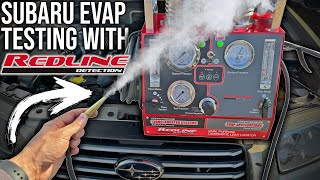
- Perform a Smoke Test: If no obvious leaks are found, a smoke test is the most effective next step. This involves injecting pressurized smoke into the EVAP system (usually via the purge valve service port). Smoke will exit from any leaks, making them easy to spot. 🎬 See how a professional smoke test identifies hidden leaks. This is the definitive way to find leaks in the filler neck, hoses, or canister.
- Test the Purge Solenoid: Locate the purge solenoid in the engine bay. With the engine cold and running, disconnect the hose coming from the canister and check for vacuum. There should be none. If there is vacuum, the valve is stuck open and needs replacement.
- Test the Vent Valve: If the smoke test reveals no leaks, the vent valve near the canister could be malfunctioning electrically. Use a scan tool to command it open and closed, or test it manually with a power source to listen for a click.
Parts You'll Likely Need
- Fuel Filler Neck
(OEM #42066SA090)— This is the most common point of failure on 2003-2008 Foresters due to severe rust, causing a large leak that triggers P0440. This part number supersedes 42066SA050.
Trusted brands: Subaru (OEM), Spectra Premium, Dorman, Liland Global
OEM price range: $130-$200
Aftermarket price range: $100-$180 - Gas Cap
(OEM #42031FE000)— A worn-out gas cap seal is a very common and simple cause for any EVAP leak code. It's always the first part to check and replace. Using an OEM cap is highly recommended.
Trusted brands: Subaru (OEM), Stant, Gates
OEM price range: $25-$40
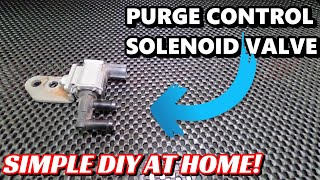
Aftermarket price range: $10-$20 - Purge Control Solenoid Valve
(OEM #16102AA380)— Can become stuck open or closed, preventing the EVAP system from sealing correctly during its self-test. This part number is listed for 2006-2013 models.
Trusted brands: Subaru (OEM), Denso, Standard Motor Products
Related Codes That Often Appear With This One
- P0455 — This code means 'EVAP System Large Leak Detected.' It is a more specific version of P0440 and is very commonly caused by the same rusted fuel filler neck issue.
- P0442 — This code means 'EVAP System Small Leak Detected.' It can be caused by a less severe version of the same problems, like a slightly worn gas cap seal or a pinhole leak in the filler neck or a hose.
- P0457 — This code means 'EVAP System Leak Detected (Fuel Cap Loose/Off).' While it points specifically to the gas cap, a large leak elsewhere, like a completely rusted-through filler neck, can sometimes trigger this code as well.
Platform-Specific Known Issues
- The fuel filler neck on the SG Forester is extremely prone to rusting out, especially in states that use road salt. This is the most significant vehicle-specific issue related to code P0440. A similar issue was documented in NHTSA ODI #10283295 for the Subaru Outback, where fuel filler tube corrosion caused fuel and vapor leaks, illuminating the P0440 code.
Mechanic-Grade Diagnostic Values
- EVAP Purge Control Solenoid Valve Coil Resistance — expected: 26 - 33 Ohms. Failure: A reading significantly outside this range, or an open (infinite) or short (zero) circuit.
- EVAP Vent Valve / Drain Valve Solenoid Coil Resistance — expected: 30 - 50 Ohms. Failure: A reading outside this range indicates a faulty coil. One technician noted a reading of 26.1 Ohms was out of spec and required replacement.
Scan Tool Commands That Help
- Subaru Select Monitor (SSM) or equivalent high-end scanner: Evaporative System Leak Test — This is the dealer-level forced test to run the complete EVAP system self-test on command, which pressurizes the system to check for leaks without having to wait for the natural drive cycle conditions to be met.
- Physical Connector (No Scan Tool): Activate 'Test Mode' — Under the driver's side dash, there are two green, single-pin connectors. Connecting them and turning the ignition to 'ON' (engine off) puts the car in a diagnostic test mode. This mode cycles all relays and solenoids on and off at one-second intervals. A technician can use this to physically listen for the 'click' of the purge and vent solenoids to confirm they are receiving a signal and are mechanically actuating.
Wiring & Ground Locations
- ECM (Engine Control Module) — Under the dashboard on the passenger side, typically below or behind the glovebox.. The ECM controls and monitors the entire EVAP system. All sensor data (like fuel tank pressure) and valve control signals (for purge and vent solenoids) originate or terminate here.
- Gb-1, Gb-3 — Main chassis ground points. Gb-1 is located at the driver's side kick panel. Gb-3 is located at the passenger's side kick panel.. Poor grounds can cause erratic behavior in sensors and solenoids. The ECM and other modules rely on these clean ground connections for accurate readings and operation.
- EVAP Vent Control Solenoid Valve Connector — Near the charcoal canister at the rear of the vehicle, driver's side.. This is the connection point for testing voltage and resistance of the vent valve. One pin should have battery voltage (~12V) with the key on, and the other is the ground path controlled by the ECM.
- Engine Block / Transmission Grounds — Main ground straps run from the engine block to the chassis (often below the battery) and from the transmission to the firewall.. While not directly part of the EVAP harness, a poor main engine ground can introduce electrical noise and voltage drops throughout the vehicle's systems, potentially affecting sensor readings.
Real Owner Repair Stories
- Hearth.com forum user (Subaru (year unspecified, but common to 03-08 Foresters)) — P0440 Check Engine Light.
❌ Tried (didn't work) Initial diagnosis pointed towards various EVAP components.
✅ What actually fixed it The user discovered a hole in the fuel filler neck approximately the size of a half dollar. They performed a temporary field repair by patching the hole with a metal square and JB Weld, which resolved the leak. This highlights the severity of the rust issue on these parts. - Common owner experience across multiple forums (2003-2008 Subaru Forester, especially in rust belt regions) — P0440, often accompanied by P0455 or P0457, and a fuel smell near the rear driver's side wheel.
❌ Tried (didn't work) Replacing the gas cap with an aftermarket version., Clearing the code without inspection, only for it to return quickly.
✅ What actually fixed it The definitive fix for a vast number of owners was the complete replacement of the fuel filler neck assembly. After removing the rear driver's side wheel and splash shield, the original neck was found to be severely corroded with visible pinholes or large cracks, particularly on the main pipe and smaller vent lines. Replacing it with an OEM or quality aftermarket part (like Spectra Premium) resolved the code.
"I Checked Everything" — The Actual Cause
- A faulty Fuel Tank Pressure (FTP) sensor can send incorrect data to the ECM, triggering a P0440 even though no physical leak exists. The system believes it's failing a pressure test due to bad sensor readings, not actual pressure loss.
- A leak in the O-ring seal for the fuel pump module, located on the top of the fuel tank. A standard, low-pressure smoke test may not generate enough pressure to reveal a leak in this location, leading a technician to believe the system is sealed when it is not. Dropping the tank is required for inspection.
OEM Part Supersession History
42066SA050→42066SA090— Likely an update to the material, coating, or manufacturing process to improve corrosion resistance.42084FA120→— This is the long-standing part number for the EVAP Vent Valve.
Heads up: This part is widely cross-referenced by aftermarket brands like Dorman with part number 911-650.
Model Year Variations Within This Range
- 2003-2005 vs 2006-2008: The 2006 model year marked a significant facelift for the Forester. While the core P0440 issue (filler neck rust) affects the entire generation, some part numbers for the filler neck may differ between pre-facelift (03-05) and post-facelift (06-08) models. One source suggests 42066SA020 for 2003-2005 and 42075SA150 for 2006-2008, while the more common 42066SA090 is often listed for 2005-2008. Always verify the part number with the vehicle's VIN before ordering.
Diagnostic Flowchart
Other Known Issues on This Vehicle
Issues unrelated to this code that are worth knowing about as an owner of this generation:
- Head Gasket Failure (External Leaks) 🔴 High — Very common on naturally aspirated 2.5L EJ25 engines, typically between 100,000 and 150,000 miles. Affects models up to 2010/2011.
- Rear Wheel Bearing Failure 🟠 Medium — A higher-than-average failure rate is reported for rear wheel bearings, causing a loud humming or roaring noise that changes with speed. Failure can occur as early as 70,000 miles.
- Front Lower Control Arm Rust/Failure 🔴 High — Subject to a recall in rust-belt states. The control arm hanger brackets can corrode and break, causing a loss of steering control. (Ref: NHTSA Recall 11V464000)
- Excessive Oil Consumption 🟠 Medium — These engines are known to consume oil, sometimes requiring a quart to be added between oil changes. This is often due to the piston ring design.
- Leaking AVCS Oil Control Solenoid 🟡 Low — The oil control valve (OCV) for the Active Valve Control System (AVCS) can leak oil into its electrical connector, potentially causing various AVCS-related DTCs. An updated part was released to fix this. (Ref: Subaru TSB 02-170-17R)
Used vs. New Parts: Buying Guide for This Vehicle
When a used part is the smart pick: For electronic components like the purge solenoid, vent valve, or charcoal canister, a used part from a low-mileage donor vehicle in a dry, salt-free climate can be a cost-effective option. Inspect for any signs of physical damage or corrosion before purchasing.
Donor-vehicle mileage cap: roughly under 80000 miles for the part to have meaningful remaining life.
What to inspect on the donor part:
- For solenoids/valves: Ensure connectors are clean, not corroded, and the plastic housing is not cracked or brittle.
- For charcoal canisters: Check for cracks in the plastic body and ensure hose nipples are intact and not broken.
- For any part: Ask for the donor vehicle's history if possible; parts from southern or western states (non-rust-belt) are highly preferable.
OEM-only on this vehicle (don't cheap out):
- Gas Cap: It is almost universally recommended to use a genuine OEM Subaru gas cap. Many aftermarket caps, especially cheaper ones, are known to have sealing issues that will not fix a P0440 and will lead to a frustrating misdiagnosis.
Aftermarket brands forum-validated for this vehicle:
- Fuel Filler Neck: Spectra Premium is a well-regarded aftermarket brand that owners report has good fitment and quality, often including new seals. Dorman is another widely available option.
- EVAP Solenoids: Denso (often the original OEM supplier), Standard Motor Products, and Dorman are reliable choices for purge or vent valves.
Brands owners have reported issues with on this vehicle:
- Avoid generic, unbranded, or 'white-box' gas caps and electronic sensors from online marketplaces, as their quality control and sealing performance are often poor.
Real Owner Stories
Aggregated from forums and TSBs cited above. Mileages and costs reflect what owners reported in those sources.
2003-2008 Subaru Forester
Symptoms: Check engine light on with code P0440; found a fix for the error code after troubleshooting.
What fixed it: Identified and repaired the specific leak point in the EVAP system.
Source hint: hearth.com thread titled 'Subaru check engine light on and error code is p0440- what needs to be fixed- finally a fix found'
2003-2008 Subaru Forester
Symptoms: P0442 and P0440 codes present; significant rust found in the rear wheel well area.
What fixed it: Replacement of the fuel filler neck assembly.
Source hint: subaruforester.org thread titled 'p0442-and-filler-neck-replacement'
Subaru Outback (Cross-Model Reference)
Symptoms: An owner reported fuel filler tube corrosion causing a leak of fuel and fuel vapor, which illuminated the check engine light with code P0440.
What fixed it: The fuel filler tube and valve assembly were replaced. The owner noted this was a common problem (NHTSA ODI #10283295).
Related OBD-II Codes
Frequently Asked Questions
Why is my cruise control not working on my 2005 Forester now that the Check Engine Light is on?
I'm having trouble filling my gas tank; the pump keeps clicking off. Is this related to P0440?
Is there a specific gas cap I should buy for my Forester to fix this code?
Where is the most common place for a leak to occur on a Forester driven in the 'rust belt'?
Is there a recall for the rusted components causing my P0440 code?
How can I check if my purge solenoid is the cause of the P0440?
Helpful Videos

We Have This Part in Stock


The information in this article is provided for general reference and educational purposes only. Vehicle specifications, procedures, and part compatibility can vary by production date, trim level, and region. Always consult your vehicle's factory service manual and verify part numbers before purchasing or performing repairs. Safety-critical components such as airbags, seat belts, and braking systems should be installed by a qualified professional.
- Subaru Forester:
- 🎬 Helpful Videos
- 🛍️ Shop This Part
- What's Unique About the 2003-2008 Subaru Forester
- Symptoms You May Notice
- Most Likely Causes
- Rare But Worth Checking
- Diagnosis Steps
- Parts You'll Likely Need
- Related Codes That Often Appear With This One
- Platform-Specific Known Issues
- Mechanic-Grade Diagnostic Values
- Scan Tool Commands That Help
- Wiring & Ground Locations
- Real Owner Repair Stories
- "I Checked Everything" — The Actual Cause
- OEM Part Supersession History
- Model Year Variations Within This Range
- Diagnostic Flowchart
- Other Known Issues on This Vehicle
- Used vs. New Parts: Buying Guide for This Vehicle
- Real Owner Stories
- 2003-2008 Subaru Forester
- 2003-2008 Subaru Forester
- Subaru Outback (Cross-Model Reference)
- Related OBD-II Codes
- Frequently Asked Questions
- 🎟️ Get 5% Off