

P0430 on 2007-2015 Mazda CX-9: Bank 2 Catalyst Efficiency Causes and Fixes
On the 2007-2015 Mazda CX-9, code P0430 almost always points to a failing catalytic converter on Bank 2 (the firewall side). While an oxygen sensor or exhaust leak is possible, the converter itself is the most common failure item, especially after 100,000 miles. This failure is often accelerated by a previous engine misfire from a bad ignition coil.
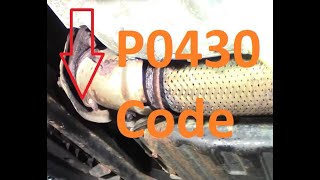
- P0430 on your Mazda CX-9 means the catalytic converter on the firewall side (Bank 2) is no longer cleaning the exhaust effectively.
- The most likely cause is a worn-out catalytic converter, especially if the vehicle has over 100,000 miles.
- Before replacing the expensive converter, rule out a bad downstream oxygen sensor or an exhaust leak.
- If you recently had an engine misfire fixed, it likely damaged the converter by sending raw fuel into the exhaust.
- Proper diagnosis involves using a scan tool to watch the behavior of the upstream and downstream oxygen sensors. If the downstream sensor copies the upstream one, the converter has failed.
What's Unique About the 2007-2015 Mazda CX-9
The 3.5L and 3.7L MZI V6 engines in the first-generation CX-9 are generally reliable, but like many vehicles of this era, the catalytic converters are a common failure point as the vehicle ages. A known issue that can lead to premature converter failure on these engines is a prior ignition coil failure. When a coil fails, it can dump unburnt fuel into the exhaust, which then superheats and damages the delicate internal structure of the catalytic converter. Owners have reported that a P0420 and/or P0430 code appeared shortly after fixing a misfire caused by a bad ignition coil and a damaged PCM. The Bank 2 converter is integrated into the exhaust manifold and located on the firewall side of the engine, requiring significant labor to access and replace.
Generation note: This guide covers the first generation (2007-2015) of the Mazda CX-9. This generation used a 3.5L MZI V6 for the 2007 model year and switched to a very similar 3.7L MZI V6 from 2008 to 2015. The causes and diagnostic procedures for P0430 are consistent across both engines, which are part of the Ford Cyclone engine family.
Symptoms You May Notice
- Check Engine Light is on.
- Vehicle will fail an emissions inspection.
- Reduced engine power or sluggish acceleration if the converter is clogged.
- A sulfur or "rotten egg" smell from the exhaust, especially on startup.
- Immediately replacing the oxygen sensor without checking live data. A bad catalytic converter is the most common cause, and an O2 sensor replacement will not fix it.
- Replacing the catalytic converter without first checking for and fixing any engine misfires, vacuum leaks, or rich/lean running conditions that may have caused the original converter to fail.
Most Likely Causes
- Failing Catalytic Converter 🔴 High Probability Converters have a finite lifespan and fail from age. This can be accelerated by engine issues like misfires from bad ignition coils or internal engine problems (like a failing water pump leaking coolant into the oil) which were not uncommon on the MZI V6.
How to confirm: Use a scan tool to monitor live data from the Bank 2 upstream and downstream O2 sensors. The upstream sensor (B2S1) should fluctuate rapidly. A healthy downstream sensor (B2S2) will show a steady, slow-switching voltage. If B2S2 mimics the rapid switching of B2S1, the converter is not working. An infrared thermometer can also be used; the outlet of a working converter should be significantly hotter (at least 100°F) than the inlet.
Typical fix: Replace the Bank 2 catalytic converter. This is integrated with the exhaust manifold and is labor-intensive due to its firewall-side location.
Est. part cost: $300-$800 - Failing Downstream Oxygen Sensor (Bank 2, Sensor 2) 🟡 Medium Probability Oxygen sensors are wear items and can become lazy or biased with age, sending inaccurate data to the PCM. However, it is more common for the converter to be the root cause.
How to confirm: If the scan tool shows the downstream O2 sensor voltage is stuck high, low, or not responding, the sensor is likely faulty. Swapping the Bank 1 and Bank 2 downstream sensors (if they are identical and accessible) and seeing if the code changes to P0420 is another diagnostic trick.
Typical fix: Replace the Bank 2, Sensor 2 oxygen sensor.
Est. part cost: $50-$150 - Exhaust Leak ⚪ Low Probability Rust can cause leaks at gaskets or in the exhaust manifold/pipe, especially on older vehicles in regions that use road salt. A leak can introduce oxygen into the exhaust stream and confuse the O2 sensors.
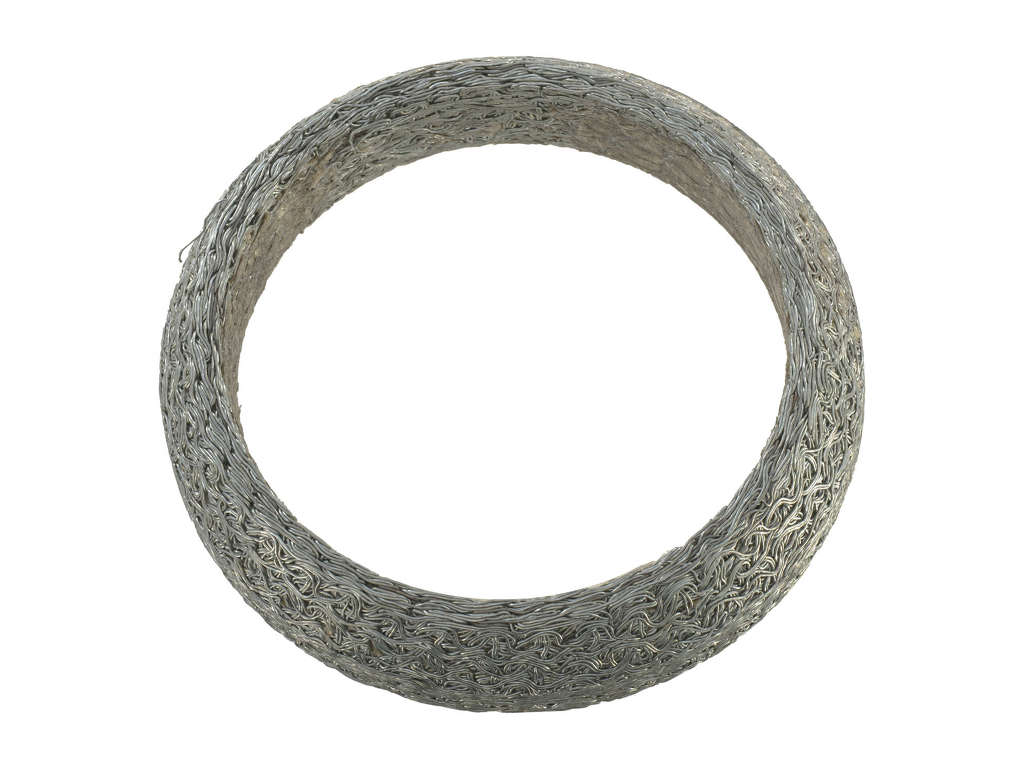
How to confirm: Visually inspect the exhaust system from the engine to the catalytic converter for cracks, rust holes, or black soot marks indicating a leak. A smoke test can definitively locate hard-to-see leaks. The leak must be between the upstream and downstream O2 sensors to cause this code.
Typical fix: Repair the leak. This may involve replacing a gasket, welding a crack, or replacing a section of pipe.
Est. part cost: $10-$300
Rare But Worth Checking
- Engine Misfires or Fuel System Issues: While not a direct cause, an unresolved engine issue (like bad spark plugs, failing ignition coils, or leaky fuel injectors) will destroy a new catalytic converter quickly. Always ensure the engine is in a good state of tune before replacing a converter.
Diagnosis Steps
- Confirm the P0430 code is present using an OBD-II scanner. Check for any other pending or active codes.
- Address any misfire (P030x), fuel system (P017x), or oxygen sensor circuit codes (P015x) before diagnosing the P0430.
- Perform a visual inspection of the Bank 2 exhaust system. Look for obvious cracks, rust, or soot trails indicating a leak between the engine and the rear O2 sensor.
- Using a scan tool with live data, graph the voltage for the Bank 2 upstream (B2S1) and downstream (B2S2) oxygen sensors. Warm the engine up to operating temperature.
- At a steady 2,500 RPM, observe the sensor graphs. B2S1 should show rapid, high-amplitude switching. B2S2 should show a relatively flat and stable voltage.
- If the B2S2 voltage is switching frequently and mirroring the pattern of B2S1, the catalytic converter has failed and requires replacement.
- If the B2S2 voltage is stuck and unresponsive, the sensor itself is likely bad and should be tested and/or replaced.
- If an exhaust leak is suspected but not visible, a professional smoke test can be used to pinpoint the source.
- Use an infrared thermometer to measure the temperature of the exhaust pipe before and after the catalytic converter. A working converter should have an outlet temperature at least 100°F hotter than the inlet.
Parts You'll Likely Need
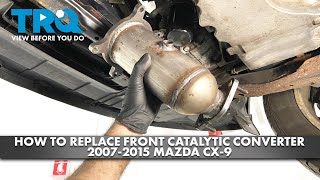
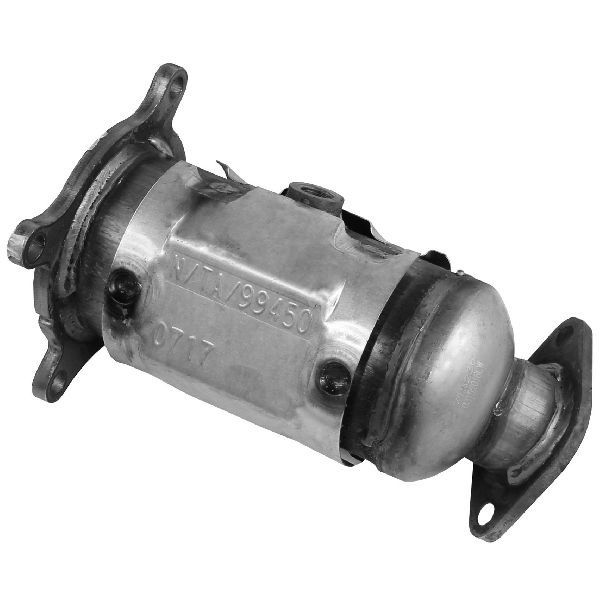
- Catalytic Converter (Bank 2)
(OEM #CA11-20-500 (for 2010-2015 models), PYK9-20-50XA)— This is the most common cause of P0430 on higher-mileage CX-9s. The internal catalyst material degrades over time and loses efficiency. Bank 2 is the rear, firewall-side converter.
Trusted brands: Walker Exhaust, MagnaFlow, Dorman
OEM price range: $1400+
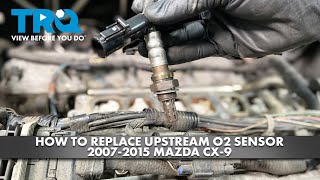
Aftermarket price range: $400-$900 - Downstream Oxygen Sensor (Bank 2, Sensor 2)
(OEM #CA41-18-861 (fits 2011-2015))— This sensor is responsible for reporting the converter's efficiency. If it fails, it can send incorrect data, falsely triggering the P0430 code. Denso part 234-4489 is a common aftermarket cross-reference.
Trusted brands: Denso, Bosch, NGK/NTK
OEM price range: $120-$200
Aftermarket price range: $50-$150
Related Codes That Often Appear With This One
- P0420 — This is the identical code for Bank 1 (radiator side). If both P0420 and P0430 appear together, it suggests a systemic issue like contaminated fuel or a problem affecting the entire engine, rather than two simultaneous converter failures.
- P0300-P0306 — These are misfire codes. An engine misfire allows unburnt fuel to enter the exhaust, which can overheat and damage the catalytic converter, leading to a P0430 code.
- P0016, P0018 — These are crankshaft/camshaft position correlation codes. On this engine, they can be an early sign of a failing internal water pump causing slack in the timing chain, which can lead to engine failure and related exhaust issues.
Technical Service Bulletins (TSBs) & Recalls
- SSP 92: Warranty extension for the All-Wheel Drive Power Transfer Unit (PTU) on certain 2010-2014 models due to failures from oil deterioration.
- SSP 93: Warranty extension for the power brake booster on 2007-2013 models due to internal diaphragm failure.
Platform-Specific Known Issues
- The Bank 2 catalytic converter is on the firewall side of the engine bay, making access extremely difficult. Replacement often requires removing the cowl, and some mechanics may even slightly lower the subframe for clearance, dramatically increasing labor time and cost compared to the more accessible Bank 1 converter.
Mechanic-Grade Diagnostic Values
- Downstream O2 Sensor (HO2S) Voltage — expected: Relatively steady reading between 0.4 to 0.5 volts under normal, stable operating conditions.. Failure: Voltage rapidly switching between ~0.1V and ~0.9V, mimicking the upstream sensor's pattern, indicates a failed converter.
- Short-Term and Long-Term Fuel Trims (STFT/LTFT) — expected: Should ideally be within +/- 5% at idle and steady cruise.. Failure: Sustained values outside of +/- 10% indicate a rich or lean condition that must be fixed before replacing a catalytic converter, as it is likely the root cause of the failure.
- Mode $06 Catalyst Monitor Efficiency — expected: The PCM runs a self-test (TID $81, CID $01 for Bank 1, TID $82, CID $02 for Bank 2 on some Ford/Mazda platforms) comparing upstream and downstream sensor switch ratios. The test value should be below the maximum threshold set by the manufacturer.. Failure: If the scan tool's Mode $06 data shows the test value for the Bank 2 catalyst monitor (often TID $82) has exceeded the maximum limit, it confirms the PCM's diagnosis of low efficiency.
Scan Tool Commands That Help
- Mazda IDS (or equivalent high-end scanner): KOER (Key On, Engine Running) Self-Test — This command initiates a comprehensive self-test of all emission-related components under specific running conditions. It can help confirm if the P0430 is a hard fault or an intermittent issue and may trigger other related codes that provide more diagnostic clues.
- Mazda IDS (or equivalent high-end scanner): PCM Reset / Keep Alive Memory (KAM) Reset — After replacing a catalytic converter or oxygen sensor, this function should be used to clear the long-term fuel trim adaptations and other learned values. This forces the PCM to relearn with the new components, preventing the old, skewed data from causing the code to return incorrectly.
Wiring & Ground Locations
- PCM Ground — The PCM itself is located in the left rear corner of the engine compartment. It shares a ground point with the Mass Air Flow sensor and the transaxle control module.. A poor ground at this location can cause erratic voltage readings from multiple sensors, including the oxygen sensors, leading to false codes. The PCM relies on a stable ground reference to accurately interpret sensor data.
- G11 — Located behind the left side of the dashboard.. This is a major interior ground point. While less likely to directly cause a P0430, issues here can affect the instrument cluster and data link connector, complicating diagnosis.
- Bank 2 Downstream O2 Sensor Connector — The Bank 2 (firewall side) downstream sensor's harness runs up behind the engine. The connector is typically clipped to a bracket on the back of the engine or firewall.. This connector is in a high-heat area and can become brittle or contaminated. Checking for corrosion, pushed-out pins, or damage here is crucial before condemning the sensor or converter.
Real Owner Repair Stories
- Mazdas247 Forum User 'j30' (2007 Mazda CX-9 Touring, 107k miles) — Vehicle lost power, ran rough, and died. Flashing check engine light.
❌ Tried (didn't work) Initial replacement of one bad coil and spark plugs did not fix the misfires.
✅ What actually fixed it The root cause was a cracked ignition coil that destroyed the PCM. After replacing all coils and having the PCM repaired, the misfires were gone, but codes P0420 and P0430 immediately appeared. The forum consensus was that the unburnt fuel from the misfires had destroyed both catalytic converters, confirming the direct link between the ignition failure and subsequent catalyst failure.
OEM Part Supersession History
PYK9-20-50X→PYK9-20-50XA— Part revision or update.
Heads up: Warning: Multiple parts sites list PYK9-20-50XA for the 2018-2021 CX-9 with the 2.5L Turbo engine, NOT the 2007-2015 V6. The part number provided in Pass 2 (CA11-20-500) is more likely correct for the later first-gen models. Always verify with a dealer using the VIN before ordering.
Model Year Variations Within This Range
- 2007 vs 2008-2015: The 2007 model year used the 3.5L MZI V6, while 2008-2015 models used the bored-out 3.7L MZI V6. While diagnostically similar for P0430, some ancillary parts, wiring, and specific OEM part numbers for the converters or sensors may differ. The internal water pump failure is a known issue on both engine variants.
Diagnostic Flowchart
Other Known Issues on This Vehicle
Issues unrelated to this code that are worth knowing about as an owner of this generation:
- Internal Water Pump Failure 🔴 High — Commonly occurs between 90,000 and 120,000 miles. Failure allows coolant to mix with engine oil, leading to catastrophic engine damage if not caught immediately. (Ref: No recall, but subject of a class-action lawsuit alleging a design defect.)
- AWD Transfer Case (PTU) Failure 🔴 High — Failures are common, often starting with a burning gear oil smell or fluid leaks. The unit is located near the hot exhaust, causing the fluid to break down and leading to poor lubrication and failure. (Ref: Mazda issued a warranty extension (SSP 92) for certain 2010-2014 models, extending coverage to 7 years or 90,000 miles.)
- Power Brake Booster Failure 🟠 Medium — Symptoms include a hard brake pedal and a hissing sound from the driver's footwell during braking. Caused by a diaphragm tear inside the booster, often accelerated by high ambient temperatures. (Ref: Mazda issued Special Service Program (SSP 93) extending the warranty for this part on 2007-2013 models to 7 years or 90,000 miles.)
- Ignition Coil Failure 🟠 Medium — A common cause of misfires (P0300-P0306 codes). A failed coil can go on to destroy the catalytic converter by sending unburnt fuel into the exhaust, making it a direct upstream cause for P0420/P0430.
- Transmission Hard Shifts / Slipping 🟠 Medium — Owners report jerky shifting, slipping, and delayed engagement, especially when the transmission is warm. This can be caused by issues with the valve body, solenoids, or outdated TCM software.
Used vs. New Parts: Buying Guide for This Vehicle
When a used part is the smart pick: A used OEM catalytic converter from a low-mileage, rear-ended donor vehicle can be a cost-effective alternative to expensive new OEM parts, especially since aftermarket converters for this vehicle have a mixed reputation for longevity and passing emissions tests.
Donor-vehicle mileage cap: roughly under 80000 miles for the part to have meaningful remaining life.
What to inspect on the donor part:
- Verify the donor vehicle's mileage and check its history for accidents or engine problems.
- Inspect the converter for any signs of physical damage, heavy rust, or rattling, which indicates a broken internal substrate.
- Look at the O2 sensor bungs to ensure threads are not stripped or damaged.
- If possible, inspect the honeycomb structure from the inlet/outlet; it should be intact and not melted or clogged.
OEM-only on this vehicle (don't cheap out):
- Catalytic Converter: Many owners report that aftermarket (non-CARB compliant) converters fail to keep the P0430 code away for long, sometimes failing the PCM's efficiency monitor within a year. A used OEM or a new, high-quality CARB-compliant aftermarket unit is a safer bet.
Aftermarket brands forum-validated for this vehicle:
- Denso, Bosch, and NGK/NTK are widely trusted for oxygen sensors.
- MagnaFlow and Walker are commonly used for aftermarket catalytic converters, but ensure you purchase a version that is compliant with your state's emissions laws (CARB/EPA).
Brands owners have reported issues with on this vehicle:
- Avoid unbranded, 'generic' oxygen sensors from online marketplaces, as users have reported these failing to resolve codes or failing prematurely.
- Be wary of extremely cheap catalytic converters (under $200), as they often lack sufficient precious metal loading to perform correctly and will likely cause the code to return.
Real Owner Stories
Aggregated from forums and TSBs cited above. Mileages and costs reflect what owners reported in those sources.
2007 Mazda CX-9 3.5L V6
Symptoms: The vehicle suffered a misfire caused by a cracked ignition coil which subsequently fried the PCM. Shortly after these repairs, the Check Engine Light returned with P0420 and P0430 codes.
What fixed it: Repairing the ignition coil and PCM was the initial fix, but the damage to the converters had already occurred, leading to the P0420/P0430 codes.
Source hint: Mazdas247 - Thread: 'Catalytic Converter Problem? Please Help.'
2007-2015 Mazda CX-9 3.7L V6
Symptoms: The P0430 code kept returning even after being cleared. The owner was concerned it might be a sensor issue.
What fixed it: The shop tested the O2 sensors and found them to be functioning correctly, confirming the catalytic converter itself was the culprit.
Source hint: Mazdas247 - Thread: 'Catalytic converter question'
Related OBD-II Codes
Frequently Asked Questions
Does Mazda SSP 92 or SSP 93 cover my P0430 catalytic converter issue?
Why is the labor cost so high for replacing the Bank 2 converter on my CX-9?
Can a failing water pump on the 3.7L MZI V6 cause a P0430 code?
I have a P0430; should I just replace the Bank 2, Sensor 2 oxygen sensor first?
Is there a way to verify the Bank 2 converter is bad without a shop?
Helpful Videos
We Have This Part in Stock

The information in this article is provided for general reference and educational purposes only. Vehicle specifications, procedures, and part compatibility can vary by production date, trim level, and region. Always consult your vehicle's factory service manual and verify part numbers before purchasing or performing repairs. Safety-critical components such as airbags, seat belts, and braking systems should be installed by a qualified professional.
- Mazda CX-9:
- 🎬 Helpful Videos
- 🛍️ Shop This Part
- What's Unique About the 2007-2015 Mazda CX-9
- Symptoms You May Notice
- Most Likely Causes
- Rare But Worth Checking
- Diagnosis Steps
- Parts You'll Likely Need
- Related Codes That Often Appear With This One
- Technical Service Bulletins (TSBs) & Recalls
- Platform-Specific Known Issues
- Mechanic-Grade Diagnostic Values
- Scan Tool Commands That Help
- Wiring & Ground Locations
- Real Owner Repair Stories
- OEM Part Supersession History
- Model Year Variations Within This Range
- Diagnostic Flowchart
- Other Known Issues on This Vehicle
- Used vs. New Parts: Buying Guide for This Vehicle
- Real Owner Stories
- 2007 Mazda CX-9 3.5L V6
- 2007-2015 Mazda CX-9 3.7L V6
- Related OBD-II Codes
- Frequently Asked Questions
- 🎟️ Get 5% Off