

P0430 on 2019-2025 Honda Pilot: Faulty Fuel Injector Causes & Fixes
On a 2019-2022 Honda Pilot, code P0430 is almost always caused by faulty fuel injectors, not a bad catalytic converter. This is a known manufacturing defect acknowledged by Honda. Check with a dealer for warranty extension eligibility (TSB 21-010, 10 years/150,000 miles) before paying for repairs. For 2023+ models, the cause is less certain as the engine was redesigned.
- Before any other action, call a Honda dealer with your VIN to check if your vehicle is covered by the fuel injector warranty extension for code P0430.
- Do NOT automatically replace the catalytic converter. On this vehicle, the P0430 code is most likely a symptom of a faulty fuel injector, not a bad converter.
- If the code is accompanied by P219B or misfire codes (P030x), it is almost certainly the fuel injector issue described in Honda's TSBs.
- Ignoring the code can lead to the destruction of the catalytic converter, a much more expensive repair that will not be covered by the injector warranty.
What's Unique About the 2019-2025 Honda Pilot

While P0430 typically points to a failed catalytic converter, on the 2019-2022 Honda Pilot with the J35Y6 engine, the root cause is overwhelmingly likely to be faulty fuel injectors. Honda has acknowledged that debris from the manufacturing process of the high-pressure fuel pump or the injectors themselves can cause them to fail. This leads to an improper air/fuel mixture, which the engine's computer misinterprets as a catalyst problem, triggering the P0430 code. This issue is so prevalent that Honda issued multiple Technical Service Bulletins (TSBs) and a significant warranty extension to cover the repair.
Generation note: This range covers the end of the third generation (2019-2022, J35Y6 engine) and the beginning of the fourth generation (2023-2025, J35Y8 DOHC engine). The primary cause related to the widespread, faulty fuel injector manufacturing defect is specific to the 2019-2022 models with the J35Y6 engine, as documented in Honda's TSBs and warranty extensions. While the P0430 code can appear on 2023+ models, it is not confirmed to be from the same known defect, and diagnosis should be more conventional. However, manufacturer service bulletin #ATI&01302026904 notes that Honda is actively collecting parts from certain 2025 Pilots where the Check Engine Light is on with DTC P0420 and/or P0430 stored to better understand the cause in these newer models.
Symptoms You May Notice
- Check Engine Light is on
- Vehicle may fail an emissions test
- Potential for reduced fuel economy
- In some cases, engine vibration or a rough idle if the injector issue is severe enough to cause misfires
- In rare cases, a lack of power if the converter becomes clogged from being fed unburned fuel
- Replacing the Bank 2 catalytic converter without addressing the root cause, which is most often the fuel injectors. The code will likely return, and the new converter will eventually be damaged.
- Replacing the oxygen sensors without proper diagnosis. While a sensor can fail, it is not the most probable cause for this code on this specific vehicle. Many owners have replaced sensors only to have the light return.
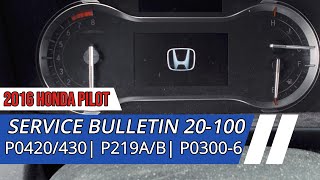
- Ignoring the warranty extension. Many owners are unaware of the 10-year/150,000-mile coverage 🎬 Watch a technician perform this fuel injector warranty repair. and pay out-of-pocket for a repair that would have been free at a dealership.
Most Likely Causes

- Faulty Fuel Injectors 🔴 High Probability A known manufacturing defect, acknowledged by Honda in TSBs like 20-100 and 21-010, can cause debris to clog or wear the injectors, leading to an improper air/fuel mixture. This is the most common cause for P0430 on 2019-2022 models.
How to confirm: First, contact a Honda dealer with your VIN to check for eligibility under the fuel injector warranty extension (10 years/150,000 miles). A technician will follow TSB procedures. If P0430 is present with misfire (P030x) or imbalance (P219B) codes, the injectors are replaced. If only P0430 is present, a PCM software update is performed, followed by a cylinder A/F balance test using a Honda-specific scan tool to confirm the failure. NHTSA ODI #11717994 describes a case where a cylinder AF test revealed that three cylinders failed for rich conditions due to the fuel injectors.
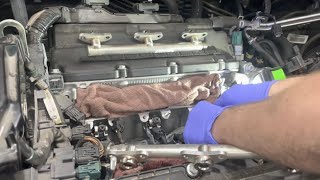
Typical fix: If the diagnosis confirms faulty injectors under the TSB, the fix involves replacing all six fuel injectors 🎬 Watch this step-by-step guide for replacing the fuel injectors. and the fuel joint pipe, followed by a PCM software update in some cases. This repair is often covered under Honda's warranty extension.
Est. part cost: $400-$800 - Failed Catalytic Converter (Bank 2) ⚪ Low Probability Converter failure is typically a secondary issue, resulting from prolonged driving with faulty fuel injectors dumping unburned fuel into the exhaust, causing the internal honeycomb structure to overheat, melt, and fail. NHTSA ODI #11695640 reports an owner who replaced catalytic converters after finding code P0430, only to have the emissions light return later with code P219B.
How to confirm: This should only be considered after the fuel injector issue has been definitively ruled out via the TSB diagnostic procedure. A mechanic can test the converter's temperature differential or use a scan tool to graph the upstream and downstream O2 sensor readings. A healthy converter shows a fluctuating upstream signal and a steady downstream signal.
Typical fix: Replacement of the Bank 2 catalytic converter assembly, which is the front converter, often integrated with the exhaust manifold.
Est. part cost: $1800-$2800 - Faulty Oxygen (O2) or Air/Fuel (A/F) Sensor ⚪ Low Probability
How to confirm: A technician can use a scan tool to observe the live data stream from the sensors. A lazy, biased, or non-responsive sensor is faulty. NHTSA ODI #11718170 describes a vehicle showing DTC P219B (O2 Sensor Signal Biased/Stuck Lean – Bank 2 Sensor 1) along with P0430.
Typical fix: Replacement of the specific faulty sensor (Bank 2, upstream A/F sensor or downstream O2 sensor).
Est. part cost: $80-$250
Rare But Worth Checking
- Exhaust Leak: A leak in the exhaust manifold or pipes between the two Bank 2 oxygen sensors can allow extra oxygen into the system, tricking the downstream sensor and triggering the code.
- PCM Software Glitch: Some of the earliest TSBs for this issue involved only a PCM software update, as the original software was too sensitive or could misinterpret sensor data. Most current repairs also involve hardware replacement.
Diagnosis Steps

- Contact a Honda dealer with your Vehicle Identification Number (VIN). Ask them to check for eligibility under the fuel injector warranty extension detailed in TSB 21-010. This is the most important first step and could lead to a free repair.
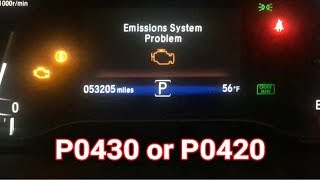
- Use a capable OBD-II scanner to check for any other stored codes. The presence of P219B or P030x codes alongside P0430 🎬 See how these codes relate to the Honda warranty extension. is a very strong indicator of the fuel injector issue, per Honda's own bulletins. NHTSA ODI #11586475 notes a case where codes P0430, P0300, P0304, P0306, and P219A appeared together, resulting in the vehicle requiring a tow.
- If proceeding with independent diagnosis, follow the logic of TSB 20-100/21-010. If P0430 exists with P030x or P219B, the cause is the injectors. If P0430 exists alone, the official procedure is to update the PCM software, then run a cylinder A/F test.
- If the cylinder test fails, replace all six fuel injectors and the fuel joint pipe.
- If the cylinder test passes, then proceed with conventional diagnosis: inspect for exhaust leaks and test the Bank 2 oxygen sensors by graphing their live data on a scan tool.
- As a final step, inspect the catalytic converter itself for physical damage or signs of melting/clogging, but only replace it after the fuel delivery issue is confirmed to be resolved.
Parts You'll Likely Need

- Fuel Injector Kit (Set of 6)
(OEM #16010-RLV-315)— This is the most common root cause of P0430 on 2019-2022 models due to a known manufacturing defect. The repair requires replacing all six injectors as a set, along with seals and a fuel pipe as part of the kit.
Trusted brands: Honda (OEM)
OEM price range: $400-$800
Aftermarket price range: $250-$500 - Bank 2 Catalytic Converter
(OEM #18180-RN0-A20)— Only needed if the converter has failed, usually as collateral damage from a long-term, unaddressed fuel injector issue. Bank 2 is the front converter assembly.
Trusted brands: Walker, MagnaFlow, AP Exhaust, Honda (OEM)
OEM price range: $2000+
Aftermarket price range: $600-$1200 - Bank 2 Upstream Air/Fuel Sensor
(OEM #36531-RLV-A01 (Denso/NGK equivalent is often 234-9152 or 27073))— This is the primary sensor (Sensor 1) that measures the air-fuel ratio before the catalyst. It can fail but is often replaced unnecessarily. It should be tested before replacement.
Trusted brands: Denso (OEM supplier), NGK/NTK, Bosch
OEM price range: $180-$280
Aftermarket price range: $90-$160
Related Codes That Often Appear With This One
- P0420 — The same catalyst efficiency code but for Bank 1 (rear). If both appear, it strongly suggests a systemic issue like the fuel injectors, not two simultaneously failed converters. The warranty extension covers this combination.
- P219B — This code means 'Air-Fuel Ratio Imbalance Bank 2'. Its presence is a major clue that the fuel injectors on Bank 2 are the problem. The TSBs state that if P0430 is present with P219B, the injectors should be replaced.
- P0300-P0306 — These are cylinder misfire codes (P0300 for random, P0301-P0306 for specific cylinders). A faulty injector can cause misfires, which then leads to the P0430 code. The TSBs explicitly link these codes together as part of the same injector issue.
Technical Service Bulletins (TSBs) & Recalls
- TSB 21-010: 'Warranty Extension: MIL Comes On with DTC P0420/P0430, P030x, and/or P219A/B (Without Software Update)'. This is a key bulletin that expands coverage to 2017-19 Pilots and other models and outlines the diagnostic path without a mandatory software update.
- TSB 20-100: 'Warranty Extension: MIL Comes On with DTC P0420/P0430, P030x, and/or P219A/B (With Software Update)'. The precursor to 21-010, this bulletin established the warranty extension and repair procedure, which included a software update for certain models.
- TSB 19-072: 'MIL Comes On with DTC P0430 or P0430 with P030X, P219A, P219B'. An earlier bulletin that first linked P0430 to the faulty injectors and required a software update as part of the fix. It has since been superseded by the warranty extension TSBs.
- Bulletin #ATI&01302026904: A manufacturer bulletin regarding certain 2025 Pilots with customer complaints of Check Engine Light on with DTC P0420 and/or P0430 stored, indicating Honda is researching these codes on the newest models.
Platform-Specific Known Issues
- Honda has a warranty extension for the fuel injectors related to this code, covering repairs for 10 years or 150,000 miles, whichever comes first, for eligible VINs.
- The issue is specific to the direct-injection J35Y6 engine used from 2016-2022 in the Pilot and other models.
- A separate NHTSA investigation (Recall 23V-751) exists for a crankshaft manufacturing defect on some of these same J35Y6 engines, which can cause catastrophic engine failure. While unrelated to the P0430 code, it highlights other known issues with this engine family.
Mechanic-Grade Diagnostic Values
- High-Pressure Fuel Pump Output Pressure — expected: 55 ±5 MPa (7979 ±725 psi). Failure: Pressure significantly below this range indicates a failing high-pressure pump, which could contribute to fuel delivery issues.
- Fuel Rail Pressure (at engine start) — expected: 30 ±5 MPa (4352 ±725 psi). Failure: Low pressure during cranking could indicate a problem with the high-pressure pump or a significant leak.
- A/F Sensor Heater Circuit Resistance — expected: Typically 2 to 4 Ohms at room temperature, but can vary. One test showed a good sensor at 5.6 Ohms in colder weather.. Failure: No reading (open circuit) or an extremely high reading indicates a failed heater element, requiring sensor replacement.
- Downstream O2 Sensor Voltage (at steady idle/RPM) — expected: A relatively steady voltage between 0.1 and 0.9 volts.. Failure: A fluctuating voltage that mimics the upstream sensor indicates a failed catalytic converter. A fixed, non-responsive voltage can indicate a failed sensor.
Scan Tool Commands That Help
- Honda Diagnostic System (HDS): Cylinder Air/Fuel Balance Test — This test is the specific procedure mandated by Honda's TSBs when P0430 appears *without* other codes like P219B or P030x. A failed test confirms the fuel injector fault and greenlights their replacement.
Wiring & Ground Locations
- A/F and O2 Sensor Connector Lock — On the sensor-side half of the electrical connector for the oxygen sensors.. The connector has a small tab that physically locks it onto the vehicle's mounting bracket, preventing the connector halves from being separated. A technician must first slide the connector off its bracket before attempting to press the release tab to separate the two halves. Attempting to pry the connector apart while it is still mounted will not work and can lead to damage.
Real Owner Repair Stories
- YouTube channel 'Pete's Garage' (2016 Honda Pilot with 50,000+ miles) — Check Engine Light with codes P0430, P219B (A/F Imbalance Bank 2), and a pending misfire for cylinder 4.
✅ What actually fixed it The mechanic immediately identified the combination of codes as the known fuel injector issue. The video documents the successful replacement of all six fuel injectors, noting heavy carbon buildup on the tips of the old ones. This was a classic case of the TSB-documented failure. - Reddit user in r/hondapilot (2016 Honda Pilot EX-L with 163,300 miles) — Check Engine Light with codes P0420 and P0430.
❌ Tried (didn't work) The user was researching the issue and had not yet attempted repairs.
✅ What actually fixed it The owner was outside the 150,000-mile warranty extension for the injectors. A commenter suggested that at this high mileage, the Variable Cylinder Management (VCM) system could be a significant contributing factor to catalyst and engine health issues, and recommended installing a VCM disabler before replacing expensive parts like injectors or converters. - Go-Parts analysis of a forum thread (Honda Pilot with 170,000 miles) — P0430 code.
❌ Tried (didn't work) Initial diagnosis focused on fuel injectors due to the common issue.
✅ What actually fixed it The long-term fuel trims were negative (LTFT1: -11.7%, LTFT2: -8.6%) but were not considered low enough to definitively condemn the injectors. A knowledgeable commenter suggested that at 170k miles, a valve clearance adjustment should be performed as tight valves can affect cylinder sealing and efficiency, potentially triggering the P0430 code. This pointed to a mechanical wear issue rather than the common injector defect.
OEM Part Supersession History
16010-RLV-305→16010-RLV-315— The original fuel injectors were prone to failure from manufacturing debris. The updated part number is the required replacement.N/A→N/A— When replacing the fuel injectors, a one-time-use fuel joint pipe is required. This can be purchased as a separate kit (p/n 16012-R9P-315) or as part of a larger injector kit (p/n 06161-RLV-305).
Heads up: Failure to replace the one-time-use fuel pipe can result in fuel leaks at the high-pressure fuel rail.
Model Year Variations Within This Range
- 2019-2022: These models use the J35Y6 SOHC V6 with direct injection. This is the engine family primarily affected by the fuel injector manufacturing defect that causes P0430.
- 2023-2025: These models use the redesigned J35Y8 DOHC V6. This engine features a new high-pressure direct injection system and dual overhead cams, and does not have VTEC. It was changed primarily for emissions reasons. While P0430 can still occur, it is not linked to the same widespread injector defect as the earlier models, and diagnosis should follow a more traditional path.
Diagnostic Flowchart
Real Owner Stories
Aggregated from forums and TSBs cited above. Mileages and costs reflect what owners reported in those sources.
2019+ Honda Pilot
Symptoms: Received an 'Emissions System Problem' warning with code P0430.
What fixed it: Visited a dealer and had all 6 fuel injectors replaced for free under the Honda warranty extension.
Source hint: Piloteers.org - 'Emissions System Problem P0430'
2018 Honda Pilot
Symptoms: P0430 code triggered; an independent mechanic suggested it was just a software issue.
What fixed it: Community advised the owner to push the dealership to address the known fuel injector TSBs and warranty extension instead of settling for a software update.
Source hint: Reddit r/hondapilot - '2018 Pilot with P0430!'
Honda Ridgeline (J35Y6)
Symptoms: Emissions light came on shortly after receiving the warranty extension letter in the mail.
What fixed it: Took the vehicle to the dealer, where the fuel injectors were successfully replaced under the warranty extension.
Source hint: Reddit r/hondaridgeline - 'Honda extending warranty for fuel injector failure'
Documented NHTSA Reports
NHTSA ODI #11586475
Symptoms: Three of the six fuel injectors failed, with Diagnostic Trouble Codes P0430, P0300, P0304, P0306, and P219A.
What fixed it: The vehicle required transportation via tow truck to an independent service facility for repair.
NHTSA ODI #11717994
Symptoms: The Check Engine Light would go on and off every several days. A dealer diagnosed a P0430 code and ran a cylinder AF test.
What fixed it: The test revealed that cylinders 2, 5, and 6 failed for rich conditions due to the fuel injectors.
Related OBD-II Codes
Frequently Asked Questions
Is there a warranty extension for the P0430 code on my Honda Pilot?
What does TSB 21-010 mean for my 2019 Pilot?
My mechanic wants to replace the oxygen sensors for code P0430. Should I do that?
Why is my Pilot showing P0430 along with P030x and P219B codes?
Does the NHTSA crankshaft recall (23V-751) have anything to do with my P0430 code?
If the fuel injectors are causing my P0430 code, what is the actual repair?
Helpful Videos
Used OEM Parts in Stock

New Aftermarket Parts Available


The information in this article is provided for general reference and educational purposes only. Vehicle specifications, procedures, and part compatibility can vary by production date, trim level, and region. Always consult your vehicle's factory service manual and verify part numbers before purchasing or performing repairs. Safety-critical components such as airbags, seat belts, and braking systems should be installed by a qualified professional.
- Honda Pilot:
- 🎬 Helpful Videos
- 🛍️ Shop This Part
- What's Unique About the 2019-2025 Honda Pilot
- Symptoms You May Notice
- Most Likely Causes
- Rare But Worth Checking
- Diagnosis Steps
- Parts You'll Likely Need
- Related Codes That Often Appear With This One
- Technical Service Bulletins (TSBs) & Recalls
- Platform-Specific Known Issues
- Mechanic-Grade Diagnostic Values
- Scan Tool Commands That Help
- Wiring & Ground Locations
- Real Owner Repair Stories
- OEM Part Supersession History
- Model Year Variations Within This Range
- Diagnostic Flowchart
- Real Owner Stories
- 2019+ Honda Pilot
- 2018 Honda Pilot
- Honda Ridgeline (J35Y6)
- Documented NHTSA Reports
- NHTSA ODI #11586475
- NHTSA ODI #11717994
- Related OBD-II Codes
- Frequently Asked Questions
- 🎟️ Get 5% Off