

P0430 on 2011-2018 Honda Pilot: Fuel Injector Failure vs. Catalytic Converter vs. Software
On 2016-2018 Honda Pilots, code P0430 is very often caused by faulty fuel injectors, not the catalytic converter itself. Honda has issued technical service bulletins (like 20-100) and a warranty extension (10 years/150,000 miles) for this specific issue. The fix involves a software update and replacing all six fuel injectors. For 2011-2015 models, the cause is more likely an aged catalytic converter.
- For a 2016-2018 Honda Pilot, DO NOT automatically replace the catalytic converter for a P0430 code.
- The most likely cause on these later models is faulty fuel injectors, an issue covered by Honda TSBs and a warranty extension (TSB 20-100).
- The correct diagnostic procedure is: 1) Update PCM software, 2) Perform a cylinder air/fuel test, 3) Replace injectors if the test fails.
- For older 2011-2015 models, a failed catalytic converter is a more probable cause.
- Check with a Honda dealer using your VIN to see if your vehicle is covered under the warranty extension before paying for repairs.
What's Unique About the 2011-2018 Honda PILOT

For the 3rd generation Pilot (2016-2018) with the direct-injected 3.5L J35Y6 engine, this code is frequently a red herring. Honda has acknowledged via multiple service bulletins (TSB 19-072, 20-100) that faulty fuel injectors are often the true cause. Debris from the high-pressure fuel pump or original manufacturing can clog or damage the injectors, leading to an improper air/fuel mixture. The PCM misinterprets this as a failed catalytic converter, or the rich condition eventually overheats and destroys the converter. Simply replacing the converter without addressing the injectors will likely result in the code returning.
Diagnostic Flowchart

Tap your situation to follow the diagnostic path that matches what you're seeing on this vehicle.
Generation note: This guide covers the end of the 2nd generation (2011-2015) and the start of the 3rd generation (2016-2018) Pilot. The primary cause is very different between them. For 2016-2018 models, faulty fuel injectors are a well-documented cause covered by Honda TSBs and a warranty extension. For 2011-2015 models, the cause is more likely a standard aged catalytic converter, a faulty oxygen sensor, or oil consumption issues related to the VCM system fouling the converter.
Symptoms You May Notice
- Check Engine Light is on
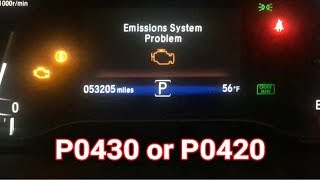
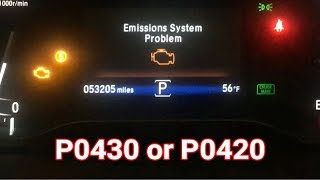
- "Emissions System Problem" message on the dashboard
- Loss of power or hesitation, especially at highway speeds.
- Rough or vibrating idle
- Rotten egg or sulfur smell from the exhaust
- Reduced fuel economy
- Replacing the Bank 2 catalytic converter on a 2016-2018 model without first investigating the fuel injectors. The new converter will likely be damaged by the same underlying fuel system fault, causing the code to return.
- Replacing the downstream O2 sensor. While it can be the cause, it is far less likely than the injector or converter issues on this vehicle and is often a waste of money.
- Using a catalytic converter cleaner additive. While some users report temporary success, it rarely fixes a legitimately failed converter or an underlying fuel system problem.
Most Likely Causes

- Faulty Fuel Injectors (especially 2016-2018 models) 🔴 High Probability Honda TSBs 19-072 and 20-100 state that debris from the high-pressure fuel pump or original manufacturing can cause injectors to clog or wear, leading to air/fuel ratio imbalances. This is a known issue for the direct-injected J35Y6 engine used in Pilots, Odysseys, and Ridgelines.
How to confirm: A Honda dealer or qualified shop must first check for and apply any required PCM software updates. Then, they perform a 'Cylinder AF Test' with a diagnostic tool. If any cylinder fails this test, the injectors are the cause. The presence of codes P219B (Air/Fuel Ratio Imbalance) or P030x (misfires) strongly points to the injectors.
Typical fix: Replace all six fuel injectors as a set and replace associated seals and pipes. A PCM software update is also required as part of the TSB procedure.
Est. part cost: $550-$900 for an OEM injector kit (Part No. 16010-RLV-315). - Failed Catalytic Converter (Bank 2) 🟡 Medium Probability This is the most common cause on older (2011-2015) models or on high-mileage 2016-2018 models where the fuel injector issue went unaddressed for too long, causing the converter to fail from being overheated by a rich fuel mixture. One owner of a 2012 Pilot was quoted over $4,300 by a dealer to replace both converters.
How to confirm: After ruling out injectors and O2 sensors, a technician can use a scan tool to watch O2 sensor data. The downstream O2 sensor (Sensor 2) voltage should be steady and high (e.g., >0.6V). If it fluctuates rapidly, mimicking the upstream sensor, the converter is not storing oxygen and has failed.
Typical fix: Replace the Bank 2 catalytic converter, which is integrated with the front exhaust manifold. 🎬 Watch: Step-by-step guide to replacing the Bank 2 catalytic converter.
Est. part cost: $400-$800 aftermarket, $1500-$2100 OEM. - PCM Software Issue 🟡 Medium Probability Honda TSB 17-036 (later replaced by 19-072 and 20-100) explicitly states that the PCM software may misinterpret sensor inputs, incorrectly flagging a P0430 code. The first step in the official diagnostic procedure is to update the software before testing components.
How to confirm: A Honda dealer or a shop with a J2534 pass-thru device can check the current software version against the latest version listed in the service bulletins. An owner on a forum was told by an independent mechanic it was likely a software issue before going to the dealer.
Typical fix: Update the Powertrain Control Module (PGM-FI) software.
Est. part cost: $0 (if part of a warranty or TSB repair), $100-$250 for labor if performed as a standalone service. - Faulty Oxygen (O2) Sensor ⚪ Low Probability
How to confirm: A lazy or failed downstream (Bank 2, Sensor 2) O2 sensor can send incorrect data, tricking the PCM. However, this is far less common than injector or converter failure on this platform. It's best to rule out other causes first, as replacing the sensor is often a temporary fix if the converter is truly bad.
Typical fix: Replace the Bank 2, Sensor 2 (downstream) oxygen sensor.
Est. part cost: $50-$150
Rare But Worth Checking
- Exhaust Leak: A leak in the exhaust manifold, flex pipe, or flange before or near the Bank 2 catalytic converter can introduce oxygen and trick the sensors into reporting a false P0430 code.
- Excessive Oil Consumption (2011-2015 models): Some 2nd generation Pilots with the J35Z4 engine can consume oil due to issues with the VCM (Variable Cylinder Management) system causing piston rings to stick. This burned oil can contaminate and eventually destroy the catalytic converters, leading to P0420/P0430 codes.
Diagnosis Steps
- Check for Warranty Extension: For 2016-2018 models, immediately check with a Honda dealer if your vehicle's VIN is covered by the warranty extension for this issue (detailed in TSB 20-100 and 21-010). 🎬 Watch: How to diagnose these codes using the service bulletin. It extends coverage to 10 years or 150,000 miles. Many owners report being covered even when an online VIN check shows nothing.
- Scan for Other Codes: The presence of P219B or P030x codes alongside P0430 is a strong indicator of the fuel injector problem on 2016+ models.
- (2016-2018 models) Perform TSB-Mandated Repair: Take the vehicle to a dealer or qualified shop. The correct procedure is to first update the PGM-FI (engine computer) software.
- (2016-2018 models) Perform Cylinder AF Test: After the software update, the technician must perform the 'Cylinder AF Test' using a Honda-specific scan tool. If the test fails, the fuel injectors must be replaced. If P0430 is present with misfire or A/F imbalance codes, the TSB may direct to replace the injectors without the test.
- (2011-2015 models) Inspect for Exhaust Leaks: Carefully inspect the exhaust system for any leaks between the engine and the Bank 2 catalytic converter. A leak can falsely trigger the code.
- Analyze O2 Sensor Data: Use a scan tool to graph the voltage of the upstream (Sensor 1) and downstream (Sensor 2) O2 sensors for Bank 2. At a steady 2500 RPM, the upstream sensor should fluctuate rapidly. The downstream sensor's voltage should be relatively stable and high (above 0.6V). If it mirrors the upstream sensor's fluctuations, the catalytic converter has failed.
- If all other causes are ruled out, consider a faulty Bank 2 downstream O2 sensor, but be aware this is the least likely cause.
Parts You'll Likely Need

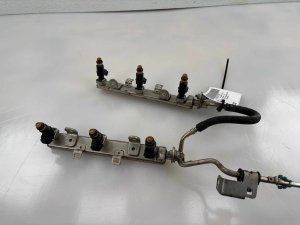
- Fuel Injector Kit
(OEM #16010-RLV-315)— This is the most probable root cause for P0430 on 2016-2018 Pilots, as documented by Honda's service bulletins. The kit includes all 6 injectors and required seals. One owner reported a $1940 dealer bill for this repair before the warranty extension was widely known.
Trusted brands: Honda (OEM)
OEM price range: $550-$900
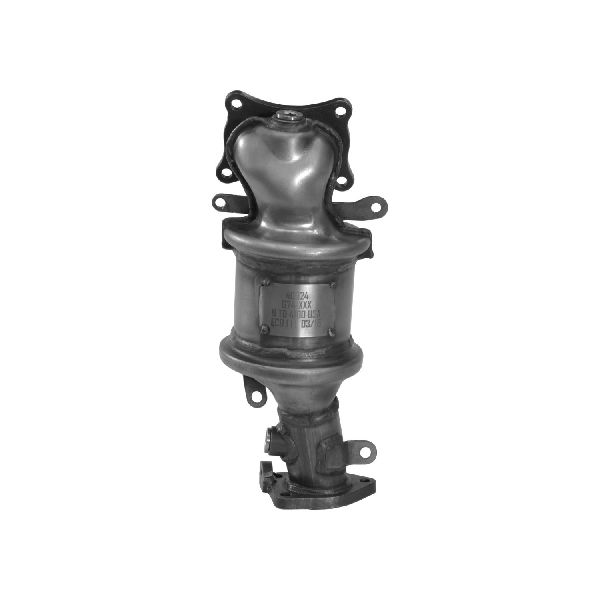
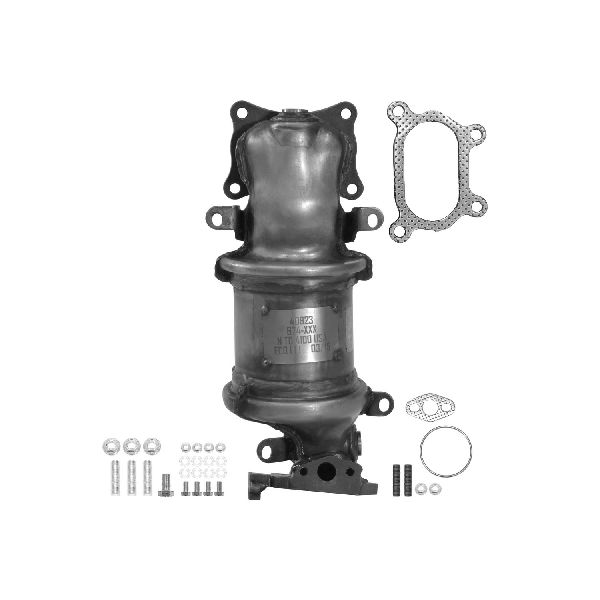
Aftermarket price range: $400-$600 (Remanufactured) - Bank 2 Catalytic Converter (Front) — This is the part the code directly points to. It's the most likely failure on 2011-2015 models, or on 2016-2018 models if the injector issue was not fixed in time. A 2012 Pilot owner was quoted $4,347 by a dealer for both converters.
Trusted brands: Walker, MagnaFlow, AP Exhaust, Dorman, Honda (OEM)
OEM price range: $1500-$2100
Aftermarket price range: $400-$800
Related Codes That Often Appear With This One
- P0420 — Catalyst efficiency code for Bank 1. Its presence alongside P0430 strongly suggests a systemic problem like a fuel injector issue affecting the entire engine, not just one converter. The TSBs and warranty extension cover both codes.
- P219B — Air/Fuel Ratio Imbalance for Bank 2. This code is a major clue that the fuel injectors on Bank 2 are not performing correctly, directly supporting the TSB findings. An owner complaint and a repair video both showed P0430 and P219B together.
- P0300-P0306 — Cylinder misfire codes. Unburnt fuel from a misfire can overheat and destroy the catalytic converter. Faulty injectors are a common cause of misfires, and these codes are often seen with P0430.
- P2652 — B Rocker Arm Actuator System Stuck On Bank 2. This was reported by one owner along with P0430 and could indicate an issue with the VCM (Variable Cylinder Management) system, which can also affect combustion and emissions.
Technical Service Bulletins (TSBs) & Recalls
- TSB 20-100: Warranty Extension: MIL Comes On with DTC P0420/P0430, P030x, and/or P219A/B (With Software Update).
- TSB 19-072: Supersedes 17-036, adds faulty fuel injectors as a primary cause alongside the software issue.
- TSB 17-036: The original bulletin, mentioned in an owner complaint, which focused on a PCM software update as the fix.
Platform-Specific Known Issues
- Warranty Extension: Honda Service Bulletin 20-100 (and its successor 21-010) extends the warranty coverage for P0430/P0420 caused by fuel injectors to 10 years or 150,000 miles from the original purchase date for many 2016-2018 Pilots. Owners should check their VIN with a Honda dealer, as the repair is free if covered. Owners who previously paid for this repair may be eligible for reimbursement.
- Fuel Injector Contamination: On 2016-2018 models with direct injection, debris from the manufacturing process of the high-pressure fuel pump or the injectors themselves can cause the injectors to fail, leading to fuel control issues that trigger the P0430 code.
- VCM-Related Oil Consumption (2011-2015): The Variable Cylinder Management (VCM) system on the 2nd generation Pilot can cause the piston rings on deactivated cylinders to become stuck with carbon, leading to high oil consumption. This burned oil can foul the catalytic converters over time, causing P0420/P0430.
Helpful Videos
Used OEM Parts in Stock

New Aftermarket Parts Available


The information in this article is provided for general reference and educational purposes only. Vehicle specifications, procedures, and part compatibility can vary by production date, trim level, and region. Always consult your vehicle's factory service manual and verify part numbers before purchasing or performing repairs. Safety-critical components such as airbags, seat belts, and braking systems should be installed by a qualified professional.
- Honda PILOT:
- 🎬 Helpful Videos
- 🛍️ Shop This Part
- What's Unique About the 2011-2018 Honda PILOT
- Diagnostic Flowchart
- Symptoms You May Notice
- Most Likely Causes
- Rare But Worth Checking
- Diagnosis Steps
- Parts You'll Likely Need
- Related Codes That Often Appear With This One
- Technical Service Bulletins (TSBs) & Recalls
- Platform-Specific Known Issues
- 🎟️ Get 5% Off