

P0430 on 2017-2018 GMC Savana: Catalyst Efficiency Causes and Fixes
P0430 on a 2017-2018 GMC Savana means the passenger side (Bank 2) catalytic converter is inefficient. While the converter itself may have failed, always check for cheaper fixes first, like exhaust leaks from broken manifold bolts or a bad downstream oxygen sensor, to avoid a costly misdiagnosis.
- P0430 points to an issue with the passenger-side catalytic converter's efficiency.
- Before buying an expensive new converter, ALWAYS rule out an exhaust leak or a faulty downstream (Bank 2, Sensor 2) oxygen sensor.
- The best diagnostic tool is a scanner that can show live O2 sensor data. A bad converter is confirmed when the downstream sensor's voltage graph mimics the upstream sensor's.
- If you have any other codes, especially for engine misfires (P0300-P0308), you must fix those problems first, or you will ruin a new catalytic converter.
What's Unique About the 2017-2018 Gmc SAVANA
The 2017-2018 GMC Savana and its twin, the Chevy Express, are workhorses, and this code is a common issue as they age. A notorious problem on these GM V8 engines is the rearmost exhaust manifold bolts breaking off, causing a leak. This leak introduces oxygen into the exhaust, which can trick the O2 sensors and cause a false P0430 code long before the converter has actually failed. Rust is a major factor, often causing these leaks at manifold flanges. It's also important to note that GM issued a bulletin (PIP3119P) stating that on new vehicles, the diagnostic for this code is disabled for the first hour of operation to prevent false positives during break-in.
Diagnostic Flowchart
Tap your situation to follow the diagnostic path that matches what you're seeing on this vehicle.
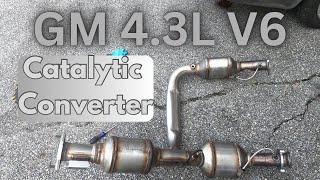
Generation note: The 2017-2018 model years are part of a long-running generation, but they feature distinct gasoline engine options. The 2017 models offered a 4.8L V8 or a 6.0L V8. For 2018, the base 4.8L V8 was replaced by a new 4.3L V6, while the 6.0L V8 remained an option. This guide applies to all these gasoline engines, as the P0430 diagnostic principle is the same across GM's V-type engines.
Symptoms You May Notice
- Check Engine Light is on
- Reduced engine power or sluggish acceleration, especially if the converter is clogged
- A sulfur or "rotten egg" smell from the exhaust
- Failing an emissions test
- A distinct ticking or hissing noise from the engine area, especially on a cold start, indicating an exhaust manifold leak.
- Immediately replacing the catalytic converter without first checking for exhaust leaks or testing the oxygen sensors. An exhaust leak from a broken manifold bolt is a very common cause on these vans and a much cheaper fix.
- Replacing the wrong parts. P0430 is for Bank 2, which is the passenger side on these vans. Bank 1 (driver's side) would trigger code P0420.
- Replacing the O2 sensor hoping it will fix the code when the catalytic converter is truly bad. While sensors can fail, if the live data shows it's reporting correctly (i.e., mimicking the upstream sensor), the sensor is doing its job by reporting a bad converter.
Most Likely Causes
- Failing Catalytic Converter 🔴 High Probability These vans often see high mileage and heavy use, which leads to natural wear and tear of the catalytic converter's internal materials. Damage from unaddressed engine misfires or rich/lean conditions is also a primary cause of premature failure.
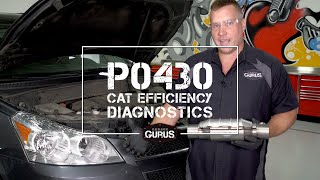
How to confirm: Use a scan tool to observe the downstream O2 sensor (Bank 2, Sensor 2). If its voltage reading is switching rapidly between ~0.1V and ~0.9V, mimicking the upstream sensor (Bank 2, Sensor 1), the converter is likely bad. 🎬 Watch: How to diagnose catalytic converter efficiency with a scan tool. Another test is to use an infrared thermometer to measure the converter's inlet and outlet pipes; the outlet should be at least 100-150°F hotter than the inlet on a fully warmed-up engine.
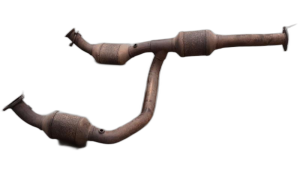
Typical fix: Replace the Bank 2 catalytic converter. This is often part of a Y-pipe assembly. An example OEM part number is 19418932.
Est. part cost: $400-$1200 - Exhaust System Leak (especially at Manifold) 🔴 High Probability Rust is common on these work vans. More specifically, the V8 engines are notorious for the rear-most exhaust manifold bolts breaking off flush with the cylinder head, creating a leak right at the gasket. This is a very common cause of a false P0430 on Savana and Express vans.
How to confirm: Perform a visual inspection for black soot trails or cracks around gaskets and welds, especially where the passenger-side manifold meets the cylinder head. A smoke test is the most definitive way to find small leaks. Listen for an audible ticking or hissing noise from the exhaust when the engine is cold, which often diminishes as the metal expands and seals the leak.
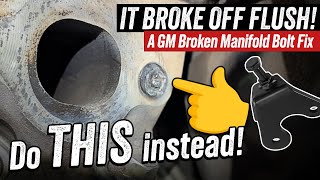
Typical fix: Repair the leak. This often involves replacing a gasket and, in the case of broken manifold bolts, extracting the broken bolt and replacing it. A common DIY repair involves using a specialized clamp bracket (like those from Dorman) to seal the manifold without bolt extraction. 🎬 See how to use a specialized clamp to fix broken bolts.
Est. part cost: $20-$150 - Faulty Downstream Oxygen (O2) Sensor 🟡 Medium Probability O2 sensors are wear items and can fail over time, sending incorrect data to the ECM. A previous GM recall for older models noted sensor failures due to condensation, indicating a potential sensitivity. While a possible cause, it's more often misdiagnosed.
How to confirm: Review live sensor data on a scan tool. A faulty downstream sensor may have a voltage that is stuck (e.g., stuck at 0.1v or 0.9v), has a very slow/lazy response when the engine is revved, or shows no activity at all.
Typical fix: Replace the Bank 2, Sensor 2 (downstream) oxygen sensor. The OEM part number is 12609457, which corresponds to ACDelco part 213-4229.
Est. part cost: $40-$90
Rare But Worth Checking
- Underlying Engine Misfire: A misfire (codes P0300-P0308) sends unburned fuel into the exhaust, which superheats and melts the internal ceramic honeycomb of the catalytic converter. You MUST fix any misfire before replacing the converter, or the new one will be destroyed quickly.
- Fuel System Issue (Rich/Lean Condition): Codes like P0171/P0174 (lean) or P0172/P0175 (rich) indicate a fuel mixture problem that can damage the converter over time. These issues, caused by things like faulty fuel injectors or vacuum leaks, must be addressed first to prevent repeat failure of the converter.
Diagnosis Steps
- Check for other DTCs. If codes for misfires (P030x), fuel trim (P0171/P0174), or O2 sensor circuits are present, diagnose and fix them first as they are the root cause.
- Inspect the exhaust system thoroughly from the passenger-side exhaust manifold back to the rear O2 sensor. Listen for a ticking noise on a cold start, which suggests a manifold leak. Look for any signs of leaks, such as black soot trails, cracks, or rust holes. Pay close attention to the manifold-to-head connection for broken bolts.
- Use a scan tool to monitor live data for the Bank 2 oxygen sensors (B2S1 and B2S2).
- With the engine fully warmed up and idling, observe the sensor voltages. The upstream sensor (B2S1) should switch rapidly between approximately 0.1V and 0.9V. The downstream sensor (B2S2) should show a much slower, steadier voltage, typically above 0.5V.
- If the downstream sensor (B2S2) is mimicking the rapid switching of the upstream sensor, the catalytic converter has failed and is no longer storing oxygen. This confirms a bad converter.
- If the downstream sensor (B2S2) voltage is stuck high, low, or is not responding to changes in engine RPM, the sensor itself is likely faulty.
- If an exhaust leak is suspected but not visible, a smoke test is the most reliable method to confirm its location and severity.
- If no exhaust leaks, misfires, or sensor faults are found, the catalytic converter is the most likely culprit.
Parts You'll Likely Need
- Catalytic Converter (Bank 2)
(OEM #19418932)— This is the most common failure part that directly causes the P0430 code after high mileage or damage from engine issues. OEM part number 19418932 supersedes 15127419 and 25824121 for some V8 models.
Trusted brands: Walker Exhaust, MagnaFlow, AP Exhaust, ACDelco
OEM price range: $800-$3400
Aftermarket price range: $400-$800 - Oxygen Sensor (Bank 2, Sensor 2)
(OEM #12609457)— This sensor measures the converter's efficiency. If it fails, it can send false data and trigger the code. It's a common wear item and a frequent misdiagnosis for a bad converter.
Trusted brands: ACDelco, Denso, Bosch
OEM price range: $70-$120
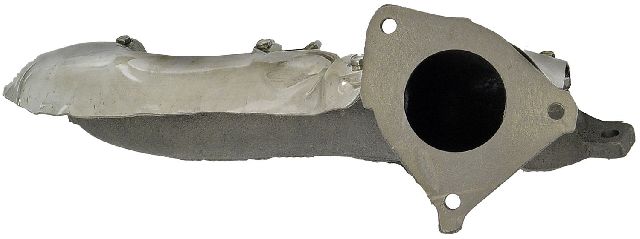
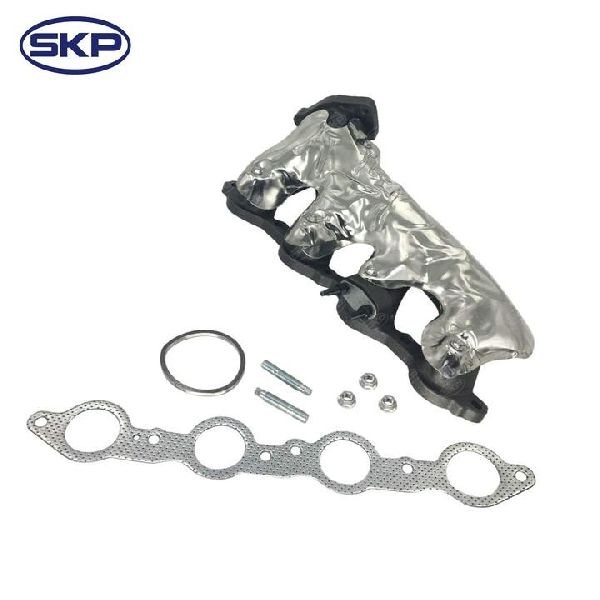
Aftermarket price range: $40-$90 - Exhaust Manifold Gasket Set — Exhaust leaks at the manifold due to broken bolts are a very common source of false P0430 codes on these V8/V6 engines. A quality replacement like the Fel-Pro MS 92467 is often used.
Trusted brands: Fel-Pro, ACDelco
OEM price range: $25-$50
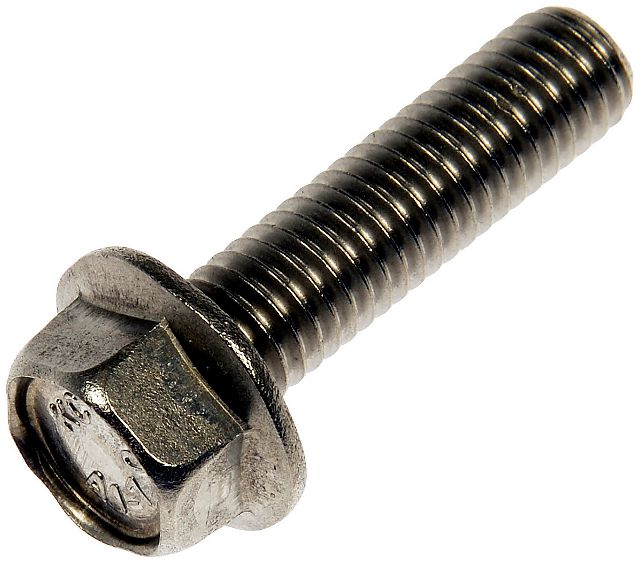
Aftermarket price range: $15-$30 - Exhaust Manifold Bolt Kit — When repairing a manifold leak, it's almost certain that one or more bolts will be seized or broken and require replacement. Upgraded stainless steel bolts are a common preventative measure.
Related Codes That Often Appear With This One
- P0420 — This is the identical code for Bank 1 (driver's side). If both appear together, it may point to a systemic issue like bad fuel quality or high mileage causing both converters to fail around the same time.
- P0300-P0308 — These are misfire codes. An active misfire is a primary cause of catalytic converter failure and must be repaired first to prevent destroying a new converter.
- P0171 / P0174 — These lean condition codes can be caused by an exhaust leak upstream of the O2 sensors, which is also a primary cause of a false P0430 code.
Technical Service Bulletins (TSBs) & Recalls
- TSB #PIP3119P: Details that the P0420/P0430 diagnostic is disabled for the first hour of engine run time on new vehicles to allow for converter break-in. A power loss event (like a battery disconnect) can reset this timer and cause a false code. It also applies to newly replaced converters and provides a drive cycle to ensure proper break-in.
Platform-Specific Known Issues
- A Technical Service Bulletin (#PIP3119P) notes that on some low-mileage GM vehicles, the diagnostic test for P0430 is disabled for the first hour of engine operation to allow the converter to break in. A battery disconnect during manufacturing could interfere with this process and cause a false code to set. The bulletin provides a specific drive cycle to perform to properly break in a new converter and prevent a false code from returning.
- Broken exhaust manifold bolts, particularly on the V8 models, are a very common failure point that directly leads to exhaust leaks and false P0430/P0420 codes. The rearmost bolts near the firewall are the most frequent to break.
Mechanic-Grade Diagnostic Values
- Downstream O2 Sensor (B2S2) Voltage at Idle/Cruise — expected: Relatively stable reading between 0.4V and 0.8V on a warm engine.. Failure: Voltage rapidly fluctuates between ~0.1V and ~0.9V, mimicking the upstream sensor, or is stuck at a specific voltage.
- Upstream O2 Sensor (B2S1) Voltage at Idle/Cruise — expected: Rapidly fluctuating voltage between approximately 0.1V and 0.9V.. Failure: Slow or no fluctuation, or voltage stuck at a specific level.
- Short/Long Term Fuel Trims (Bank 2) — expected: Combined value should be within +/- 10%. A healthy engine is often closer to +/- 5%.. Failure: Consistently high positive values (>+10%) suggest a lean condition or vacuum/exhaust leak. Consistently high negative values (<-10%) suggest a rich condition.
- O2 Sensor Heater Circuit Resistance — expected: Typically between 2 and 16 ohms, but consult the specific vehicle repair manual.. Failure: No reading (open circuit) or a reading far outside the specified range indicates a failed heater element within the sensor.
Hidden / Shadow Codes Worth Checking
- Mode $06, TID $01/$02, CID $01/$02: This data provides the raw test results from the PCM's catalyst efficiency monitor. For CAN vehicles, this is reported as MID $21/$22. It shows the measured value versus the maximum allowable threshold. A value very close to the limit indicates a borderline converter, even if a DTC hasn't set yet. (see via An advanced OBD-II scan tool with Mode $06 capability. The raw hexadecimal data often needs to be converted and cross-referenced with manufacturer charts to be understood.)
Scan Tool Commands That Help
- Tech2/GDS2: Catalyst System Test — This function allows a technician to manually initiate the catalyst efficiency monitor test after a repair, rather than performing a full, lengthy drive cycle. It provides a much quicker verification that the fix was successful.
- Generic OBD-II Scanner: GM Drive Cycle / Emissions Readiness Monitor Reset — After a repair (like replacing a sensor or converter), the catalyst monitor must be run to completion to verify the fix and allow the Check Engine Light to be turned off permanently. Initiating a drive cycle mode can help meet the specific criteria needed to run the test.
Wiring & Ground Locations
- O2A and O2B Fuses — In the underhood fuse panel. On many GM trucks, these are 15-amp fuses labeled 'O2A' and 'O2B'.. These fuses provide power to the oxygen sensor heater circuits. A blown fuse will cause the sensor to heat up slowly or not at all, leading to incorrect readings and potentially triggering catalyst or sensor heater codes.
- Bank 2 Downstream O2 Sensor Connector — On the exhaust pipe, just after the passenger-side catalytic converter. It is a 4-pin gray connector.. This is the direct connection for the sensor that measures catalyst efficiency. Wiggling this connector while watching live data can reveal intermittent connections. Corrosion or damage to the pins or wires here will cause false signals to the ECM.
Real Owner Repair Stories
- Garage Gurus (YouTube) (2012 Chevrolet Traverse (similar V6 architecture and diagnostic principles)) — Check Engine Light with code P0430.
❌ Tried (didn't work) Initial scan confirmed P0430., Fuel trims were checked and found to be within spec (+/- 10%)., Visual inspection of the catalytic converter showed no signs of physical damage or discoloration.
✅ What actually fixed it A pinhole leak was discovered in the Y-pipe downstream of the Bank 2 oxygen sensor. Replacing the Y-pipe assembly resolved the issue, and follow-up scan tool data showed proper downstream O2 sensor readings, confirming the catalytic converter was not faulty. - DIY for GMC CHEVY (YouTube) (GMC/Chevy LS motor truck (e.g., Sierra/Silverado)) — Audible exhaust tick, especially when cold. Likely accompanied by P0430 or P0171/P0174.
❌ Tried (didn't work) Attempting to extract the broken manifold bolt, which can be extremely difficult due to rust and limited access, especially for the rearmost bolts near the firewall.
✅ What actually fixed it Installed a Dorman-style exhaust manifold clamp bracket. This device bolts to unused holes on the cylinder head and uses a jackscrew to press against the manifold, clamping it securely against the head and sealing the gasket leak without needing to remove the broken bolt.
OEM Part Supersession History
25824121, 15127419→19418932— Part consolidation and potential design updates by GM over the model years.ACDelco 213-4229→GM 12609457— This is the corresponding GM part number for the ACDelco service part for the downstream oxygen sensor.
Model Year Variations Within This Range
- 2018: For the 2018 model year, the base 4.8L V8 (L20) engine was discontinued and replaced with a new 4.3L V6 (LV1) engine mated to an 8-speed automatic transmission. The 6.0L V8 (L96) remained an option.
- 2017: The 2017 model year was the last year for the 4.8L V8 as the base engine. The primary engine options were the 4.8L V8 and the 6.0L V8.
Helpful Videos


Used OEM Parts in Stock
New Aftermarket Parts Available



The information in this article is provided for general reference and educational purposes only. Vehicle specifications, procedures, and part compatibility can vary by production date, trim level, and region. Always consult your vehicle's factory service manual and verify part numbers before purchasing or performing repairs. Safety-critical components such as airbags, seat belts, and braking systems should be installed by a qualified professional.
- Gmc SAVANA:
- 🎬 Helpful Videos
- 🛍️ Shop This Part
- What's Unique About the 2017-2018 Gmc SAVANA
- Diagnostic Flowchart
- Symptoms You May Notice
- Most Likely Causes
- Rare But Worth Checking
- Diagnosis Steps
- Parts You'll Likely Need
- Related Codes That Often Appear With This One
- Technical Service Bulletins (TSBs) & Recalls
- Platform-Specific Known Issues
- Mechanic-Grade Diagnostic Values
- Hidden / Shadow Codes Worth Checking
- Scan Tool Commands That Help
- Wiring & Ground Locations
- Real Owner Repair Stories
- OEM Part Supersession History
- Model Year Variations Within This Range
- 🎟️ Get 5% Off