

P0430 on 2016-2018 Ford Taurus: Catalyst Efficiency Causes and Fixes
P0430 on a 2016-2018 Ford Taurus indicates low efficiency from the Bank 2 catalytic converter. For 3.7L engines in Police Interceptor models, a PCM update per TSB 18-2297 should be the first step to avoid misdiagnosis. Otherwise, the most likely causes are a genuinely failed catalytic converter, a faulty oxygen sensor, or an exhaust leak. On these transverse engines, Bank 2 is the front bank, closer to the radiator.
- For a 2016-2018 Taurus with a 3.7L engine, your first step for a P0430 code should be to check if TSB 18-2297 (PCM reflash) has been performed.
- P0430 points to a problem with the Bank 2 catalytic converter, which is located at the front of the engine bay on a Taurus.
- Before replacing the expensive catalytic converter, always rule out cheaper and simpler problems like exhaust leaks and faulty oxygen sensors.
- If you have other engine codes, especially for misfires, you must fix those problems first to avoid destroying a new catalytic converter.
What's Unique About the 2016-2018 Ford TAURUS

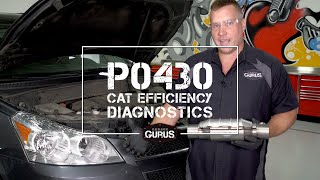
For the 2016-2018 Ford Taurus, particularly the Police Interceptor Sedan models with the 3.7L Ti-VCT engine, this code has a very specific history. Ford issued Technical Service Bulletin (TSB) 18-2297 because these vehicles could trigger a P0430 (or P0420 for the other bank) due to a software calibration issue that was overly sensitive. The official fix is to first reprogram the PCM, which can prevent the unnecessary and expensive replacement of a perfectly good catalytic converter. This makes a software check a critical first step for this specific engine. 🎬 Watch: Ford catalyst efficiency codes P0420 and P0430 explained. Additionally, Ford has acknowledged premature catalytic converter failures on these platforms through other TSBs and customer satisfaction programs, meaning a P0430 is very likely to be a legitimate converter failure if the software update doesn't apply or has already been performed.
Diagnostic Flowchart
Tap your situation to follow the diagnostic path that matches what you're seeing on this vehicle.
Symptoms You May Notice
- Check Engine Light is on
- Vehicle will fail an emissions test
- Reduced engine performance or power
- Slight decrease in fuel efficiency
- Possible sulfur or "rotten egg" smell from the exhaust
- Replacing the catalytic converter without first checking for software updates (on 3.7L Police Interceptors), exhaust leaks, or properly testing the oxygen sensors.
- Replacing the downstream oxygen sensor when the catalytic converter has genuinely failed. The sensor is often just doing its job of reporting the failure.
- Replacing the catalytic converter without addressing the root cause, such as an engine misfire or a rich fuel condition, which will cause the new converter to fail as well.
Most Likely Causes

- Failing Catalytic Converter (Bank 2) 🔴 High Probability Catalytic converters can degrade over time from age and mileage. Ford has also acknowledged premature failures on this platform, sometimes due to aggressive driving (in police use) causing overheating. Underlying issues like engine misfires or coolant leaks can also accelerate failure.
How to confirm: After ruling out other causes, a mechanic can use a scan tool to observe O2 sensor data or use an infrared thermometer to check the converter's inlet and outlet temperatures. The outlet should be significantly hotter (by at least 100-150°F) than the inlet on a fully warmed-up engine. A cool outlet temperature indicates the catalyst is inactive.
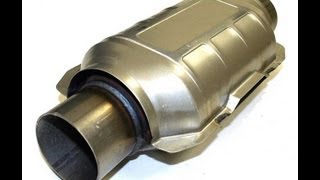
Typical fix: Replace the Bank 2 catalytic converter. This is integrated with the exhaust manifold. Bank 2 is the front manifold, closer to the radiator, which is easier to access than Bank 1.
Est. part cost: $600-$2300 - PCM Software Calibration Issue 🔴 High Probability Specifically affects 2016-2018 3.7L Police Interceptor Sedans as documented in Ford TSB 18-2297. The factory software may be too sensitive, leading to false P0420/P0430 codes.
How to confirm: A Ford dealership or a qualified shop with Ford's diagnostic software (IDS) can check the current PCM calibration level against the one recommended in the TSB. This should be the first step for any 3.7L model.
Typical fix: Reprogram the Powertrain Control Module (PCM) to the latest calibration. This is a software-only fix.
Est. part cost: $0 (parts), labor only ($100-$250) - Faulty Oxygen (O2) Sensor 🟡 Medium Probability The downstream O2 sensor (Bank 2, Sensor 2) can become lazy or biased with age, sending incorrect data to the PCM that mimics a bad converter. It's also possible for a slow-responding *upstream* (Bank 2, Sensor 1) sensor to cause a false catalyst code.
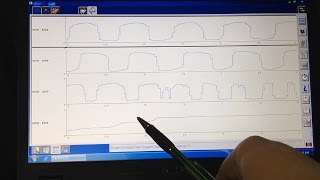
How to confirm: Use a scan tool to graph the voltage of the downstream O2 sensor. A healthy sensor on a good converter will show a relatively steady voltage (typically above 0.5V). If the sensor is faulty or the converter has failed, it will switch rapidly between high and low voltage, similar to the upstream sensor. Swapping the downstream sensors between Bank 1 and Bank 2 is a good diagnostic test; if the code changes to P0420, the sensor is bad.
Typical fix: Replace the faulty oxygen sensor. It is often recommended to replace O2 sensors in pairs (e.g., both downstream sensors) if they are original and high-mileage.
Est. part cost: $50-$150 - Exhaust System Leak 🟡 Medium Probability Leaks from cracked exhaust manifolds, broken flange gaskets, or rusted pipes upstream of or near the O2 sensors can introduce extra oxygen into the exhaust, confusing the sensors and triggering a false code. Flex pipes are a common location for leaks.
How to confirm: Perform a visual inspection of the exhaust system from the engine to the catalytic converter. Listen for hissing or ticking sounds, especially on a cold start. A smoke test is the most effective way to definitively identify the location of any leaks.
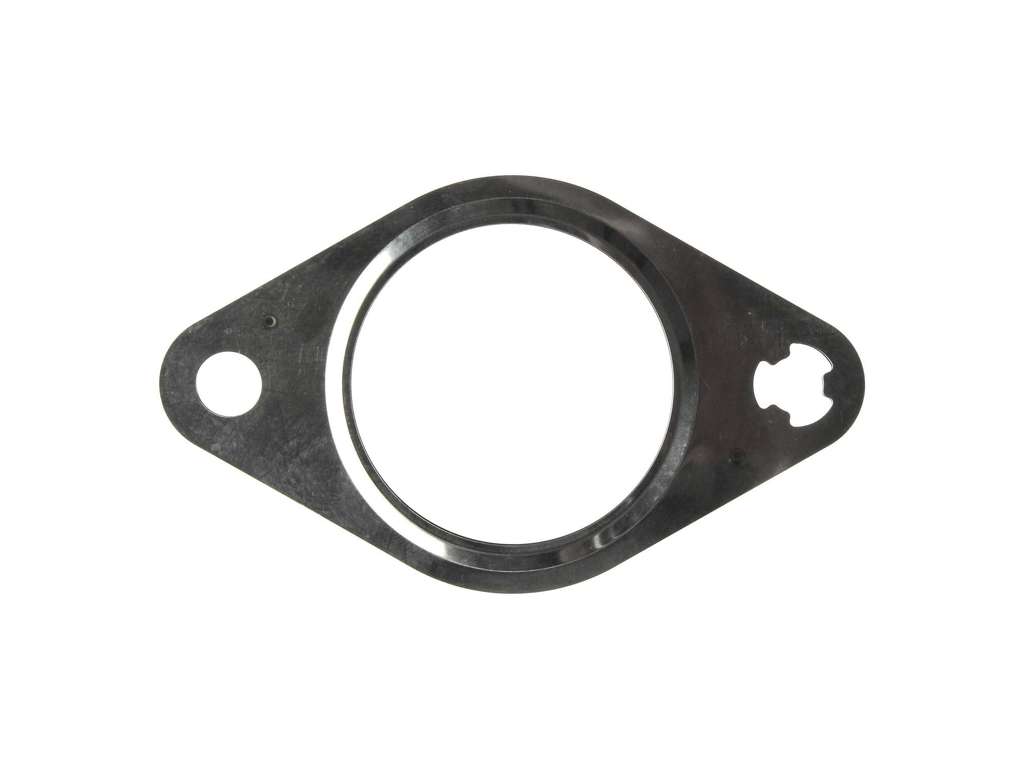
Typical fix: Replace the leaking gasket or repair/replace the damaged exhaust component. Exhaust putty can be a temporary fix for small pinholes but is not a permanent solution.
Est. part cost: $20-$300
Rare But Worth Checking
- Engine Misfires or Fuel System Issues: Unburned fuel from persistent misfires (bad spark plugs, ignition coils) or leaking fuel injectors can enter the exhaust and overheat the catalytic converter, causing permanent damage. These are often the root cause of a converter failure and must be fixed to prevent damaging the new one. A user with a Ford Flex (a platform mate) with P0430 fixed the issue by replacing spark plugs and a leaky intake manifold gasket.
- Use of Fuel Additives: Some owners on forums for the Taurus SHO (which shares the 3.5L engine architecture) report that certain octane boosters or fuel additives can clog the catalytic converter's honeycomb structure over time, leading to efficiency codes.
Diagnosis Steps

- Scan for any other DTCs. If misfire, fuel system, or other O2 sensor codes are present, address them first as they are likely the root cause.
- If the vehicle is a 2016-2018 Police Interceptor Sedan with a 3.7L engine, check with a dealer if TSB 18-2297 applies and if the PCM has the latest software update. This should be the very first step.
- Thoroughly inspect the exhaust system for any leaks, especially at the exhaust manifold gaskets, flex pipes, and flanges. A smoke test is the most reliable method.
- Use a scan tool with live data graphing capabilities. Observe the Bank 2 oxygen sensors at a steady 2500 RPM. The upstream sensor (B2S1) should switch rapidly (0.1V-0.9V). The downstream sensor (B2S2) should hold a relatively steady, high voltage (e.g., >0.6V). If the B2S2 voltage is switching rapidly like B2S1, the converter is likely not working.
- Test the downstream O2 sensor's function. A simple field test is to swap the downstream sensors between Bank 1 and Bank 2. Clear the codes and drive. If the code returns as P0420 (Bank 1), the O2 sensor you moved is the problem.
- Perform a temperature check. Using an infrared thermometer, measure the temperature of the exhaust pipe just before the catalytic converter and just after. The outlet should be at least 100°F hotter than the inlet. If it's the same or cooler, the converter is not functioning.
- If all other possibilities are ruled out, the catalytic converter has failed and needs replacement.
Parts You'll Likely Need

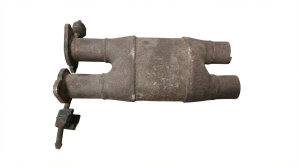
- Bank 2 Catalytic Converter
(OEM #DB5Z-5G232-A (Front, for 3.5L/3.7L NA))— This is the component being monitored and is the most common cause of the code if software, leaks, and sensors are ruled out. Bank 2 is the front converter.
Trusted brands: Walker Exhaust, MagnaFlow, AP Exhaust Technologies, Motorcraft
OEM price range: $900-$1200
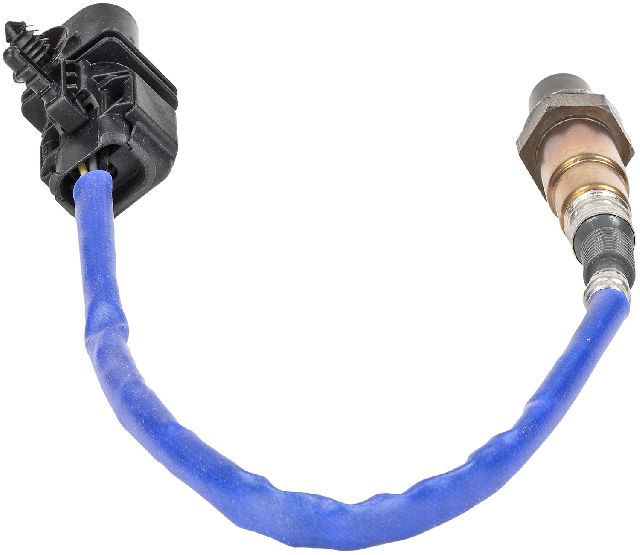
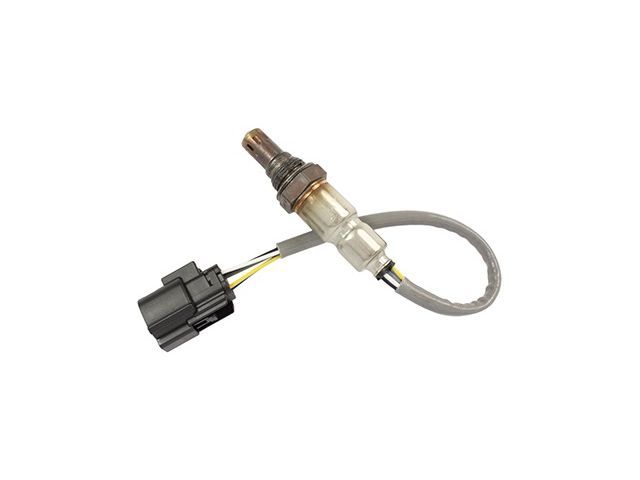
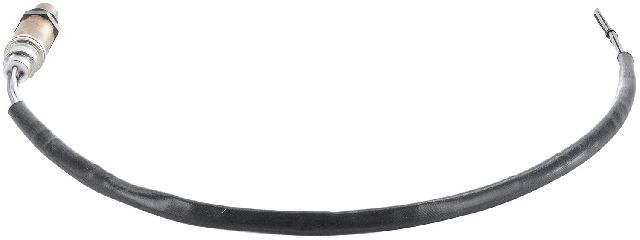
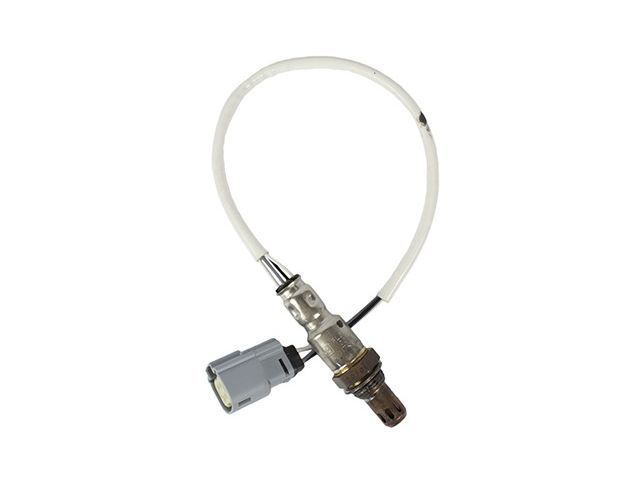
Aftermarket price range: $250-$700 - Downstream Oxygen Sensor (Bank 2, Sensor 2) — A faulty downstream sensor can send incorrect readings, falsely triggering the P0430 code. It's a common misdiagnosis but is a relatively inexpensive part to rule out. 🎬 Watch: Easy walkthrough for replacing a Ford Taurus oxygen sensor.
Related Codes That Often Appear With This One
- P0420 — This is the identical code for Bank 1 (firewall side). It's common for converters on both banks to fail around the same time due to age or a systemic engine issue. TSB 18-2297 explicitly mentions both codes.
- P0300, P0301-P0306 — These are misfire codes. An engine misfire is a primary cause of catalytic converter failure, as it sends raw fuel into the exhaust, which then burns inside the converter and melts its internal structure.
- P0171, P0174 (Lean) or P0172, P0175 (Rich) — These fuel trim codes indicate a systemic problem with the air/fuel mixture. A long-term rich or lean condition can damage the catalytic converter over time and should be addressed before replacing the converter.
Technical Service Bulletins (TSBs) & Recalls
- TSB 18-2297: Addresses an illuminated MIL with DTC P0420 and/or P0430 on some 2016-2018 Police Interceptor Sedans with the 3.7L engine, recommending a PCM reflash to correct a potentially oversensitive diagnostic monitor.
- TSB 19-2366 & 21-2063: While not for the exact year range, these later bulletins for Police Interceptors also address P0420/P0430, indicating a persistent issue. They call for replacing the converter and reprogramming the PCM, showing Ford's acknowledgement of hardware failure.
Platform-Specific Known Issues
- TSB 18-2297 specifically calls out 2016-2018 Police Interceptor Sedan models with the 3.7L engine for potentially needing a PCM reflash to correct a false P0420 or P0430 code.
- On the transverse-mounted V6 engines in the Taurus (3.5L, 3.7L), Bank 2 is the cylinder bank located at the front of the engine bay, closer to the radiator. This makes it significantly easier to access for service compared to Bank 1, which is against the firewall.
- Police Interceptor models are known for high idle hours, which can contribute to premature catalytic converter failure. Ford has also noted that aggressive driving maneuvers can lead to overheated and damaged converters on this platform.
Mechanic-Grade Diagnostic Values
- Downstream O2 Sensor (B2S2) Voltage — expected: Relatively steady voltage, typically between 0.6V and 0.8V, on a fully warmed-up engine at steady RPM.. Failure: Voltage fluctuates rapidly between ~0.1V and ~0.9V, mimicking the behavior of the upstream (B2S1) sensor. This indicates the catalyst is not storing oxygen.
- Upstream O2 Sensor (B2S1) Voltage — expected: Rapidly fluctuating voltage between approximately 0.1V (lean) and 0.9V (rich), switching multiple times per second during closed-loop operation.. Failure: A slow or non-responsive sensor that is stuck at a certain voltage or does not switch quickly. This can also lead to a false P0430 code.
Hidden / Shadow Codes Worth Checking
- Mode $06, Test ID $82 (TID $82): This is not a DTC, but a non-continuous monitor test result for the Bank 2 Catalyst Efficiency. The PCM calculates a switch ratio value based on downstream vs. upstream O2 sensor activity. This value is compared against a calibrated threshold. (see via A professional scan tool capable of displaying Mode $06 data. When viewing the results for TID $82, a value that is close to or has exceeded the maximum allowable limit indicates the catalyst has failed the on-board diagnostic test, even if the P0430 code has not become permanent.)
Scan Tool Commands That Help
- Ford IDS (or equivalent professional scanner): Catalyst Monitor Drive Cycle — After a repair (like replacing a converter or O2 sensor) or after clearing codes, this specific driving procedure must be performed to allow the PCM to re-test the catalyst system and confirm the fix. Without it, the P1000 code (monitors not ready) will remain and the P0430 may not reappear immediately even if the fault persists.
- Ford IDS: PCM Reset / Clear Keep Alive Memory (KAM) — This function should be used after replacing a major component like a catalytic converter. It erases all learned adaptations (like fuel trims) and forces the PCM to start the learning process over, which is crucial for accurate diagnosis and preventing the new part from being affected by old, incorrect learned values.
Wiring & Ground Locations
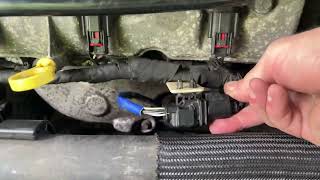
- Bank 2 O2 Sensor Wiring — Bank 2 is the cylinder bank closer to the radiator on the transverse 3.5L/3.7L V6 engine. The upstream sensor is in the exhaust manifold, and the downstream sensor is located after the catalytic converter body.. On many Ford O2 sensors, the two wires with matching colors (e.g., two black wires) are for the heater circuit. The other two wires with different colors are the signal and ground. Knowing this can help a technician test the heater circuit resistance and signal wire integrity without a wiring diagram. Damage to the harness from heat or road debris can cause incorrect sensor readings, mimicking a failed converter.
"I Checked Everything" — The Actual Cause
- PCM Software Calibration: As per TSB 18-2297 for 3.7L Police Interceptors, the catalyst monitor can be overly sensitive and trigger a false P0430. This is a software issue, not a physical leak, and will never be found with a smoke test.
- Leaking Fuel Injectors / Engine Misfire: A fuel injector that is stuck open or an intermittent misfire from a bad spark plug or coil can send raw, unburned fuel into the exhaust. This fuel superheats and destroys the catalyst's internal structure. A smoke test on the exhaust will show no leaks, but the root cause in the fuel or ignition system is what ultimately caused the P0430.
OEM Part Supersession History
DB5Z-5G232-A→No supersession found.— This appears to be the current and correct part number for the Bank 2 (front) catalytic converter for the specified vehicle range.
Model Year Variations Within This Range
- 2016-2018: Police Interceptor Sedan models equipped with the 3.7L Ti-VCT engine are subject to TSB 18-2297. These models may set a false P0430 due to overly sensitive PCM software, whereas the standard 3.5L models are not covered by this specific bulletin and the code is more likely to indicate a hardware failure.
Helpful Videos
Used OEM Parts in Stock
New Aftermarket Parts Available


The information in this article is provided for general reference and educational purposes only. Vehicle specifications, procedures, and part compatibility can vary by production date, trim level, and region. Always consult your vehicle's factory service manual and verify part numbers before purchasing or performing repairs. Safety-critical components such as airbags, seat belts, and braking systems should be installed by a qualified professional.
- Ford TAURUS:
- 🎬 Helpful Videos
- 🛍️ Shop This Part
- What's Unique About the 2016-2018 Ford TAURUS
- Diagnostic Flowchart
- Symptoms You May Notice
- Most Likely Causes
- Rare But Worth Checking
- Diagnosis Steps
- Parts You'll Likely Need
- Related Codes That Often Appear With This One
- Technical Service Bulletins (TSBs) & Recalls
- Platform-Specific Known Issues
- Mechanic-Grade Diagnostic Values
- Hidden / Shadow Codes Worth Checking
- Scan Tool Commands That Help
- Wiring & Ground Locations
- "I Checked Everything" — The Actual Cause
- OEM Part Supersession History
- Model Year Variations Within This Range
- 🎟️ Get 5% Off