

P0430 on 2011-2019 Ford Explorer 3.5L V6: Catalyst Efficiency Bank 2 Causes and Fixes
On a 2011-2019 Ford Explorer with the 3.5L V6, the P0430 code almost always indicates a failing Bank 2 catalytic converter, which is the one on the radiator side of the engine. Before replacement, rule out exhaust leaks and faulty O2 sensors. A history of misfires or a failing internal water pump are common root causes of converter failure on this engine. Expect to pay $400-$800 for an aftermarket converter and $700-$1100 for an OEM part, with DIY difficulty rated at 4/5 due to tight access.
- P0430 on a 2011-2019 Explorer points to the catalytic converter on the radiator side of the engine (Bank 2).
- The most likely cause is a failed catalytic converter, often damaged by previous engine misfires.
- Before replacing the expensive converter, rule out exhaust leaks and a faulty downstream O2 sensor.
- Always fix any other engine codes (especially for misfires) before installing a new catalytic converter, or the new part will likely fail prematurely.
- The repair is possible for a skilled DIYer but is labor-intensive due to the tight location of the Bank 2 converter.
What's Unique About the 2011-2019 Ford Explorer

The 2011-2019 Explorer's 3.5L V6 is mounted transversely (sideways), which places the Bank 2 catalytic converter in a tight spot between the engine and the radiator fan assembly, making replacement more difficult than on other vehicles. These engines, particularly the related 3.7L variant, are known to have converters fail, sometimes leading owners to replace both converters at the same time even if only one has set a code. A history of engine misfires, which can be caused by failing ignition coils or even an ECM issue, is a common precursor to P0430 on these Explorers, as unburnt fuel can overheat and destroy the converter's internal structure. Critically, this engine family features an internal water pump; if its seal fails, it can leak coolant directly into the engine oil, leading to widespread engine damage that can ultimately cause converter failure.
Symptoms You May Notice
- Check Engine Light is on
- Reduced engine power and sluggish acceleration if the converter is clogged.
- A sulfur or "rotten egg" smell from the exhaust.
- Vehicle will fail an emissions inspection.
- A rattling sound from the exhaust if the internal honeycomb substrate of the converter has broken apart.
- Replacing the oxygen sensors when the catalytic converter is the actual point of failure. While a bad sensor *can* cause P0430, a failing converter is far more common.
- Replacing the upstream (pre-cat) O2 sensor instead of the downstream (post-cat) sensor, which is the one that monitors converter efficiency.
- Replacing the catalytic converter without addressing the root cause of its failure, such as a persistent engine misfire or coolant leak. The new converter will likely fail prematurely.
Most Likely Causes

- Failed Bank 2 Catalytic Converter 🔴 High Probability Catalytic converters have a finite lifespan and can be damaged by other engine problems like misfires or coolant contamination from the internal water pump, which are known issues on this platform. The internal ceramic honeycomb can break apart, causing a blockage or loss of efficiency. NHTSA ODI #11714409 confirms the activation of the engine light specifically for P0430 Catalyst system efficiency below threshold Bank 2.
How to confirm: The most reliable test is to use an infrared thermometer to measure the temperature of the pipe going into and out of the converter after the engine is fully warm. The outlet temperature should be significantly higher (at least 100°F) than the inlet. If they are the same or the outlet is cooler, the converter is not working. Visual inspection after removal may show a melted or fragmented internal structure. A scan tool can also be used to check Mode $06 data; a catalyst oxygen storage value greater than 0.4 on Bank 2 indicates failure.
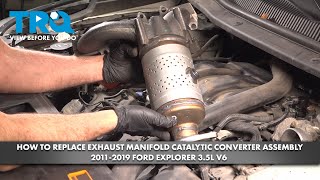
Typical fix: Replace the Bank 2 (front) catalytic converter assembly. This part is an integrated unit with the exhaust manifold. 🎬 See this walkthrough for replacing the manifold converter assembly. It is often recommended to inspect, and possibly replace, the Bank 1 converter at the same time.
Est. part cost: $700-$1100 (OEM), $400-$800 (Aftermarket) - Failed Downstream Oxygen (O2) Sensor 🟡 Medium Probability O2 sensors are wear items and can fail over time, sending incorrect data to the PCM. However, they are often replaced unnecessarily when the converter is the real issue. A Reddit user with a platform-mate Lincoln MKX reported the P0430 code remained even after replacing the O2 sensors and the catalytic converter.
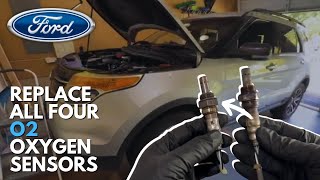
How to confirm: Use a diagnostic scan tool to monitor the live voltage data from the Bank 2 downstream O2 sensor (Bank 2, Sensor 2). A healthy sensor on a good converter will show a steady, relatively flat voltage (typically 0.6V-0.8V). If the sensor is bad, it may be stuck at a certain voltage or not respond at all. A simpler method is to swap the downstream O2 sensors between Bank 1 and Bank 2. If the trouble code changes to P0420 (Bank 1), the sensor is faulty. 🎬 Watch: How to replace all four oxygen sensors yourself.
Typical fix: Replace the Bank 2, Sensor 2 (downstream) oxygen sensor.
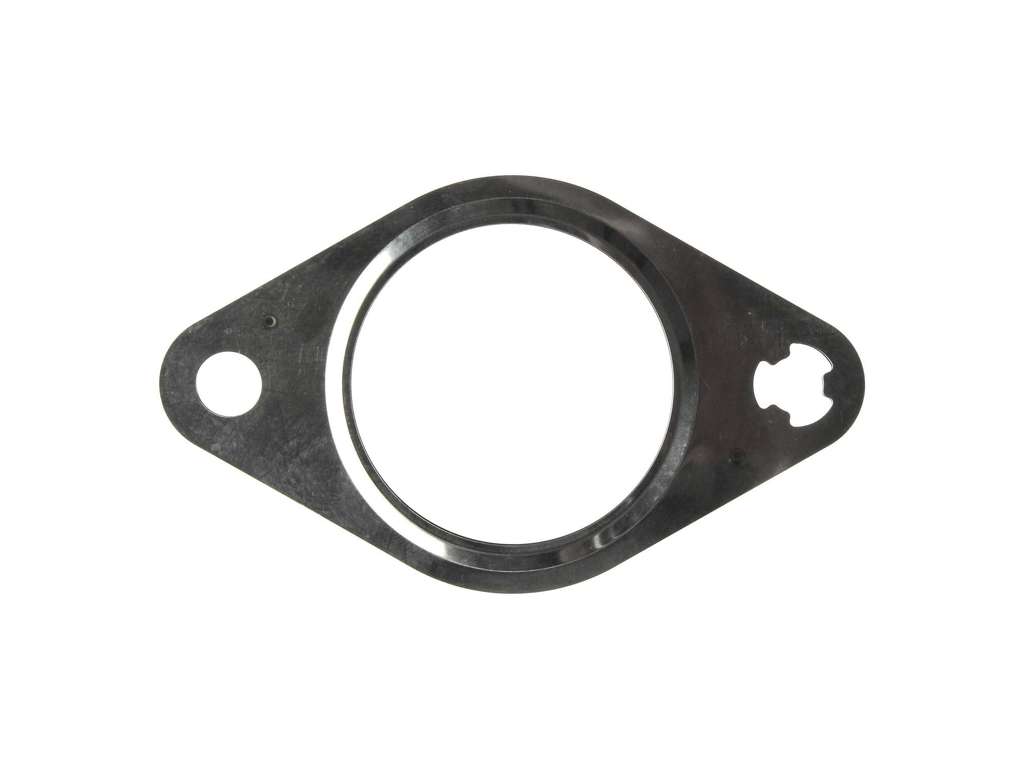
Est. part cost: $50-$120 - Exhaust Leak ⚪ Low Probability Rust can cause leaks at manifold gaskets or flange connections, allowing oxygen to enter the exhaust stream and confuse the O2 sensors. NHTSA ODI #11546795 notes an owner's concern regarding an exhaust safety issue when their CEL came on with code P0430 for the Bank 2 catalytic converter.
How to confirm: Visually inspect the exhaust manifold and all piping upstream of the Bank 2 catalytic converter for cracks, holes, or black soot trails indicating a leak. You can also use a smoke machine to pressurize the exhaust system and easily spot leaks.
Typical fix: Replace the leaking gasket or repair the cracked pipe.
Est. part cost: $20-$100
Rare But Worth Checking
- Underlying Engine Issues: An engine that is misfiring or has an incorrect air/fuel mixture can send unburnt fuel into the exhaust, which will quickly damage a new catalytic converter. Always resolve any misfire (P030x) or fuel trim (P017x) codes before replacing the converter. A leaky intake manifold gasket was the root cause for a P0430 on a Ford Flex with the same engine.
- PCM Software Issue: In some cases, the PCM's software may be too sensitive. Ford has issued TSBs for other models like the F-150 for this exact issue. Check with a Ford dealer to see if there are any available software updates for your vehicle's PCM before performing expensive repairs.
- Internal Water Pump Failure: A unique and critical failure point on the 3.5L/3.7L Cyclone V6 is the internal water pump. When it fails, it leaks coolant into the engine oil. This contaminated oil can cause a cascade of engine problems, including VCT solenoid failure and timing issues, which can ultimately lead to conditions that destroy the catalytic converters. This is a major repair and should be investigated if you have other engine symptoms.
Diagnosis Steps

- Check for other DTCs. If any misfire, fuel system, or other O2 sensor codes are present, diagnose and fix them first.
- Visually inspect the exhaust system for any signs of leaks, damage, or corrosion, especially around the Bank 2 (front) manifold and flanges.
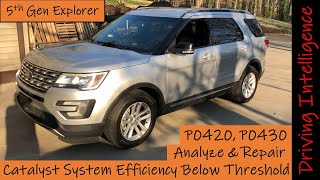
- With a scan tool, observe the voltage of the downstream O2 sensors (Bank 1 Sensor 2 and Bank 2 Sensor 2). A good converter will result in a steady voltage (typically above 0.5V, ideally 0.6V-0.8V). If the Bank 2 Sensor 2 voltage is fluctuating rapidly, mimicking the upstream sensor, the converter is likely bad. 🎬 Watch: How to analyze and correct catalyst efficiency codes. NHTSA ODI #11669228 describes a diagnostic scan identifying stored engine code P0430 corresponding to the catalytic converter on the left side of the engine.
- If the sensor's signal seems stuck or unresponsive, consider swapping the downstream sensors from Bank 1 and Bank 2. Clear the codes and drive the vehicle. If the code returns as P0420, the O2 sensor is the problem.
- If the O2 sensor is confirmed to be working, perform a temperature test on the Bank 2 catalytic converter using an infrared thermometer. Warm the engine to operating temperature, then measure the inlet and outlet pipe temperatures. A good converter will have an outlet temperature at least 100°F higher than the inlet. If the temperatures are similar or the outlet is cooler, the converter has failed.
- When removing the Bank 2 converter, inspect the outlet of the Bank 1 (rear) converter for signs of degradation. It is common for the second converter to be failing as well, and replacing both at the same time can save significant future labor.
Parts You'll Likely Need

- Bank 2 Catalytic Converter Assembly
(OEM #FB5Z-5G232-A)— This is the most common failure item for a P0430 code on this vehicle. The converter is integrated with the exhaust manifold. Part number confirmed for 2016-2019 models.
Trusted brands: Motorcraft, Walker, MagnaFlow, AP Exhaust
OEM price range: $700-$1100
Aftermarket price range: $400-$800 - Bank 1 Catalytic Converter Assembly
(OEM #FB5Z-5G232-B)— Optional but recommended. The Bank 1 (rear/firewall side) converter often fails around the same time as Bank 2. Replacing both at once saves on duplicate labor costs.
Trusted brands: Motorcraft, Walker, MagnaFlow
OEM price range: $700-$1100
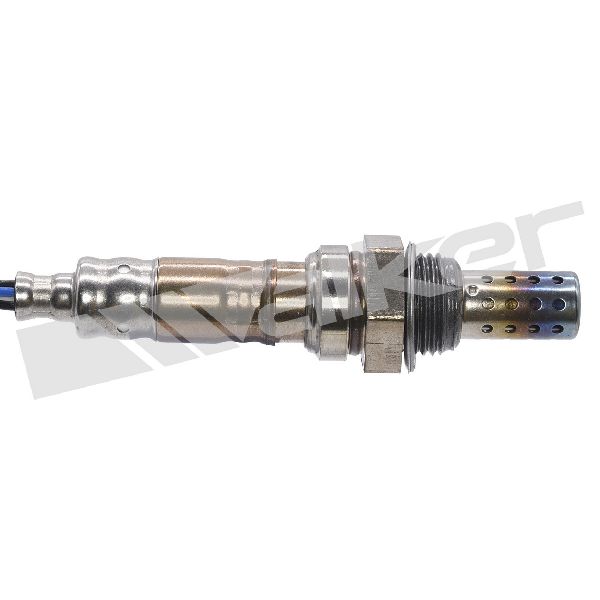
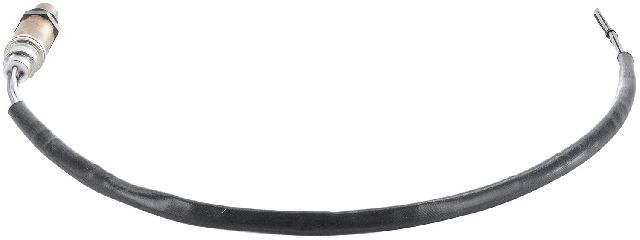
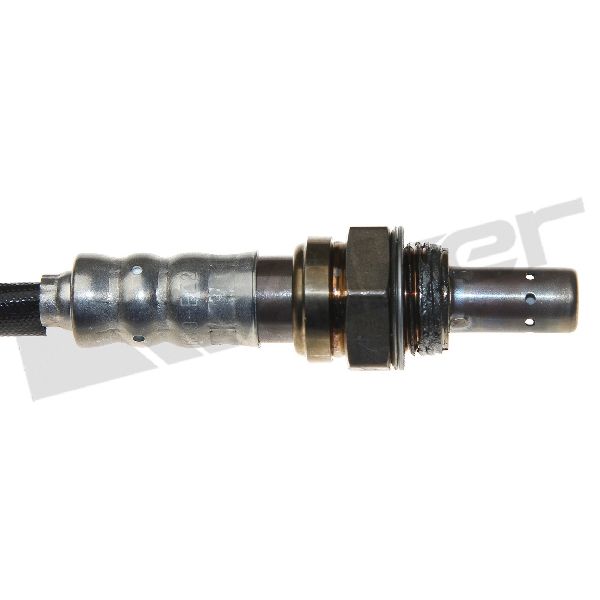
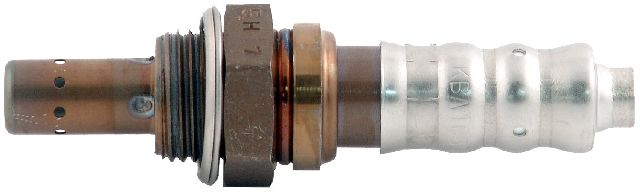
Aftermarket price range: $400-$800 - Bank 2, Sensor 2 (Downstream) Oxygen Sensor — This sensor is responsible for monitoring the converter's efficiency and can fail, causing a false P0430 code.
Trusted brands: Motorcraft, Bosch, Denso, NTK
OEM price range: $70-$130
Aftermarket price range: $50-$120
Related Codes That Often Appear With This One
- P0420 — This is the equivalent code for Bank 1 (firewall side). It's common for both converters to degrade at a similar rate, so seeing both codes together often means both converters need replacement. It can also point to a systemic issue like a PCM software problem.
- P0300, P0301-P0306 — These are misfire codes. A history of misfires is a leading cause of catalytic converter failure because unburnt fuel superheats and melts the converter's internal structure.
Technical Service Bulletins (TSBs) & Recalls
- TSB 13-3-3: While written for the 2011-2012 F-150 3.5L GTDI engine, this TSB shows an official link between misfire DTCs and code P0430. The service procedure explicitly states to replace the left bank catalytic converter if P0430 is present along with specific misfire conditions.
Platform-Specific Known Issues
- Ford issued Customer Satisfaction Program 19M01 for some 2013-2018 Police Interceptor Utility models (which share the Explorer platform and 3.7L engine) extending the warranty on catalytic converters. The program extends coverage to 11 years or 120,000 miles from the vehicle's warranty start date. It was initiated because aggressive driving cycles could cause the converters to overheat and fail, triggering DTCs P0420 and/or P0430. Owners may be eligible for a refund for previously paid repairs if the vehicle qualifies. It is worth checking with a dealer if your vehicle's VIN might be covered.
- The 3.5L V6 engine features an internal, chain-driven water pump. A failure of this pump's seal can cause a direct and often catastrophic leak of coolant into the engine oil. This contamination ruins the oil's lubricating properties, which can cause timing chain and VCT phaser issues that may ultimately lead to engine conditions that damage the catalytic converters.
Mechanic-Grade Diagnostic Values
- Mode $06 Catalyst Monitor Oxygen Storage Value (Bank 2) — expected: Less than 0.4. Failure: A value greater than 0.4 indicates the converter has failed the PCM's internal efficiency test.
- Downstream O2 Sensor (B2S2) Voltage at steady 2,000 RPM (warm engine) — expected: Relatively steady voltage between 0.6V and 0.8V.. Failure: Voltage fluctuates rapidly between ~0.1V and ~0.8V, mimicking the upstream sensor's pattern.
- Long-Term and Short-Term Fuel Trim (Bank 2) — expected: Combined percentage of plus or minus 10%.. Failure: A value significantly outside of +/- 10% indicates a fuel control issue that must be fixed before replacing the converter.
Scan Tool Commands That Help
- Ford IDS (Integrated Diagnostic System): Powertrain > Fuel > Fuel System Test — To verify proper fuel system operation and rule out fuel delivery issues that could cause a rich condition and damage the catalytic converter.
- Ford IDS (Integrated Diagnostic System): Powertrain > Ignition > Power Balance — To identify specific cylinders that are misfiring. Unburnt fuel from a misfire is a primary cause of catalytic converter failure. This test helps pinpoint the root cause before replacing the expensive converter.
- FORScan: Mode $06 Tests — To access the raw results of the PCM's onboard diagnostic tests for the catalyst system, specifically the oxygen storage capacity value, which provides a definitive pass/fail result without requiring extensive driving.
Wiring & Ground Locations
- PCM Connector C175E (Bank 2 O2 Sensors) — The main Powertrain Control Module connector, typically located in the engine bay near the firewall.. Allows for direct testing of the O2 sensor circuits. For the Bank 2 downstream sensor (HO2S22), you can check for continuity and shorts on the signal and heater circuit wires running between the sensor connector and the PCM. For example, the HO2S22 signal wire connects to pin E21 and the heater control to pin E84 of the PCM connector.
- Ground Distribution Points — Multiple ground points exist. Key engine grounds are typically located on the engine block, cylinder heads, and on the chassis near the battery. For the 2011 Explorer, one major ground point (G103/G104) is on the left side of the engine compartment.. A poor ground connection for the PCM or the O2 sensor heater circuits can cause erratic sensor readings, potentially leading to a false P0430 code. Verifying clean and tight ground connections is a crucial step in diagnosing electrical faults.
Real Owner Repair Stories
- YouTube channel 'Driving Intelligence' (2011-2019 Ford Explorer with 161,000+ miles) — P0430 code appeared after a history of severe engine misfires.
❌ Tried (didn't work) Replacing all ignition coils and spark plugs (fixed original misfire but not the subsequent P0430)., Ford dealer replaced ECM injector driver (fixed another misfire but not the P0430)., Auto parts store replaced upstream O2 sensor on Bank 2 (did not fix the P0430).
✅ What actually fixed it The owner confirmed the catalytic converter was bad using an infrared thermometer test. As a temporary, non-emissions-compliant fix, an O2 sensor spacer (defouler) was installed on the downstream Bank 2 sensor. This masked the signal from the bad converter, stabilized the voltage reading, and cleared the P0430 code. The narrator notes this is not a legal or proper repair for emissions-tested areas. - Ford Expedition Forum user 'stilbo' (2015 Ford Explorer with 47,000 miles (and a 2015 Expedition with the same issue)) — P0420 code (Bank 1 equivalent of P0430).
❌ Tried (didn't work) Running fuel system cleaner (Chevron Techron) and ethanol-free gas provided a temporary fix for over 1,000 miles, but the code returned.
✅ What actually fixed it Using a graphing scan tool, the owner noticed a difference in O2 sensor voltage waveforms between Bank 1 and Bank 2. They chose to replace the Bank 1 oxygen sensors as the first, most affordable step. This permanently fixed the code, which did not return after 3,000+ miles, suggesting a premature failure of the OEM Motorcraft O2 sensor. - NHTSA ODI #11703219 — An owner reported that their vehicle was inspected by two dealerships who simply cleared the P0430 error code without mentioning potential coverage under Campaign 22M06. The error code persisted even after the owner replaced numerous components, including spark plugs.
When the Usual Fixes Don't Work
- While a failing catalytic converter is the most common cause of P0430, it is not the only cause. In a documented case on a 2015 Explorer with only 47,000 miles, the root cause was a faulty downstream oxygen sensor, not the converter itself. The owner confirmed this by graphing sensor data and noticing abnormal waveforms before replacing the sensor, which resolved the code long-term. This highlights the importance of testing sensors before assuming the expensive converter has failed, especially on lower-mileage vehicles.
OEM Part Supersession History
Unknown→FB5Z-5G232-A— Part update for later model years.
Heads up: The part FB5Z-5G232-A is specified for 2016-2019 Ford Explorer models with the 3.5L Ti-VCT engine. While it may physically fit earlier models (2011-2015), there could be subtle differences. Always verify fitment with a VIN.
Model Year Variations Within This Range
- 2011-2015 vs 2016-2019: The Ford Explorer received a significant facelift for the 2016 model year. While the base 3.5L V6 engine remained fundamentally the same, part numbers for components like the catalytic converter assembly were updated (e.g., FB5Z-5G232-A is listed for 2016-2019). Always confirm part numbers with the vehicle's VIN, especially for crossover years like 2015-2016.
Diagnostic Flowchart
Real Owner Stories
Aggregated from forums and TSBs cited above. Mileages and costs reflect what owners reported in those sources.
2016 Lincoln MKX 3.7L V6
Symptoms: Persistent check engine light returning even after replacing the purge valve, O2 sensors, spark plugs, ignition coils, and the catalytic converter itself.
What fixed it: Installed an O2 sensor spacer to trick the PCM after all legitimate replacement parts failed to keep the light off.
Source hint: Reddit r/Ford - 2016 Lincoln MKX P0430 Saga
2019 Ford Explorer 3.7L
Symptoms: Check engine light on with a P0430 code. Upon inspection, the internal honeycomb material of the Bank 2 converter was completely disintegrated.
What fixed it: Replaced both the Bank 1 and Bank 2 catalytic converters simultaneously, along with new gaskets, studs, and nuts.
Source hint: YouTube - Ford Boss Me: 2019 Explorer P0430 Turns Into Replacing Both Converters
Ford Flex 3.5L V6
Symptoms: Check engine light illuminated with a P0430 code due to underlying engine performance issues rather than a failed catalyst.
What fixed it: Replaced the spark plugs and repaired a leaking upper intake manifold gasket. The catalytic converter did not need to be replaced.
Source hint: YouTube - Pine Hollow Auto Diagnostics: Ford Flex P0430 Diagnosis
Related OBD-II Codes
Frequently Asked Questions
Is there an extended warranty or recall for the catalytic converter on my 2011-2019 Ford Explorer?
Can the internal water pump failure on the 3.5L V6 cause a P0430 code?
Does Ford have any Technical Service Bulletins (TSBs) linking misfires to the P0430 code?
If my Bank 2 catalytic converter is bad, should I replace the Bank 1 converter at the same time?
Should I just replace the downstream O2 sensors first to see if it clears the P0430?
Where do exhaust leaks typically occur on this platform that might trigger a false P0430?
Helpful Videos

We Have This Part in Stock


The information in this article is provided for general reference and educational purposes only. Vehicle specifications, procedures, and part compatibility can vary by production date, trim level, and region. Always consult your vehicle's factory service manual and verify part numbers before purchasing or performing repairs. Safety-critical components such as airbags, seat belts, and braking systems should be installed by a qualified professional.
- Ford Explorer:
- 🎬 Helpful Videos
- 🛍️ Shop This Part
- What's Unique About the 2011-2019 Ford Explorer
- Symptoms You May Notice
- Most Likely Causes
- Rare But Worth Checking
- Diagnosis Steps
- Parts You'll Likely Need
- Related Codes That Often Appear With This One
- Technical Service Bulletins (TSBs) & Recalls
- Platform-Specific Known Issues
- Mechanic-Grade Diagnostic Values
- Scan Tool Commands That Help
- Wiring & Ground Locations
- Real Owner Repair Stories
- When the Usual Fixes Don't Work
- OEM Part Supersession History
- Model Year Variations Within This Range
- Diagnostic Flowchart
- Real Owner Stories
- 2016 Lincoln MKX 3.7L V6
- 2019 Ford Explorer 3.7L
- Ford Flex 3.5L V6
- Related OBD-II Codes
- Frequently Asked Questions
- 🎟️ Get 5% Off