

P0430 on 2012-2018 Chevrolet Suburban: Catalyst Efficiency Fixes
P0430 on a Chevy Suburban means the passenger side (Bank 2) catalytic converter is failing its efficiency test. Before replacing the expensive converter, thoroughly check for exhaust leaks at the manifold (especially broken bolts), a faulty downstream oxygen sensor, and air intake leaks, which are all common and cheaper-to-fix causes.
- P0430 means the passenger-side catalytic converter is not working efficiently.
- Before replacing the converter, ALWAYS inspect for exhaust leaks at the manifold and check the downstream O2 sensor's function.
- On these Suburbans, also check that the air filter box is sealed correctly, per a GM service bulletin.
- If you replace the converter, ensure any engine misfires or oil burning issues are resolved first to prevent damaging the new part.
- Using OEM (like ACDelco) or high-quality aftermarket parts is recommended, as cheap converters and sensors are known to fail quickly.
What's Unique About the 2012-2018 Chevrolet SUBURBAN

The 2012-2018 Suburban spans two generations (GMT900 and K2XX) with different 5.3L V8 engines, but both are known for setting this code. A unique issue documented by GM is that a poorly sealed air filter box can let in sand and debris, damaging O2 sensors and clogging the converter, triggering a P0430 code; this is detailed in Technical Service Bulletin #16-NA-111. Additionally, exhaust manifold leaks, particularly from broken or missing rear bolts, are a very frequent underlying cause on these V8 engines that can introduce extra oxygen into the exhaust stream and trick the sensors into reporting a bad converter. Owners often replace the catalytic converter only to have the code return because the root cause, like an exhaust leak or an oil consumption issue related to Active Fuel Management (AFM), was not addressed.
Diagnostic Flowchart

Tap your situation to follow the diagnostic path that matches what you're seeing on this vehicle.
Generation note: This range covers the end of the 10th generation (2012-2014, GMT900 platform) with the Vortec 5.3L engine and the beginning of the 11th generation (2015-2018, K2XX platform) with the EcoTec3 5.3L direct-injection engine. While the code's meaning is the same, causes like exhaust manifold leaks from broken bolts are common to both. Issues like the air box seal (TSB #16-NA-111) are specifically noted for the newer generation (2015+), which can allow debris to contaminate sensors and the converter itself. The K2XX generation also has dedicated O2 sensor fuses (F90 and F100) in the underhood fuse block.
Symptoms You May Notice
- Check Engine Light is on
- Vehicle will fail an emissions test
- Reduced engine power or acceleration, especially if the converter is clogged
- Slightly rough idle, particularly when the engine is cold
- A sulfur or "rotten egg" smell from the exhaust
- A ticking or tapping exhaust leak noise, especially noticeable on a cold start, that may point to a broken manifold bolt
- Immediately replacing the catalytic converter without checking for exhaust leaks, faulty O2 sensors, or intake leaks first. An exhaust leak from a broken manifold bolt is a very common cause and a much cheaper fix.
- Replacing the O2 sensor when it is accurately reporting the failure of the catalytic converter. If the downstream O2 sensor is switching similarly to the upstream one, it's doing its job correctly by identifying an inefficient converter.
Most Likely Causes

- Failing Catalytic Converter (Bank 2) 🔴 High Probability Converters can fail from age (100k+ miles) or contamination from engine issues like burning oil (sometimes related to AFM), coolant leaks, or excessive unburned fuel from misfires. The internal substrate can become coated or break apart.
How to confirm: Use a scan tool to watch O2 sensor data; if Bank 2 Sensor 2 voltage fluctuates rapidly like Sensor 1, the converter is likely bad. An infrared thermometer can also be used; the outlet should be at least 100-150°F hotter than the inlet on a working converter after the engine is fully warmed up.
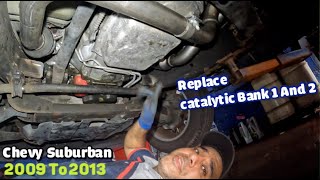
Typical fix: Replace the Bank 2 catalytic converter assembly. It is often integrated with the Y-pipe.
Est. part cost: $400-$1200 - Exhaust Leak 🔴 High Probability The 5.3L V8 engines in these trucks are notorious for breaking exhaust manifold bolts, especially the rear-most ones closest to the firewall. This causes a leak that lets in fresh air, which fools the downstream O2 sensor and triggers the P0430 code.
How to confirm: Listen for a distinct ticking or tapping noise from the passenger side of the engine, especially on a cold start, which lessens as the metal expands. Visually inspect the exhaust manifold for black soot trails indicating a leak. A smoke test is a definitive way to pinpoint leaks.
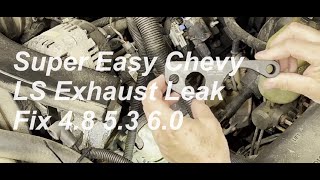
Typical fix: Replace the broken manifold bolts and the exhaust manifold gasket. In some cases, a special clamp kit (like Kral Auto Parts KAP-Single or Dorman products) can be used to repair the leak without removing the manifold. 🎬 See how to install a manifold bolt repair bracket.
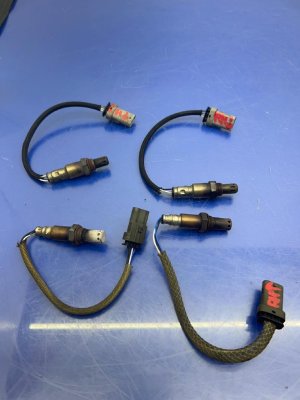
Est. part cost: $20-$150 - Faulty Downstream Oxygen Sensor (Bank 2, Sensor 2) 🟡 Medium Probability
How to confirm: A lazy or biased O2 sensor can send incorrect data. Graph the sensor's voltage on a scan tool; it should be relatively steady around 0.4-0.6V on a warm engine at steady RPM. If it's stuck, switching wildly like the upstream sensor, or has a low reading, it's suspect. However, a bad sensor often has its own specific code (like P0157), making this a less likely primary cause if only P0430 is present.
Typical fix: Replace the Bank 2, Sensor 2 (downstream) oxygen sensor.
Est. part cost: $50-$100 - Air Intake Leak (per TSB) ⚪ Low Probability According to GM TSB #16-NA-111, a poor seal on the air filter housing can let unmetered air and debris enter the system. This can cause a lean condition, damage the O2 sensor element, and even block the converter with particles, leading to a P0430 code.
How to confirm: Visually inspect the air filter box, its seal, and the entire intake tube to ensure it is properly seated and all clamps are tight. Check for missing tabs or fasteners on the housing cover.
Typical fix: Reseat or replace the air box seal, air filter, or the entire air cleaner assembly if it's warped or broken.
Est. part cost: $15-$50
Rare But Worth Checking
- Engine Misfires or Fuel Mixture Issues: Unburned fuel from misfires (e.g., P0300-P0308) or a rich condition can overheat and destroy a catalytic converter. If you have other codes for misfires or fuel trim (like P219B), you must fix those first or you will destroy the new converter. A technician noted that after fixing injector issues, the catalyst monitor was able to run and immediately set a P0430.
- Contaminated Fuel or Oil: Using leaded fuel (where available) will quickly poison a converter. Excessive oil consumption, a known issue on some 5.3L AFM engines, can also contaminate the catalyst over time, reducing its efficiency.
Diagnosis Steps

- Check for other DTCs. If any misfire (P0300), fuel system (P219B), or other O2 sensor codes are present, diagnose and repair them first, as they are the likely root cause.
- Visually and audibly inspect the exhaust system on Bank 2 (passenger side) from the engine manifold to the rear O2 sensor. Listen for a ticking noise on a cold start and look for black soot marks near the manifold, which indicate a leak from a broken bolt.
- Inspect the air intake system per TSB #16-NA-111. 🎬 Watch: How a broken air box ruins your converter. Ensure the air filter box is fully sealed, has no broken tabs, and that the filter seal is making good contact. Check the intake tube for dirt/debris.
- Use a scan tool with live data capabilities. Warm the engine to operating temperature, then hold the RPM steady around 2,000-2,500 RPM. Monitor the voltage graphs of the upstream (Bank 2, Sensor 1) and downstream (Bank 2, Sensor 2) O2 sensors.
- A good converter will show the upstream sensor fluctuating rapidly (e.g., 0.1V to 0.9V), while the downstream sensor remains relatively stable and high (e.g., >0.6V).
- If the downstream sensor's graph mirrors the rapid fluctuations of the upstream sensor, it confirms the converter is not storing oxygen and has failed.
- If the downstream sensor reads very low, is stuck, or is slow to respond, test the sensor and its wiring before condemning the converter. For 2015+ models, check fuse F100 in the underhood fuse block for the Bank 2 sensors.
- As a secondary test, use an infrared temperature gun on a fully hot exhaust. The pipe exiting the converter should be significantly hotter (at least 100°F) than the pipe entering it. If temperatures are similar or the outlet is cooler, the catalyst is not working.
- If all other possibilities are ruled out, the catalytic converter requires replacement.
Parts You'll Likely Need
- Catalytic Converter (Bank 2)
(OEM #19420276 (replaces 20757674 for 2016-2020 models))— This is the component that the code directly identifies as inefficient. It often fails due to age or contamination from engine problems. OEM parts are expensive but generally recommended for longevity.
Trusted brands: ACDelco (GM Genuine), Walker Exhaust, MagnaFlow
OEM price range: $2000-$3000 - Exhaust Manifold Bolt Repair Clamp — A common and cost-effective fix for the notorious broken rear manifold bolt. This bracket clamps the manifold to the head, sealing the leak without requiring the difficult task of extracting the broken bolt.
Trusted brands: Dorman, Kral Auto Parts (KAP-Single)
OEM price range: $30-$60 - Downstream Oxygen Sensor (Bank 2 Sensor 2) — Replaced when the sensor itself is faulty (e.g., stuck voltage, slow response, or has a specific sensor circuit code) rather than accurately reporting a bad converter.
Trusted brands: ACDelco, Denso, NGK/NTK
OEM price range: $50-$100 - Exhaust Manifold Gasket — Required if removing the exhaust manifold to extract broken bolts. It should always be replaced whenever the manifold is removed.
Trusted brands: Fel-Pro, ACDelco
OEM price range: $15-$40
Related Codes That Often Appear With This One
- P0420 — This is the identical code but for Bank 1 (driver's side). If both appear, it could point to a systemic issue like a fuel problem, a shared vacuum leak, a contaminated batch of fuel, or simply that both converters have failed around the same time due to high mileage.
- P0157 — This code indicates 'O2 Sensor Circuit Low Voltage (Bank 2, Sensor 2)'. It points directly to a problem with the sensor used to monitor the Bank 2 converter, suggesting the sensor itself or its wiring is the culprit, not the converter.
- P0300-P0308 — These are misfire codes (P0300 for random, P0301-P0308 for specific cylinders). An ongoing misfire will dump raw fuel into the exhaust, which will quickly overheat and destroy the catalytic converter. A misfire must be fixed before replacing a converter.
Technical Service Bulletins (TSBs) & Recalls
- 16-NA-111: Diagnostic Tip for Malfunction Indicator Light (MIL) Illuminated, DTC P0420 and P0430 Set. Details inspection of the air box for improper sealing.
- PIP3119P: Mentions that P0420/P0430 codes are disabled for the first hour of engine operation on some models to prevent false codes at low mileage.
Platform-Specific Known Issues
- Air Box / Air Filter Seal Leak: TSB #16-NA-111 specifically calls out that a poor seal in the air intake system on 2015-2018 models can allow sand/debris to enter, damaging the O2 sensor and clogging the catalytic converter, causing P0420 and P0430 codes.
- Exhaust Manifold Bolt Failure: The 5.3L V8 engines are prone to the rearmost exhaust manifold bolts breaking off due to heat cycles. This creates an exhaust leak right before the upstream O2 sensor, which introduces air and leads to a false P0430 reading. This is a very common issue and should be the first suspect after checking for other codes.
- AFM Oil Consumption: Some 5.3L engines with Active Fuel Management (AFM) can consume excessive oil, which can foul the catalytic converters over time, leading to premature failure and a P0430 code.
Mechanic-Grade Diagnostic Values
- Downstream O2 Sensor (Bank 2, Sensor 2) Voltage at Idle — expected: Relatively stable voltage between 0.4V and 0.6V on a fully warmed engine.. Failure: Voltage fluctuates rapidly, mimicking the upstream sensor's 0.1V-0.9V swings, or is stuck at a very low/high value.
- Catalytic Converter Temperature Differential — expected: The outlet pipe should be at least 100°F hotter than the inlet pipe after the engine is at full operating temperature.. Failure: The outlet temperature is similar to or cooler than the inlet temperature, indicating no chemical reaction is occurring.
Hidden / Shadow Codes Worth Checking
- N/A (Diagnostic Logic): No specific shadow code was found, but a critical diagnostic behavior was identified. The catalyst efficiency monitor (which sets P0430) will not run if more severe codes, such as P0300 (Random Misfire) or P219B (Bank 2 Fuel Trim Imbalance), are present. Fixing the primary issue may cause P0430 to appear on the next drive cycle, revealing that the prior condition damaged the catalytic converter. (see via Observe catalyst monitor status ('Not Complete' or 'Disabled') on a scan tool when other engine codes are active. After repairs, the monitor will change to 'Ready' and may then set the P0430 code.)
Scan Tool Commands That Help
- GDS2 / Tech2 / Professional Scan Tool: Catalyst Monitor Status Check — Use this function before and after repairs. Before, it can show if the monitor is being inhibited by other codes. After, it confirms the monitor has run and passed. Note that per TSB #PIP3119P, the monitor is disabled for the first hour of engine operation on low-mileage vehicles, so the test must be performed after this period.
Wiring & Ground Locations
- Fuse F100 (2015-2018 K2XX) — In the underhood fuse block.. This 15A fuse specifically powers the heater circuit for the Bank 2 (passenger side) oxygen sensors. A blown fuse will cause sensor-related codes and can contribute to an incorrect P0430 diagnosis.
- G103 (2012-2014 GMT900) — On the cowl, at the left rear of the engine compartment, often above the brake booster.. This is a major ground point for the Body Control Module (BCM) and Engine Control Module (ECM). A poor connection here can cause a wide range of erratic sensor readings and codes, including those related to the emissions system. A TSB mentions checking this ground for misfire issues, which can lead to P0430.
- G104 (2012-2014 GMT900) — On the front of the left (driver's side) cylinder head.. This is a primary engine ground. A loose or corroded connection can affect ignition and sensor performance, potentially leading to issues that damage the catalytic converter.
- Bank 2 Oxygen Sensor Connectors — Bank 2 Sensor 1 is on the passenger side exhaust manifold. Bank 2 Sensor 2 is located after the catalytic converter on the passenger side exhaust pipe.. These connectors and their wiring are exposed to high heat and road debris. Damage or corrosion can cause faulty sensor readings, leading directly to P0430 or other O2 sensor codes.
Real Owner Repair Stories
- Technician Video (National Diagnostic & Repair) (2015 GMC Sierra 5.3L V8 (K2XX Platform)) — Check engine light came on during the second drive cycle immediately after a different repair.
❌ Tried (didn't work) The initial repair fixed P219B (Fuel Trim Imbalance) and P0300 (Random Misfire) by replacing fuel injectors and cleaning intake ports.
✅ What actually fixed it The P0430 code appeared because the catalyst monitor was finally able to run after the misfire was fixed. The prolonged misfiring and fuel imbalance had destroyed the Bank 2 catalytic converter, which then needed to be replaced to resolve the P0430. - Reddit user @FlyingZebra34 (2015 Chevrolet Suburban, 125,000 miles) — Catastrophic and repeated mechanical failures.
❌ Tried (didn't work) Regular maintenance (5k oil changes, 60k trans services).
✅ What actually fixed it This is a cautionary tale rather than a fix. The user reported that by 125k miles, the vehicle had destroyed an engine due to lifter failure, required a second set of lifters, a new transmission, and a rear end rebuild. This highlights how severe underlying engine problems, particularly with the Active Fuel Management (AFM) system, can lead to oil consumption and other issues that will inevitably destroy catalytic converters.
"I Checked Everything" — The Actual Cause
- A perfect example is GM TSB #16NA111. A technician could perform an exhaust smoke test and find zero leaks, leading them to condemn the catalytic converter. However, the actual root cause was a poorly sealed air filter housing allowing unmetered, dirty air into the engine. This contaminated air skewed sensor readings and damaged components downstream, eventually triggering the P0430 code without any leak in the exhaust itself.
When the Usual Fixes Don't Work
- While replacing the catalytic converter is the direct fix for the code's definition, it often fails to be a permanent solution. A technician's report showed that a P0430 code only appeared *after* fixing underlying misfires and fuel trim issues; the converter had already been damaged and was the final part to be replaced. Similarly, owner complaints of repeated failures of lifters and transmissions on the 2015+ models suggest that P0430 is frequently a symptom of a much larger, more expensive engine problem related to the AFM system, not just a simple case of the converter wearing out.
OEM Part Supersession History
20757674→19420276— Part has been updated or replaced by the manufacturer.
Heads up: Using the old part number may result in receiving older stock or an incorrect part. Always verify with VIN, but 19420276 is the current replacement for the Bank 2 converter assembly.
Model Year Variations Within This Range
- 2012-2014 (GMT900): These models use the Vortec 5.3L V8. Common issues are age-related converter failure and broken exhaust manifold bolts. Grounding points like G103 and G104 are specific to this chassis architecture.
- 2015-2018 (K2XX): These models use the EcoTec3 5.3L V8 with direct injection. They are subject to TSB #16-NA-111 for the air box seal leak. They have dedicated O2 sensor fuses (F90 for Bank 1, F100 for Bank 2) in the underhood block. Forum discussions suggest more prevalent issues with the Active/Dynamic Fuel Management (AFM/DFM) system leading to lifter failure and oil consumption, which in turn contaminates and destroys the catalytic converters.
Helpful Videos

We Have This Part in Stock


The information in this article is provided for general reference and educational purposes only. Vehicle specifications, procedures, and part compatibility can vary by production date, trim level, and region. Always consult your vehicle's factory service manual and verify part numbers before purchasing or performing repairs. Safety-critical components such as airbags, seat belts, and braking systems should be installed by a qualified professional.
- Chevrolet SUBURBAN:
- 🎬 Helpful Videos
- 🛍️ Shop This Part
- What's Unique About the 2012-2018 Chevrolet SUBURBAN
- Diagnostic Flowchart
- Symptoms You May Notice
- Most Likely Causes
- Rare But Worth Checking
- Diagnosis Steps
- Parts You'll Likely Need
- Related Codes That Often Appear With This One
- Technical Service Bulletins (TSBs) & Recalls
- Platform-Specific Known Issues
- Mechanic-Grade Diagnostic Values
- Hidden / Shadow Codes Worth Checking
- Scan Tool Commands That Help
- Wiring & Ground Locations
- Real Owner Repair Stories
- "I Checked Everything" — The Actual Cause
- When the Usual Fixes Don't Work
- OEM Part Supersession History
- Model Year Variations Within This Range
- 🎟️ Get 5% Off