

P0430 on 2002-2009 Chevrolet Silverado 1500: Catalytic Converter Causes and Fixes
On a 2002-2009 Silverado, P0430 most often means the driver's side (Bank 2) catalytic converter is worn out. However, before spending over $500 on a new converter, you must check for exhaust leaks (especially from broken manifold bolts) and test the downstream O2 sensor, as either can falsely trigger this code for under $100.
- P0430 means the driver's side catalytic converter is not working efficiently.
- **DO NOT** immediately replace the catalytic converter. First, rule out a bad downstream O2 sensor and exhaust leaks.
- On these specific trucks, check for broken exhaust manifold bolts; they are a very common cause of leaks that trigger this code.
- Use a scan tool that can graph live data to watch the O2 sensor signals. This is the best way to confirm if the converter is truly bad.
- If the converter has failed, try to determine why (age, oil consumption, misfires) to prevent the replacement from failing prematurely.
What's Unique About the 2002-2009 Chevrolet SILVERADO 1500

For the 2002-2009 Silverado, this code is complicated by two main factors. First, this year range spans two truck generations (GMT800 and GMT900), both of which are notorious for exhaust manifold bolts breaking off, especially the rearmost bolts. This creates exhaust leaks that let in oxygen and can trick the sensors into setting a false P0430 code. Second, some of the V8 engines used, particularly the 5.3L with Active Fuel Management (AFM) in the GMT900s (2007-2009), can have issues with oil consumption which contaminates and prematurely destroys the catalytic converters.
Diagnostic Flowchart
Tap your situation to follow the diagnostic path that matches what you're seeing on this vehicle.
Generation note: This range covers the first generation GMT800 platform (2002-2006 and 2007 "Classic") and the second generation GMT900 platform (2007-2009). The common causes are similar, but the GMT900s with the 5.3L V8 are more known for potential oil consumption issues related to Active Fuel Management (AFM) that can lead to this code. Both generations are highly susceptible to broken exhaust manifold bolts, a frequent cause of false P0430 codes.
Symptoms You May Notice
- Check Engine Light is on
- Vehicle fails emissions testing
- Slightly reduced fuel economy
- Reduced engine power or hesitation (only if the converter is severely clogged)
- A sulfur or "rotten egg" smell from the exhaust
- Rattling noise from under the truck if the converter's internal ceramic honeycomb has broken apart.
- Replacing the catalytic converter when the actual fault is a much cheaper downstream O2 sensor or an exhaust leak from a broken manifold bolt.
- Replacing the O2 sensor when live data clearly shows it is functioning correctly and reporting the inefficiency of the catalytic converter.
- Using cheap, poor-quality aftermarket catalytic converters that do not meet the efficiency standards of the OEM part, causing the P0430 code to return shortly after installation.
Most Likely Causes

- Failing Catalytic Converter 🔴 High Probability Catalytic converters have a finite lifespan and fail from age and mileage (typically over 100,000 miles). Contamination from oil consumption on AFM engines (2007+) or coolant from internal engine leaks can accelerate this failure.
How to confirm: Graph the upstream (B2S1) and downstream (B2S2) oxygen sensors on a scan tool. If the B2S2 voltage waveform mimics the B2S1 waveform, the converter is not storing oxygen and has failed. A non-contact infrared thermometer should show the outlet is at least 100°F hotter than the inlet on a fully warmed-up engine; if not, it's likely failed.
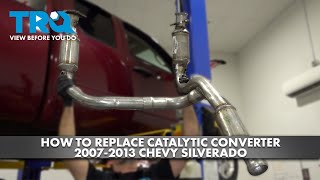
Typical fix: Replace the Bank 2 catalytic converter, which is often part of a Y-pipe assembly on 🎬 See this step-by-step catalytic converter replacement walkthrough these trucks.
Est. part cost: $300-$800 for aftermarket; $600-$1200+ for OEM. - Faulty Downstream (Post-Cat) Oxygen Sensor 🟡 Medium Probability O2 sensors age and become slow to respond. A lazy or biased Bank 2, Sensor 2 can send incorrect data to the ECM, making it appear the catalytic converter has failed when it hasn't. However, many forum users report that the PCM is effective at identifying a bad sensor and will set a specific O2 sensor code, making this a less frequent cause than many hope.
How to confirm: Observe the sensor's voltage on a scan tool with the engine fully warm and at a steady 2000 RPM. It should be relatively stable, typically above 0.6V. If it is stuck low, fluctuating wildly like the upstream sensor, or not responding, it is likely faulty. Test the sensor's internal heater circuit for proper resistance.
Typical fix: Replace the Bank 2, Sensor 2 (downstream) oxygen sensor.
Est. part cost: $40-$90 - Exhaust Leak 🟡 Medium Probability These trucks are well-known for exhaust manifold bolts breaking, especially the rear-most bolt near the firewall. This causes a leak between the cylinder head and the manifold. Gaskets at the collector flanges can also fail. This allows un-metered oxygen into the exhaust, which skews O2 sensor readings and tricks the PCM into thinking the converter is inefficient.
How to confirm: Visually inspect the exhaust manifold for broken bolt heads (a missing head on the rear driver's side is very common). Listen for a ticking noise that is loudest on a cold start and may quiet down as the engine warms. Use a smoke machine or soapy water spray to definitively find leaks. Soot trails near flanges are also a clear indicator.
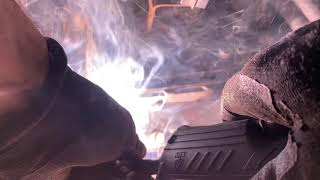
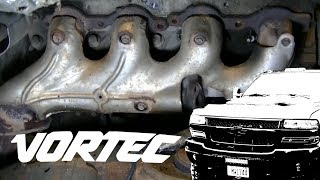
Typical fix: Repair the exhaust leak. This often involves extracting broken bolts (sometimes by welding a nut onto the broken stud) and replacing the exhaust manifold gasket. 🎬 Watch: How to remove broken manifold bolts and install headers
Est. part cost: $20-$150 - Underlying Engine Misfire ⚪ Low Probability Worn spark plugs, wires, or ignition coils are common maintenance items that, if neglected, cause misfires. A misfire sends raw, unburnt fuel into the exhaust, which superheats and melts the catalytic converter's internal structure.
How to confirm: Check for other stored trouble codes, specifically P0300-P0308. A misfire is a root cause of cat failure, not a symptom. Address any misfire codes *before* replacing the converter to prevent destroying the new part.
Typical fix: Perform a full tune-up, replacing spark plugs and wires. Inspect and replace faulty ignition coils. Address the root cause of the misfire BEFORE replacing the catalytic converter.
Est. part cost: $100-$300
Rare But Worth Checking
- Use of fuel additives like 'Cataclean'. While some users report temporary success in clearing the code, many find it does not work or the code returns, indicating it's not a permanent fix for a physically failed converter.
- O2 sensor 'spacer' or 'non-fouler' has been installed. This is a common but illegal attempt to trick the downstream sensor by pulling it out of the direct exhaust stream. These can fail, get clogged, or be installed incorrectly, causing the code to appear.
- Damaged O2 sensor wiring. Wires can be damaged by road debris or contact with hot exhaust components, leading to incorrect signals.
Diagnosis Steps

- Read Codes: Use an OBD-II scanner to confirm P0430 and check for any other codes (e.g., misfire, fuel trim, or O2 sensor codes). Note any pending codes as well.
- Inspect for Exhaust Leaks: This is critical on these trucks. Start the engine cold and listen for a ticking sound near the exhaust manifolds. Visually inspect for broken manifold bolts, especially the one closest to the firewall on the driver's side. Check for soot trails around exhaust flanges.
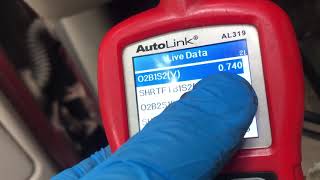
- Analyze Live O2 Sensor Data: Use a scan tool that can graph live data. Warm up the 🎬 Watch: How to diagnose P0430 using live sensor data engine fully. At a steady 2,000 RPM, observe the Bank 2 Sensor 1 (B2S1) and Bank 2 Sensor 2 (B2S2) voltages.
- Interpret Data: A good converter will show a rapidly fluctuating B2S1 (switching between ~0.1V and ~0.9V) and a very steady B2S2 (typically >0.6V). If B2S2 is fluctuating rapidly and mirroring B2S1, the converter has failed.
- Perform Temperature Test: Use an infrared temperature gun on a fully warmed-up engine. The outlet of the catalytic converter should be at least 100°F hotter than the inlet. If temperatures are similar or the outlet is cooler, the converter is not working.
- Test the O2 Sensor: If the B2S2 reading is suspect (stuck, slow, or flatlined), test the sensor itself before condemning the converter. Many technicians advise that if there isn't a specific O2 sensor code, the sensor is likely doing its job of reporting the bad cat.
- Check for Underlying Causes: If the converter is confirmed bad, investigate why it failed. Check fuel trims (should be within +/- 10%), check for misfires, and assess for oil consumption (especially on 2007+ 5.3L models) or coolant leaks to ensure you don't destroy the new converter.
- Confirm the Repair: After replacing a part, clear the codes and perform a complete OBD-II drive cycle to ensure the code does not return.
Parts You'll Likely Need

- Bank 2 Catalytic Converter Assembly
(OEM #Varies by year/engine, e.g., GM 15861399 (replaces 10345415, 15861403 for some models). Always verify with VIN.)— This is the most common ultimate failure that causes a legitimate P0430 code once other causes are ruled out.
Trusted brands: ACDelco, Walker Exhaust, MagnaFlow
OEM price range: $600-$1200+
Aftermarket price range: $300-$800 (Note
Related Codes That Often Appear With This One
- P0420 — This is the identical code for Bank 1 (passenger side). If the cause is age-related, it's common for both converters to fail around the same time. It can also appear if an exhaust leak or oil consumption issue is affecting both banks.
- P0300-P0308 — These are misfire codes. An engine misfire is a primary cause of catalytic converter failure, as it dumps raw fuel into the exhaust, overheating the converter. Always fix misfires first.
- P0171 / P0174 — These are 'System Too Lean' codes. An exhaust leak before the upstream O2 sensor can sometimes trigger these alongside a P0430, as the leak allows unmetered air to enter, confusing the fuel trim system.
Technical Service Bulletins (TSBs) & Recalls
- PIP3119P: Notes that on some low-mileage vehicles, the diagnostic tests for P0420/P0430 are disabled for the first hour of operation to prevent false codes during the converter's break-in period.
- 10-06-01-008H: While not directly for P0430, this TSB addresses excessive oil consumption on AFM engines, which is a primary root cause for converter failure on 2007-2009 models. The fix often involves piston cleaning and potentially piston ring replacement.
Platform-Specific Known Issues

- Broken exhaust manifold bolts are extremely common and can cause leaks that trigger a false P0430 code. Always check this before replacing parts. The rearmost bolts are most prone to breaking.
- Some 5.3L V8 engines with Active Fuel Management (AFM), primarily in the 2007+ (GMT900) models, are known for excessive oil consumption which fouls and destroys catalytic converters.
- The federal emissions warranty covers catalytic converters for 8 years or 80,000 miles. If your truck is within this window, a dealer must replace a failed converter free of charge.
Mechanic-Grade Diagnostic Values
- Mode $06 Catalyst Monitor Test (Bank 2) — expected: The raw test value should be below the maximum threshold stored in the PCM. For GM, this is often Monitor ID $22, Test ID $A2.. Failure: A test value that exceeds the PCM's maximum limit will flag the P0430 code. A value of 65535 often indicates the test has not yet completed for the current drive cycle.
- Long-Term Fuel Trim (LTFT) for Bank 2 — expected: Within +/- 10% at idle and steady cruise.. Failure: Consistently high positive values (>+10%) suggest a vacuum leak or an exhaust leak before the upstream O2 sensor. Consistently high negative values (< -10%) can indicate a leaking fuel injector. These must be corrected before replacing the converter.
- Fuel Pressure (Key on, Engine off) — expected: 55-62 PSI for most 4.8L, 5.3L, and 6.0L engines in this range.. Failure: Low fuel pressure can cause a lean condition, leading to misfires and long-term catalyst damage. High fuel pressure can cause a rich condition, which can also damage the converter.
Hidden / Shadow Codes Worth Checking
- Mode $06, Test ID $A2: This is not a DTC (trouble code) but a specific test result within the OBD-II system's non-continuous monitors. It directly shows the calculated efficiency value of the Bank 2 catalytic converter from the last completed test cycle, along with the minimum and maximum allowable values. (see via A professional scan tool or an advanced OBD-II app that can display Mode $06 data. It allows a technician to see if the converter is borderline or failing badly, even before the P0430 code becomes active.)
Scan Tool Commands That Help
- GM Tech2 / GDS2 or equivalent professional scanner: Catalyst System Test (or Service Bay Test) — This is a bidirectional command that forces the PCM to run the catalyst efficiency monitor on demand in the service bay. It saves the technician from having to perform a lengthy drive cycle to verify if a repair was successful or to confirm a failure before replacing parts.
- GM Tech2 / GDS2 or equivalent professional scanner: Reset Fuel Trims — After repairing a vacuum leak, exhaust leak, or fuel system issue that caused skewed fuel trims, this command should be used to reset the learned long-term fuel trim values to zero. This prevents the old, incorrect values from affecting engine operation after the repair.
Wiring & Ground Locations
- G103 — On the GMT900 (2007.5+), this primary engine ground is located on the front of the passenger's side cylinder head. On GMT800s, it's often on the right rear of the engine block.. This is a critical ground for the engine control system. Corrosion or a loose connection here can create electrical noise and voltage offsets for sensors on Bank 2 (driver's side), potentially causing incorrect O2 sensor readings and a false P0430 code.
- G104 — On the GMT900 (2007.5+), this ground is on the rear of the driver's side cylinder head. On GMT800s, it's on the bottom of the left rear cylinder head.. A poor connection at this ground strap, which connects the engine block to the firewall/body, can affect PCM and sensor performance. While less directly tied to Bank 2 than G103, ensuring all major grounds are clean and tight is a crucial step in diagnosing elusive electrical issues.
- Bank 2, Sensor 2 (Downstream) O2 Sensor Connector — On the driver's side exhaust pipe, after the catalytic converter.. Knowing the pinout allows for direct testing. For many 2004-2005 models, wire colors are Pink (Heater Power), Black (Heater Ground), Tan (Low Signal/Reference), and Purple or Gray (High Signal). Testing for 12V at the heater circuit and checking the signal wire for proper voltage can confirm if the sensor or the wiring is at fault.
Real Owner Repair Stories
- SilveradoSierra.com forum user (2008 Silverado 5.3L with AFM) — P0430 code returned after replacing the catalytic converter.
❌ Tried (didn't work) Replaced Bank 2 catalytic converter
✅ What actually fixed it The root cause was excessive oil consumption from the Active Fuel Management (AFM) system. The oil fouled and destroyed the new converter. The final fix involved installing an AFM delete kit and replacing the catalytic converter again. - YouTube Mechanic Channel (2005 Silverado 1500 5.3L) — Persistent P0430 code, audible ticking noise only on cold start.
❌ Tried (didn't work) Replaced downstream O2 sensor, Used catalytic converter cleaner additive
✅ What actually fixed it The cause was a broken rear exhaust manifold bolt on the driver's side (Bank 2). The leak would seal itself when the manifold heated up and expanded, making it difficult to find when the engine was warm. Extracting the broken bolt and replacing the gasket resolved the code. - Professional technician forum (2007 Silverado Classic 4.8L) — P0430 and P0420 codes present. O2 sensor graphs showed inefficient converters.
❌ Tried (didn't work) Smoke test of the exhaust system showed no leaks.
✅ What actually fixed it A second, more thorough inspection revealed a tiny, hairline crack on the Y-pipe weld just before the main converter body. It was too small to show up on a low-pressure smoke test but was enough to let oxygen in and trigger the codes. Replacing the Y-pipe assembly fixed the issue.
"I Checked Everything" — The Actual Cause
- A technician reported a case on a 5.3L Silverado where a smoke test revealed no exhaust leaks, and O2 sensors tested good, but the P0430 code persisted. The root cause was found to be a slightly leaking fuel injector on a cylinder in Bank 2. It was not leaking enough to cause a misfire code but was creating a rich condition that slowly degraded the catalytic converter over time. The issue was identified by analyzing long-term fuel trims and performing a cylinder balance test.
When the Usual Fixes Don't Work
- The NHTSA Technical Service Bulletin #PIP3119P notes that for some vehicles, the diagnostic tests for codes P0420 and P0430 are intentionally disabled by the ECM for the first hour of operation. This is a specific software strategy and not a fault. While this is an unusual edge case, it highlights that the code's appearance can be influenced by the PCM's software logic under specific conditions, not just a hard part failure.
OEM Part Supersession History
10345415, 15861403→15861399— Part consolidation and design updates by the manufacturer.
Heads up: While this part number fits many GM vehicles, it is critical to verify fitment with the vehicle's VIN. Also, vehicles originally sold in California or other CARB states require a specific CARB-compliant catalytic converter. Installing a Federal (EPA) converter on a CARB vehicle will likely result in a recurring P0430 code and a failed emissions test.
Model Year Variations Within This Range
- 2007-2009 (GMT900 platform): The 5.3L (LY5, LMG) and 6.0L (L76) V8 engines in the GMT900 generation introduced Active Fuel Management (AFM). This system is a frequent root cause of P0430 due to oil consumption issues related to lifters and the PCV system, which contaminates the catalytic converters. GMT800 trucks (2002-2006) do not have AFM and are less prone to this specific failure mode.
- 2007: The 2007 model year was a transition year. The "Classic" body style is a GMT800 truck, while the "New Body Style" (NBS) is a GMT900. They have different frames, interiors, and some exhaust components. It is essential to identify which version of the 2007 truck you are working on before ordering parts like catalytic converters or exhaust manifolds.
Helpful Videos
We Have This Part in Stock



The information in this article is provided for general reference and educational purposes only. Vehicle specifications, procedures, and part compatibility can vary by production date, trim level, and region. Always consult your vehicle's factory service manual and verify part numbers before purchasing or performing repairs. Safety-critical components such as airbags, seat belts, and braking systems should be installed by a qualified professional.
- Chevrolet SILVERADO 1500:
- 🎬 Helpful Videos
- 🛍️ Shop This Part
- What's Unique About the 2002-2009 Chevrolet SILVERADO 1500
- Diagnostic Flowchart
- Symptoms You May Notice
- Most Likely Causes
- Rare But Worth Checking
- Diagnosis Steps
- Parts You'll Likely Need
- Related Codes That Often Appear With This One
- Technical Service Bulletins (TSBs) & Recalls
- Platform-Specific Known Issues
- Mechanic-Grade Diagnostic Values
- Hidden / Shadow Codes Worth Checking
- Scan Tool Commands That Help
- Wiring & Ground Locations
- Real Owner Repair Stories
- "I Checked Everything" — The Actual Cause
- When the Usual Fixes Don't Work
- OEM Part Supersession History
- Model Year Variations Within This Range
- 🎟️ Get 5% Off