

P0430 on 2004-2006 Cadillac Escalade EXT 1500: Catalyst Efficiency Causes and Fixes
P0430 on a 2004-2006 Escalade EXT most often points to a failing catalytic converter on Bank 2 (driver's side). Before replacing this expensive part, always check for exhaust leaks, especially from broken exhaust manifold bolts, and test the oxygen sensors, as they can also trigger the code for a fraction of the cost.
- P0430 points to an inefficient catalytic converter on the driver's side (Bank 2).
- Before spending thousands on a new converter, always rule out cheaper causes: exhaust leaks and faulty oxygen sensors.
- Use a scan tool to watch live O2 sensor data. If the downstream sensor (Bank 2, Sensor 2) fluctuates like the upstream sensor, the converter has failed.
- If you have any other codes, especially for engine misfires (P030x) or rich conditions (P0172/P0175), fix those problems first or you will destroy the new converter.
- On GM V8s of this era, Bank 2 is the driver's side.
What's Unique About the 2004-2006 Cadillac ESCALADE EXT 1500
On these GMT800 platform trucks, including the Escalade EXT with the 6.0L V8, the P0430 code is a very common issue as the vehicles age. While the catalytic converters themselves are a frequent failure point, the problem is often misdiagnosed. A very common issue on these GM V8s is broken exhaust manifold bolts, particularly the rearmost ones, which cause an exhaust leak that can trick the O2 sensors and trigger a false P0430. Owners and technicians sometimes replace the converter only to have the code return, suggesting the root cause was a less-obvious exhaust leak or a lazy oxygen sensor. A notable manufacturer TSB for this period, #PIP3119N, mentions that P0420/P0430 codes were disabled for the first hour of operation on new vehicles to prevent false triggers, highlighting the sensitivity of the monitoring system.
Diagnostic Flowchart
Tap your situation to follow the diagnostic path that matches what you're seeing on this vehicle.
Symptoms You May Notice
- Check Engine Light is on
- Reduced fuel economy
- Sluggish acceleration or lack of engine power
- A sulfur or "rotten egg" smell from the exhaust
- Rattling noise from under the vehicle if the converter's internal structure has broken apart
- Ticking or tapping noise from the engine bay, especially when cold, which points to an exhaust manifold leak
- Immediately replacing the catalytic converter without first testing the oxygen sensors or checking for exhaust leaks. This is an expensive mistake if the converter was not the actual problem.
- Replacing an oxygen sensor when an un-repaired engine misfire has already damaged the catalytic converter. The code will return until the converter is also replaced.
- Replacing the catalytic converter when the true cause is broken exhaust manifold bolts. Many owners have fixed their P0430 code simply by repairing the manifold leak.
Most Likely Causes
- Failed Catalytic Converter (Bank 2) 🔴 High Probability Catalytic converters have a finite lifespan and can fail from age, contamination from burning oil, or damage from engine misfires. On high-mileage GMT800 trucks (100k+ miles), failure of the original converter is the most common resolution for a P0430 code.
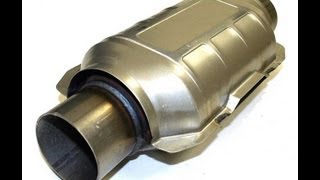
How to confirm: After ruling out other causes, a technician can use a scan tool to analyze O2 sensor data. 🎬 Watch: How to diagnose and test for P0420 and P0430 codes. A downstream O2 sensor voltage that fluctuates rapidly like the upstream sensor indicates a failed converter. An infrared temperature gun can also be used; the outlet of a working converter should be at least 100°F hotter than the inlet.
Typical fix: Replace the Bank 2 (driver's side) catalytic converter assembly.
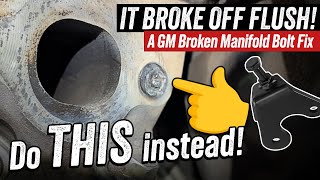
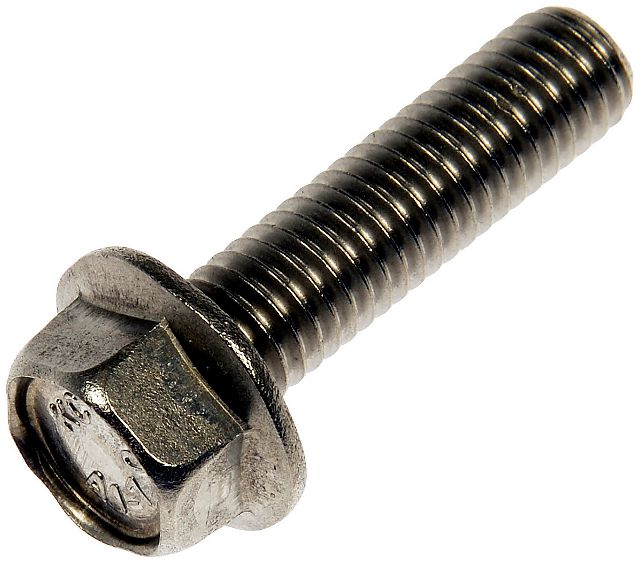
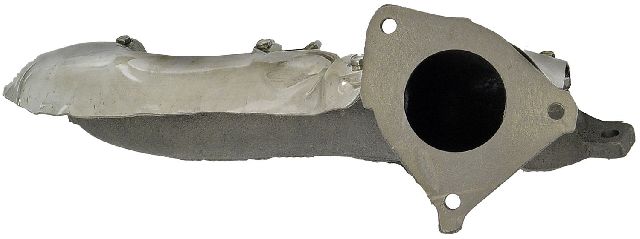
Est. part cost: $300-$1200 (aftermarket), $2800+ (OEM) - Exhaust System Leak 🔴 High Probability A very common failure on GMT800 trucks with V8 engines is for the rearmost exhaust manifold bolts to snap due to heat cycles and rust. This creates a leak that allows fresh air into the exhaust, skewing O2 sensor readings and causing a false P0430 code. Leaks can also occur at flange gaskets.
How to confirm: Perform a visual inspection for soot trails or cracks, especially at the exhaust manifold-to-head connection. A ticking noise on a cold start is a classic symptom. A smoke test is the most effective method, where a machine fills the exhaust with smoke to reveal any leaks between the upstream and downstream O2 sensors.
Typical fix: Replace the broken exhaust manifold bolts and the manifold gasket. This often requires drilling out the broken bolt remnants. Repairing a flange leak may require a new gasket or welding.
Est. part cost: $20-$100 - Failed Oxygen (O2) Sensor 🟡 Medium Probability Oxygen sensors are wear items and can become 'lazy' or biased with age, sending inaccurate data to the computer. This can trick the PCM into thinking the converter is bad when it's actually the sensor that's faulty.
How to confirm: Use a scan tool to graph the O2 sensor voltages. The downstream (Sensor 2) reading should be relatively stable around 0.45V-0.8V on a healthy, warm engine. If it's stuck, slow to respond, or fluctuating wildly, the sensor is likely bad. A common diagnostic trick is to swap the downstream O2 sensors from Bank 1 and Bank 2. If the code changes to P0420, the sensor is confirmed to be faulty.
Typical fix: Replace the Bank 2, Sensor 2 (downstream, driver's side) oxygen sensor.
Est. part cost: $50-$110 - Engine Misfire or Fuel Mixture Issue ⚪ Low Probability An engine that is misfiring or running too rich sends unburned fuel into the exhaust, which can overheat and destroy the catalytic converter. This is less a direct cause of the code and more a root cause of the converter failure itself.
How to confirm: Check for other trouble codes, especially misfire codes (P0300-P0308) or fuel trim codes (P0172, P0175). Address these codes before replacing any exhaust components.
Typical fix: Diagnose and repair the root cause of the misfire or rich condition (e.g., bad spark plugs, faulty fuel injector, vacuum leak) before replacing the catalytic converter.
Est. part cost: $50-$500+
Rare But Worth Checking
- Damaged O2 Sensor Wiring: The wiring harness to the O2 sensors can be damaged by road debris or contact with hot exhaust components, causing a short or open circuit that mimics a sensor failure. Always inspect the wiring before replacing the sensor.
- PCM Fault: In very rare cases, the Powertrain Control Module itself can be the source of a false P0430 code. A dealer may also be able to check for any PCM software updates that address overly sensitive diagnostic parameters. This should only be considered after all other possibilities have been exhaustively ruled out.
Diagnosis Steps
- Check for any other stored DTCs. If misfire or fuel trim codes are present, address them first, as they are likely the root cause of the converter failure.
- Visually and audibly inspect the exhaust system from the engine manifold to the rear O2 sensor on the driver's side. Listen for a 'ticking' noise when the engine is cold, which strongly suggests an exhaust manifold leak. Look for cracks, holes, or black soot marks indicating a leak, especially around gaskets and welds.
- Use a scan tool with live data capability. Graph the voltage for Bank 2 Sensor 1 (upstream) and Bank 2 Sensor 2 (downstream).
- At a steady 2,500 RPM on a warm engine, the upstream sensor (B2S1) should fluctuate rapidly between ~0.1V and ~0.9V. The downstream sensor (B2S2) should remain relatively steady and stable, typically between 0.45V and 0.8V.
- If the downstream sensor's graph mimics the upstream sensor's rapid fluctuations, the catalytic converter is not working and has likely failed.
- If the downstream sensor's voltage is stuck high, low, or is slow to respond, the oxygen sensor itself is likely faulty. Consider swapping the Bank 1 and Bank 2 downstream sensors to see if the code follows the sensor.
- If no exhaust leaks are found and the O2 sensors test good, the catalytic converter is the confirmed point of failure.
Parts You'll Likely Need
- Catalytic Converter (Bank 2, Driver's Side) — This is the most common cause of a P0430 code, failing due to age or contamination.
Trusted brands: Walker Exhaust, MagnaFlow, AP Exhaust, ACDelco (OEM) 🎬 Watch: How to replace the catalytic converters and Y-pipe.
OEM price range: $2800-$3100
Aftermarket price range: $300-$1200 - Downstream Oxygen Sensor (Bank 2, Sensor 2)
(OEM #ACDelco 213-4229 (GM 12609457))— A faulty sensor can send incorrect readings, falsely triggering the P0430 code. It's a critical diagnostic step and a common point of failure.
Trusted brands: Denso, Bosch, NTK, ACDelco
OEM price range: $80-$150
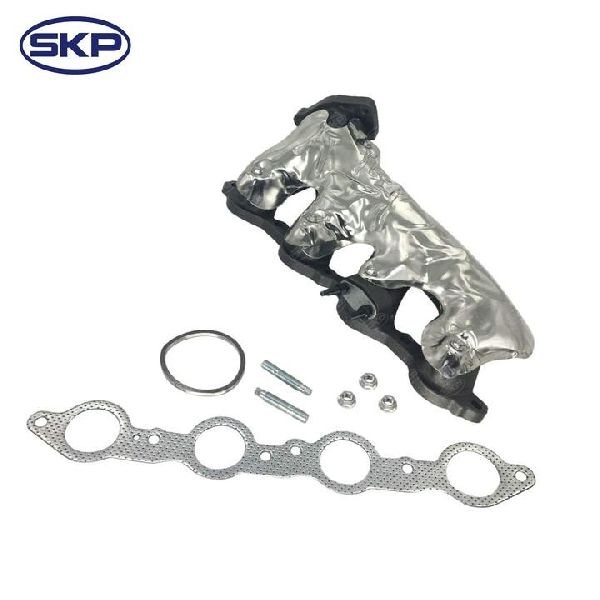
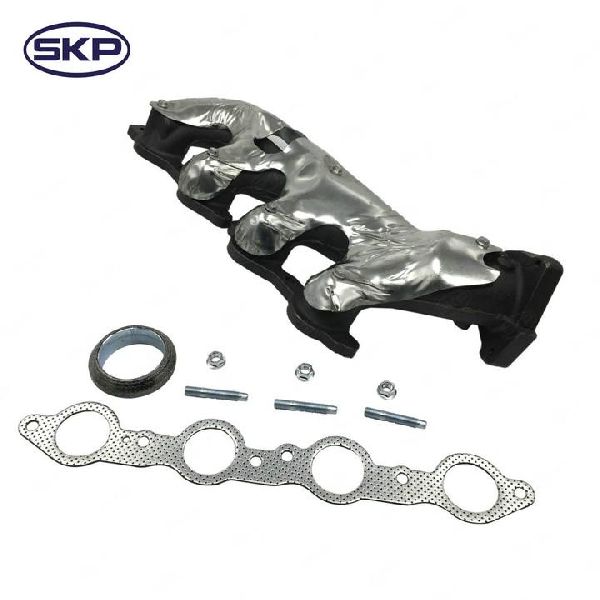
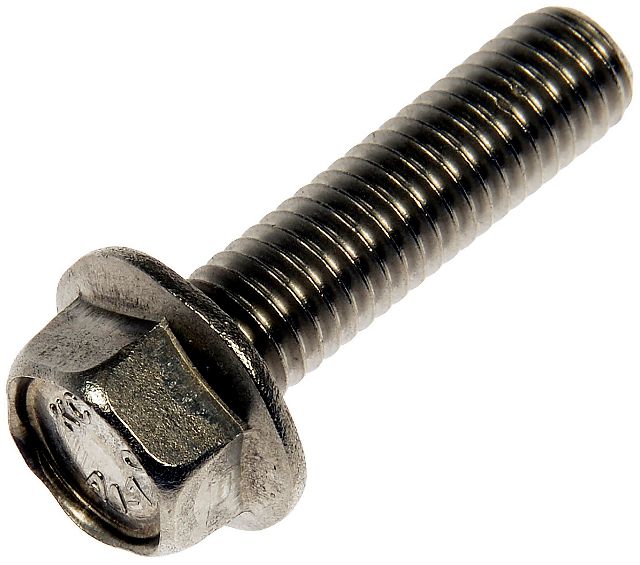
Aftermarket price range: $50-$110 - Exhaust Manifold Gasket
(OEM #Fel-Pro MS 92467 (Kit))— A leak at the exhaust manifold, often from broken bolts, is a very common cause of false P0430 codes on this platform. It allows oxygen to enter the exhaust stream and skew O2 sensor readings.
Related Codes That Often Appear With This One
- P0420 — This is the identical code for Bank 1 (passenger side). It's common for both catalytic converters to fail around the same time due to age and mileage, or for a single root cause like oil consumption to damage both.
- P0300-P0308 — These are misfire codes. A persistent misfire can dump raw fuel into the exhaust, quickly destroying the catalytic converter and causing a P0430 code. This root cause must be fixed first.
- P0172 / P0175 — These codes indicate a rich fuel condition on Bank 1 and Bank 2, respectively. A rich condition can overwhelm and damage the catalytic converter over time, leading to the P0430 code.
Technical Service Bulletins (TSBs) & Recalls
- PIP3119N: Mentions that on some vehicles, the diagnostic tests for P0420 and P0430 are disabled for the first hour of engine operation to prevent false codes from setting at low mileage, highlighting the system's sensitivity.
Platform-Specific Known Issues
- Broken Exhaust Manifold Bolts: This is arguably the most significant vehicle-specific issue for P0430 on GMT800 trucks. The rearmost bolts on the manifolds are highly prone to snapping from heat cycles. This creates an exhaust leak that is often misdiagnosed as a failed catalytic converter. A ticking sound on cold start-up is the tell-tale symptom.
Mechanic-Grade Diagnostic Values
- Downstream O2 Sensor (Bank 2, Sensor 2) Voltage — expected: A steady voltage between 0.45V and 0.8V at operating temperature and steady RPM.. Failure: Voltage fluctuates rapidly between ~0.1V and ~0.9V, mimicking the upstream sensor, or is stuck at a specific voltage.
- Long-Term Fuel Trim (LTFT) for Bank 2 — expected: Within +/- 5% at idle and steady cruise.. Failure: Consistently high positive values (e.g., > +10%) suggest an unmetered air leak, such as from an exhaust manifold, which can trigger a false P0430.
- Fuel Pressure (KOEO - Key On, Engine Off) — expected: Approximately 50-60 PSI.. Failure: Significantly low pressure can lead to lean conditions, which over time can affect catalyst performance, though it would typically set other codes first.
Hidden / Shadow Codes Worth Checking
- Mode $06, TID $05: On GM vehicles using the older J1850/Class2 data link, Test ID (TID) $05 corresponds to the Idle Catalyst Efficiency Test for Bank 2. A technician can view the raw test value and compare it to the PCM's minimum/maximum threshold to see how close the catalyst is to failing, even before the DTC is set. (see via A professional scan tool with Mode $06 capability.)
- Mode $06, OBDMID $22: On newer GMLAN-based systems, the On-Board Diagnostic Monitor ID (OBDMID) $22 is used for the Bank 2 Catalyst Monitor. This provides similar data to the older TID system but under a standardized SAE format. (see via A professional scan tool with Mode $06 capability that supports CAN/GMLAN vehicles.)
Scan Tool Commands That Help
- Tech2 / GDS2 or equivalent professional scanner: Live Data Graphing - O2 Sensors — This is the primary diagnostic function. Graphing B2S1 and B2S2 simultaneously allows for a direct visual comparison to see if the downstream sensor is mimicking the upstream sensor, which confirms a failed converter.
- Tech2 / GDS2 or equivalent professional scanner: Heated O2 Sensor Relearn — Some sources suggest that after replacing an O2 sensor on GM vehicles, a relearn or reset function may be required to ensure the PCM uses the new sensor data correctly. This may be more applicable to the next generation (2007+), but is worth checking for.
Wiring & Ground Locations
- G104 / G105 — G104 is located on the left rear of the engine block. G105 is on the lower left front of the engine block.. These are primary engine block grounds. A poor connection at these points can introduce electrical noise or incorrect ground reference for various sensors, including the crank sensor and O2 sensors, potentially causing erratic readings that could contribute to a false P0430.
- G102 — Located at the left rear of the engine.. This ground specifically serves the 8 ignition coils. A bad ground here can lead to weak spark and incomplete combustion (misfires), which can destroy a catalytic converter and cause a legitimate P0430 code.
- Bank 2 O2 Sensor Connector — The downstream sensor is located on the driver's side exhaust pipe, after the catalytic converter. The connector is typically a 4-way male gray connector.. The connector and its wiring are vulnerable to heat and debris. Wiggling the connector while watching live data can reveal intermittent connections. The 4 wires serve the heater circuit (power and ground) and the sensor signal circuit (signal and ground/reference).
Real Owner Repair Stories
- 2CarPros Forum User (Vehicle with P0430, likely GM V-engine) — P0430 code, rough running, exhaust fumes.
❌ Tried (didn't work) Initially had a misfire code that went away, leaving only P0430.
✅ What actually fixed it The user discovered a large hole rusted through the driver's side exhaust manifold. This leak was the root cause of the P0430 code, as it allowed unmetered air to enter the exhaust stream before the O2 sensors. - YouTube video by 'danny's things' (2006 Cadillac STS (with similar GM V8 architecture)) — Persistent P0430 code.
❌ Tried (didn't work) Replaced spark plugs and coils, Cleaned fuel injectors, Replaced fuel filter, Used a catalytic converter cleaner additive, Replaced the downstream O2 sensor
✅ What actually fixed it After exhausting all other options, the catalytic converter was replaced. Upon removal, shaking the old converter produced a rattling sound, confirming the internal substrate had broken apart, which was the ultimate cause of the code.
"I Checked Everything" — The Actual Cause
- A small pinhole leak in the exhaust pipe, even downstream of the catalytic converter but before the rear O2 sensor, can cause a false P0430. As high-velocity exhaust gas passes over the pinhole, it can create a Venturi effect, actively drawing outside air (oxygen) into the pipe. This extra oxygen fools the downstream sensor into thinking the catalyst isn't working. This type of leak may be too small to be obvious during a standard smoke test but is enough to trigger the code.
When the Usual Fixes Don't Work
- While Pass 2 correctly identifies a failed O2 sensor as a 'medium' probability cause, many professional technicians and experienced owners argue that a P0430 code is almost never caused by a bad O2 sensor. Their reasoning is that it takes a properly functioning O2 sensor to accurately monitor the catalyst and determine that it has failed. A faulty O2 sensor will typically set its own performance or heater circuit codes (e.g., P0155-P0161). Therefore, if P0430 is the only code present, the catalytic converter itself is the much more likely culprit, after exhaust leaks have been ruled out.
OEM Part Supersession History
GM 12609457 (ACDelco 213-4229)→This part number appears to be current for the specified application.— N/A
Heads up: Some parts suppliers note that this sensor may require 'programming and/or special setup procedures' after installation. Also, visually verify the connector type before ordering; while often a 4-pin gray square connector for this model, variations exist across the broader GMT800 platform.
Model Year Variations Within This Range
- 2004-2006: These Escalade models use the Gen III 6.0L V8 LQ9 engine. This is an iron-block engine with a 24x crankshaft reluctor wheel and cathedral port heads. This is distinct from the Gen IV V8s (like the 6.2L L92) introduced in 2007, which have different block materials, sensor locations (e.g., knock sensors), and PCM logic. Diagnostics and parts are not interchangeable between these generations.
Helpful Videos
We Have This Part in Stock


The information in this article is provided for general reference and educational purposes only. Vehicle specifications, procedures, and part compatibility can vary by production date, trim level, and region. Always consult your vehicle's factory service manual and verify part numbers before purchasing or performing repairs. Safety-critical components such as airbags, seat belts, and braking systems should be installed by a qualified professional.
- Cadillac ESCALADE EXT 1500:
- 🎬 Helpful Videos
- 🛍️ Shop This Part
- What's Unique About the 2004-2006 Cadillac ESCALADE EXT 1500
- Diagnostic Flowchart
- Symptoms You May Notice
- Most Likely Causes
- Rare But Worth Checking
- Diagnosis Steps
- Parts You'll Likely Need
- Related Codes That Often Appear With This One
- Technical Service Bulletins (TSBs) & Recalls
- Platform-Specific Known Issues
- Mechanic-Grade Diagnostic Values
- Hidden / Shadow Codes Worth Checking
- Scan Tool Commands That Help
- Wiring & Ground Locations
- Real Owner Repair Stories
- "I Checked Everything" — The Actual Cause
- When the Usual Fixes Don't Work
- OEM Part Supersession History
- Model Year Variations Within This Range
- 🎟️ Get 5% Off