

OBD-II Code P0425: Catalyst Temperature Sensor Circuit
The Ultimate Guide to Diagnosing and Fixing P0425
- Test the sensor and wiring with a multimeter before replacing the catalytic converter, as P0425 is an electrical circuit code that rarely requires a $1,000+ converter replacement.
- Inspect the exhaust gas temperature (EGT) sensor first on diesel trucks (Ford, Ram, GM) and VW TDIs, as it is the primary failure point for this code.
- Look for burnt wires, corroded connectors, and exhaust leaks near the Bank 1 sensor, which account for the majority of P0425 triggers and cost under $50 in parts to fix.
- Check for manufacturer Technical Service Bulletins (TSBs) or warranty extensions, such as Ram's 67A recall, which provide free software updates or sensor replacements.
What Does P0425 Mean?

P0425 indicates the Powertrain Control Module (PCM) detected an electrical circuit malfunction in the Bank 1 catalyst temperature sensor. This sensor (often an Exhaust Gas Temperature or EGT sensor) monitors the catalytic converter to ensure it operates efficiently and prevents overheating. The code specifically points to a circuit problem—like a broken wire, short, or faulty sensor—rather than a failed catalytic converter.
Technical definition: The official SAE definition for P0425 is 🎬 Watch: A quick overview of the P0425 code and its meaning. "Catalyst Temperature Sensor Circuit (Bank 1 Sensor 1)". The PCM detected a voltage signal from the Bank 1 catalyst temperature sensor outside the manufacturer's specified range. This indicates an open circuit, short to ground, short to voltage, or internal sensor failure. The sensor provides feedback on catalyst operating temperature for fuel trim adjustments and catalyst protection.
Can I Drive With P0425?
Yes, But With Caution. Yes, but driving with a P0425 code is not recommended for extended periods. Continuing to drive masks underlying issues that lead to catalytic converter damage, costing $800 to $2,500 to repair. It is safe to drive under 100 miles to a repair shop, but you risk poor fuel economy, failing an emissions test, and triggering a reduced power 'limp mode' in some vehicles.
Common Causes

- Faulty Catalyst Temperature Sensor (EGT Sensor) (Very Common) — The sensor itself is the most common failure point. After thousands of heat cycles, the internal thermistor or thermocouple degrades and fails, sending incorrect or zero signals to the PCM. This is especially frequent on diesel vehicles.
- Damaged Wiring or Corroded Connector (Very Common) — The sensor's proximity to the hot exhaust system makes its wiring highly susceptible to damage. Extreme heat, road debris, moisture, and vibrations cause wires to break or connector pins to corrode, resulting in an open or shorted circuit.
- Exhaust Leak Upstream of the Sensor (Common) — A leak from a cracked exhaust manifold, bad flange gasket, or loose sensor bung allows outside air into the exhaust stream. This drastically alters the temperature at the sensor's location, causing irrational readings that trigger a circuit code.
- Blown Fuse or Relay (Less Common) — On systems where the catalyst temperature sensor is part of a heated circuit, a blown fuse or faulty relay interrupts the power supply. This prevents the sensor from operating correctly and triggers the P0425 code.
- Faulty Oxygen (O2) Sensor Sending Irrational Data (Less Common) — A failing upstream or downstream O2 sensor provides incorrect air-fuel ratio data. The PCM sometimes misinterprets this data, incorrectly flagging the catalyst temperature sensor circuit as the source of the problem.
- Clogged or Failing Catalytic Converter (Less Common) — While P0425 is an electrical code, a physically clogged catalytic converter creates extreme hot spots. This causes the temperature sensor to report values so far out of range that the PCM flags it as a circuit fault.
- Use of Aftermarket Exhaust Components (Less Common) — Installing an aftermarket downpipe changes the location or depth of the sensor bung. This alters the sensor's exposure to exhaust gas flow and heat, leading to readings outside the normal range.
- Powertrain Control Module (PCM) Fault or Outdated Software (Rare) — In rare instances, the issue lies within the PCM itself. This is usually outdated software that misinterprets sensor data. Manufacturers release software updates (TSBs) to correct overly sensitive diagnostic parameters.
Symptoms
- Check Engine Light is On — The Malfunction Indicator Lamp (MIL) illuminates on your dashboard immediately after the PCM detects the circuit fault.
- Failed Emissions Test — A P0425 code results in an automatic failure of a vehicle emissions inspection, as the catalyst monitoring system is disabled.
- Poor Engine Performance — You experience hesitation during acceleration or a general lack of power. On many diesel trucks, this code triggers a 'limp mode' to prevent engine damage.
- Hissing or Whistling Noise from Exhaust — A hissing sound during acceleration indicates a significant exhaust leak upstream of the sensor, which is a common trigger for P0425.
- Rotten Egg or Sulfur Smell from Exhaust — If the catalytic converter overheats due to the conditions causing the P0425 code, it produces a distinct rotten egg smell from the tailpipe.
- Reduced Fuel Economy (also visible on scanner) — The PCM relies on temperature data for optimal fuel mixture. A faulty sensor causes the system to run richer than necessary, leading to a noticeable drop in gas mileage, often by 1-3 MPG.
Diagnostic Flowchart
Tap your situation to follow the diagnostic path that matches what you're seeing on this code.
Common Fixes & Costs
- Replace Catalyst Temperature Sensor
— Parts: $80-$250, Labor: $100-$200, ~1.2 hr book time
(DIY)
Ford F-Series (6.7L Power Stroke): OEM AC3Z-5J213-B, HC3Z-5J213-B (Alt: Dorman 904-403, Standard Motor Products ETS116, Walker 273-10340)
Ram 2500/3500 (6.7L Cummins): OEM 68035780AA (Alt: Dorman 904-714, NTK (NGK) EG205)
Subaru Outback/Forester (2.5L): OEM 22630AA29A (Alt: Denso 234-9135 (often combined with O2), Bosch 17025) - Repair Wiring or Replace Connector Pigtail — Parts: $15-$40, Labor: $100-$250, ~1.5 hr book time (Intermediate)
- Repair Exhaust Leak — Parts: $20-$100, Labor: $150-$300, ~2.5 hr book time (Intermediate)
- Replace Oxygen (O2) Sensor — Parts: $60-$220, Labor: $100-$250, ~0.8 hr book time (DIY)
- Update or Replace Powertrain Control Module (PCM) — Parts: $500-$1500, Labor: $150-$350, ~1.5 hr book time (Professional)
DIY vs Professional
- Replace Catalyst Temperature Sensor — Beginner:
Tools: Jack stands, socket set, open-end wrench (often 13mm or 17mm), penetrating oil, wire brush. - Repair Wiring or Replace Connector — Beginner:
Tools: Soldering iron or quality crimping tool, wire strippers, heat gun, heat-shrink tubing, digital multimeter. - Repair Exhaust Leak — Beginner:
Tools: Socket set, penetrating oil, gasket scraper, new gasket/hardware. - Update or Replace PCM — Beginner:
Tools: Professional-grade scan tool with programming capabilities, vehicle-specific programming subscription.
Used vs. New Parts: Buying Guide
When a used part is worth it: For the primary fix (Catalyst Temperature Sensor), buying used is not recommended. These sensors fail from heat cycles and age, so a used part has a limited lifespan. Savings are minimal compared to the risk of repeat labor costs.
Donor-vehicle mileage cap: roughly under 40000 miles for the part to have meaningful remaining life.
Donor quality checklist:
- If considering a used sensor, source it from a low-mileage vehicle scrapped for non-engine related reasons (e.g., collision).
- Avoid parts from rust-belt states, as corrosion is a primary failure mode.
- Match the OEM part number exactly; aftermarket equivalents have different resistance curves.
Decision logic:
- If The part is an electronic sensor like an EGT or O2 sensor. → Buy new (OEM or reputable aftermarket like Bosch, Denso, NTK). The warranty and reliability are worth the extra cost.
- If The required part is a catalytic converter and budget is the top priority. → A used OEM converter from a low-mileage donor is a viable option, often better than a cheap aftermarket converter.
- If The vehicle is over 150,000 miles and you plan to sell it soon. → A quality used sensor is an acceptable short-term solution if the cost savings are significant.
Warranty tradeoff: Used sensors typically have a 30-90 day warranty at best. New aftermarket sensors offer a 1-year to limited lifetime warranty. New OEM parts carry a 12-month/12,000-mile warranty.
Worst-case if a used part fails: $200-$400 if a used sensor fails shortly after installation, requiring repeat labor costs plus the price of another part.
What Happens If You Wait — Timeline
- 0-2 weeks: Code is stored and the Check Engine Light is on. The PCM uses default values for the sensor, potentially causing a slight change in fuel trim. No other symptoms are likely. (MPG impact: 0-3%% · Added cost: $0)
- 2 weeks - 3 months: A noticeable drop in fuel economy occurs as the PCM defaults to a richer fuel mixture to protect the engine. The vehicle automatically fails an emissions test. (MPG impact: 3-8%% · Added cost: $20-60 in wasted fuel.)
- 3-8 months: Incorrect temperature data causes the catalytic converter to run consistently too hot or prevents proper DPF regeneration on diesels. This begins to degrade the precious metals and substrate inside the converter. (MPG impact: 5-12%% · Added cost: Risk of catalytic converter damage begins. Potential cost: $800+.)
- 8+ months: Sustained overheating causes the catalytic converter's internal honeycomb substrate to crack, melt, or become physically clogged. This leads to a major exhaust restriction, severe power loss, and triggers a P0420 efficiency code. (MPG impact: 10-25%% · Added cost: $1,200-$3,000 for catalytic converter replacement.)
Cost of Not Fixing It
- 0-1 month: Failed emissions test and a 5-10% drop in fuel economy. (Added cost: $20-$50 per month in wasted fuel.)
- 1-6 months: The PCM operates in a 'limp mode,' causing poor performance. The faulty temperature data leads to the catalytic converter overheating, beginning internal damage. (Added cost: Negligible, but risk of major damage increases.)
- 6+ months: Sustained overheating due to incorrect fuel mixture or regeneration cycles destroys the catalytic converter, leading to a P0420 code and requiring expensive replacement. (Added cost: $1200-$2800 for catalytic converter replacement.)
Diagnosis Steps

- Retrieve Codes and Freeze Frame Data
Use an OBD-II scanner to confirm P0425 is present. Check for related codes like P0420 (efficiency) or O2 sensor codes. Analyze the freeze-frame data to see the exact engine temperature, RPM, and load when the fault triggered.
Tools: OBD-II Scanner (Beginner) - Thorough Visual Inspection
Safely elevate the vehicle. Follow the wiring from the catalyst temperature sensor (Bank 1, Sensor 1) back to the PCM. Look for burnt insulation, chafed wires, loose connectors, or corrosion. Pay close attention to harness mounting points.
Tools: Jack and Jack Stands, Flashlight (Beginner) - Check Live Sensor Data
Using an advanced scanner, view the live data stream for 'Cat Temp B1S1'. A healthy sensor's temperature rises steadily as the engine warms up, typically reaching over 1000°F (540°C). A reading stuck at -40°F or over 2000°F indicates a hard circuit fault.
Tools: Advanced OBD-II Scanner (Intermediate) - Test Sensor Resistance
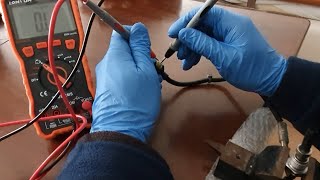
Disconnect the sensor and use a multimeter set to Ohms (Ω) to measure resistance across the pins. Compare the reading to manufacturer specifications. An open circuit (infinite resistance) or a short (near-zero resistance) confirms a bad sensor.
Tools: Digital Multimeter, Vehicle Service Manual (Advanced) - Test Circuit Voltage and Ground
Disconnect the sensor and turn the key to 'On' (engine off). On the harness-side connector, use a multimeter to verify a 5-volt reference signal. Check the ground pin for continuity to the chassis (under 1 Ω). No voltage or bad ground points to a wiring or PCM issue.
Tools: Digital Multimeter, Vehicle Service Manual (Advanced) - Inspect for Exhaust Leaks
With the engine cold, start it and feel for puffing sounds or air leaks from the exhaust manifold, gaskets, and the pipe leading to the catalytic converter. A leak before the sensor causes false readings.
Tools: None (or Smoke Machine) (Intermediate) - Validate Sensor Voltage Signal
With the sensor connected and the engine running, back-probe the sensor's signal wire. A healthy sensor produces a variable voltage between 0.5V (cold) and 4.5V (hot). A stuck voltage confirms a circuit fault. Stop DIY testing and take the vehicle to a shop if you lack back-probing tools.
Tools: Digital Multimeter or Oscilloscope, Back-probe Pins (Advanced) - Check for Technical Service Bulletins (TSBs)
Before replacing the PCM, check with a dealer or online for any TSBs related to P0425 for your specific vehicle. Manufacturers sometimes release software updates to fix overly sensitive diagnostic triggers.
Tools: Online Access or Dealer Inquiry (Intermediate)
When This Code Triggers (Freeze-Frame Conditions)
- Engine Coolant Temp: 170-230°F (Engine at full operating temperature.)
- RPM: 1500-2500 (Steady cruise or light acceleration.)
- Engine Load: 20-40% (Maintained part-throttle, not idle or wide-open throttle.)
- Vehicle Speed: 40-60 mph (Steady highway or arterial road speed.)
Related Codes
- P0426 — P0426 means 'Catalyst Temperature Sensor Range/Performance.' While P0425 points to a hard electrical fault (open, short), P0426 indicates the sensor's signal is electrically valid but not behaving as expected, often due to a lazy sensor or exhaust leak.
- P0420 — P0420 means 'Catalyst System Efficiency Below Threshold.' This is a performance code, not an electrical one. If you have both codes, fix P0425 first, as a bad temperature reading prevents the PCM from accurately testing catalyst efficiency.
- P0427 / P0428 — These are specific circuit faults. P0427 means 'Circuit Low Input' (short to ground). P0428 means 'Circuit High Input' (open circuit or short to voltage). P0425 is the general circuit malfunction code encompassing these possibilities.
- P0137 — This code is for 'O2 Sensor Circuit Low Voltage (Bank 1 Sensor 2).' The downstream O2 sensor and catalyst temperature sensor are located near each other. A wiring harness damaged by heat or road debris affects both circuits simultaneously.
Climate & Environmental Factors
- Cold Climates with Road Salt: Road salt creates a potent electrolyte that dramatically accelerates undercarriage corrosion. This rust attacks the sensor body and electrical wiring, leading to shorts and open circuits that trigger P0425.
- High Humidity: Constant moisture hastens corrosion on compromised wiring insulation. It seeps into unsealed connectors, causing poor connections and erratic signals.
- Short-Trip Driving in Cold Weather: Frequent short trips prevent the exhaust system from reaching temperatures high enough to evaporate condensation. This trapped moisture rusts the exhaust pipes and sensor from the inside out.
How to Talk to a Mechanic About This Code
Say this: "I have a P0425 code for the Catalyst Temperature Sensor Circuit on my [Year, Make, Model]. I'd like to schedule a diagnostic to test the sensor, its wiring, and check for exhaust leaks before assuming any parts need to be replaced."
This signals that you understand P0425 is an electrical code, not a converter failure code. It directs the mechanic to perform a proper diagnosis of the most likely, and cheapest, failure points first (wiring/sensor) rather than immediately quoting an expensive catalytic converter.
Avoid saying:
- 'My check engine light is on, can you look at it?' (This is too vague and invites a broad, expensive diagnosis).
- 'I think I need a new catalytic converter.' (This leads a dishonest shop to sell you an expensive part you don't need).
- 'Just fix whatever is wrong.' (This gives the shop a blank check to replace parts without your approval).
Questions to ask before authorizing the repair:
- Did you test the sensor's resistance and check for 5-volt reference and ground at the connector?
- If you are recommending a sensor replacement, can you show me the failed test result (e.g., open circuit, out-of-spec resistance)?
- If you are recommending a catalytic converter, can you show me the data (like from a 5-gas analyzer or O2 sensor readings) that proves it has failed internally?
- What is the warranty on the parts and labor for this specific repair?
Where to Take It: Dealer vs Independent vs Chain
- Dealer:
Best for: Vehicles still under an emissions or powertrain warranty., Complex, manufacturer-specific electrical issues, especially on German brands., Checking for exclusive TSBs or software updates.
Downsides: Highest labor rates, often $150-$250 per hour., More likely to recommend replacing an entire assembly rather than repairing a specific wire or component. (Typical cost: +50% vs. baseline) - Independent Shop:
Best fit for most cases. An experienced independent technician efficiently diagnoses the wiring, sensor, or exhaust leak causing P0425 without the high overhead of a dealership. Ensure the shop is well-regarded for electrical diagnostics.
Best for: Out-of-warranty vehicles where cost is a factor., Diagnosing common electrical and emissions codes like P0425., Building a long-term relationship with a trusted mechanic.
Downsides: Quality and expertise vary widely; look for ASE certification or specialization in emissions/electrical work., May not have access to the very latest manufacturer-specific software updates. (Typical cost: +0% vs. baseline) - Chain Shop:
Use with caution. Acceptable for a straightforward sensor replacement if you have already diagnosed the problem yourself. AVOID for initial diagnosis of any check engine light, as they lack diagnostic depth and frequently recommend unnecessary, high-profit repairs.
Best for: Simple, routine maintenance like oil changes or tire rotations.
Downsides: Technician skill varies dramatically from one location to another., High pressure to upsell services and parts, which leads to misdiagnosis of a P0425 as a more expensive problem. (Typical cost: -10% vs. baseline)
When to Walk Away From the Repair
If the estimated repair cost exceeds 40-50% of your car's private-party value (check Kelley Blue Book or Edmunds), it is time to seriously consider selling or trading it in.
- Car worth $4000, fix is $2000: Borderline. The repair is 50% of the car's value. Get a second opinion before proceeding, as another major repair could be right around the corner.
- Car worth $12000, fix is $1800: Fix it. The repair cost is only 15% of the vehicle's value, which is well below the threshold.
- Car worth $2500, fix is $1500: Walk away. The repair is 60% of the car's value. It is not economically sensible to invest this much into an aging vehicle.
What Scan Tool You Need for This Code

Minimum: A scanner that reads live sensor data and accesses Mode 06 test results.
A basic $20 code reader only shows the P0425 code. It cannot show live temperature data to verify sensor function, nor can it view Mode 06 data to check emissions monitors. Without this data, you are just guessing at the cause.
Budget: BlueDriver Pro (~$100) — Connects to your smartphone via Bluetooth. It graphs live data, allowing you to watch the catalyst temperature sensor's readings as the engine warms up. It also provides access to Mode 06 data and suggests possible repairs based on the code.
Mid-range: Foxwell NT510 Elite (~$180) — A powerful handheld scanner offering OE-level diagnostics for a specific car brand. It provides robust live data, graphing, and access to Mode 06. Crucially, it offers bidirectional control, allowing you to command components to test their function directly, which is very useful for electrical diagnosis.
Professional: Autel MaxiCOM MK808S (~$450) — A professional-level tablet scanner providing full bidirectional control, extensive live data, and all-system diagnostics. It is fast, covers a huge range of vehicles, and offers advanced service functions, making it a top choice for serious DIYers or small shops needing deep diagnostic capabilities.
Rent vs buy: If this is a one-time repair, many AutoZone locations lend you an OBD-II scanner for free with a refundable deposit. This is a great way to read the code and get initial data. However, if you plan on doing your own car maintenance more than once a year, buying a quality scanner is a worthwhile investment.
How to Clear the Code After You Fix It
- Use an OBD-II scan tool to clear the P0425 code.
- Perform a complete drive cycle to allow readiness monitors to run.
- Do not disconnect the battery, as this resets all monitors to 'incomplete'.
Drive cycle (~30 minutes): Start with a cold engine (sit overnight). Idle for 2-5 minutes. Drive at a steady 55 mph for 5-10 minutes. Decelerate without using the brakes (coast) to 20 mph. Repeat steady driving and coasting. Perform some stop-and-go city driving.
Readiness monitors affected: Catalyst monitor, Oxygen (O2) sensor monitor
Before emissions retest: drive at least 50 miles to fully set monitors.
Watch out for:
- Disconnecting the battery clears the code but erases all readiness monitor data, guaranteeing an emissions test failure until a full drive cycle is completed.
- The code returns immediately if the underlying electrical fault (bad sensor or wiring) was not properly fixed.
Will This Fail Emissions / State Inspection?
Yes — this code typically fails an OBD-II emissions inspection.
- California: A P0425 code is an automatic failure. All readiness monitors must be 'Ready' for the test to proceed. You must complete a full drive cycle after repairs.
- New York: The NYS DMV inspection includes an OBD-II scan. An active P0425 code causes an immediate failure. Readiness monitors must also be set.
- Texas: As of 2025, safety inspections are no longer required for non-commercial vehicles, but an emissions test is still required in 17 counties. A P0425 code causes a failure in these counties.
Most Commonly Affected Vehicles
- Subaru Outback, Forester, Impreza, Legacy (2005-2012) — Highly prone to exhaust leaks at the manifold or flange gaskets, which triggers catalyst codes. Always inspect the gasket between the manifold and the front pipe before replacing sensors.
- Ford F-Series, E-Series (with Power Stroke diesel) (2008-2016) — Diesel exhaust gas temperature (EGT) sensors are a very common failure item. P0425 typically refers to the sensor just before the catalytic converter. The wiring is also prone to melting.
- Ram 2500/3500 (with Cummins diesel) (2007-2018) — EGT sensor failure is a frequent problem due to extreme heat and soot. The wiring harness routed near the turbo and exhaust is a common point of failure.
- Chevrolet / GMC Silverado/Sierra HD (with Duramax diesel) (2007-2016) — The Duramax engines use several EGT sensors for DPF regeneration. These sensors are a frequent failure point and a common cause for catalyst temperature codes.
- Volkswagen Jetta, Golf, Passat (with TDI diesel engines) (2009-2015) — The EGT sensors on TDI models are a known weak point. A P0425 code is a strong indicator that one of the EGT sensors has failed internally.
- BMW 335d, X5 xDrive35d (2009-2013) — Diesel BMWs suffer from EGT sensor failures. Another known issue is the sensor becoming physically loose in its bung, creating a small exhaust leak that causes irrational readings.
- Nissan Titan, Frontier, Xterra (2005-2015) — These models are notorious for premature failure of the catalytic converters. Sensor-related codes like P0425 appear as the converter starts to fail and produce extreme temperatures.
- Mercedes-Benz Sprinter, E-Class, ML-Class (with BlueTEC diesel) (2007-2016) — BlueTEC diesel engines utilize a complex exhaust aftertreatment system with multiple temperature sensors prone to failure, triggering codes like P0425 and P0426.
Manufacturer-Specific Notes
- Subaru: Subaru extended the warranty on the front exhaust pipe for some 2017-2018 Forester models to 15 years/150,000 miles due to cracking (TSB WI22-013). An exhaust leak from this crack causes various sensor codes.
- General Motors (GM): GM issued numerous technical service bulletins for PCM software updates to resolve false catalyst and sensor codes (e.g., TSB 11-06-04-004B). Always check for an available re-flash before replacing expensive components.
- Dodge / Ram / Chrysler: For 2013-2018 Ram 2500/3500 trucks with the 6.7L Cummins, recall 67A provides a free software update and a 'Special Extended Warranty' on many emissions parts, including temperature sensors.
- Ford (Diesel): Ford issued recall 14E03 for 2011-2014 Power Stroke trucks to update software to prevent EGT sensor failures from stranding drivers. A scan tool that reads all sensor PIDs is crucial for correct diagnosis on these engines.
Real Owner Stories
2013 Ram 2500 Cummins at 115K miles
Check engine light with P0425 appeared. Truck ran normally, no noticeable performance issues.
What they tried:
- Initial thought was a bad EGT sensor, a common issue.
- Upon inspection, found the wiring harness for the sensor was resting against a hot exhaust pipe.
- The insulation was melted, causing the wires to short out.
Outcome: Repaired the damaged section of the wiring harness using heat-shrink butt connectors and re-routed the harness away from the pipe using high-temp zip ties. Total cost was under $20 for materials. The code was cleared and did not return.
Lesson: Always perform a thorough visual inspection of the wiring harness before replacing the sensor itself. A $20 wiring repair saves you from buying a $150+ sensor you don't need.
2010 Subaru Forester at 140K miles
P0425 code appeared along with a slight hesitation during acceleration and a 2-3 MPG drop in fuel economy.
What they tried:
- Replaced the catalyst temperature sensor (Bank 1), but the code returned within a day.
- Replaced the upstream O2 sensor, but the code persisted.
- Took it to a shop that used a smoke machine to check for leaks.
Outcome: A significant exhaust leak was found at the gasket between the exhaust manifold and the front pipe. Replacing the gasket (a $30 part) and clearing the codes permanently resolved the issue. Performance and MPG returned to normal.
Lesson: On vehicles known for exhaust leaks like Subarus, this should be one of the first checks. Misdiagnosing the issue led to spending over $300 on unneeded sensors before finding the simple, underlying cause.
2012 VW Jetta TDI at 85K miles
Car suddenly went into 'limp mode' with the CEL and glow plug light flashing. Scanner showed P0425.
What they tried:
- The owner suspected an EGT sensor failure, which is a known weak point on TDI models.
- Tested the sensor's resistance with a multimeter and found it was an open circuit (infinite resistance), confirming internal failure.
Outcome: Replaced the EGT sensor (Bank 1, Sensor 1). The replacement was straightforward, involving unscrewing the old sensor and plugging in the new one. After clearing the code, the car exited limp mode and ran perfectly. The fix cost about $120 for an OEM-quality sensor.
Lesson: A simple resistance test with a multimeter definitively confirms a bad sensor, preventing guesswork. For many diesel vehicles, EGT sensor failure is a primary and common cause for this code.
How to Prevent This Code From Triggering
- Use Top Tier certified gasoline (Every fill-up) — Higher levels of detergents in Top Tier fuel prevent carbon deposits on fuel injectors and valves. This ensures more complete combustion, reducing the amount of unburnt fuel and soot that fouls sensors and overloads the catalytic converter.
- Perform regular engine maintenance (spark plugs, air filter) (Per manufacturer's schedule (e.g., spark plugs every 60-100k miles)) — Worn spark plugs or a clogged air filter lead to engine misfires and a rich air-fuel mixture. This dumps raw fuel into the exhaust, which overheats and damages the EGT sensor and the catalytic converter itself.
- Address engine misfires or oil leaks immediately (As needed) — Misfires destroy catalytic converters. Similarly, engine oil leaking into the exhaust (e.g., from bad valve seals) contaminates and poisons the catalyst and fouls sensors, leading to failure.
- Apply dielectric grease to sensor connectors (When replacing a sensor or during other undercar service) — Applying a small amount of dielectric grease to the electrical connector's seals blocks moisture and prevents the corrosion that causes many circuit-related codes like P0425.
- Ensure periodic highway driving (At least once a month) — Sustained highway driving allows the exhaust system to reach and maintain optimal operating temperature, which burns off condensation and carbon deposits that accumulate during short-trip driving.
Frequently Asked Questions
What is the most common mistake when diagnosing P0425?
The biggest mistake is replacing the catalytic converter without proper diagnosis. P0425 is an electrical circuit code, so the fault usually lies with the sensor, wiring, or connectors. Always test the sensor and wiring before assuming the expensive converter has failed.
What does 'Bank 1 Sensor 1' mean?
Bank 1 refers to the side of the engine housing cylinder #1. 'Sensor 1' is the first temperature sensor in the exhaust stream for that bank, typically located before the catalytic converter. You will need a service manual diagram to identify Bank 1 on V-type engines.
Can a bad battery cause a P0425 code?
Yes, a weak or failing battery causes low system voltage, leading to erratic sensor behavior. This sometimes results in false trouble codes being stored in the PCM. Test your battery and charging system if you have experienced recent starting issues.
Can I clean a catalyst temperature sensor?
No, cleaning is not an effective solution. The failure is typically an internal electrical fault within the sensor's thermistor or thermocouple. If multimeter testing confirms the sensor is faulty, it must be replaced.
Will a catalytic converter cleaner additive fix P0425?
No, fuel additives cannot fix a P0425 code. This code indicates an electrical circuit problem, such as a broken wire or failed sensor. Additives only clean internal deposits and cannot repair physical electrical damage.
Is the catalyst temperature sensor the same as an O2 sensor?
No, they are different components with distinct functions. A temperature sensor measures exhaust heat, while an oxygen sensor measures unburned oxygen levels. Both provide critical data to the PCM, but they are not interchangeable.
How much does it cost to fix a P0425 code?
A simple wiring repair costs $150 to $300 at a shop. Replacing the sensor itself typically costs between $180 and $450 for parts and labor, though diesel EGT sensors can exceed $600. A PCM replacement is the most expensive fix, often exceeding $1,000.
Key Takeaways
- Test the sensor and wiring with a multimeter before replacing the catalytic converter, as P0425 is an electrical circuit code that rarely requires a $1,000+ converter replacement.
- Inspect the exhaust gas temperature (EGT) sensor first on diesel trucks (Ford, Ram, GM) and VW TDIs, as it is the primary failure point for this code.
- Look for burnt wires, corroded connectors, and exhaust leaks near the Bank 1 sensor, which account for the majority of P0425 triggers and cost under $50 in parts to fix.
- Check for manufacturer Technical Service Bulletins (TSBs) or warranty extensions, such as Ram's 67A recall, which provide free software updates or sensor replacements.
Helpful Videos

The information in this article is provided for general reference and educational purposes only. Vehicle specifications, procedures, and part compatibility can vary by production date, trim level, and region. Always consult your vehicle's factory service manual and verify part numbers before purchasing or performing repairs. Safety-critical components such as airbags, seat belts, and braking systems should be installed by a qualified professional.
- 🎬 Helpful Videos
- What Does P0425 Mean?
- Can I Drive With P0425?
- Common Causes
- Symptoms
- Diagnostic Flowchart
- Common Fixes & Costs
- DIY vs Professional
- Used vs. New Parts: Buying Guide
- What Happens If You Wait — Timeline
- Cost of Not Fixing It
- Diagnosis Steps
- When This Code Triggers (Freeze-Frame Conditions)
- Related Codes
- Climate & Environmental Factors
- How to Talk to a Mechanic About This Code
- Where to Take It: Dealer vs Independent vs Chain
- When to Walk Away From the Repair
- What Scan Tool You Need for This Code
- How to Clear the Code After You Fix It
- Will This Fail Emissions / State Inspection?
- Most Commonly Affected Vehicles
- Manufacturer-Specific Notes
- Real Owner Stories
- 2013 Ram 2500 Cummins at 115K miles
- 2010 Subaru Forester at 140K miles
- 2012 VW Jetta TDI at 85K miles
- How to Prevent This Code From Triggering
- Frequently Asked Questions
- What is the most common mistake when diagnosing P0425?
- What does 'Bank 1 Sensor 1' mean?
- Can a bad battery cause a P0425 code?
- Can I clean a catalyst temperature sensor?
- Will a catalytic converter cleaner additive fix P0425?
- Is the catalyst temperature sensor the same as an O2 sensor?
- How much does it cost to fix a P0425 code?
- Key Takeaways
- 🎟️ Get 5% Off