

OBD-II Code P0424: Heated Catalyst Temperature Below Threshold
The Ultimate Guide to What P0424 Means, Why It Triggers, and How to Fix It for Good
- Code P0424 indicates the Bank 1 catalytic converter fails to reach its 482°F (250°C) minimum operating temperature within the ECM's required timeframe.
- Do not replace the $1,500+ catalytic converter first; the root cause is almost always a faulty $100 Exhaust Gas Temperature (EGT) sensor or melted wiring.
- Diagnose the issue by monitoring the 'Heated Catalyst Temp' live data PID from a cold start to verify if the temperature steadily rises above 482°F within 3 minutes.
- Driving with an active P0424 code drops fuel economy by 2-4 MPG and guarantees an automatic failure during state OBD-II emissions inspections.
What Does P0424 Mean?

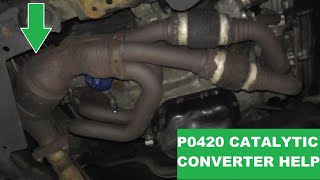
Code P0424 means the Engine Control Module (ECM) detects the catalytic converter on engine bank 1 is not reaching its required operating temperature within a specified time. Catalytic converters must reach high temperatures (over 1,200°F/650°C on diesels) to convert harmful exhaust gases. When too cold, the converter cannot perform this chemical conversion, which increases pollution, reduces fuel economy, and degrades engine performance. This code primarily affects diesel vehicles 🎬 Watch: How to fix P0424 on diesel emissions systems with complex emissions systems.
Technical definition: The SAE/OBD-II definition is "Heated Catalyst Temperature Below Threshold (Bank 1)". This indicates the three-way catalytic converter is not reaching its minimum 'light-off' temperature—typically 250°C–300°C (482°F–572°F)—to start its chemical reaction efficiently. The ECM uses dedicated Exhaust Gas Temperature (EGT) sensors on diesels or compares upstream and downstream oxygen sensors on gas engines to determine this. The fault points specifically to a failure in the catalyst's heating-up phase.
Can I Drive With P0424?
Yes, But With Caution. You can drive for a short period, but continuous driving (over 100 miles) with an unheated catalyst causes higher emissions, poor fuel economy, and engine performance issues. Ignoring the code guarantees an emissions test failure and risks eventual catalytic converter contamination, a repair costing over $2,000.
Common Causes

- Faulty Exhaust Gas Temperature (EGT) Sensor (Very Common) — On diesel trucks, this is the primary cause. EGT sensors provide direct temperature feedback to the ECM. If a sensor is faulty, 'lazy,' or provides an inaccurate reading, the ECM incorrectly believes the catalyst is cold and triggers the code.
- Wiring, Connectors, and Ground Issues (Very Common) — Heater and sensor circuits use high-current wires routed near extremely hot exhaust components. Melted insulation, corroded connectors, broken strands, or a loose ground connection prevent the heater or sensors from functioning correctly.
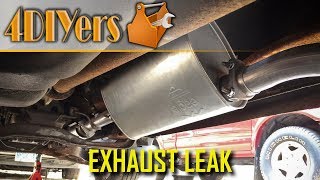
- Exhaust System Leak (Common) — A leak in the exhaust manifold, gaskets, or flex pipe located before the catalytic converter introduces outside oxygen. 🎬 See this guide on how to easily find exhaust leaks This skews sensor readings and cools the exhaust gases, preventing the converter from reaching its target temperature.
- Faulty Oxygen (O2) Sensor (Common) — On gasoline engines, a faulty or 'lazy' rear O2 sensor sends incorrect voltage readings to the computer, making it think the converter is not working efficiently or heating properly.
- Faulty Catalyst Heater Circuit or Element (Common) — On vehicles with an actively heated catalyst, the electric heater element embedded in the converter burns out. The circuit that controls it, including relays or a driver transistor within the ECM, also fails, preventing the heater from turning on.
- Low or Contaminated Diesel Exhaust Fluid (DEF) (Less Common) — On diesel vehicles, the DEF system injects fluid to help the catalyst process NOx gases at high temperatures. If the DEF tank is empty, the fluid is contaminated, or the injector is clogged, the chemical reaction fails, affecting temperature.
- Engine Misfires or Rich/Lean Fuel Mixture (Less Common) — Unburned fuel from engine misfires enters the exhaust and damages the catalytic converter's internal structure over time. An incorrect air-fuel mixture causes the converter to operate outside its normal temperature range.
- Faulty Engine Control Module (ECM) or Software (Rare) — The vehicle's main computer experiences a software glitch or internal failure, causing it to misinterpret sensor data and incorrectly report a P0424 code. Consider this only after exhausting all other possibilities.
Symptoms
- Check Engine Light is On — This is often the only symptom. The light flashes during the first few minutes of operation when the heating failure is detected, then becomes solid.
- Failed Emissions Test — With an active P0424 code, your vehicle automatically fails an OBD-II emissions test, preventing legal registration.
- Reduced Fuel Economy — Your vehicle uses noticeably more fuel, dropping by 2-4 MPG, as the engine management system adjusts to compensate for the emissions system failure.
- Sluggish Engine Performance or Hesitation — The ECM limits engine power or throttle response to protect the catalyst, resulting in hesitation during acceleration or reduced power, especially when towing.
- Black Smoke or Rotten Egg Smell from Exhaust — On diesel vehicles, black smoke from the tailpipe indicates inefficient combustion. A sulfur or 'rotten egg' smell occurs if the converter is not processing gases correctly.
Diagnostic Flowchart
Tap your situation to follow the diagnostic path that matches what you're seeing on this code.
Common Fixes & Costs
- Replace Exhaust Gas Temperature (EGT) Sensor
— Parts: $80-$250, Labor: $100-$200, ~1 hr book time
(DIY)
Ford F-Series Powerstroke: OEM
Chevrolet/GMC Duramax: OEM
Ram Cummins: OEM - Repair Wiring or Connectors — Parts: $10-$50, Labor: $150-$400, ~2 hr book time (Intermediate)
- Repair Exhaust Leak — Parts: $20-$150, Labor: $100-$300, ~1.5 hr book time (Intermediate)
- Replace Oxygen (O2) Sensor
— Parts: $50-$200, Labor: $100-$250, ~0.8 hr book time
(DIY)
Subaru Outback/Forester (Downstream): OEM
Jeep Wrangler 3.6L (Downstream): OEM
Toyota Camry (Downstream): OEM - Replace Catalytic Converter
— Parts: $600-$2,500+, Labor: $200-$500, ~2.5 hr book time
(Professional)
Ford F-250 Powerstroke (SCR Assembly): OEM
Subaru Outback (Manifold Converter): OEM
Jeep Wrangler 3.6L (Bank 1): OEM - Reprogram or Replace ECM — Parts: $0-$900, Labor: $150-$400, ~1.5 hr book time (Professional)
DIY vs Professional
- Replace EGT/Oxygen Sensor — Beginner: Yes
Tools: Basic hand tools, penetrating oil, and a specialized oxygen sensor socket or flare nut wrench. - Repair Wiring or Connectors — Beginner: No
Tools: Digital multimeter, wiring diagrams, wire strippers, crimpers, heat shrink tubing, and a soldering iron. - Repair Exhaust Leak — Beginner: Maybe
Tools: Basic wrenches and sockets for gaskets. A cracked manifold or flex pipe repair requires a welder or specialized cutting tools. - Replace Catalytic Converter — Beginner: No
Tools: Vehicle lift or jack stands, heavy-duty impact wrenches, sockets, pry bars, and a torch to heat seized bolts.
Used vs. New Parts: Buying Guide
When a used part is worth it: For expensive catalytic converters on older, high-mileage vehicles, a used part from a low-mileage donor is a cost-effective option. Check local laws, as selling used catalytic converters is illegal in some states. Used EGT or O2 sensors are never recommended.
Donor-vehicle mileage cap: roughly under 80000 miles for the part to have meaningful remaining life.
Donor quality checklist:
- Verify the donor vehicle was not scrapped due to engine or emissions failure.
- Avoid parts from regions with heavy road salt use ('rust-belt') as corrosion compromises the housing.
- Match the part number exactly; visual similarity is not enough.
Decision logic:
- If Vehicle is under 80,000 miles → Check if the part is covered under the Federal Emissions Warranty before buying anything.
- If The cost of a new aftermarket part is under $500 → Buy new. The savings from a used part are minimal compared to the risk of premature failure.
- If Vehicle is over 150,000 miles and the OEM part is over $1,500 → A verified low-mileage used OEM part is a reasonable choice, but expect a shorter lifespan.
Warranty tradeoff: Used parts typically offer a 30-90 day warranty. New aftermarket parts come with a 1-5 year warranty. New OEM parts carry a 12-month/12,000-mile warranty.
Worst-case if a used part fails: $400-$1500 if a used catalytic converter fails after installation, covering repeat labor costs and sourcing another part.
What Happens If You Wait — Timeline
- 0-2 weeks: Code P0424 sets, and the Check Engine Light turns on. The light flashes briefly on startup then remains solid. No other symptoms are noticed. (MPG impact: 0-3%% · Added cost: $0)
- 2 weeks - 3 months: A noticeable drop in fuel economy of 2-4 MPG occurs. The vehicle fails OBD-II emissions tests. Sluggishness is felt during acceleration. (MPG impact: 5-10%% · Added cost: $50-$150 in wasted fuel)
- 3-8 months: Sustained operation with an unheated catalyst causes the internal substrate to become contaminated or crack. Downstream O2 sensors are damaged. (MPG impact: 10-15%% · Added cost: $1,200-$2,800 (Catalytic converter and O2 sensor replacement required).)
- 8+ months: The catalytic converter's internal honeycomb melts, creating a severe exhaust blockage. This causes extreme backpressure, leading to catastrophic engine damage. (MPG impact: 20-50%+% · Added cost: $3,000-$7,000+ (Converter replacement plus engine repairs).)
Cost of Not Fixing It
- 0-1 month: Failed emissions test and a noticeable drop in fuel economy (2-4 MPG). No immediate risk of mechanical damage. (Added cost: Negligible, other than increased fuel costs.)
- 1-6 months: Continued operation with a faulty heating system causes the catalyst substrate to become contaminated or 'poisoned' by unburnt fuel, leading to permanent failure. This damages downstream oxygen sensors. (Added cost: $1,200-$2,800 for catalytic converter and O2 sensor replacement.)
- 6+ months: A severely clogged or melted catalytic converter creates excessive exhaust backpressure. This leads to serious engine damage, including burnt exhaust valves, damaged pistons, or turbocharger failure. (Added cost: $3,000-$7,000+ for catalytic converter and engine or turbo repairs.)
Diagnosis Steps

- Scan for All Trouble Codes
Use an OBD-II scanner to confirm the P0424 code. Document and investigate any other codes present, such as misfires (P030x), oxygen sensors (P0135-P0161), fuel trim (P0171, P0174), or EGT sensors. Fix these other codes first, as they are usually the root cause.
Tools: OBD-II Scanner (Beginner) - Perform a Thorough Visual Inspection
Inspect the entire exhaust system for cracks, rust, or broken gaskets at the manifold and flex pipe. On diesel trucks, check the DEF fluid level and visually inspect the EGT sensor wiring harnesses for melting or chafing near hot exhaust pipes.
Tools: Flashlight, Safety Glasses (Beginner) - PRO TIP: Analyze Live Data for Temperature Rise
From a cold start, use a scanner with live data to monitor the 'Heated Catalyst Temperature Bank 1' PID. The temperature must rise steadily above 250°C (482°F) within 2-3 minutes. If it doesn't, or if the reading is erratic (e.g., stuck at -40°F), the EGT sensor or circuit is faulty.
Tools: OBD-II Scanner with Live Data (Intermediate) - Check Catalyst Temperature Manually
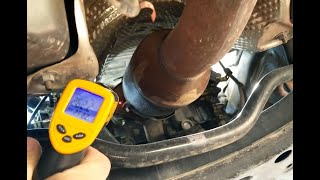
After the engine fully warms up (15-20 minutes), use an infrared thermometer to measure the exhaust pipe temperature just before and just after the catalytic converter. The outlet pipe must be at least 50-100°F (28-56°C) hotter than the inlet. If temperatures are identical, the chemical reaction is failing.
Tools: Infrared Thermometer (Intermediate) - Test EGT Sensor Resistance (Diesel)
Disconnect the EGT sensor and measure its internal resistance with a multimeter. For a typical PTC-type sensor, resistance is around 200-250 Ohms at room temperature (70°F/21°C). A reading of infinity (open circuit) or near-zero (short circuit) indicates a failed sensor.
Tools: Digital Multimeter, Vehicle-Specific Repair Manual (Advanced) - Test Sensor Circuit Voltage Reference
With the sensor unplugged and the key in the 'On' position (engine off), use a multimeter to check for a 5.0 Volt reference voltage at the sensor's electrical connector. No voltage points to a wiring or ECM problem.
Tools: Digital Multimeter, Wiring Diagram (Advanced) - PRO TIP: Graph O2 Sensor Waveforms (Gasoline)
For gasoline engines, use a graphing scanner. A healthy upstream O2 sensor (Sensor 1) shows a rapidly fluctuating voltage (0.1V to 0.9V). The downstream O2 sensor (Sensor 2) shows a steady voltage (0.5V-0.8V). If the downstream sensor flatlines or shows illogical readings, it causes the P0424.
Tools: Graphing Scanner or Oscilloscope (Advanced) - Test Heater Circuit Voltage and Command
While monitoring live data, check the 'Catalyst Heater Circuit Voltage' PID. The ECM commands it on during warmup, showing 11-12V. If the command is present but voltage is low or absent, test the circuit manually for shorts or blown fuses.
Tools: OBD-II Scanner, Digital Multimeter (Advanced) - Inspect the Catalytic Converter Internally
If all components and circuits test good, unbolt the converter for a visual inspection. Look inside for a melted, clogged, or physically broken ceramic honeycomb structure to confirm catastrophic failure.
Tools: Wrenches, Safety Glasses, Pry Bar (Advanced)
When This Code Triggers (Freeze-Frame Conditions)
- Engine Coolant Temp: 170-220°F (77-104°C) (Engine is fully warmed up and operating in closed-loop fuel control.)
- RPM: 1500-2500 (Steady cruise or light acceleration, not during heavy load or deceleration.)
- Engine Load: 20-60% (The engine is working moderately, typical of maintaining speed on a level road.)
- Vehicle Speed: 40-60 mph (Sustained highway or freeway driving, which allows the catalyst monitor to run.)
Related Codes
- P0420 — P0420 means 'Catalyst System Efficiency Below Threshold.' P0424 is specific to a temperature problem (not getting hot enough), while P0420 indicates a general efficiency problem. A P0424 fault almost always leads to a P0420 fault.
- P0430 — This is the equivalent of a P0420/P0424 but for engine Bank 2. If your vehicle has a V6 or V8 engine, it has two catalytic converters. This code points to a problem on the second bank.
- P0544 - P0549 — These codes are specific to 'Exhaust Gas Temperature (EGT) Sensor Circuit' malfunctions. If present alongside P0424, the EGT sensor or its wiring is the root cause and must be diagnosed first.
- P0135 / P0155 — These codes indicate an 'O2 Sensor Heater Circuit Malfunction.' A failure here causes the O2 sensor to provide slow or inaccurate readings during engine warm-up, indirectly contributing to a catalyst code.
Climate & Environmental Factors
- Cold Climates: Extreme cold prolongs the warm-up period. If any component (like a sensor or heater) is slightly degraded, it fails to meet the ECM's required time threshold, setting the code more frequently in winter.
- Short-Trip Driving: Frequent short trips prevent the exhaust system from reaching full operating temperature. This stops the catalyst from burning off contaminants, leading to reduced efficiency and temperature-related codes.
- High Altitude: Lower air density at high altitudes affects combustion efficiency. This places additional stress on the emissions system and makes it more sensitive to borderline faults.
How to Talk to a Mechanic About This Code
Say this: "I have a P0424 code and I'd like to schedule a diagnostic. Before recommending a catalytic converter replacement, please perform a full diagnostic that includes checking for exhaust leaks, testing the exhaust gas temperature (EGT) or oxygen sensors, and inspecting the related wiring."
This signals you are an informed customer. It directs them to diagnose common, less expensive failure points (sensors, wiring, leaks) before jumping to a catalytic converter replacement.
Avoid saying:
- 'My check engine light is on, can you just fix it?' (Invites upselling).
- 'I think I need a new catalytic converter.' (Leads a dishonest shop to replace a perfectly good part).
- 'Just do whatever you think is best.' (Gives up your control over the repair process).
Questions to ask before authorizing the repair:
- Can you show me the data confirming the catalytic converter failed, such as live EGT sensor readings or O2 sensor waveforms?
- Did you find any exhaust leaks or wiring issues causing this code?
- Will you provide a written estimate breaking down parts and labor?
- What is the warranty on the proposed repair and parts?
- Can I have my old parts back after the repair is completed?
Where to Take It: Dealer vs Independent vs Chain
- Dealer:
Recommended if the vehicle is under warranty. Otherwise, a qualified independent shop is more cost-effective.
Best for: Vehicles under the 8-year/80,000-mile federal emissions warranty., Complex, brand-specific issues or when a known Technical Service Bulletin (TSB) exists., Newer vehicles with highly integrated electronic systems.
Downsides: Significantly higher labor rates and OEM part costs., Quicker to recommend replacing a whole assembly rather than repairing a smaller component. (Typical cost: +50% vs. baseline) - Independent Shop:
Best fit for most out-of-warranty vehicles. An independent shop accurately pinpoints the cause (sensor, wiring, or converter) and offers flexible repair options.
Best for: Out-of-warranty vehicles where cost is a major factor., Diagnosing common codes like P0424, as experienced technicians have seen the issue many times., Getting a second opinion on a dealership's diagnosis.
Downsides: Quality varies widely; find a shop with ASE-certified technicians specializing in emissions., Lacks access to the latest manufacturer-specific software updates. (Typical cost: +0% vs. baseline) - Chain Shop:
AVOID for diagnosing a P0424 code. They are generally not equipped for the in-depth electrical diagnosis required, increasing the risk of a misdiagnosis.
Best for: Simple, routine maintenance like oil changes or tire rotations.
Downsides: Technician skill varies dramatically, lacking advanced diagnostic equipment for complex electrical issues., Service advisors are pressured to upsell, leading to unnecessary part replacements. (Typical cost: -10% vs. baseline)
When to Walk Away From the Repair
If the estimated repair cost is more than 50% of your car's private-party value, seriously consider selling or trading it in instead of repairing it.
- Car worth $4000, fix is $2200: Walk away. The repair cost is over 50% of the car's value. It's not a sound financial decision.
- Car worth $12000, fix is $1800: Fix it. The repair cost is well below the 50% threshold and is a reasonable investment.
- Car worth $2500, fix is $1500: Walk away. The repair cost is 60% of the car's value, making it a poor investment.
What Scan Tool You Need for This Code

Minimum: A scanner that reads and clears codes, shows freeze frame data, and displays live data streams for O2 sensors and catalyst temperature.
A basic $20 code reader only gives the 'P0424' code. To properly diagnose this issue and avoid replacing expensive parts, you must see live data from the sensors to determine if they report correctly.
Budget: BlueDriver Pro (~$100) — Connects to your smartphone via Bluetooth. It reads the P0424 code, views freeze frame data, and graphs live data from EGT or O2 sensors, which is crucial for this diagnosis.
Mid-range: Foxwell NT510 Elite (~$180) — A handheld unit offering manufacturer-specific diagnostics. It provides bidirectional control, allowing you to command the catalyst heater circuit to turn on, directly testing its function.
Professional: Autel MaxiCOM MK808S (~$450) — A professional-level tablet scanner offering full system diagnostics and comprehensive bidirectional control. It allows deep analysis of all related modules and advanced live data graphing.
Rent vs buy: Auto parts stores offer free code scanning, but their tools are basic readers. To perform the necessary live data diagnosis for P0424, you must own or borrow an advanced scanner. Buy a budget or midrange pick if you plan to do your own maintenance.
How to Clear the Code After You Fix It
- Use an OBD-II scan tool to clear the P0424 code.
- Reconnect the battery if it was disconnected for the repair.
- Perform a complete drive cycle to allow the readiness monitors to run.
Drive cycle (~20 minutes): Start the engine from cold and idle for 2-3 minutes. Drive at a steady highway speed of 55 mph for 5-7 minutes. Perform mixed city driving with stop-and-go traffic for 5-10 minutes. Finally, coast (decelerate without braking) for at least 30 seconds. Repeat this cycle twice on separate days.
Readiness monitors affected: Catalyst Monitor, Oxygen Sensor Monitor, Heated Catalyst Monitor
Before emissions retest: drive at least 50 miles to fully set monitors.
Watch out for:
- Disconnecting the battery clears the code but resets all OBD-II readiness monitors, causing an immediate emissions test failure.
- The code returns within a few drive cycles if the underlying root cause was not correctly repaired.
- Short, around-town trips are insufficient to meet the specific criteria needed to run the catalyst monitor.
Will This Fail Emissions / State Inspection?
Yes — this code typically fails an OBD-II emissions inspection.
- California: A P0424 code is an automatic failure. California's BAR-OIS inspection requires all readiness monitors to be 'Ready'. After repair, a specific drive cycle must be completed, taking 100-200 miles of driving before a re-test.
- New York: The NYS DMV inspection includes an OBD-II scan. An active P0424 code causes an immediate failure. The Catalyst readiness monitor must be set to 'Ready' to pass.
- Texas: In the 17 counties requiring emissions testing, a P0424 code results in a failed inspection. Texas allows up to two readiness monitors to be 'Not Ready' for vehicles 2001 and newer, but an active check engine light is an automatic fail.
Most Commonly Affected Vehicles

- Ford F-Series Powerstroke (Diesel) (2011-2019) — Extremely common issue. Caused by failed EGT sensors (Ford has multiple part number revisions) or burnt wiring harnesses near the turbo and exhaust manifolds.
- Chevrolet / GMC Silverado/Sierra Duramax (Diesel) (2011-2019) — These trucks suffer from EGT sensor failures and wiring damage due to heat. Issues with the DEF injector crystallizing also lead to improper temperatures.
- Ram 2500/3500 Cummins (Diesel) (2011-2019) — Failures often trace back to one of the multiple EGT sensors or problems within the DEF dosing system. TSB 18-053-14 addresses software updates for related EGT codes.
- Subaru Outback, Forester, Impreza, Legacy (2011-2023) — Sensitive to catalyst issues. Excessive oil consumption from the boxer engine contaminates the converter and O2 sensors, leading to temperature and efficiency codes.
- Hyundai / Kia Tucson, Santa Fe, Sportage (2014-2019) — Subject to TSBs (e.g., 20-FL-010H) requiring an ECM software update to change monitoring logic, and sometimes replacement of the manifold catalytic converter due to premature failure.
- Jeep / Chrysler / Dodge Wrangler, Grand Cherokee, 300 (3.6L Pentastar) (2012-2018) — An extended warranty (X56) was issued for the driver's side cylinder head on 2011-2013 models; misfires from this issue destroy the converter, leading to temperature codes.
- Volkswagen Jetta, Passat, Golf (Gasoline & TDI) (2002-2015) — On TDI models, this relates to the DPF/SCR system. On gasoline models, diagnosis points to exhaust leaks at the flex pipe or failed O2 sensors before condemning the converter.
- Toyota / Lexus Camry, Corolla, RAV4, ES350, RX350 (2005-2019) — Known for highly sensitive catalyst monitors. The root cause is often a small exhaust leak or a failing oxygen sensor. Using OEM sensors for replacement is mandatory.
Manufacturer-Specific Notes
- Diesel Trucks (Ford, GM, Ram): This code is almost exclusively found on diesel vehicles. The cause is overwhelmingly related to the diesel emissions system: failed EGT sensors, burnt wiring near the exhaust, or DEF injection system issues.
- General Motors (GM): TSB 16-NA-111 notes a poorly sealed air filter box allows dirt to bypass the filter, 'sandblasting' and damaging downstream O2 sensors and the catalytic converter.
- Ford: TSB 22-2260 exists for 2018-2021 F-150 and Expedition models showing catalyst codes due to high sulfur fuel. The fix is a specific de-sulfation procedure performed with a scan tool before replacing parts.
- Subaru: Excessive oil consumption on 2011-2018 models fouls the O2 sensors and contaminates the catalytic converter. Check for oil consumption before replacing the converter.
- Jeep / Chrysler / Dodge: Chrysler extended the warranty on the left cylinder head for 2011-2013 3.6L Pentastar vehicles to 10 years/150,000 miles (campaign X56). A failure of this head causes misfires that destroy the catalytic converter.
Real Owner Stories
2013 Subaru Outback at 130K miles with P0420 (related efficiency code)
Check Engine Light came on intermittently for a year, then became permanent. No other symptoms were present.
What they tried:
- A local shop diagnosed a bad upstream O2 sensor; owner replaced it with an OEM part, but the code returned.
- Following advice from a dealer, the owner replaced the downstream O2 sensor.
Outcome: Replacing the downstream O2 sensor resolved the issue, and the code did not return.
Lesson: For catalyst codes, do not assume the converter is bad. A faulty downstream O2 sensor is a common misdiagnosis culprit, even if shops point to the upstream sensor first.
2015 Ford F-350 Powerstroke at 110K miles
P0424 code appeared along with sluggish performance, especially when towing. No other codes were present.
What they tried:
- Owner checked DEF fluid level, which was full.
- A visual inspection revealed a section of the EGT sensor wiring harness melted from contact with the exhaust pipe.
Outcome: Owner repaired the damaged wires using a pigtail connector kit ($35). After clearing the codes, P0424 did not return and engine power was restored.
Lesson: On diesel trucks, meticulously inspect sensor wiring harnesses near the exhaust. Heat-related wiring failure is a very common cause for P0424 and is a much cheaper fix than replacing sensors or the catalyst.
2012 Chevy Cruze at 85K miles
P0424 code triggered, but the only symptom was the Check Engine Light. The car drove normally.
What they tried:
- A mechanic quoted $2,200 for a new catalytic converter.
- Owner sought a second opinion. The second mechanic found a Technical Service Bulletin (TSB) related to ECM software logic for catalyst monitoring.
- The mechanic flashed the ECM with updated software.
Outcome: The ECM reprogram (~$150) fixed the issue. The catalytic converter was not faulty.
Lesson: Always ask the repair shop to check for relevant TSBs before agreeing to a major repair. A simple software update resolves the problem for a fraction of the cost.
How to Prevent This Code From Triggering
- Use Top-Tier Certified Gasoline (Every fill-up) — Top-Tier fuels contain enhanced detergents that prevent carbon deposit buildup. This ensures complete combustion, reducing unburned fuel that overheats the catalytic converter.
- Replace Oxygen Sensors Proactively (Every 100,000 miles) — O2 sensors become 'lazy' with age. A sluggish sensor causes the engine to run too rich, which overheats and poisons the catalyst substrate.
- Address Engine Misfires Immediately (As soon as a flashing Check Engine Light appears) — A misfire sends raw fuel directly into the exhaust. This fuel ignites inside the catalytic converter, melting the ceramic honeycomb and causing catastrophic failure.
- Perform Regular Oil Changes with Quality Oil (Per manufacturer's schedule (e.g., 5,000-7,500 miles)) — Old oil leads to increased oil consumption. Phosphorus and zinc additives in engine oil coat the precious metals in the converter, rendering them ineffective.
- Avoid Short-Trip Driving When Possible (Daily habit) — Frequent short trips prevent the exhaust system from reaching full operating temperature, allowing moisture and acidic byproducts to accumulate and corrode components.
Frequently Asked Questions
What is the most common misdiagnosis for a P0424 code?
The most common and expensive mistake is immediately replacing the catalytic converter. The code points to a temperature issue, which is far more likely a faulty EGT sensor, damaged wiring, or a failed heater circuit. Always test sensors and wiring before condemning the converter.
What is the difference between code P0424 and P0420?
P0424 means the catalyst is not getting hot enough during the warm-up phase. P0420 is a general efficiency code meaning the converter is not cleaning the exhaust properly once hot. A P0424 fault causes a P0420 fault, but not vice versa.
Can low DEF fluid cause a P0424 code?
Yes, on diesel vehicles. Diesel Exhaust Fluid (DEF) is required for the chemical reaction in the SCR catalyst. If the fluid is low or contaminated, the catalyst cannot maintain its proper operating temperature, triggering the code.
What is an EGT sensor and how does it relate to P0424?
An EGT (Exhaust Gas Temperature) sensor measures the heat of the exhaust gas. Diesel emissions systems use them to monitor catalyst function. P0424 triggers when the Bank 1 EGT sensor reports the catalyst is not heating up fast enough.
Will a catalytic converter cleaner fix a P0424 code?
No. Cleaners remove carbon deposits to help with borderline efficiency codes (P0420). P0424 is an electrical or temperature-sensing fault caused by a failed sensor, wiring, or heater element that liquid additives cannot repair.
Is the catalytic converter covered under warranty?
Yes, the Federal Emissions Warranty covers major emissions components, including the catalytic converter and ECM, for 8 years or 80,000 miles. Always check your vehicle's warranty status at a dealership before paying out of pocket.
Is it better to use an OEM or aftermarket catalytic converter?
OEM converters are significantly better because they contain more precious metals and match your vehicle's exact emissions tuning. Highly sensitive vehicles (like Toyota and Subaru) often continue setting codes with cheaper aftermarket converters. If buying aftermarket, stick to reputable brands like Walker or MagnaFlow.
Key Takeaways
- Code P0424 indicates the Bank 1 catalytic converter fails to reach its 482°F (250°C) minimum operating temperature within the ECM's required timeframe.
- Do not replace the $1,500+ catalytic converter first; the root cause is almost always a faulty $100 Exhaust Gas Temperature (EGT) sensor or melted wiring.
- Diagnose the issue by monitoring the 'Heated Catalyst Temp' live data PID from a cold start to verify if the temperature steadily rises above 482°F within 3 minutes.
- Driving with an active P0424 code drops fuel economy by 2-4 MPG and guarantees an automatic failure during state OBD-II emissions inspections.
Helpful Videos

The information in this article is provided for general reference and educational purposes only. Vehicle specifications, procedures, and part compatibility can vary by production date, trim level, and region. Always consult your vehicle's factory service manual and verify part numbers before purchasing or performing repairs. Safety-critical components such as airbags, seat belts, and braking systems should be installed by a qualified professional.
- 🎬 Helpful Videos
- What Does P0424 Mean?
- Can I Drive With P0424?
- Common Causes
- Symptoms
- Diagnostic Flowchart
- Common Fixes & Costs
- DIY vs Professional
- Used vs. New Parts: Buying Guide
- What Happens If You Wait — Timeline
- Cost of Not Fixing It
- Diagnosis Steps
- When This Code Triggers (Freeze-Frame Conditions)
- Related Codes
- Climate & Environmental Factors
- How to Talk to a Mechanic About This Code
- Where to Take It: Dealer vs Independent vs Chain
- When to Walk Away From the Repair
- What Scan Tool You Need for This Code
- How to Clear the Code After You Fix It
- Will This Fail Emissions / State Inspection?
- Most Commonly Affected Vehicles
- Manufacturer-Specific Notes
- Real Owner Stories
- 2013 Subaru Outback at 130K miles with P0420 (related efficiency code)
- 2015 Ford F-350 Powerstroke at 110K miles
- 2012 Chevy Cruze at 85K miles
- How to Prevent This Code From Triggering
- Frequently Asked Questions
- What is the most common misdiagnosis for a P0424 code?
- What is the difference between code P0424 and P0420?
- Can low DEF fluid cause a P0424 code?
- What is an EGT sensor and how does it relate to P0424?
- Will a catalytic converter cleaner fix a P0424 code?
- Is the catalytic converter covered under warranty?
- Is it better to use an OEM or aftermarket catalytic converter?
- Key Takeaways
- 🎟️ Get 5% Off