

P0420 on 2013-2018 Volkswagen Passat: Catalyst Efficiency Causes and Fixes
The P0420 code on a 2013-2018 VW Passat almost always means the catalytic converter has failed. Before replacing this expensive part, it is critical to rule out exhaust leaks between the O2 sensors and any underlying engine issues like misfires. A professional replacement can cost between $1,500 and $2,300, while aftermarket parts are cheaper but may have longevity issues.
- P0420 on your Passat points to low catalytic converter efficiency on Bank 1.
- The most likely cause is a failed catalytic converter, which is an expensive part.
- ALWAYS check for exhaust leaks between the two oxygen sensors before replacing the converter; a small leak can mimic a failed converter.
- Do not replace the oxygen sensors unless they have been specifically tested and proven to be faulty.
- If other codes are present, especially for engine misfires, fix those problems first to avoid damaging a new catalytic converter.
What's Unique About the 2013-2018 Volkswagen PASSAT

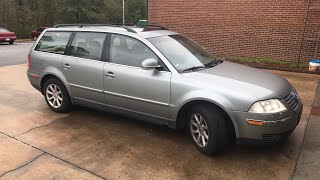
The 2013-2018 North American Passat (NMS) is a different platform from its European counterpart. For this vehicle, a P0420 code is a straightforward, albeit expensive, issue. While oxygen sensors can fail, owner experiences on forums like VWVortex and Reddit strongly suggest that the catalytic converter itself is the most frequent culprit, 🎬 Watch: A mechanic diagnoses a Passat P0420 check engine light. especially on higher mileage vehicles. It's crucial to rule out exhaust leaks, a common issue on many vehicles, before condemning a converter that can cost over $1,500 to replace.
Diagnostic Flowchart

Tap your situation to follow the diagnostic path that matches what you're seeing on this vehicle.
Generation note: This guide covers the North American 2012-2019 Volkswagen Passat (NMS), which includes a facelift for the 2016 model year. The core engine and exhaust architecture related to this code remained similar across the various powertrains (2.5L, 1.8T, 2.0T, 3.6L VR6).
Symptoms You May Notice
- Check Engine Light is on
- Failure to pass an emissions inspection
- Reduced engine power or acceleration, especially if the converter is clogged
- A sulfur or "rotten egg" smell from the exhaust if the converter is overheating due to unburned fuel.
- Slight decrease in fuel efficiency.
- Immediately replacing the downstream oxygen sensor without proper diagnosis. The P0420 code means the sensor is detecting a problem; it does not usually mean the sensor itself is the problem. It is often just doing its job of reporting an inefficient converter.
Most Likely Causes

- Failed Catalytic Converter 🔴 High Probability Catalytic converters have a finite lifespan and can fail from age (typically over 80,000-100,000 miles) or contamination from underlying engine issues like misfires or oil consumption. The internal ceramic honeycomb breaks down over time.
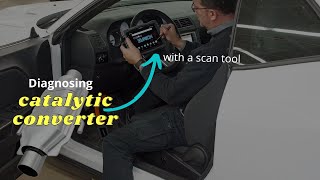
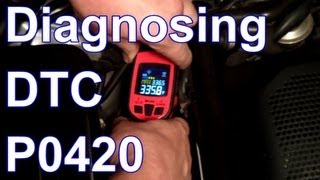
How to confirm: Use a scan tool to graph O2 sensor data; if the downstream sensor voltage mirrors the upstream sensor, the converter is not working. An infrared thermometer can also be used; the outlet of a working converter should be significantly hotter (100-150°F+) than the inlet after the engine is warm. A cooler outlet temperature confirms a non-functioning, likely clogged, converter.
Typical fix: Replace the Bank 1 catalytic converter.
Est. part cost: $1100-$1600 - Exhaust Leak 🟡 Medium Probability Leaks can develop at gasket junctions or flex pipes due to corrosion and vibration. A leak before the downstream O2 sensor can allow oxygen into the exhaust, fooling the sensor into reporting an inefficient converter.
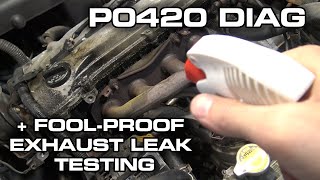
How to confirm: Visually inspect the exhaust system from the engine to the rear O2 sensor for black soot marks, which indicate a leak. A ticking or hissing noise that is louder on a cold start can also point to a leak. A DIY smoke test can be performed by hooking a shop-vac (on blow) to the tailpipe and spraying soapy water on joints to look for bubbles. 🎬 Watch: How to perform a DIY exhaust leak smoke test.
Typical fix: Replace the leaking gasket or repair/replace the leaking section of the exhaust pipe (e.g., the flex pipe).
Est. part cost: $20-$150 - Faulty Downstream Oxygen Sensor ⚪ Low Probability O2 sensors can become 'lazy' or fail with age, but they are more often correctly reporting the failure of another component. Misdiagnosing a bad converter and replacing the sensor first is a common mistake.
How to confirm: Review scan tool data. A healthy downstream sensor should show a relatively steady voltage. If it is stuck high, low, or not responding when the engine is forced rich/lean, it may be faulty. However, this is less common than the sensor accurately reporting a bad converter.
Typical fix: Replace the downstream (post-catalyst) oxygen sensor for Bank 1.
Est. part cost: $80-$200 - Underlying Engine Problem ⚪ Low Probability Engine misfires (from bad spark plugs or ignition coils) or a rich fuel condition (from a leaking injector) can send unburned fuel into the exhaust, overheating and destroying the catalytic converter's internal structure.
How to confirm: Check for other trouble codes, especially misfire codes (P0300-P0306) or fuel trim codes (P0171, P0172). Address these codes first before replacing the converter.
Typical fix: Repair the root cause of the misfire or fuel system issue (e.g., replace spark plugs, ignition coils, or fuel injectors). The catalytic converter may also need replacement if it has already been damaged.
Est. part cost: $50-$500
Rare But Worth Checking
- Damaged O2 Sensor Wiring: Wiring can be damaged by road debris or contact with hot exhaust components, leading to incorrect signals being sent to the ECM.
- ECM Software Issue: In some cases, the parameters for triggering the code may be too sensitive. VW has issued TSBs for other models (like the Atlas) to update ECM software to reduce thermal stress on the converter and adjust monitoring sensitivity. Check for any applicable TSBs for your specific Passat VIN.
Diagnosis Steps

- Scan for all codes. If any misfire (P030x) or fuel system (P017x) codes are present, diagnose and fix them first, as they are the likely root cause.
- Visually inspect the exhaust system from the engine manifold to the second O2 sensor. Look for any signs of leaks, such as black soot around flanges and gaskets, or cracks in the pipes. Listen for a ticking noise on a cold start.
- Use a scan tool with live data capability. Graph the voltage signals from the upstream (Bank 1, Sensor 1) and downstream (Bank 1, Sensor 2) oxygen sensors.
- Observe the graphs with the engine fully warmed up and held at a steady 2,000-2,500 RPM. The upstream sensor should show rapid, frequent fluctuations. The downstream sensor should show a much steadier, flatter voltage.
- If the downstream sensor's graph mimics the upstream sensor's fluctuations, the catalytic converter is not functioning and is the most likely cause.
- If you suspect a leak but cannot see one, perform a smoke test to pinpoint the source.
- As a final confirmation, use an infrared thermometer to measure the temperature of the pipe just before and just after the catalytic converter. The outlet should be at least 100-150°F hotter than the inlet. If it's the same temperature or cooler, the converter is not working.
Parts You'll Likely Need
- Catalytic Converter (Bank 1)
(OEM #1.8T/2.0T: 561254300L; 2.5L: 1K0254512NX; 3.6L VR6: 03H254400NX (Bank 1))— This is the most common failure that directly causes the P0420 code.
Trusted brands: Walker Exhaust, Bosal, MagnaFlow, AP Exhaust
OEM price range: $1500-$2200
Aftermarket price range: $400-$900 - Downstream Oxygen Sensor (Bank 1, Sensor 2)
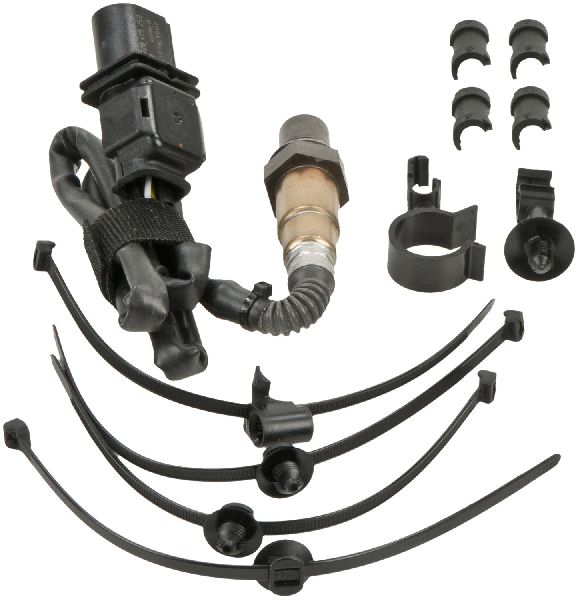
(OEM #06A906262BR (varies by engine))— Replaced if it is diagnosed as faulty, but more commonly replaced as a 'while you're in there' item during a converter replacement.
Trusted brands: Bosch, Denso, NGK
OEM price range: $150-$250
Aftermarket price range: $70-$130 - Exhaust Manifold Gasket
(OEM #06F253039F (varies by engine))— A common source of exhaust leaks that can trigger a false P0420 code.
Trusted brands: Victor Reinz, Elring, Fel-Pro
OEM price range: $20-$40
Aftermarket price range: $10-$25
Related Codes That Often Appear With This One
- P0430 — If the vehicle has a V6 engine (3.6L VR6), P0430 may appear alongside P0420. P0430 is the equivalent code for Bank 2, indicating both catalytic converters are failing or there's a systemic issue.
- P0300-P0306 — Misfire codes (e.g., P0301 for Cylinder 1) indicate an engine problem that allows unburned fuel to enter the exhaust, which can quickly damage the catalytic converter and cause a P0420 code.
- P0171/P0172 — Fuel trim codes for lean (P0171) or rich (P0172) conditions indicate an air/fuel mixture problem that can lead to catalytic converter damage over time.
Technical Service Bulletins (TSBs) & Recalls
- VIN-4-A-PIN Sept (2017 EQUIPMENT, dated 2017-09-07): Mentions the possibility of MIL-on with P0420 and/or P0430 stored.
- VW TSB 01-20-01 (March 16, 2020): While specifically for the 2018-2019 Atlas 3.6L, this TSB is relevant as it shows VW's approach to P0420/P0430 codes. The fix involves replacing the catalytic converters with improved hardware and performing an ECM software update to 'reduce thermal stress on the catalytic converter.' This indicates that software sensitivity can be a factor.
Platform-Specific Known Issues
- Intermittent P0420/P0430 After Timing Chain Service (VR6): Some 3.6L VR6 owners have reported the intermittent appearance of both P0420 and P0430 codes shortly after a major service like a timing chain replacement. This could indicate a related issue rather than sudden failure of both catalytic converters. One owner on Reddit noted the dealer suggested it was just an emissions warning and not urgent, but an independent German car specialist might be better equipped to diagnose such a specific scenario.
- DIY O2 Sensor Spacer Fix: A common, though not technically correct, 'fix' discussed in forums for older VWs is to install an O2 sensor spacer (also called a spark plug anti-fouler) on the downstream O2 sensor. This pulls the sensor out of the direct exhaust stream, tricking it into seeing a larger oxygen differential and turning off the P0420 light. This does not fix the underlying problem and will not pass a visual emissions inspection in states that check for such modifications.
Mechanic-Grade Diagnostic Values
- Downstream O2 Sensor (Bank 1, Sensor 2) Voltage at Idle/Cruise — expected: Relatively stable voltage between 0.4V and 0.7V when the catalytic converter is working efficiently.. Failure: Voltage fluctuates rapidly, mimicking the upstream sensor's 0.1V to 0.9V swings, or is stuck low (near 0.1V) or high (near 0.9V).
- Upstream O2 Sensor (Bank 1, Sensor 1) Voltage — expected: Rapidly fluctuating (oscillating) between approximately 0.1V (lean) and 0.9V (rich) as the ECM adjusts the air-fuel mixture.. Failure: A flat or slow-to-respond signal indicates a faulty sensor.
- Mode 6, Test ID $84 (Catalyst Monitor Bank 1) — expected: The measured value should be below the maximum threshold. For a 2016 Passat, the max value is listed as 0.9999811.. Failure: A value at or above the maximum threshold indicates the catalyst efficiency test has failed.
- Long/Short Term Fuel Trims (Bank 1) — expected: Should ideally be within +/- 5%. Values up to +/- 10% are generally acceptable.. Failure: Consistently high positive values (e.g., > +10%) suggest a vacuum leak or weak fuel delivery. Consistently high negative values suggest a leaking injector or other issue causing a rich condition, which can damage the converter.
Scan Tool Commands That Help
- VCDS (VAG-COM) / ODIS: Basic Settings, Group 043 - Catalyst Temperature — To initiate the catalyst heating cycle and monitor temperatures. This can help determine if the catalyst is reaching its required operating temperature, which is a prerequisite for the efficiency test to run.
- VCDS (VAG-COM) / ODIS: Advanced Measuring Blocks - O2 Sensor Voltages and Catalyst Readiness — To graph upstream and downstream O2 sensor voltages simultaneously under various load conditions (idle, 2500 RPM, etc.) to visually confirm if the downstream sensor is mimicking the upstream, which indicates a bad converter.
Wiring & Ground Locations
- Engine Ground Strap — On many Passat models, a primary engine-to-chassis ground strap is located under the driver's side, connecting the chassis crossmember to one of the engine mounts.. A poor or corroded engine ground can cause a host of electrical issues, including incorrect sensor readings. While not a direct cause, verifying the integrity of main grounds is a crucial step in diagnosing any electronic fault code.
- Ignition Coil Ground Wires — On 1.8T/2.0T engines, each ignition coil has a ground wire secured by a 10mm nut to the valve cover studs.. Loose or corroded coil grounds can lead to weak spark and intermittent misfires. These misfires can send unburned fuel into the exhaust, damaging the catalytic converter and eventually causing a P0420 code.
- Fuse F12 (Engine Bay Fuse Box) — In the fuse box located in the engine bay on the Passat B7 platform.. This 10A or 20A fuse provides power to the heated oxygen sensor circuit. If this fuse is blown, the O2 sensors will not heat up properly, leading to incorrect readings and potentially triggering emissions-related codes like P0420.
Real Owner Repair Stories
- Ross-Tech Forums user 'Florian' (VW with 226,000 km, engine previously had excessive oil consumption (1L/1000km) which was fixed by replacing pistons and rings.) — Intermittent P0420 code appeared 5 times over the last year.
❌ Tried (didn't work) Using a fuel additive twice did not resolve the issue.
✅ What actually fixed it The user replaced the catalytic converter with a used OEM unit from a car with 70,000 km. Upon inspection, the old converter was found to have many blocked cells and both the converter internals and O2 sensors were covered with a white powder, likely from the previous excessive oil burning. The replacement converter resolved the issue.
Helpful Videos

We Have This Part in Stock






The information in this article is provided for general reference and educational purposes only. Vehicle specifications, procedures, and part compatibility can vary by production date, trim level, and region. Always consult your vehicle's factory service manual and verify part numbers before purchasing or performing repairs. Safety-critical components such as airbags, seat belts, and braking systems should be installed by a qualified professional.
- Volkswagen PASSAT:
- 🎬 Helpful Videos
- 🛍️ Shop This Part
- What's Unique About the 2013-2018 Volkswagen PASSAT
- Diagnostic Flowchart
- Symptoms You May Notice
- Most Likely Causes
- Rare But Worth Checking
- Diagnosis Steps
- Parts You'll Likely Need
- Related Codes That Often Appear With This One
- Technical Service Bulletins (TSBs) & Recalls
- Platform-Specific Known Issues
- Mechanic-Grade Diagnostic Values
- Scan Tool Commands That Help
- Wiring & Ground Locations
- Real Owner Repair Stories
- 🎟️ Get 5% Off