

P0420 on 2012-2019 Land Rover Range Rover Evoque: Causes and Fixes for Catalyst Inefficiency
On a 2012-2019 Range Rover Evoque, code P0420 almost always indicates a degraded primary catalytic converter, a fact supported by Land Rover's own technical service bulletins. While an oxygen sensor could be the cause, the converter itself is the most likely failure point. This is often a costly repair, and underlying issues like oil consumption or exhaust leaks should be investigated.
- For the 2012-2019 Evoque, P0420 strongly points to a failed catalytic converter, as per Land Rover's own service bulletin (SSM74404).
- Always diagnose before replacing parts. Rule out cheaper fixes like exhaust leaks and faulty oxygen sensors first.
- If other engine codes are present, especially for misfires (P030x) or rich fuel conditions (P2188), resolve those issues before replacing the converter to prevent damaging the new part.
- A clogged converter can cause other issues, like a P0299 turbo underboost code, due to restricted exhaust flow.
What's Unique About the 2012-2019 Land Rover RANGE ROVER EVOQUE

Unlike many vehicles where a P0420 code is frequently caused by a failing oxygen sensor, Land Rover has specifically issued a TSB (SSM74404) for the 2.0L GTDi engine in the Evoque that points directly to catalytic converter degradation. The bulletin even notes that while other components can impact the system, the P0420 code itself will only be set based on the converter's efficiency. This makes the catalytic converter a much higher probability culprit on this specific vehicle compared to others. The engine is a version of the Ford 2.0L EcoBoost, which has also been noted in other vehicles to have issues that can lead to P0420.
Diagnostic Flowchart

Tap your situation to follow the diagnostic path that matches what you're seeing on this vehicle.
Symptoms You May Notice

- Check Engine Light is on
- Reduced engine performance and acceleration
- Worse fuel economy
- A rotten egg or sulfur smell from the exhaust (less common, but possible)
- Rattling noise from under the vehicle if the converter's internal structure has broken apart
- Exhaust fumes smelled inside the cabin, which could point to a cracked exhaust manifold.
- Immediately replacing the catalytic converter without testing the oxygen sensors or checking for exhaust leaks. An O2 sensor is a much cheaper part to replace and can be the root cause.
- Replacing the catalytic converter without diagnosing an underlying engine issue like misfires, a rich fuel condition, or excessive oil consumption, which will destroy the new converter.
Most Likely Causes

- Failed Primary Catalytic Converter 🔴 High Probability Land Rover TSB #SSM74404 explicitly identifies "Degradation of the primary catalytic converter" as the issue for P0420 on this engine. The TSB suggests that the fueling strategy during repeated, excessive engine overrun (like coasting downhill) during warm-up can contribute to this failure. Underlying issues like engine misfires or oil consumption can also destroy a new converter.
How to confirm: After confirming O2 sensors are working and there are no exhaust leaks, the converter is the presumed cause per TSB #SSM74404. A technician can also perform a backpressure test or use an infrared thermometer to check the inlet and outlet temperatures; the outlet should be significantly hotter. A visual inspection of the catalyst brick (if removed) may show clogging or melting.
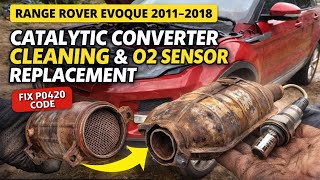
Typical fix: Replace the primary catalytic converter and integrated downpipe.
Est. part cost: $400-$1800 - Faulty Oxygen Sensor(s) 🟡 Medium Probability While the TSB points to the converter, O2 sensors are a common failure point on all vehicles and can send erroneous data, falsely triggering a P0420 code. It's a frequent misdiagnosis to replace the converter when a sensor is the true cause. Some owners have reported fixing the code by replacing a faulty downstream O2 sensor.
How to confirm: Use a diagnostic scan tool to graph the voltage of the upstream and downstream O2 sensors. The upstream sensor should fluctuate rapidly, while the downstream (post-catalyst) sensor should hold a relatively steady, high voltage. If the downstream sensor's voltage is lazy, stuck, or mirrors the upstream sensor's activity, it may be faulty. A specific code for the O2 sensor heater circuit, like P0030, may also be present.
Typical fix: Replace the faulty oxygen sensor, most commonly the downstream (rear) one.
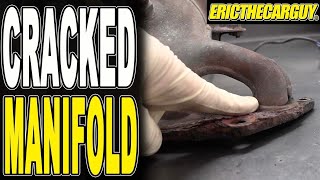
Est. part cost: $50-$250 - Exhaust System Leak ⚪ Low Probability The exhaust manifold on the 2.0L GTDi engine is known to crack. Forum users have noted this can cause exhaust fumes in the cabin and trigger codes by allowing unmetered air to enter the exhaust stream, confusing the O2 sensors. Leaks can also develop in the flex pipe or at gasket flanges.
How to confirm: Perform a visual inspection for soot trails or cracks, especially on the exhaust manifold. A smoke test is the most effective way to find small leaks between the engine and the rear O2 sensor. A ticking noise on a cold start that goes away as the engine warms up is also a classic sign of a manifold leak.
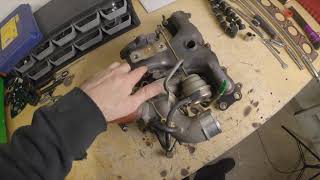
Typical fix: Repair the leak by welding the crack or replacing the failed gasket or component. In the case of a cracked manifold on this vehicle, it often requires replacing the entire turbocharger/manifold assembly.
Est. part cost: $100-$3000+
Rare But Worth Checking
- Engine Misfires or Fuel System Issues: Unburned fuel from misfires can enter the exhaust and overheat the catalytic converter, causing permanent damage. TSBs for the Evoque list P0420 alongside misfire (P030x) and rich condition (P2188) codes, indicating they can be related. [Bulletin #LTB00799NAS2, Bulletin #LTB00688NAS1] A faulty canister purge valve (CPV) has also been linked to P0420 on the related Ford 2.0L engine.
- Engine Oil Consumption: Excessive oil burning can contaminate the catalytic converter and oxygen sensors, leading to a P0420 code. TSB #SSM74404 specifically advises technicians to perform oil consumption checks as part of the diagnostic process for this code. If oil consumption is high, replacing the converter without addressing the root cause will likely result in the new converter failing prematurely.
Diagnosis Steps
- Scan for all DTCs. If codes for misfires (P030x), O2 sensor circuits (P0030), or fuel trim (P2188) are present, diagnose and fix them first as they are likely the root cause.
- Visually inspect the exhaust system from the engine to the muffler. Look for cracks, holes, or black soot marks indicating a leak. Pay close attention to the integrated exhaust manifold for cracks, a known issue on this engine. A smoke test is the definitive way to find leaks.
- Check for excessive oil consumption. TSB #SSM74404 specifically recommends this step. High oil consumption can poison the catalyst.
- Use a scan tool to monitor live data from the upstream (Bank 1, Sensor 1) and downstream (Bank 1, Sensor 2) oxygen sensors. At operating temperature and a steady 2500 RPM, the upstream sensor voltage should switch rapidly. The downstream sensor voltage should remain relatively stable and at a lower voltage than the upstream sensor.
- If the downstream O2 sensor's voltage fluctuates in sync with the upstream sensor, it confirms the converter is not storing oxygen and is therefore inefficient.
- If the downstream sensor's voltage is flatlined, slow to respond, or other O2 sensor codes are present, the sensor itself is likely faulty and should be replaced first.
- If no exhaust leaks are found, O2 sensors test good, and no other engine-related DTCs are present, the catalytic converter is the most likely cause of the problem, as stated in TSB #SSM74404.
Parts You'll Likely Need
- Catalytic Converter / Downpipe Assembly
(OEM #LR067412)— This is the most common failure part for P0420 on this vehicle, as confirmed by Land Rover TSB #SSM74404. The part number LR067412 has superseded several previous numbers, including LR024235, LR041429, and LR055954, indicating revisions to the part over time.
Trusted brands: Land Rover (OEM), Walker Exhaust, MagnaFlow
OEM price range: $1000-$1800
Aftermarket price range: $400-$900 - Downstream Oxygen Sensor (Post-Catalyst)
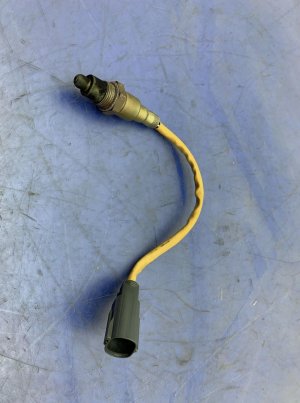
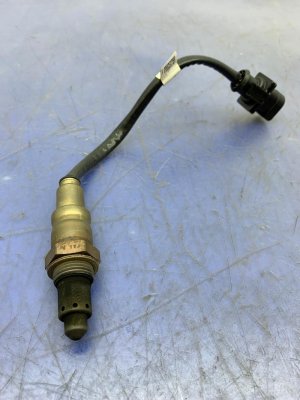
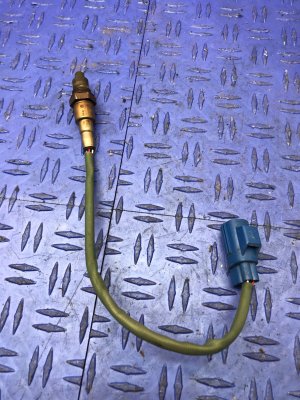
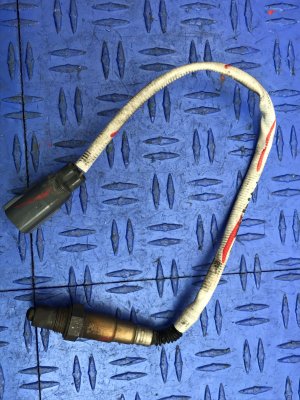
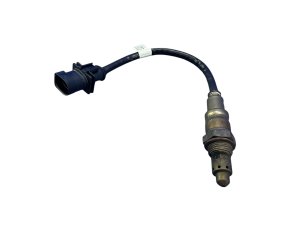
(OEM #LR028931)— A faulty downstream sensor can send incorrect data, falsely triggering a P0420 code. It's a common misdiagnosis and should be tested before replacing the converter. This part fits the Evoque from 2012-2013 according to some vendors.
Trusted brands: Bosch, Denso, NTK
OEM price range: $150-$250
Aftermarket price range: $50-$150
Related Codes That Often Appear With This One
- P0300, P0301, P0302, P0303, P0304 — These are misfire codes. An engine misfire can dump raw fuel into the exhaust, damaging the catalytic converter and triggering P0420. (Cited in TSB #LTB00799NAS2)
- P2188 — This code means "System Too Rich at Idle." A rich fuel condition can also overheat and damage the converter over time. (Cited in TSB #LTB00688NAS1)
- P0299 — This code indicates a turbocharger underboost condition. A clogged catalytic converter can create excessive backpressure, preventing the turbo from spooling correctly. A cracked exhaust manifold, a known issue on this engine, can also cause boost leaks and trigger this code along with P0420.
- P0030 — This code for the 'Heated Oxygen Sensor Heater Control Circuit' points directly to a fault with the O2 sensor itself, which could be the root cause of an incorrect P0420 reading.
Technical Service Bulletins (TSBs) & Recalls
- SSM74404: Notes that P0420 indicates degradation of the primary catalytic converter and that it's the most likely component to fail if other related DTCs are not present. It also mentions a potential cause related to fueling strategy during engine overrun on warm-up and advises checking for oil consumption.
- LTB00799NAS2: Lists P0420 among a series of other potential DTCs, including multiple misfire codes (P030x), that could be stored in the PCM.
- LTB00688NAS1: Mentions P0420 appearing alongside codes P0044 and P2188 (System Too Rich at Idle), highlighting that fuel system issues can be related.
Platform-Specific Known Issues
- TSB #SSM74404 explicitly states: "Degradation of the primary catalytic converter. The DTC P0420-00 stored in the PCM indicates the primary catalyst is not operating at an optimal level." The bulletin advises that if other components like O2 sensors pass inspection, only the primary catalytic converter should be replaced.
- A known issue is a cracked exhaust manifold, which is integrated with the turbocharger. A user on babyRR.com reported exhaust leaking into the cabin and a dealer quote of over $5000 for a replacement, ultimately opting to have the original manifold welded for $1000.
- Some owners on forums have tried using catalyst cleaning additives like Cataclean with mixed, often temporary, success. One user reported the check engine light turned off shortly after using the product, but this is not a guaranteed or permanent fix.
Mechanic-Grade Diagnostic Values
- Downstream O2 Sensor (Bank 1, Sensor 2) Voltage — expected: A relatively stable voltage between 0.4V and 0.6V (400-600mV) at idle/steady RPM once the engine is warm.. Failure: Voltage that fluctuates rapidly in a pattern similar to the upstream O2 sensor, indicating the catalytic converter is not storing oxygen effectively.
Scan Tool Commands That Help
- JLR SDD (Symptom Driven Diagnostics): Recommendations / Extras Tab — After reading DTCs, the SDD software provides a 'Recommendations' tab. This guides the technician through a diagnostic flow which may include running pinpoint tests on wiring, referencing specific TSBs, or performing software updates ('Configure existing module') before condemning a part.
Wiring & Ground Locations
- G1D108 / G1D108B — In the engine compartment, near the battery.. This is a primary ground point for the Engine Control Module (ECM). A poor ground here can cause erratic sensor readings and incorrect diagnostic codes.
- G1D130A — Located at the left front of the engine compartment.. This is another ground point for the ECM. Verifying its integrity is crucial when diagnosing any engine management codes, including P0420.
- G1D132A — Located at the right front of the engine compartment.. A third key ground location for the ECM. All ECM grounds should be checked for corrosion and tightness before replacing expensive components.
Real Owner Repair Stories
- babyRR.com - The Range Rover Evoque Forum (2012 Range Rover Evoque Pure, ~70,000 miles) — Exhaust leaking into the cabin.
❌ Tried (didn't work) Land Rover North America denied warranty assistance., Dealer quoted $5300 to replace the entire turbo/manifold assembly., Could not find an OEM Borg Warner replacement part in stock from third-party sellers.
✅ What actually fixed it The owner took the vehicle to an independent shop. They removed the turbo/manifold assembly, welded the crack, and reinstalled it with new gaskets and fluids for a total cost of $1000.
OEM Part Supersession History
LR024235→LR041429 > LR045424 > LR050537 > LR055954 > LR065336 > LR067412— Likely revisions to improve durability and address the degradation issue noted in TSB SSM74404.
Heads up: The latest part number, LR067412, is the correct replacement for all previous versions on the 2.0L GTDi engine.
Model Year Variations Within This Range
- 2012-2017: These model years used the Ford-derived 2.0L GTDi 'EcoBoost' engine. The known issues of catalytic converter degradation (TSB SSM74404) and cracked exhaust manifolds apply specifically to this engine.
- 2018-2019: For the 2018 model year, Land Rover switched to its own 2.0L 'Ingenium' petrol engine (Si4). While this engine can still log a P0420 code, the specific causes, TSBs, and common failure points like the manifold may be different from the earlier GTDi engine. Diagnosis for these later years should not assume the same common faults.
Helpful Videos


We Have This Part in Stock


The information in this article is provided for general reference and educational purposes only. Vehicle specifications, procedures, and part compatibility can vary by production date, trim level, and region. Always consult your vehicle's factory service manual and verify part numbers before purchasing or performing repairs. Safety-critical components such as airbags, seat belts, and braking systems should be installed by a qualified professional.
- Land Rover RANGE ROVER EVOQUE:
- 🎬 Helpful Videos
- 🛍️ Shop This Part
- What's Unique About the 2012-2019 Land Rover RANGE ROVER EVOQUE
- Diagnostic Flowchart
- Symptoms You May Notice
- Most Likely Causes
- Rare But Worth Checking
- Diagnosis Steps
- Parts You'll Likely Need
- Related Codes That Often Appear With This One
- Technical Service Bulletins (TSBs) & Recalls
- Platform-Specific Known Issues
- Mechanic-Grade Diagnostic Values
- Scan Tool Commands That Help
- Wiring & Ground Locations
- Real Owner Repair Stories
- OEM Part Supersession History
- Model Year Variations Within This Range
- 🎟️ Get 5% Off