

P0420 on 2012-2018 GMC Yukon XL: Causes and Fixes for Catalyst Inefficiency
The P0420 code on a 2012-2018 GMC Yukon XL most often indicates a failing catalytic converter on Bank 1. Before replacing this expensive part, it's crucial to check for common related issues like exhaust leaks from broken manifold bolts, failing oxygen sensors, and a unique problem with the air filter housing seal noted in a GM Technical Service Bulletin.
- P0420 means the driver's side catalytic converter is not working efficiently.
- Before replacing the expensive converter, ALWAYS check for simpler issues first: exhaust leaks (especially broken manifold bolts) and a faulty downstream O2 sensor.
- On 2015-2018 models in particular, inspect the air filter housing for a proper seal, as debris entering the intake is a known issue (TSB #16NA111) that can cause this code.
- If other codes are present (especially for misfires or rich conditions), they must be fixed first, as they are likely the root cause of the converter failure.
What's Unique About the 2012-2018 Gmc YUKON XL

For this generation of Yukon XL, a notable and unusual cause for a P0420 code is a poor seal on the engine's air filter housing. A specific Technical Service Bulletin (TSB #16-NA-111) from GM warns that sand and debris can bypass a bad seal, contaminating the mass airflow sensor and damaging both the oxygen sensors and the catalytic converter. This makes inspecting the air intake system a critical first step that is unique to this platform, potentially saving a costly and unnecessary converter replacement. Another very common issue is broken exhaust manifold bolts, particularly the rearmost bolt on the driver's side near the firewall, which creates an exhaust leak that triggers the code.
Diagnostic Flowchart

Tap your situation to follow the diagnostic path that matches what you're seeing on this vehicle.
Generation note: This range covers two generations of the GMC Yukon XL: the GMT900 platform (2012-2014) and the K2XX platform (2015-2018). While the P0420 code's meaning is the same for both, the specific catalytic converter and oxygen sensor part numbers will differ. TSB #16NA111 regarding the air filter seal specifically calls out 2015-2017 models, indicating this may be more common on the K2XX generation.
Symptoms You May Notice

- Check Engine Light is on
- Reduced engine power or sluggish acceleration
- Poor fuel economy
- A 'rotten egg' or sulfur smell from the exhaust, which indicates unburned fuel is being processed by the converter
- Failing a state emissions test
- A ticking or exhaust leak sound, especially when the engine is cold, that may point to a broken manifold bolt
- Immediately replacing the catalytic converter without checking for other causes like O2 sensors, exhaust leaks, or the air filter seal issue.
- Replacing the upstream (pre-cat) O2 sensor, which is responsible for fuel trim, not primarily for monitoring converter efficiency.
- Using an O2 sensor spacer or 'trick' to turn off the light. This does not fix the underlying problem and will not pass a visual emissions inspection.
Most Likely Causes

- Failed Catalytic Converter 🔴 High Probability Catalytic converters can fail from age, contamination from engine oil/coolant, or physical damage. Persistent engine issues like misfires or a rich fuel condition can also overheat and destroy the converter's internal honeycomb structure. Many owners on forums report that once one converter fails, the other is not far behind.
How to confirm: A professional can use an exhaust gas analyzer. A DIY method involves using a scan tool to watch O2 sensor data; if the downstream (Bank 1, Sensor 2) sensor's voltage graph mimics the rapid fluctuations of the upstream sensor, the converter is likely bad. Another test is to use an infrared thermometer to check temperatures after the engine is fully warm; the outlet should be at least 100°F hotter than the inlet. If it's cooler, the converter may be clogged or inactive.
Typical fix: Replace the Bank 1 catalytic converter. This is often part of a Y-pipe assembly on these trucks. Some owners opt for aftermarket brands like MagnaFlow or Walker as a more affordable alternative to OEM.
Est. part cost: $400-$1200 - Failing Downstream Oxygen (O2) Sensor 🟡 Medium Probability O2 sensors are wear items and can become 'lazy' or biased with age, sending incorrect data to the ECM and falsely triggering a P0420 code.
How to confirm: The easiest way is to swap the downstream (post-cat) O2 sensors from Bank 1 and Bank 2. Clear the codes and drive. If the code returns as P0430 (the code for Bank 2), the sensor is bad. If P0420 returns, the sensor is likely good and the problem lies elsewhere.
Typical fix: Replace the Bank 1, Sensor 2 (downstream) oxygen sensor. A common OEM part is ACDelco 213-4764.
Est. part cost: $50-$150 - Exhaust Leak 🟡 Medium Probability Exhaust manifold bolts, especially the rearmost one on the driver's side (Bank 1) near the firewall, are notorious for breaking off. This allows outside oxygen into the exhaust, which fools the O2 sensors into reporting an inefficient converter. Gaskets can also fail over time.
How to confirm: Perform a visual inspection for black soot trails or broken/missing bolt heads on the exhaust manifold and flanges. A distinct 'ticking' sound that is loudest on a cold start and may quiet down as the engine warms up is a common symptom. A smoke test is the most definitive way to pinpoint small leaks.
Typical fix: Replace the broken exhaust manifold bolts and/or the leaking gasket. Due to the difficulty of extracting the broken bolt, many owners use a specialized exhaust manifold bolt repair clamp as a permanent, easier fix.
Est. part cost: $20-$100 - Improperly Sealed Air Filter Housing ⚪ Low Probability Per TSB #16-NA-111, the air filter housing on 2015-2017 models may not seal properly, allowing sand and debris to bypass the filter. This abrasive material can damage the delicate element on the O2 sensors and clog the catalytic converter.
How to confirm: Inspect the air filter housing cover for missing tabs or fasteners. Remove the air filter and look for dirt, sand, or debris in the 'clean' side of the housing and the air intake tube leading to the throttle body.
Typical fix: Replace the air filter and, if the housing is warped or broken, the entire air cleaner assembly to ensure a proper seal. Clean the intake tube and MAF sensor. After ensuring the seal is good, the P0420/P0430 codes can be addressed.
Est. part cost: $30-$250
Rare But Worth Checking
- Engine Misfires or Fuel System Issues: Unburned fuel from a misfire or a leaking injector can enter the exhaust and overheat/damage the catalytic converter. Usually, this will be accompanied by other codes like P030x (misfire) or P0172/P0175 (rich condition). Checking long-term fuel trims (LTFT) can reveal an underlying fuel issue; values greater than +/- 10% should be investigated before replacing a converter.
Diagnosis Steps
- Read the code and any other stored codes with an OBD-II scanner. Note any accompanying codes like P0430, P030x, or P017x.
- Inspect the air filter and air filter housing for a proper seal and signs of debris bypassing the filter, as per TSB #16-NA-111. Check the 'clean' side of the intake tube for sand or dirt.
- Perform a thorough visual and auditory inspection of the exhaust system for leaks. Listen for a 'ticking' noise on a cold start. Look for soot trails or broken bolts, especially on the Bank 1 (driver's side) exhaust manifold near the firewall.
- Use a scan tool to monitor the live data from the upstream (Sensor 1) and downstream (Sensor 2) oxygen sensors for Bank 1. The upstream sensor should fluctuate rapidly between ~0.1V and ~0.9V. The downstream sensor should hold a relatively steady, high voltage (typically >0.45V). If the downstream sensor mirrors the upstream, the converter is likely bad.
- If O2 sensor performance is suspect, swap the downstream sensors between Bank 1 and Bank 2. Clear codes and drive. If the code changes to P0430, the Bank 1 sensor you moved is faulty.
- Check long-term fuel trims (LTFT). If they are significantly positive or negative (e.g., > +/- 10%), investigate potential vacuum leaks or fuel delivery problems that could be damaging the converter.
- If all other possibilities are ruled out, the catalytic converter is the most likely culprit. Confirm with an infrared thermometer test if possible.
Parts You'll Likely Need
- Catalytic Converter (Bank 1)
(OEM #23486656)— This is the most common cause of a P0420 code, as the internal materials degrade over time. Bank 1 is the driver's side.
Trusted brands: ACDelco (OEM), Walker Exhaust, MagnaFlow
OEM price range: $800-$1500
Aftermarket price range: $400-$900 - Downstream Oxygen Sensor (Bank 1, Sensor 2)
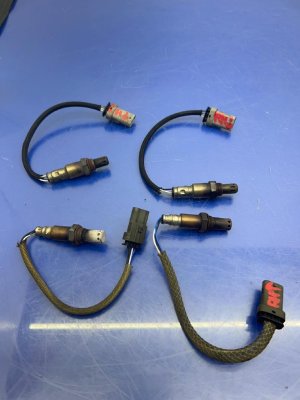
(OEM #ACDelco 213-4764 (GM 55572993))— This sensor is responsible for monitoring the catalytic converter's efficiency. A faulty sensor can send incorrect readings, falsely triggering the P0420 code.
Trusted brands: ACDelco
OEM price range: $50-$100
Aftermarket price range: $40-$80 - Exhaust Manifold Bolt Repair Clamp — A common and often permanent fix for the frequently broken rear exhaust manifold bolt, which causes an exhaust leak that triggers P0420. This avoids the difficult and costly process of extracting the broken bolt.
Trusted brands: Dorman, K-D Tools
OEM price range: N/A
Aftermarket price range: $20-$50
Related Codes That Often Appear With This One
- P0430 — This is the identical code for Bank 2 (passenger side). It's common for both converters to fail around the same time due to age and similar operating conditions. The air filter housing issue (TSB 16-NA-111) also frequently causes both codes to appear together.
- P0172 / P0175 — These codes indicate a rich fuel condition on Bank 1 and Bank 2. A persistent rich condition can damage the catalytic converter over time, leading to a P0420 code. A user on Tahoe Yukon Forum noted their P0420 appeared only after fixing their P0172/P0175 codes.
- P0300 - P0308 — These are misfire codes (P0300 for random, P0301-P0308 for specific cylinders). A consistent misfire allows unburned fuel to enter the exhaust, which can quickly destroy the catalytic converter.
Technical Service Bulletins (TSBs) & Recalls
- 16-NA-111: Addresses P0420/P0430 codes caused by an improperly sealed air box/filter, allowing debris to damage emissions components. The bulletin advises inspecting the air filter housing for a proper seal before replacing any parts.
- PIP3119P: Notes that catalytic converter efficiency diagnostics (P0420/P0430) are disabled at very low mileage on some vehicles to prevent false codes during the break-in period.
Platform-Specific Known Issues
- A GM Technical Service Bulletin (#16-NA-111) highlights that on 2015-2017 models, a poorly sealing air filter housing can allow sand and debris to enter the intake, damaging O2 sensors and clogging the catalytic converter, leading to P0420 and P0430 codes.
- Broken exhaust manifold bolts, particularly the rearmost bolt on the driver's side (Bank 1), are a very frequent cause of an exhaust leak that triggers P0420. Repair often involves using a special clamp bracket to seal the leak without extracting the broken bolt.
Mechanic-Grade Diagnostic Values
- Upstream O2 Sensor (Bank 1, Sensor 1) Voltage — expected: Rapidly fluctuating between 0.1V and 0.9V at idle and steady RPM.. Failure: Slow or no fluctuation, or voltage stuck high or low.
- Downstream O2 Sensor (Bank 1, Sensor 2) Voltage (Good Converter) — expected: Relatively stable voltage, typically between 0.45V and 0.8V, when engine is warm and at steady RPM.. Failure: Voltage fluctuates rapidly, mimicking the upstream sensor's pattern.
- Long-Term Fuel Trim (LTFT) — expected: Should be less than +/- 10% at idle and various RPMs (1500, 2000, 2500).. Failure: Values greater than +/- 10% indicate an underlying fuel delivery or vacuum leak issue that must be corrected before addressing the P0420 code.
- Cranking CO2 Test (5-gas analyzer) — expected: After warming up the engine and then cranking with ignition disabled, CO2 should reach and maintain at least 12% within 10 seconds.. Failure: CO2 does not reach 12%, or only spikes briefly, indicating a weak converter.
Hidden / Shadow Codes Worth Checking
- Mode 6, Test ID $a9: This is the onboard monitor test for the Bank 1 Catalytic Converter. Accessing this data with a capable scan tool shows the raw test value measured by the PCM, along with the minimum and maximum allowable values. (see via A professional-grade scan tool or an OBD-II app with Mode 6 capabilities. The specific test ID can vary, but is often labeled as 'CAT' or similar.)
Scan Tool Commands That Help
- GDS2/Tech2 or equivalent professional scanner: Catalyst System Test (Propane Injection) — This is a GM-specific diagnostic procedure to definitively test converter efficiency. It involves injecting propane into the intake and measuring the exhaust gas response with a 5-gas analyzer to determine the converter's ability to oxidize hydrocarbons. It's used when scan tool data is ambiguous.
- GDS2/Tech2 or equivalent professional scanner: Graphing Live Data (O2 Sensors) — This is the primary diagnostic step. Graphing the upstream and downstream O2 sensors on the same screen allows for a direct visual comparison to see if the downstream sensor is mimicking the upstream, which indicates a failed converter.
Wiring & Ground Locations
- G103 (GMT900) — On the front of the passenger side cylinder head.. This is a primary engine ground. A poor connection here can cause erratic sensor readings and codes. While not directly for the O2 sensor, it affects overall ECM and engine sensor stability.
- G104 (GMT900) — Located on the left rear corner of the driver's side cylinder head.. This ground is physically close to the Bank 1 (driver's side) O2 sensors and exhaust manifold. Corrosion or looseness can directly impact the sensor signals for the bank that sets the P0420 code.
- G101 (General) — Located on the lower front of the engine block.. This ground is critical for the Engine Control Module (ECM) and Transmission Control Module (TCM). A fault here can cause a wide array of codes, including P0420, due to incorrect data processing.
- BCM Ground (K2XX) — Inside the cab, next to the front left speaker. Requires removing the A-pillar and dash trim to access.. On newer K2XX (2015+) platforms, body control module grounds can cause strange electrical issues that can sometimes manifest as engine-related codes. While less direct, checking this is important if other electrical gremlins are present.
Real Owner Repair Stories
- Tahoe Yukon Forum user 'mftrnr' (Vehicle year not specified, but within the 2012-2018 range.) — P0420 code appeared immediately after fixing a rich fuel condition (P0172/P0175).
❌ Tried (didn't work) Fixing the rich fuel condition and resetting fuel composition did not clear the P0420.
✅ What actually fixed it The user was advised by others that the preceding rich condition likely damaged the catalytic converter, and replacement was the only solution. The consensus was that once other causes are ruled out, the cat is the culprit. One user recommended Magnaflow aftermarket converters as a cost-effective replacement.
"I Checked Everything" — The Actual Cause
- A cracked flex pipe before the catalytic converter can cause a P0420 code. This type of leak may not be easily found with a smoke test, especially if the crack only opens up when the exhaust heats up and expands, or under engine torque. The leak introduces oxygen into the exhaust stream ahead of the O2 sensors, mimicking the conditions of a failed converter.
OEM Part Supersession History
ACDelco GM Original Equipment→GM Genuine Parts— Branding change. GM is consolidating its OE parts under the 'GM Genuine Parts' name. The parts are engineered and tested to the same OE standards.
Heads up: Some parts, like the ACDelco 213-4764 O2 sensor, may state that they require programming or special setup procedures, which is important to note before installation.
Model Year Variations Within This Range
- 2012-2014 (GMT900) vs. 2015-2018 (K2XX): The 2015 model year marked a major platform change. The 2015+ K2XX models introduced new engines (5.3L L83, 6.2L L86) with direct injection and more complex Active Fuel Management (AFM) systems, which have their own failure modes (like lifter issues) that can lead to P0420. The air filter housing TSB (#16NA111) specifically applies to 2015-2017 models, indicating a design difference from the earlier GMT900 platform. The base engine horsepower also increased from 320 hp in 2014 to 355 hp in 2015.
- 2015: Early 2015 models may have used the 6-speed transmission from the previous generation before GM switched to the 8-speed transmission later in the model year. While not directly related to the P0420 code, it's a significant variation within the same model year.
Helpful Videos
We Have This Part in Stock


The information in this article is provided for general reference and educational purposes only. Vehicle specifications, procedures, and part compatibility can vary by production date, trim level, and region. Always consult your vehicle's factory service manual and verify part numbers before purchasing or performing repairs. Safety-critical components such as airbags, seat belts, and braking systems should be installed by a qualified professional.
- Gmc YUKON XL:
- 🎬 Helpful Videos
- 🛍️ Shop This Part
- What's Unique About the 2012-2018 Gmc YUKON XL
- Diagnostic Flowchart
- Symptoms You May Notice
- Most Likely Causes
- Rare But Worth Checking
- Diagnosis Steps
- Parts You'll Likely Need
- Related Codes That Often Appear With This One
- Technical Service Bulletins (TSBs) & Recalls
- Platform-Specific Known Issues
- Mechanic-Grade Diagnostic Values
- Hidden / Shadow Codes Worth Checking
- Scan Tool Commands That Help
- Wiring & Ground Locations
- Real Owner Repair Stories
- "I Checked Everything" — The Actual Cause
- OEM Part Supersession History
- Model Year Variations Within This Range
- 🎟️ Get 5% Off