

P0420 on 2004-2008 GMC Sierra Denali: Causes and Fixes for Catalyst Inefficiency
On a 2004-2008 Sierra Denali, P0420 almost always points to a failing Bank 1 (driver's side) catalytic converter. Before replacing this expensive part, first rule out a much cheaper faulty downstream oxygen sensor or an exhaust leak, which are common misdiagnoses. Broken exhaust manifold bolts are a very frequent cause of these leaks on this specific platform.
- P0420 on your Sierra Denali means the driver's side catalytic converter is reported as inefficient.
- DO NOT immediately replace the catalytic converter. It's expensive and may not be the problem.
- First, thoroughly check for exhaust leaks, especially at the exhaust manifolds, as this is a common issue on these trucks.
- Second, test the downstream (post-cat) oxygen sensor. A faulty sensor is a frequent and much cheaper cause of this code.
- If the converter has failed, ensure you also fix any underlying engine issues (like misfires) that caused it to fail.
What's Unique About the 2004-2008 Gmc SIERRA DENALI
The GMC Sierra Denali from this era uses large V8 engines (6.0L or 6.2L) that generate significant heat, putting stress on exhaust components. A widely known issue on these GM trucks is the tendency for exhaust manifold bolts to break, causing leaks that can trick the oxygen sensors and trigger a false P0420 code. The front-most and rear-most bolts are particularly prone to snapping. Additionally, a Technical Service Bulletin (TSB PIP3119-series) exists for new or recently replaced converters, where a false P0420 can set if a specific break-in procedure is not completed.
Diagnostic Flowchart

Tap your situation to follow the diagnostic path that matches what you're seeing on this vehicle.
Generation note: This year range covers two generations of the Sierra Denali: the GMT800 (2004-2006 and 2007 'Classic') which typically used a 6.0L V8 (LQ4 or LQ9), and the GMT900 (2007-2008) which often had the 6.2L V8 (L92). While the fundamental causes of P0420 are the same, specific part numbers for exhaust components will differ between these generations. The GMT900 introduced Active Fuel Management (AFM) on some engines, which can contribute to oil consumption that may poison the catalytic converters over time.
Symptoms You May Notice
- Check Engine Light is on.
- Reduced engine power and acceleration, especially under load.
- A 'rotten egg' or sulfur smell from the exhaust.
- Vehicle fails an emissions test.
- A ticking or tapping noise from the engine bay, especially when cold, indicating an exhaust leak.
- Replacing the catalytic converter without first testing the oxygen sensors and thoroughly inspecting for exhaust leaks.
- Replacing the downstream O2 sensor when the catalytic converter is actually the failed component.
Most Likely Causes

- Failing Catalytic Converter 🔴 High Probability Catalytic converters can fail from age, but failure is often accelerated by other underlying issues like engine misfires, running rich, or contamination from oil/coolant. High mileage is a primary factor.
How to confirm: Use an infrared thermometer to measure the temperature of the pipe entering and exiting the converter after the engine is fully warm. The outlet should be at least 100°F hotter than the inlet. If temperatures are similar or the outlet is cooler, the converter is not working. A scan tool showing the downstream O2 sensor voltage mirroring the upstream sensor's fluctuations also confirms a bad converter.
Typical fix: Replace the Bank 1 catalytic converter. It is critical to identify and fix the root cause of the failure (e.g., misfires, fuel issues) to prevent damaging the new converter. After replacement, the catalyst break-in procedure from TSB PIP3119P should be performed.
Est. part cost: $400-$1200 - Faulty Downstream Oxygen Sensor (Bank 1, Sensor 2) 🟡 Medium Probability Oxygen sensors are wear items and can become 'lazy' or biased with age, sending incorrect data to the PCM. This is a very common cause of a false P0420 code, though many owners replace them only to find the converter was the real issue.
How to confirm: Use a scan tool to graph the voltage of the downstream O2 sensor (Bank 1 Sensor 2). A healthy sensor after a good converter will show a relatively steady, slow-moving voltage, typically between 0.4V and 0.8V. If the sensor's voltage is stuck, flatlined, or fluctuating wildly like the upstream sensor, it may be faulty.
Typical fix: Replace the Bank 1, Sensor 2 oxygen sensor.
Est. part cost: $50-$150 - Exhaust Leak 🟡 Medium Probability Exhaust manifold bolts on these GM V8 engines are notorious for breaking, especially the front and rear bolts. A leak anywhere between the cylinder head and the downstream O2 sensor can let oxygen into the exhaust, skewing sensor readings and falsely triggering P0420.
How to confirm: Visually inspect the exhaust manifolds for broken bolts or black soot trails indicating a leak. Listen for a 'ticking' or 'hissing' sound, especially when the engine is cold, which diminishes as the metal expands. A smoke machine test can pinpoint the exact location.
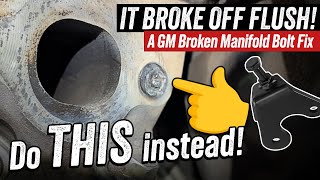
Typical fix: Replace the leaking gasket and any broken manifold bolts. This can be difficult. If extracting the broken bolt fails, aftermarket repair brackets (e.g., Dorman or Kral Auto Parts KAP169) are available 🎬 See how to easily fix a broken exhaust manifold bolt. that clamp the manifold in place using other bolt holes on the cylinder head.
Est. part cost: $20-$200 - Underlying Engine Performance Issue ⚪ Low Probability An engine that runs rich or misfires will send unburned fuel into the exhaust, which can overheat and destroy the catalytic converter.
How to confirm: Check for other trouble codes, especially misfire codes (P0300-P0308) or fuel system codes (P0171, P0174). Check long-term fuel trims with a scan tool; values consistently above +10% or below -10% indicate a problem that is damaging the converter.
Typical fix: Address the root cause, which could be worn spark plugs, faulty ignition coils, leaking fuel injectors, or a bad MAF sensor.
Est. part cost: $50-$500
Rare But Worth Checking
- Contaminated Catalyst: An internal engine problem, like a leaking head gasket or failing piston rings, can allow coolant or oil into the exhaust, which will permanently poison the catalytic converter. This is usually accompanied by other symptoms like white or blue exhaust smoke and fluid loss.
- Corroded ECM Ground: GM issued a TSB (#06-06-04-046) for some 1999-2007 trucks where a corroded main engine wiring harness ground terminal (G103) on the right cylinder head can cause various DTCs, including P0420. Cleaning the ground connection may resolve the issue.
Diagnosis Steps
- Scan for all stored DTCs. If any misfire (P030x), fuel system (P0171/P0174), or other O2 sensor codes are present, diagnose and fix them first as they are the likely root cause.
- Perform a thorough visual inspection of the exhaust system from the engine to the tailpipe. Look for broken manifold bolts (especially front and rear), black soot marks, cracks, or holes indicating a leak.
- With the engine cold, start it and listen for audible 'ticking' or 'hissing' noises from the exhaust manifolds or pipes. The sound often goes away as the engine warms up and the metal expands.
- Use a scan tool with live data graphing capabilities. Monitor the Bank 1 Sensor 1 (upstream) and Bank 1 Sensor 2 (downstream) O2 sensors at a steady 2000-2500 RPM.
- The upstream sensor (B1S1) should switch rapidly between approximately 0.1V and 0.9V. This is normal.
- If the downstream sensor (B1S2) graph mirrors the upstream sensor's rapid switching, the catalytic converter has failed and is no longer storing oxygen.
- If the downstream sensor (B1S2) holds a relatively steady voltage (e.g., >0.6V), the converter is likely functioning correctly. If its voltage is stuck low (e.g., <0.2V) or responds very slowly, the sensor itself is likely the problem.
- If scan data is inconclusive, perform a temperature test. Use an infrared thermometer to check the converter inlet and outlet pipes. The outlet should be at least 100°F hotter than the inlet. If not, the converter is inactive.
- Check Long Term Fuel Trims (LTFT). Values outside of +/-10% suggest a fuel mixture problem that needs to be resolved before replacing the converter.
Parts You'll Likely Need
- Catalytic Converter (Bank 1)
(OEM #GM 84655075 (for 6.2L, supersedes multiple older numbers), GM 19418958 (kit for 6.2L). Part numbers are highly specific to year, engine, and emissions (Federal/CA).)— This is the most common failed component that directly causes the P0420 code.
Trusted brands: ACDelco (OEM), Walker Exhaust, MagnaFlow
OEM price range: $800-$1500
Aftermarket price range: $400-$800 - Downstream Oxygen Sensor (Bank 1, Sensor 2)
(OEM #ACDelco 213-4229 (GM 12609457) or ACDelco AFS123 (GM 12573005) are common for this era. Verify by VIN. Denso 234-4668 is a popular aftermarket equivalent.)— A faulty O2 sensor can send incorrect data, leading to a misdiagnosis of a bad converter.
Trusted brands: ACDelco, Denso, Bosch
OEM price range: $80-$180
Aftermarket price range: $50-$100 - Exhaust Manifold Gasket & Bolt Kit — Required when fixing an exhaust leak at the manifold, which is a common cause of a false P0420 on these trucks.
Trusted brands: Fel-Pro, Dorman, ACDelco
OEM price range: $40-$100
Aftermarket price range: $20-$60 - Exhaust Manifold Bolt Repair Clamp — A time-saving alternative to extracting broken manifold bolts. It clamps the manifold to the cylinder head, sealing the leak.
Trusted brands: Dorman OE Solutions, Kral Auto Parts (KAP)
OEM price range: N/A
Aftermarket price range: $50-$150
Related Codes That Often Appear With This One
- P0430 — This is the identical code for Bank 2 (passenger side). It's common for both converters to degrade at a similar rate, causing both codes to appear together.
- P0300-P0308 — These are misfire codes. An engine misfire allows unburned fuel to enter the exhaust, which can quickly overheat and destroy the catalytic converter, directly causing a P0420.
- P0171 / P0174 — These codes indicate a lean condition. An unmetered air leak, often from a broken manifold bolt, can cause the system to run lean and may trigger these codes alongside a P0420.
Technical Service Bulletins (TSBs) & Recalls
- Bulletin #PIP3119N (and later revisions like PIP3119P): Notes that on new vehicles or after a converter replacement, the P0420/P0430 diagnostics are disabled for the first hour of engine run time to allow for catalyst break-in. If this is interrupted (e.g., battery disconnect), or on a used vehicle where this delay is no longer active, a false code can set. A specific highway drive cycle is recommended to properly break in the new converter and clear the code.
- Bulletin #06-06-04-046: Cites a corroded ECM ground terminal (G103) on the right cylinder head as a potential cause for P0420 and other codes on 1999-2007 trucks. Cleaning the connection is the recommended fix.
Platform-Specific Known Issues

- Broken exhaust manifold bolts are a very common problem on GM V8 engines of this era. The rear-most and front-most bolts are most susceptible to breaking due to heat cycles. A resulting leak is a frequent cause of a P0420 code and should be investigated before replacing any parts. Repair can involve difficult bolt extraction or using an aftermarket clamp kit like the Dorman or Kral KAP169.
Mechanic-Grade Diagnostic Values
- Upstream O2 Sensor (B1S1) Voltage — expected: Rapidly fluctuating between ~0.1V and ~0.9V. Failure: A flat or very slow-to-respond signal.
- Downstream O2 Sensor (B1S2) Voltage (Good Catalyst) — expected: Relatively steady, slow-moving voltage, typically between 0.4V and 0.8V.. Failure: Voltage that mimics the rapid switching of the upstream sensor.
- Catalytic Converter Temperature Differential — expected: Outlet pipe should be at least 100°F (38°C) hotter than the inlet pipe after the engine is fully warmed.. Failure: Inlet and outlet temperatures are similar, or the outlet is cooler.
Hidden / Shadow Codes Worth Checking
- Mode $06, Test ID $01: This is not a DTC but a specific test result within the OBD-II system for catalyst efficiency. A failing value here can precede the P0420 code or confirm the diagnosis. The data requires a scan tool capable of reading Mode $06. (see via Advanced OBD-II scan tool with Mode $06 functionality (e.g., Tech2, GDS2, or high-end consumer scanners).)
Scan Tool Commands That Help
- Tech2/GDS2 or equivalent: Catalyst System Test / Catalyst Monitor Drive Cycle — Used to force the vehicle's computer to run the internal test for catalytic converter efficiency after a repair or to confirm a diagnosis. This is also necessary to get the catalyst monitor 'Ready' for an emissions test.
- Tech2/GDS2 or equivalent: Catalyst Reset / Catalyst Break-in — After installing a new catalytic converter, especially an OEM one, a specific break-in procedure or reset may be required to prevent a false P0420 code, as mentioned in TSB PIP3119N.
Wiring & Ground Locations
- G103 — On the GMT800, it's often on the cowl above the brake booster. On the GMT900, it's typically on the front of the passenger side (right) cylinder head. Location can vary slightly by year and engine.. This is a critical ground for the Engine Control Module (ECM). A poor connection at G103 can cause erratic sensor readings and various DTCs, including a false P0420. This was the subject of GM TSB #06-06-04-046.
- O2 Sensor Fuses — In the underhood fuse block.. The oxygen sensor heaters have fused power. If a fuse is blown, the sensor won't heat up properly, leading to incorrect readings and potentially a P0420 code, although other O2 sensor-specific codes are more likely.
- Bank 1 O2 Sensor Connectors — Bank 1 (driver's side). Sensor 1 is on the exhaust manifold or pipe before the catalytic converter. Sensor 2 is after the catalytic converter.. Corrosion or damage to the connectors or wiring for either sensor can cause incorrect voltage signals to be sent to the ECM, leading to a false code.
Real Owner Repair Stories
- Reddit user, r/MechanicAdvice (2007 Silverado 1500, 140k miles) — P0420 code, very rich fuel mixture, horrible MPG, known exhaust leak on driver's side.
❌ Tried (didn't work) Initially, the owner knew there was a leak but hadn't fixed it yet.
✅ What actually fixed it The owner replaced the driver's side exhaust manifold to fix a major leak caused by an improperly installed stud. After the repair, the P0420 code was gone and MPG returned to normal. However, 25 miles later, both P0420 and P0430 appeared, indicating the original leak had likely damaged the converters over time. The final fix would be replacing the converters. - Reddit user, r/GMT800 (GMT800 Truck) — P0420 code.
❌ Tried (didn't work) Unspecified.
✅ What actually fixed it The user's comment implies the most common fixes are a bad O2 sensor, an exhaust leak at the manifold, or a bad catalytic converter, confirming the common causes.
"I Checked Everything" — The Actual Cause
- A common scenario on these trucks is a smoke test showing no leaks, but the actual cause is a hairline crack on the exhaust manifold that only opens up and leaks when the engine is under load and the manifold is hot. This can be missed during a static test in a garage bay.
Model Year Variations Within This Range
- 2007-2008 (GMT900): The GMT900 platform introduced the 6.2L L92 V8 and Active Fuel Management (AFM) on some 5.3L and 6.0L engines. AFM systems are known to sometimes increase oil consumption, which can lead to oil poisoning and premature failure of the catalytic converters over many miles. The GMT800 trucks (2004-2007 Classic) did not have AFM.
- 2004-2007 Classic (GMT800) vs 2007-2008 (GMT900): The physical interior, exterior, and frame are completely different. While the P0420 code's root causes are similar (cats, O2 sensors, leaks), the specific part numbers for exhaust components, sensor locations, and wiring harness routing are not interchangeable between the two generations.
Helpful Videos

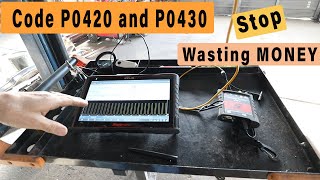
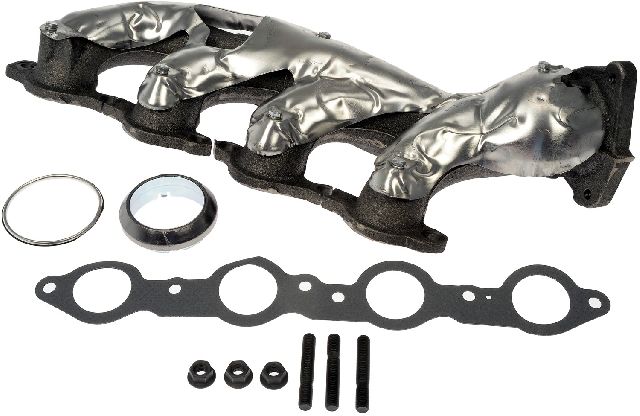
We Have This Part in Stock
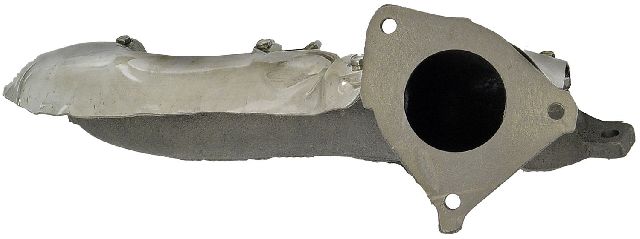
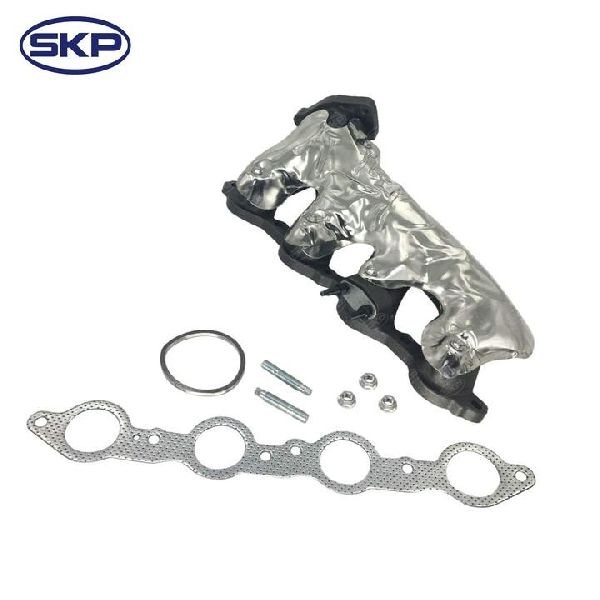
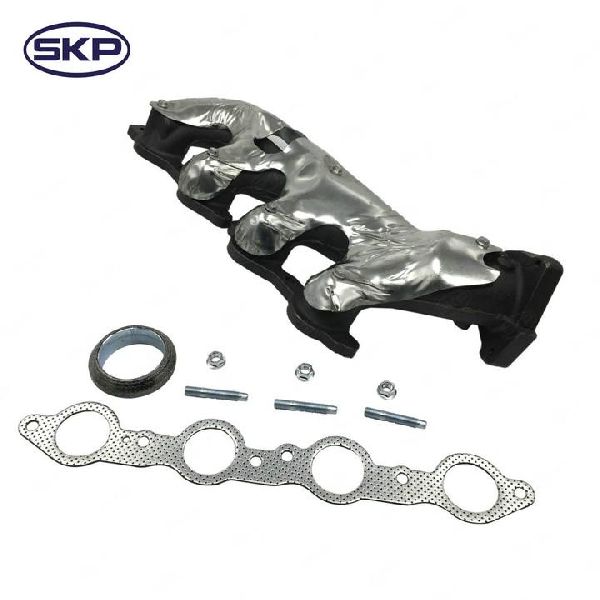



The information in this article is provided for general reference and educational purposes only. Vehicle specifications, procedures, and part compatibility can vary by production date, trim level, and region. Always consult your vehicle's factory service manual and verify part numbers before purchasing or performing repairs. Safety-critical components such as airbags, seat belts, and braking systems should be installed by a qualified professional.
- Gmc SIERRA DENALI:
- 🎬 Helpful Videos
- 🛍️ Shop This Part
- What's Unique About the 2004-2008 Gmc SIERRA DENALI
- Diagnostic Flowchart
- Symptoms You May Notice
- Most Likely Causes
- Rare But Worth Checking
- Diagnosis Steps
- Parts You'll Likely Need
- Related Codes That Often Appear With This One
- Technical Service Bulletins (TSBs) & Recalls
- Platform-Specific Known Issues
- Mechanic-Grade Diagnostic Values
- Hidden / Shadow Codes Worth Checking
- Scan Tool Commands That Help
- Wiring & Ground Locations
- Real Owner Repair Stories
- "I Checked Everything" — The Actual Cause
- Model Year Variations Within This Range
- 🎟️ Get 5% Off