

P0420 on 2006-2013 GMC Sierra 1500: Catalyst, Leak, or O2 Sensor?
On a 2006-2013 GMC Sierra, P0420 usually means the Bank 1 catalytic converter is failing. However, before replacing this expensive part, you must check for exhaust leaks, as GM has issued service bulletins (like #15821) for this exact issue. A faulty downstream oxygen sensor is also a common, cheaper culprit. Critically, on V8 models with Active Fuel Management (AFM), excessive oil consumption is a known root cause that will destroy a new converter if not addressed.
- Do not replace the catalytic converter without first performing a thorough exhaust leak check. This is a known issue documented in GM service bulletins.
- A faulty downstream O2 sensor (Bank 1, Sensor 2) can mimic the symptoms of a failed converter and is a much cheaper repair.
- If the catalytic converter has failed, you must find and fix the root cause (e.g., engine misfires, oil consumption) or the new converter will also fail prematurely.
- Bank 1 on a V6 or V8 GMC Sierra is the driver's side of the engine.
What's Unique About the 2006-2013 Gmc SIERRA 1500

For this generation of Sierra, General Motors has issued multiple Technical Service Bulletins (TSBs) pointing to exhaust leaks as a primary cause for a false P0420 code. Unlike many vehicles where the converter is the immediate suspect, on these trucks, a leak from a broken manifold bolt or a failed gasket at the converter outlet is a very common problem that can trick the sensors. Some bulletins even note that leaks occurring *after* the rear oxygen sensor can trigger the code, which is unusual and specific to these GM trucks. Furthermore, V8 engines with Active Fuel Management (AFM) are known for oil consumption issues, which can poison the catalytic converter with burnt oil, making it a frequent underlying cause of true converter failure.
Diagnostic Flowchart

Tap your situation to follow the diagnostic path that matches what you're seeing on this vehicle.
Generation note: This range covers two generations of the GMC Sierra 1500: the GMT800 (2006 and "Classic" 2007 models) and the GMT900 (2007-2013). While the causes are broadly similar, specific TSBs like #15821 for 2013 models and #PIP5110A for 2011-2013 models highlight issues more prevalent in the GMT900 generation. GMT900 models with V8 engines also introduced Active Fuel Management (AFM), which is a known contributor to oil consumption that can lead to P0420.
Symptoms You May Notice
- Check Engine Light is on
- Remote start feature may be disabled
- Reduced engine power or acceleration (if converter is clogged)
- Failure to pass an emissions inspection
- A rotten egg smell from the exhaust
- Audible ticking or exhaust leak noise, especially on a cold start, may be heard if a leak is the cause.
- Immediately replacing the catalytic converter without first checking for exhaust leaks or testing the oxygen sensors.
- Replacing the catalytic converter without addressing the root cause of its failure, such as AFM oil consumption or engine misfires, leading to the new converter failing again.
Most Likely Causes

- Exhaust System Leak 🔴 High Probability GM TSB #15821 directly calls out an exhaust leak at the Bank 1 catalytic converter outlet for the 2013 model year 6.0L. TSB #PIP5110A also notes leaks *after* the rear O2 sensor can cause this code on 2011-2013 models due to exhaust pulses pulling in fresh air. Broken exhaust manifold bolts are also a widely known issue on these V8 engines, creating leaks at the manifold that can skew O2 sensor readings.
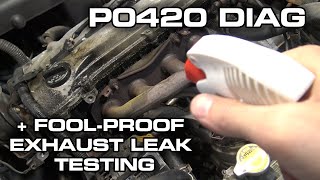
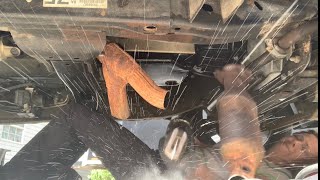
How to confirm: Visually inspect all exhaust connections from the engine to the tailpipe for black soot trails. Perform a smoke test or use soapy water on cold exhaust joints 🎬 Watch: How to perform a professional exhaust leak and P0420 test. to check for bubbles, paying close attention to the manifold-to-head connection and converter flanges.
Typical fix: Replace the faulty gasket, clamp, or broken exhaust manifold bolts. TSB #15821 specifies replacing the exhaust pipe clamp (Part No. 23424562) and gasket (Part No. 15036012).
Est. part cost: $20-$100 - Faulty Downstream Oxygen Sensor (Bank 1, Sensor 2) 🟡 Medium Probability Oxygen sensors are wear-and-tear items that degrade over time. A 'lazy' or contaminated sensor can send incorrect voltage signals to the PCM, falsely indicating a bad catalytic converter. Oil consumption from AFM issues can also foul the sensor.
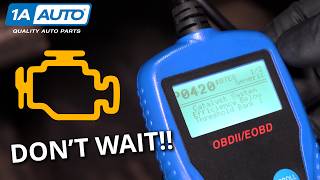
How to confirm: Use a scan tool to graph the voltage of the upstream and downstream O2 sensors. The downstream (Sensor 2) voltage should be relatively steady (e.g., above 0.5V). If it's stuck at a certain voltage or fluctuates rapidly like the upstream sensor, the sensor is likely faulty. A good diagnostic step is to swap the Bank 1 and Bank 2 downstream sensors and see if the code changes to P0430.
Typical fix: Replace the Bank 1, Sensor 2 oxygen sensor. The common ACDelco part number is 213-4229, which cross-references to GM part 12609457.
Est. part cost: $50-$150 - Failed Catalytic Converter 🟡 Medium Probability Catalytic converters can fail from old age or, more commonly, from contamination due to an underlying engine issue. Misfires, coolant leaks, or excessive oil consumption (a known issue with AFM V8s) can send unburnt fuel, coolant, or oil into the exhaust, overheating and destroying the converter's internal structure.
How to confirm: If exhaust leaks and the O2 sensor have been ruled out, this is the likely cause. An infrared thermometer can be used to check the converter's temperature; the outlet should be at least 100°F hotter than the inlet on a fully warmed-up engine. If it's cooler or the same temperature, it's not working.
Typical fix: Replace the Bank 1 catalytic converter. Crucially, any engine issues like misfires (P0300-P0308), oil consumption, or fuel system problems must be repaired first to prevent damaging the new converter.
Est. part cost: $400-$1200 - Engine Misfires or Rich/Lean Fuel Condition ⚪ Low Probability
How to confirm: Check for other stored trouble codes, especially P0300-P0308 (misfires) or fuel trim codes (P0171, P0174, P0172, P0175). Address these codes before suspecting the converter.
Typical fix: Repair the root cause of the misfire or fuel condition, which could be worn spark plugs, bad ignition coils, leaking fuel injectors, or a vacuum leak.
Est. part cost: $50-$500
Rare But Worth Checking
- Excessive Oil Consumption (AFM/DOD): The Active Fuel Management (AFM) or Displacement on Demand (DOD) system on 5.3L and other V8s is notorious for causing high oil consumption. This oil burns in the combustion chamber and passes into the exhaust, where it coats the catalytic converter's substrate, poisoning it and rendering it ineffective. This is a very common root cause for recurring P0420 codes on these trucks.
- Contaminated Fuel: Using leaded fuel (if available) or significant contamination can quickly poison the catalytic converter.
- Internal Engine Wear: Excessive oil or coolant consumption from worn piston rings or leaking head gaskets can contaminate and clog the catalytic converter over time.
- ECM Calibration Issue: In some cases, the sensitivity of the P0420 diagnostic is too high. GM has released software updates for other models to correct this. While not the most common cause, checking if an ECM update is available is a valid diagnostic step if all hardware checks out.
Diagnosis Steps
- Check for any other stored DTCs with a scan tool. If misfire (P030x) or fuel trim (P017x) codes are present, diagnose and repair those first.
- Visually inspect the entire exhaust system for obvious cracks, rust holes, or loose connections, especially around the exhaust manifolds and catalytic converter flanges. Look for black soot trails indicating a leak.
- Perform an exhaust leak test using a smoke machine or soapy water. As per TSB #15821 and #PIP5110A, check carefully at the converter outlet clamp and even areas after the rear O2 sensor.
- With a scan tool, view the live data graph for the Bank 1 oxygen sensors (Sensor 1 and Sensor 2). At a steady 2,000 RPM, Sensor 1 should show rapid up-and-down fluctuation, while Sensor 2 should show a much flatter, steadier voltage. If Sensor 2 mirrors Sensor 1, the converter is likely bad.
- If the Sensor 2 reading is flat, unresponsive, or seems 'lazy', test the sensor itself. It may be faulty. Consider swapping with the Bank 2 sensor to see if the code follows to P0430.
- With the engine fully warmed up, use an infrared thermometer to measure the temperature of the exhaust pipe just before and just after the catalytic converter. The outlet temperature should be at least 100°F hotter than the inlet. If not, the converter is not working.
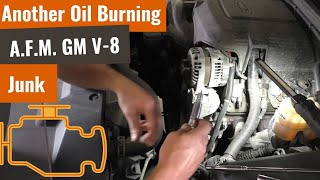
- Check engine oil level. If it is consuming oil, investigate AFM/DOD issues as the root cause 🎬 See this guide on dealing with GM's oil burning AFM issues. before replacing the converter.
- If all other tests are inconclusive, the catalytic converter is the most likely failure point.
Parts You'll Likely Need
- Bank 1 Catalytic Converter — This is the component identified by the code, replaced after ruling out leaks and sensor issues.
Trusted brands: ACDelco, Walker Exhaust, MagnaFlow
OEM price range: $800-$1200
Aftermarket price range: $400-$700
Related Codes That Often Appear With This One
- P0430 — This is the same efficiency code for Bank 2 (passenger side). If both appear together, it points towards a systemic issue like bad fuel, an air intake leak, or severe engine wear affecting both banks. It's also common for both converters to fail around the same time due to age.
- P0300-P0308 — These are cylinder misfire codes. An active misfire allows unburnt fuel to enter the exhaust, which will quickly overheat and destroy the catalytic converter. A misfire is often the root cause of a P0420 code.
Technical Service Bulletins (TSBs) & Recalls

- 15821
- PIP5110A
- PIP3119P
Platform-Specific Known Issues
- TSB #15821: Special coverage for 2013 models with 6.0L engine for a leak at the Bank 1 converter outlet flange causing P0420.
- TSB #PIP5110A: Notes that on 2011-2013 HD models, a leak *after* the Bank 1 Sensor 2 can still set a P0420 code.
- AFM Oil Consumption: V8 engines with Active Fuel Management are prone to consuming oil, which contaminates and destroys the catalytic converters, leading to a legitimate P0420 code that will return if the oil issue isn't fixed.
Mechanic-Grade Diagnostic Values
- Downstream O2 Sensor (Bank 1, Sensor 2) Voltage — expected: Relatively stable and flat, typically above 0.5V - 0.6V at a steady 2,000 RPM.. Failure: Voltage fluctuates rapidly, mimicking the pattern of the upstream (Sensor 1) O2 sensor.
- Upstream O2 Sensor (Bank 1, Sensor 1) Voltage — expected: Rapidly fluctuating between approximately 0.1V and 0.9V at operating temperature.. Failure: Slow, lazy, or stuck voltage.
- Long/Short Term Fuel Trims — expected: Within the range of -5% to +5%.. Failure: Values significantly outside the normal range, indicating an underlying fuel mixture problem that could damage the converter.
- Catalytic Converter Temperature Differential — expected: Outlet pipe temperature should be at least 100°F hotter than the inlet pipe temperature on a fully warmed-up engine.. Failure: Outlet temperature is the same or cooler than the inlet, indicating the converter is not working.
Hidden / Shadow Codes Worth Checking
- Mode $06, Test ID $53 (or similar): This is not a trouble code, but a raw data value from the onboard catalyst efficiency monitor test. It allows a technician to see how close the converter is to the failing threshold before the P0420 code is set. A value approaching the manufacturer's limit indicates a marginal converter. (see via A professional scan tool with Mode $06 data capability is required.)
Scan Tool Commands That Help
- GDS2 / Tech2: Catalyst Monitor Test — To manually initiate the onboard diagnostic test for the catalytic converter after a repair, to verify the fix without having to complete a full drive cycle.
- GDS2 / Tech2: O2 Sensor Live Data Graphing — This is the primary diagnostic step to visually compare the activity of the upstream and downstream O2 sensors to determine if the converter is functioning or if a sensor is faulty.
Wiring & Ground Locations
- G103 — On the front of the passenger side (Bank 2) cylinder head.. This is a primary engine ground. A poor connection here can cause erratic sensor readings, including for the oxygen sensors, potentially leading to false codes like P0420.
- Underhood Fuse Block — In the engine compartment, on the driver's side.. The heater circuits for the oxygen sensors are powered by fuses in this block (e.g., Fuses 8 and 18 on some models). A blown fuse for the O2 heater can cause slow sensor response and trigger catalyst efficiency codes.
- ECM Connector C2 (or X2) — At the Engine Control Module (ECM).. This connector contains the pins for the O2 sensor signals. For example, on some E38 ECMs, the Bank 1 Sensor 2 (downstream) high signal is on pin 69 (TN/WH wire) and the low signal is on pin 68 (PU/WH wire). Damage to these specific pins or wires can cause incorrect readings and a false P0420.
Real Owner Repair Stories
- Go-Parts.com owner report compilation (GMC Sierra (generation unspecified)) — Persistent P0420 code.
❌ Tried (didn't work) Replacing oxygen sensors, Replacing the catalytic converter
✅ What actually fixed it The actual cause was a cracked exhaust manifold that was missed during an initial inspection and smoke test. The crack likely only opened up when the manifold was hot. A thorough visual inspection after removing the heat shield was required to find the fault. - BobIsTheOilGuy forum user (2009 Pontiac Vibe with 2AZ-FE engine (similar issue dynamics)) — P0420 code, excessive oil consumption (1qt/1000-1200 miles), occasional low/hunting idle.
❌ Tried (didn't work) Changing spark plugs (fixed a previous misfire code), Replacing ignition coil boots, Using various oil and fuel additives (MMO, Redline, Lucas, Kreen)
✅ What actually fixed it The consensus from other users was that the excessive oil consumption was the root cause, which had likely contaminated and destroyed the catalytic converter. The final fix requires addressing the oil consumption (e.g., piston soak or engine rebuild) and then replacing the catalytic converter. Simply replacing the converter would lead to repeat failure.
"I Checked Everything" — The Actual Cause
- In some reported cases, a standard smoke test did not reveal any leaks, but the P0420 code persisted. The eventual cause was found to be a hairline crack in the exhaust manifold. These cracks can be difficult to detect when the engine is cold and may only open up and leak significantly when the metal expands with heat, making a cold smoke test ineffective. A thorough visual inspection with the heat shield removed is often necessary to find such a failure.
OEM Part Supersession History
Varies→GM 12609457 (ACDelco 213-4229)— Part consolidation and design updates over the model years.
Heads up: GM Part #12609457 and its ACDelco equivalent 213-4229 are the widely specified downstream (Bank 1 Sensor 2 and Bank 2 Sensor 2) oxygen sensors for most 2008-2013 Sierra 1500 V8 engines. While they are physically interchangeable, some sources note that this part may require programming or a special setup procedure to ensure proper operation, though this is not always necessary.
Model Year Variations Within This Range
- 2007-2013 (GMT900): The introduction and prevalence of Active Fuel Management (AFM) on 5.3L and 6.2L V8 engines is a major factor for P0420 on these later models. This system is a primary contributor to the oil consumption that poisons catalytic converters. The earlier 2006 and 2007 "Classic" (GMT800) models are less prone to this specific failure mode.
- 2013: TSB #15821 specifically calls out 2013 models with the 6.0L engine for an exhaust leak at the Bank 1 converter outlet clamp causing P0420, providing specific part numbers for the clamp and gasket.
Helpful Videos

We Have This Part in Stock



The information in this article is provided for general reference and educational purposes only. Vehicle specifications, procedures, and part compatibility can vary by production date, trim level, and region. Always consult your vehicle's factory service manual and verify part numbers before purchasing or performing repairs. Safety-critical components such as airbags, seat belts, and braking systems should be installed by a qualified professional.
- Gmc SIERRA 1500:
- 🎬 Helpful Videos
- 🛍️ Shop This Part
- What's Unique About the 2006-2013 Gmc SIERRA 1500
- Diagnostic Flowchart
- Symptoms You May Notice
- Most Likely Causes
- Rare But Worth Checking
- Diagnosis Steps
- Parts You'll Likely Need
- Related Codes That Often Appear With This One
- Technical Service Bulletins (TSBs) & Recalls
- Platform-Specific Known Issues
- Mechanic-Grade Diagnostic Values
- Hidden / Shadow Codes Worth Checking
- Scan Tool Commands That Help
- Wiring & Ground Locations
- Real Owner Repair Stories
- "I Checked Everything" — The Actual Cause
- OEM Part Supersession History
- Model Year Variations Within This Range
- 🎟️ Get 5% Off