

P0420 on 2007-2011 GMC Savana: Catalyst Efficiency Causes and Fixes
On a 2007-2011 GMC Savana, P0420 often means the Bank 1 catalytic converter is failing. However, before replacing this expensive part, thoroughly check for exhaust leaks from broken manifold bolts and faulty oxygen sensors, as these are very common, cheaper-to-fix causes on this specific platform.
- Do not immediately assume the catalytic converter is bad. A P0420 code on a Savana is frequently caused by a cheaper-to-fix exhaust leak or a faulty oxygen sensor.
- Your first step should be a thorough inspection for exhaust leaks, especially at the exhaust manifolds, as broken bolts are a very common problem on this platform.
- Use a scan tool to watch the live data from the downstream O2 sensor (Bank 1, Sensor 2). If it's fluctuating wildly, it points towards a problem. If it's steady, the converter is likely doing its job.
- Always fix any other engine codes (especially for misfires) before replacing the catalytic converter, as they are often the root cause of the converter's failure.
What's Unique About the 2007-2011 Gmc SAVANA
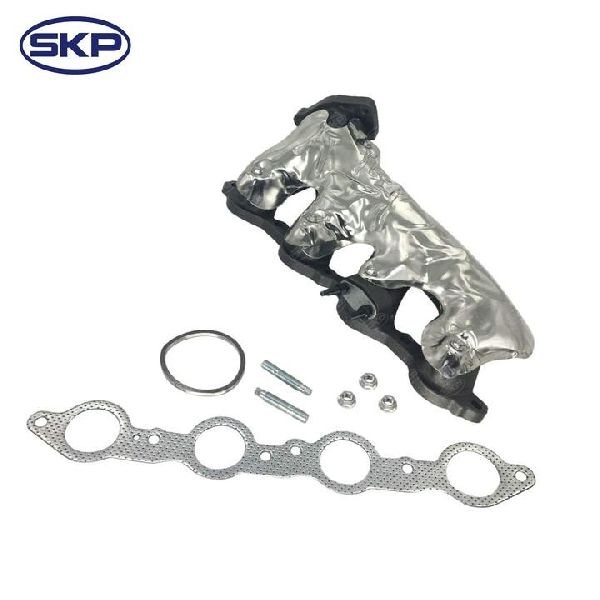
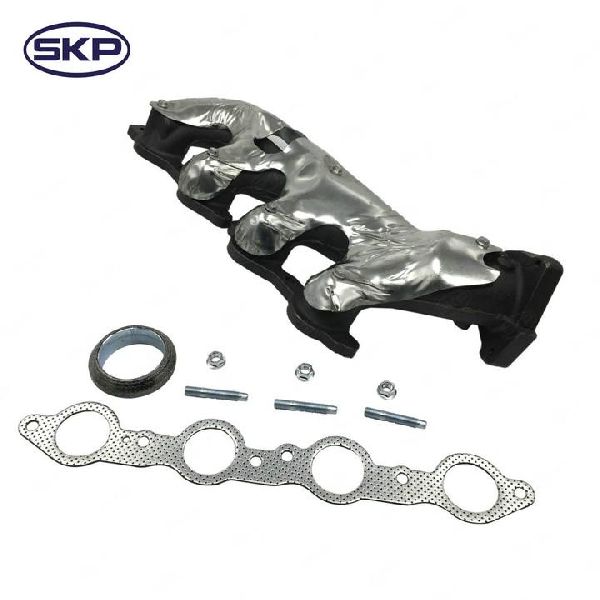
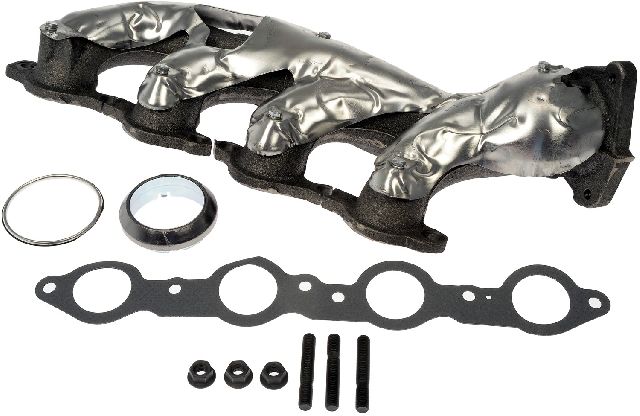
For this generation of GMC Savana and its sibling, the Chevrolet Express, the Vortec V8 engines have a widely documented tendency for the rear-most exhaust manifold bolts to break off flush with the cylinder head. This creates an exhaust leak that allows outside air to be pulled into the exhaust stream, which can trick the oxygen sensors and falsely trigger a P0420 code. GM even issued technical service bulletins (like #PIP5110C) advising technicians to check for exhaust leaks, highlighting this as a common issue that can be misdiagnosed as a failed converter. Aftermarket brackets are available that clamp the manifold in place, providing a permanent repair without the difficult task of extracting the broken bolt.
Diagnostic Flowchart
Tap your situation to follow the diagnostic path that matches what you're seeing on this vehicle.
Symptoms You May Notice
- Check Engine Light is on
- Reduced engine power or sluggish acceleration, especially if the converter is clogged
- A smell of rotten eggs (sulfur) from the exhaust
- Poor fuel economy
- Failure to pass an emissions test
- A ticking noise from the engine bay, especially when cold, indicating an exhaust leak
- Immediately replacing the catalytic converter without checking for exhaust leaks or testing the oxygen sensors. An exhaust leak from a broken manifold bolt is a very common cause for P0420 on these vans and is much cheaper to fix.
- Replacing the oxygen sensor when it is accurately reporting the inefficiency of the catalytic converter or the presence of an exhaust leak.
Most Likely Causes
- Exhaust Leak (Especially Broken Manifold Bolts) 🔴 High Probability GM TSB #PIP5110C specifically calls out checking for exhaust leaks. These vans and related trucks with Vortec engines are notorious for the rear exhaust manifold bolts breaking, creating a leak that lets in oxygen and causes incorrect sensor readings. This is often the true culprit when a P0420 is set.
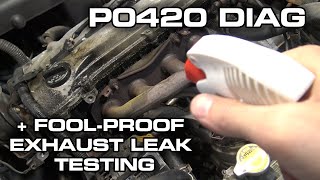
How to confirm: Listen for a ticking noise from the engine area, especially on a cold start. Visually inspect the exhaust manifolds for broken bolt heads (the rear-most ones are most common) or black soot trails indicating a leak. A smoke test can definitively locate hard-to-see leaks. 🎬 Watch: How to perform an exhaust leak and efficiency test.
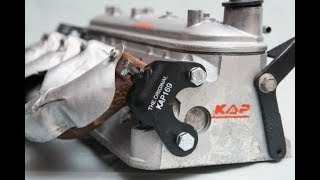
Typical fix: Repair the leak. For broken manifold bolts, the options are to extract the broken bolt and replace it, or to install an aftermarket exhaust manifold clamp/bracket (e.g., from Dorman) which is a much easier and often permanent fix.
Est. part cost: $20-$100 for a gasket and bolts or an aftermarket clamp. - Failing Catalytic Converter 🟡 Medium Probability Catalytic converters can fail from age, but are often damaged by other issues like unaddressed engine misfires or oil consumption which are not uncommon in high-mileage work vans. Raw fuel from a misfire can overheat and melt the converter's internal structure.
How to confirm: After ruling out all other causes, a technician can use a scan tool to confirm the downstream O2 sensor is mirroring the upstream sensor's pattern. A temperature check with an infrared thermometer showing the outlet is not significantly hotter (at least 100°F) than the inlet also indicates failure.
Typical fix: Replace the Bank 1 catalytic converter. This should only be done after confirming there are no exhaust leaks or sensor issues.
Est. part cost: $400-$1500 for aftermarket, $2500+ for OEM. - Faulty Downstream Oxygen (O2) Sensor 🟡 Medium Probability O2 sensors are wear items and can become 'lazy' or biased with age, sending incorrect data to the PCM. However, many people replace the sensor when the real issue is an exhaust leak or a bad converter.
How to confirm: Use a scan tool to graph the voltage of the Bank 1 Sensor 2 (downstream). A healthy sensor on a good converter will show a relatively steady voltage. If it's fluctuating rapidly like the upstream sensor, either the sensor is bad or the converter has failed. Swapping the Bank 1 and Bank 2 downstream sensors (if applicable) and seeing if the code changes to P0430 can also help diagnose a bad sensor.
Typical fix: Replace the Bank 1, Sensor 2 oxygen sensor.
Est. part cost: $40-$120 - Engine Misfires or Fuel System Issues ⚪ Low Probability Worn spark plugs, failing ignition coils, or leaky fuel injectors can cause unburnt fuel to enter the exhaust, which superheats and destroys the catalytic converter. These issues must be fixed to prevent repeat failure of a new converter.
How to confirm: Check for other trouble codes, especially misfire codes (P0300-P0308) or lean/rich codes (P0171, P0174). Address these codes first before suspecting the converter.
Typical fix: Perform a tune-up (spark plugs, wires), replace faulty ignition coils, or repair leaking fuel injectors. This must be done before replacing the converter.
Est. part cost: $50-$500
Rare But Worth Checking
- Contaminated Catalytic Converter: An internal engine problem, like a leaking head gasket or bad piston rings causing excessive oil consumption, can allow engine oil or coolant to enter the exhaust and contaminate the catalytic converter, causing it to fail.
- Outdated PCM Software: On some GM vehicles, the parameters for triggering a P0420 code were too sensitive from the factory. A dealer may have an updated calibration for the Powertrain Control Module (PCM) that can resolve the issue.
Diagnosis Steps
- Scan for other codes. If misfire (P030x) or fuel trim (P0171/P0174) codes are present, diagnose and fix them first, as they are likely the root cause.
- Inspect for exhaust leaks. This is the most critical first step on a Savana. Listen for a cold-start tick. Carefully check the exhaust manifolds for broken bolts, especially the ones near the firewall. Look for soot marks around gaskets and pipe connections. A smoke test using a shop vacuum on its blow setting is an effective DIY method.
- Analyze O2 sensor data. Use a scan tool to view live data graphs. The upstream O2 sensor (Bank 1, Sensor 1) should fluctuate rapidly between ~0.1V and ~0.9V. The downstream O2 sensor (Bank 1, Sensor 2) should hold a relatively steady, high voltage (typically >0.6V). If the downstream sensor is mirroring the upstream sensor's rapid fluctuations, the converter has likely failed or there is a significant exhaust leak.
- Test the O2 sensors. If the downstream sensor seems lazy or biased, consider it a suspect. You can test its reaction time or swap it with the sensor from Bank 2 (if the wiring reaches) to see if the fault code changes to P0430.
- Check catalytic converter temperature. Use an infrared thermometer to measure the temperature of the pipe entering and exiting the converter after the engine is fully warmed up and held at ~2000 RPM. The outlet should be at least 100°F hotter than the inlet. If it's not, the converter is not working.
- If all other components check out and there are absolutely no exhaust leaks, the catalytic converter is the most likely culprit.
Parts You'll Likely Need
- Exhaust Manifold Repair Clamp/Bracket — A common and cost-effective solution for the frequent broken rear exhaust manifold bolt, which causes leaks and a false P0420. This avoids the difficult job of extracting the broken bolt.
Trusted brands: Dorman, Kral Auto Parts (KAP108/KAP169) 🎬 See this walkthrough for installing a manifold repair clamp.
OEM price range: N/A
Aftermarket price range: $30-$80 - Downstream Oxygen Sensor (Bank 1, Sensor 2)
(OEM #12616125 (ACDelco))— A faulty sensor can send incorrect data, causing a false P0420 code. It's a common wear item.
Trusted brands: ACDelco, Denso (234-4243), Bosch (15282), NTK
OEM price range: $80-$150
Aftermarket price range: $40-$90 - Bank 1 Catalytic Converter
(OEM #19420106)— This is the final component to fail, often as a result of other untreated issues. It is the most expensive part and should only be replaced after all other causes are ruled out.
Trusted brands: GM Genuine, Walker, MagnaFlow
OEM price range: $2500+
Aftermarket price range: $400-$1500
Related Codes That Often Appear With This One
- P0430 — This is the same catalyst efficiency code but for Bank 2 (driver's side). If both appear, it could indicate a systemic issue like bad fuel, or that both converters are at the end of their life. It could also mean both rear manifold bolts have broken, one on each side.
- P0300-P0308 — These are misfire codes. An engine misfire is a primary root cause of catalytic converter failure because it sends raw fuel into the exhaust, which overheats and melts the converter's internal structure.
- P0171 / P0174 — These 'System Too Lean' codes can indicate a vacuum leak or an exhaust leak before the upstream O2 sensor, which can affect the converter's operating conditions and potentially trigger a P0420 over time.
Technical Service Bulletins (TSBs) & Recalls
- PIP5110C: Advises checking for exhaust leaks behind the Bank 1 Number 2 oxygen sensor when diagnosing P0420.
- PIP3119P: Mentions that P0420/P0430 codes may be disabled under certain conditions, possibly related to software updates or specific vehicle operations.
- 18-NA-331 (Replaced by a newer bulletin): Addresses MIL illumination for P0420, potentially due to a calibration error requiring an ECM reprogram.
Platform-Specific Known Issues
- Broken Exhaust Manifold Bolts: The Vortec engines in these vans are widely known for the rear-most exhaust manifold bolts breaking off in the cylinder head due to heat cycles and stress. This causes a significant exhaust leak right before the O2 sensors, often leading to a false P0420 code. Many owners report a 'ticking' sound on startup that may quiet down as the engine warms and the metal expands.
- Manifold Clamp as a Common Fix: Due to the difficulty of extracting the broken rear bolts (especially on the driver's side near the firewall), a popular and effective repair is to install an aftermarket clamp. This device bolts to unused holes on the cylinder head and has a jackscrew that presses against the manifold, restoring the seal.
- TSB on Exhaust Leaks: GM issued Technical Service Bulletin #PIP5110C, which specifically instructs technicians to check for exhaust leaks behind the rear oxygen sensor when diagnosing a P0420, confirming this is a known factory issue.
Mechanic-Grade Diagnostic Values
- Upstream O2 Sensor (Bank 1, Sensor 1) Voltage — expected: Rapidly fluctuating between approximately 0.1V (lean) and 0.9V (rich) on a warm engine in closed loop.. Failure: A flat, non-responsive voltage, or one that is stuck high or low.
- Downstream O2 Sensor (Bank 1, Sensor 2) Voltage — expected: A relatively steady voltage, typically above 0.6V (e.g., 0.6V-0.8V) on a warm engine with a good catalytic converter.. Failure: Voltage fluctuates rapidly, mirroring the pattern of the upstream sensor. This indicates the catalyst is not storing oxygen.
- Catalytic Converter Temperature Differential — expected: The exhaust pipe outlet of the converter should be at least 100°F hotter than the inlet pipe after the engine is fully warmed up and held at a steady 2000 RPM.. Failure: The outlet temperature is the same as, or cooler than, the inlet temperature, indicating no chemical reaction is occurring.
- Long Term Fuel Trim (LTFT) - Bank 1 — expected: As close to 0% as possible, with a normal range typically within +/- 5%.. Failure: Sustained positive values above +10% suggest the PCM is compensating for a lean condition, often caused by an unmetered air leak (vacuum or exhaust leak). Sustained negative values below -10% indicate a rich condition.
Hidden / Shadow Codes Worth Checking
- Mode $06, TID $85 (Catalyst Monitor Bank 1): This is not a DTC, but a diagnostic monitor test result accessible with an advanced scan tool. It shows the measured efficiency value from the PCM's last catalyst test cycle. The PCM compares this value against a minimum threshold to decide whether to set P0420. (see via A professional scan tool (like a GM Tech2/GDS2 or high-end generic scanner) that can display Mode $06 data. The specific Test ID (TID) and Component ID (CID) may vary slightly by year and specific ECU.)
Scan Tool Commands That Help
- GM Tech2 / GDS2: Catalyst System Test / Catalyst Monitor — This is a specific diagnostic routine that forces the conditions needed to test the catalytic converter's oxygen storage capacity. The tool may command the engine to run lean, then rich, while graphing the response of the front and rear O2 sensors to verify function, providing a more definitive pass/fail than passive observation.
- Any Graphing Scan Tool: GM Drive Cycle Procedure — After a repair (like replacing a sensor or fixing a leak), the catalyst monitor must be run to completion to verify the fix and turn off the check engine light. A specific GM drive cycle involving a cold start, idle periods, and steady-state cruising at 55 mph for 5 minutes is required to execute the test.
Wiring & Ground Locations
- G101 — Typically on the cylinder head on the front of the engine, passenger side. A main ground strap runs from the negative battery terminal to this point.. A poor engine ground can introduce electrical noise and voltage offsets into sensor readings. The PCM relies on a stable ground reference for all its sensors, including the O2 sensors. A faulty G101 can cause erratic O2 sensor readings that could be misinterpreted as a catalyst problem.
- Bank 1 Sensor 2 Harness Connector — On the passenger side of the vehicle, following the wire up from the downstream oxygen sensor located in the exhaust pipe just after the catalytic converter.. This is the primary sensor for the P0420 code. The wiring harness is exposed to significant heat and road debris. Physical damage, melting, or corrosion at the connector can cause a loss of signal or incorrect readings, directly triggering the code.
- Chassis/Frame Ground — There are multiple grounds to the frame rail in the engine bay and under the cab. A key one is often located on the frame rail near the front of the engine.. The entire electrical system, including the PCM and its sensors, uses the chassis and engine block as a common ground plane. A corroded or loose frame ground can cause unpredictable electrical issues, including emissions-related fault codes.
Real Owner Repair Stories
- YouTube user 'The Daninator' (2002 GMC Sierra 5.3L V8 (similar Vortec engine and common problem)) — Exhaust leak tick, broken rear manifold bolt discovered during header installation.
❌ Tried (didn't work) Attempting to weld a nut onto the bolt that was broken off flush with the cylinder head failed.
✅ What actually fixed it An inexpensive aftermarket exhaust manifold clamp/bracket was installed. This bracket uses two adjacent, intact bolt holes on the cylinder head to apply pressure to the manifold flange, sealing the leak without needing to extract the broken bolt. - Car Talk Community Forum (Unspecified vehicle, but common P0420 scenario) — P0420 code appeared immediately after having an exhaust pipe replaced.
❌ Tried (didn't work) The mechanic who did the pipe replacement recommended ignoring the light.
✅ What actually fixed it The diagnosis pointed to the possibility that the new pipe installation damaged the O2 sensor or its wiring, or that a previous large leak was masking the underlying P0420 condition. The fix required properly diagnosing the sensor and wiring post-repair, not just replacing the converter.
"I Checked Everything" — The Actual Cause
- A hairline crack in the cast iron exhaust manifold may not leak when the engine is cold, potentially passing a cold smoke test. However, once the engine reaches operating temperature, the metal expands, the crack opens up, and it begins to leak. This can cause a P0420 code that is difficult to diagnose because the leak isn't present during a typical cold inspection.
When the Usual Fixes Don't Work
- While replacing the catalytic converter is a common fix, it should be the last resort. In many documented cases for these vans, the P0420 code was ultimately resolved by a much cheaper repair. Owners have reported fixing the code by installing a $50 exhaust manifold clamp to seal a leak from a broken bolt, after receiving quotes for over $2000 to replace the converter. Another common resolution is finding and repairing a damaged O2 sensor wire or a corroded ground connection, which restored proper sensor readings and cleared the code without replacing any major components.
OEM Part Supersession History
15120813, 15751269, 15853439, 20858261, 25758570→19420106— Standard part evolution, consolidation, and minor design updates by the manufacturer.
Heads up: Part 19420106 is the correct replacement for the previous numbers for the Bank 1 (Right/Passenger side) converter on 4.8L and 6.0L engines with federal emissions. Ensure correct engine and emissions type before ordering.
Model Year Variations Within This Range
- 2011: Some 2011 models may be included in a voluntary emissions recall (#11221) for downstream oxygen sensors that could fracture. While the P0420 code is for efficiency and not directly for a sensor circuit fault, a physically damaged or failing sensor from this issue could provide inaccurate data leading to a false P0420. It is worth checking if this recall has been performed.
Helpful Videos
We Have This Part in Stock



The information in this article is provided for general reference and educational purposes only. Vehicle specifications, procedures, and part compatibility can vary by production date, trim level, and region. Always consult your vehicle's factory service manual and verify part numbers before purchasing or performing repairs. Safety-critical components such as airbags, seat belts, and braking systems should be installed by a qualified professional.
- Gmc SAVANA:
- 🎬 Helpful Videos
- 🛍️ Shop This Part
- What's Unique About the 2007-2011 Gmc SAVANA
- Diagnostic Flowchart
- Symptoms You May Notice
- Most Likely Causes
- Rare But Worth Checking
- Diagnosis Steps
- Parts You'll Likely Need
- Related Codes That Often Appear With This One
- Technical Service Bulletins (TSBs) & Recalls
- Platform-Specific Known Issues
- Mechanic-Grade Diagnostic Values
- Hidden / Shadow Codes Worth Checking
- Scan Tool Commands That Help
- Wiring & Ground Locations
- Real Owner Repair Stories
- "I Checked Everything" — The Actual Cause
- When the Usual Fixes Don't Work
- OEM Part Supersession History
- Model Year Variations Within This Range
- 🎟️ Get 5% Off