

P0420 on 2020-2025 Ford Explorer: Causes and Fixes for Catalyst Inefficiency
On a 2020-2025 Ford Explorer, code P0420 is frequently caused by a software glitch that requires a dealer PCM update, as noted in Ford TSBs 25-2072 and 25-2188. If not a software issue, the catalytic converter itself may have failed, a known issue on 2020 3.3L models covered by Ford's extensive Customer Satisfaction Program 24M01, which extends the warranty to 15 years/150,000 miles. Always have a dealer check for software updates and program eligibility before replacing expensive parts.
- Always check with a Ford dealer for applicable software updates (TSBs) before performing any repairs; it could be a free or low-cost fix.
- For 2020 models with the 3.3L engine, be aware of service program 24M01 S1, which may cover the replacement of a failed catalytic converter.
- While a failed catalytic converter is a common cause, do not replace it without first ruling out software issues, exhaust leaks, and faulty oxygen sensors.
- If you have any other engine codes, especially for misfires (P0300-P0308), they must be resolved first to prevent damaging a new catalytic converter.
What's Unique About the 2020-2025 Ford EXPLORER

The sixth-generation Ford Explorer is unique regarding code P0420 due to multiple official Technical Service Bulletins (TSBs) and a specific Customer Satisfaction Program issued by Ford. These bulletins point to two primary, distinct issues: powertrain control module (PCM) software that can incorrectly trigger the code, and a separate issue of premature catalytic converter failure on models equipped with the 3.3L engine. This makes it critical to check for applicable TSBs and programs with a dealer before assuming a part has failed, as the repair may be covered free of charge.
Diagnostic Flowchart

Tap your situation to follow the diagnostic path that matches what you're seeing on this vehicle.
Symptoms You May Notice
- Check Engine Light is on
- Reduced engine performance or lack of acceleration (less common)
- Rough idle (less common)
- Decreased fuel efficiency (less common)
- A sulfur or "rotten egg" smell from the exhaust (in rare cases of a severely failed converter)
- Replacing the catalytic converter when only a PCM software update was needed.
- Replacing the oxygen sensors when the catalytic converter has truly failed. This is a very common mistake made by DIYers and even some shops.
- Replacing the catalytic converter without addressing an underlying issue (like a misfire or rich fuel condition) that caused it to fail in the first place.
Most Likely Causes

- Powertrain Control Module (PCM) Software Error 🔴 High Probability Ford has identified that the PCM software on some vehicles, particularly 2025 models with the 2.3L engine, may be overly sensitive or contain logic that incorrectly flags a P0420 code, sometimes along with P008A. This is documented in TSBs 25-2072 and 25-2188.
How to confirm: Contact a Ford dealership with your vehicle's VIN. They can check their OASIS system to see if TSB 25-2072 or TSB 25-2188 are open and apply to your specific Explorer. This should be the first step before any parts are replaced.
Typical fix: The dealer will reprogram the Powertrain Control Module (PCM) with the latest updated software, which corrects the faulty logic.
Est. part cost: $0-$250 - Failed Catalytic Converter 🔴 High Probability Ford issued Customer Satisfaction Program 24M01 for 2020 Explorers and Police Interceptor Utilities with the 3.3L engine due to converters that may develop cracks or internal heat damage. This program acknowledges a specific hardware issue on this subset of vehicles.
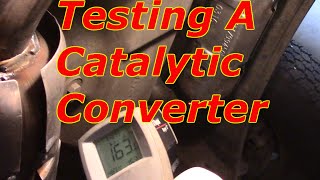
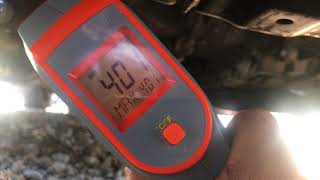
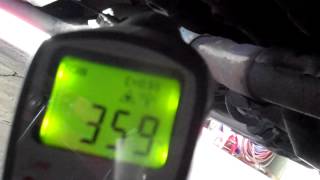
How to confirm: After ruling out software issues, a technician can confirm a bad converter. A professional scan tool can graph O2 sensor data; a failed converter shows a downstream sensor (Sensor 2) voltage that fluctuates rapidly, mimicking the upstream sensor (Sensor 1). 🎬 Watch: How to test your converter using a scanner and thermometer. An infrared thermometer can also be used; the converter outlet should be at least 100°F hotter than the inlet after the engine is warm.
Typical fix: Replace the Bank 1 catalytic converter. For eligible 2020 3.3L vehicles, this is covered free of charge under Ford's program 24M01, which extends coverage to 15 years or 150,000 miles. The program also mandates an inspection of the engine wiring harness for chafing.
Est. part cost: $700-$2500 - Faulty Downstream Oxygen (O2) Sensor 🟡 Medium Probability
How to confirm: A lazy or failed downstream O2 sensor can send incorrect data, tricking the PCM into thinking the converter is bad. However, this is a common misdiagnosis. A technician can test the sensor's response time and voltage output with a scan tool. A healthy downstream sensor should show a relatively stable voltage, while a failed one might be stuck or slow to respond.
Typical fix: Replace the Bank 1, Sensor 2 (downstream) oxygen sensor. It is often recommended to replace O2 sensors when replacing a converter, but replacing the sensor alone for a P0420 code is often unsuccessful.
Est. part cost: $50-$150 - Exhaust Leak ⚪ Low Probability
How to confirm: A leak in the exhaust system between the upstream and downstream oxygen sensors can draw in outside air, skewing the downstream sensor's reading and falsely triggering a P0420. A visual inspection may reveal cracks or soot trails at gaskets or flex pipes. A smoke test is the most definitive way to find a leak.
Typical fix: Repair the leak by replacing the faulty gasket, flex pipe, or exhaust component.
Est. part cost: $20-$300
Rare But Worth Checking
- Engine Misfire or Fuel System Issue: An engine that is misfiring or running rich sends unburned fuel into the exhaust, which can overheat and destroy the catalytic converter's internal structure. If you have other codes like P030x (misfire) or fuel trim codes, they must be addressed first to prevent destroying a new converter.
- High Sulfur Content in Fuel: While not specific to the Explorer in a TSB, other Ford models like the F-150 and Expedition have a known issue where high sulfur fuel can temporarily coat the catalyst, reducing its efficiency and triggering P0420/P0430. The fix is a specific 'de-sulfate' drive cycle procedure to burn off the deposits. This could be a potential cause if the code appeared after refueling at a different station.
Diagnosis Steps
- Check for TSBs and Customer Satisfaction Programs: This is the most critical first step. Contact a Ford dealer with your VIN to see if TSB 25-2072, TSB 25-2188, or program 24M01 S1 apply. A repair may be covered at no cost.
- Scan for Other Codes: Use an OBD-II scanner to check for any other pending or stored codes. Misfire (P0300-P0308) or fuel system codes must be diagnosed and repaired first to prevent damaging a new converter.
- Analyze Oxygen Sensor Data: Use a scan tool with live data graphing. With the engine warm and at a steady 2,000 RPM, observe the voltage of Bank 1 Sensor 1 (upstream) and Bank 1 Sensor 2 (downstream). The upstream sensor should fluctuate rapidly (0.1V-0.9V). The downstream sensor should hold a relatively stable, high voltage (e.g., 0.6V-0.8V). If it mimics the upstream sensor's rapid switching, the converter is inefficient.
- Perform an Infrared Temperature Test: Use an infrared thermometer to measure the temperature of the exhaust pipe immediately before and after the catalytic converter. The outlet pipe should be significantly hotter (at least 100°F / 38°C) than the inlet pipe, indicating the catalyst is working. If temperatures are similar or the outlet is cooler, the converter is not functioning.
- Inspect for Exhaust Leaks: Visually and audibly inspect the exhaust system from the engine manifolds to the post-converter O2 sensor for any signs of cracks, holes, or black soot that would indicate a leak. A smoke test is the most effective method.
- Test Oxygen Sensors: If sensor data is inconclusive (e.g., a flat or slow downstream sensor), the sensor itself should be tested. However, remember that a bad sensor is less likely to be the root cause than a bad converter on this platform.
- Perform a Backpressure Test: If a clogged converter is suspected (indicated by a loss of power), a backpressure test can confirm if the exhaust flow is restricted before the converter. 🎬 See this quick and dirty backpressure test for a clogged converter.
Parts You'll Likely Need
- Catalytic Converter (Bank 1)
(OEM #L1MZ-5E212-AC)— This is the direct cause of the code if the converter has failed internally. On 2020 3.3L models, this was a known issue addressed by Ford's Customer Satisfaction Program 24M01.
Trusted brands: Motorcraft, Walker Exhaust, MagnaFlow
OEM price range: $700-$1400
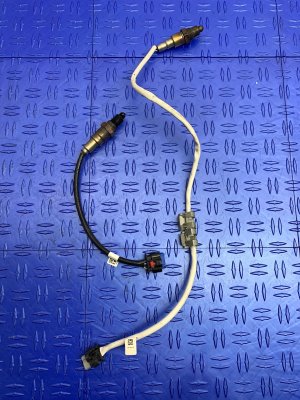
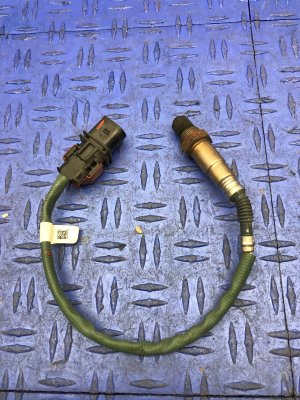
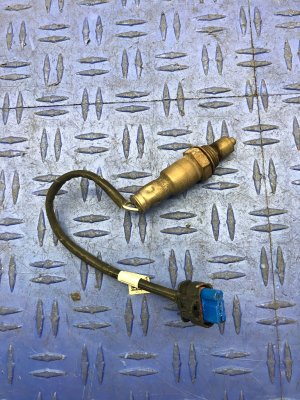
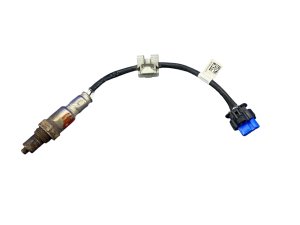
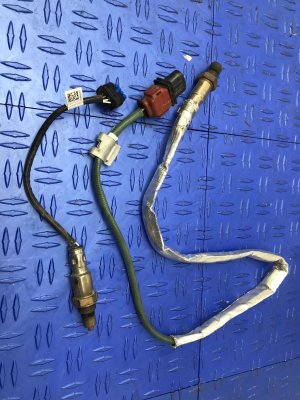
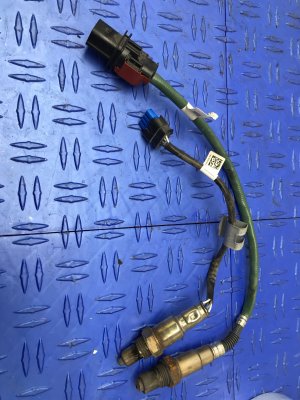
Aftermarket price range: $400-$900 - Downstream Oxygen Sensor (Bank 1, Sensor 2)
(OEM #DY-1528)— A faulty sensor can send incorrect data, falsely triggering the P0420 code. However, it is more often misdiagnosed, and the real problem is the converter itself.
Trusted brands: Motorcraft, Bosch, Denso, NTK
OEM price range: $100-$150
Aftermarket price range: $50-$100
Related Codes That Often Appear With This One
- P0430 — This is the identical code for Bank 2 (the other side of the engine). It's common to see both codes if the issue is software-related or if both converters are failing due to a systemic problem like age, contamination, or the specific defect covered by program 24M01.
- P008A — TSB 25-2072 specifically mentions that P008A (Low Pressure Fuel System Pressure - Too Low) may appear alongside P0420 on 2025 2.3L models due to the same PCM software issue.
Technical Service Bulletins (TSBs) & Recalls
- TSB 25-2072: Incorrectly illuminated MIL with DTCs P008A and/or P0420 due to PCM software.
- TSB 25-2188: Incorrectly illuminated MIL with DTC P0420 due to PCM software.
- 24M01 S1: Customer Satisfaction Program to replace catalytic converters for DTC P0420 or P0430 on 2020 3.3L engines, extending warranty to 15 years/150,000 miles.
Platform-Specific Known Issues
- Customer Satisfaction Program 24M01: For 2020 Explorer and Police Interceptor Utility models with the 3.3L engine, Ford initiated this program to address prematurely failing catalytic converters. It provides a free replacement of both converters (if needed) and an inspection of the wire harness for potential chafing that could cause misfires. This program extends the warranty on the converters to 15 years or 150,000 miles from the warranty start date.
- PCM Software TSBs 25-2072 & 25-2188: For 2022-2025 Explorers, Ford issued bulletins for an issue where the check engine light could be incorrectly illuminated with DTC P0420 (and sometimes P008A) due to the PCM software logic. The fix is not a part replacement but a simple software update performed by a dealer.
Mechanic-Grade Diagnostic Values
- Downstream O2 Sensor (Bank 1, Sensor 2) Voltage — expected: Slowly fluctuating between 0.6 and 0.8 volts with the engine warm and held at 2,000 RPM.. Failure: If the voltage fluctuates rapidly between 0.2 and 0.8 volts, mimicking the upstream sensor, the catalytic converter is defective.
Scan Tool Commands That Help
- Ford IDS (Integrated Diagnostic System): PCM Reprogramming / Module Programming — This is required if a TSB indicates a software update is the fix for an erroneous P0420 code. It is also mandatory when replacing the entire Powertrain Control Module (PCM) to sync it with the vehicle's VIN and security system.
Wiring & Ground Locations
- PCM / ECM — The Powertrain Control Module is the central computer controlling the O2 sensors. On the 2020-2025 Explorer, the battery and main power distribution components are located under a cover in the cowl area on the passenger side of the engine bay, a key area to check for main power/ground issues.. All sensor signals for the catalyst monitoring system are sent to and interpreted by the PCM. A poor ground or power feed to the PCM itself can cause a host of erroneous codes, including P0420.
- Bank 1 O2 Sensor Harness — Bank 1 is on the side of the engine with cylinder #1. On V6 engines like the 3.0L and 3.3L, this is the bank closer to the firewall (rear of the engine bay). The wiring runs from the sensors on the exhaust pipes up to the main engine harness.. Ford's Customer Satisfaction Program 24M01 for the 3.3L engine specifically includes an inspection of the engine wiring harness for chafing, which could cause misfires that damage the catalytic converter. Any damage to the O2 sensor wiring itself can cause incorrect signals, leading to a false P0420 code.
Real Owner Repair Stories
- Reddit user in r/FordExplorer (2013 Ford Explorer (5th Gen, but relevant experience)) — P0420 and P0430 codes.
❌ Tried (didn't work) Using Cataclean fuel additive., Replacing O2 sensors., Installing cheap, third-party catalytic converters.
✅ What actually fixed it The owner stated the only real fix was to replace the converters with expensive OEM parts, costing an estimated $2,200 for the pair. - YouTube channel 'Sentinal Truck Builds- D.R.V.' (2016 Ford Explorer Sport (Turbo V6, 5th Gen)) — P0420 code, quoted $1700 by a mechanic shop.
❌ Tried (didn't work) Attempting to clean the catalytic converter.
✅ What actually fixed it The owner diagnosed the Bank 1 (firewall side) converter as bad. They ordered the part online for just over $300 and replaced it themselves, which resolved the code. - YouTube channel 'Driving Intelligence' (2011-2019 Ford Explorer (5th Gen)) — P0430 (Bank 2 equivalent of P0420) after a history of severe engine misfires.
❌ Tried (didn't work) Replacing an upstream O2 sensor did not fix the check engine light.
✅ What actually fixed it The root cause was determined to be a bad catalytic converter damaged by previous engine misfires. The owner chose to install an O2 sensor spacer (defouler) to trick the computer into clearing the code, rather than replacing the expensive converter. This is not a legal repair in emissions-testing states.
"I Checked Everything" — The Actual Cause
- A hairline crack in the exhaust manifold is a known issue on some Ford Explorers. This may not be detectable with a standard smoke test performed on a cold engine. When the engine heats up, the metal expands, opening the crack and allowing oxygen to be drawn into the exhaust stream. This extra oxygen fools the downstream O2 sensor into thinking the catalytic converter isn't working, triggering a P0420 code even though there are no apparent leaks when cold.
OEM Part Supersession History
L1MZ-5E212-H, L1MZ-5E212-Y, L1MZ-5E212-Z→L1MZ-5E212-AC— Standard part revision and improvement by the manufacturer.
Heads up: This part is for the Bank 1 (Right side) on 3.3L Gas and Hybrid engines. A significant core charge (around $500) may apply, which is refunded when the old part is returned.
Model Year Variations Within This Range
- 2020 with 3.3L Engine: These models are subject to Customer Satisfaction Program 24M01 for premature catalytic converter hardware failure. The cause is primarily a hardware defect.
- 2022-2025: These models are subject to TSBs 25-2072 and 25-2188, where the P0420 code is often caused by a PCM software error, not a hardware failure.
- Models with 2.3L/3.0L Turbo Engines (EcoBoost/ST): On turbocharged models, the Bank 1 catalytic converter is often located against the firewall, bolted directly to the turbocharger, making access more difficult than the Bank 2 converter, which is on the radiator side.
- Parts manufactured up to mid-2024: Part number L1MZ-5E212-AC is specified for vehicles built up 'To 5/13/2024', which may indicate a part change or new revision for vehicles built after this date.
Helpful Videos
We Have This Part in Stock

The information in this article is provided for general reference and educational purposes only. Vehicle specifications, procedures, and part compatibility can vary by production date, trim level, and region. Always consult your vehicle's factory service manual and verify part numbers before purchasing or performing repairs. Safety-critical components such as airbags, seat belts, and braking systems should be installed by a qualified professional.
- Ford EXPLORER:
- 🎬 Helpful Videos
- 🛍️ Shop This Part
- What's Unique About the 2020-2025 Ford EXPLORER
- Diagnostic Flowchart
- Symptoms You May Notice
- Most Likely Causes
- Rare But Worth Checking
- Diagnosis Steps
- Parts You'll Likely Need
- Related Codes That Often Appear With This One
- Technical Service Bulletins (TSBs) & Recalls
- Platform-Specific Known Issues
- Mechanic-Grade Diagnostic Values
- Scan Tool Commands That Help
- Wiring & Ground Locations
- Real Owner Repair Stories
- "I Checked Everything" — The Actual Cause
- OEM Part Supersession History
- Model Year Variations Within This Range
- 🎟️ Get 5% Off