

P0420 on 2002-2009 Cadillac Escalade: Catalyst, O2 Sensor, or Exhaust Leak?
P0420 on a Cadillac Escalade means the passenger-side catalytic converter is inefficient. However, before replacing the expensive converter, always check for cheaper and common causes like a failing downstream oxygen (O2) sensor or an exhaust leak. A bad O2 sensor costs around $50-$150, while a converter can cost over $1,000.
- P0420 means the passenger-side catalytic converter is not working efficiently.
- Do not immediately replace the catalytic converter. It's expensive and may not be the root cause.
- First, inspect thoroughly for exhaust leaks between the engine and the rear O2 sensor.
- Second, test the downstream (Bank 1, Sensor 2) oxygen sensor. It's a frequent and much cheaper cause of the code.
- Always fix any underlying engine issues like misfires or oil consumption to prevent damaging a new converter.
What's Unique About the 2002-2009 Cadillac ESCALADE
On the 2002-2009 Escalade, the P0420 code is common but has two key platform-specific nuances. First, the V8 engines (5.3L, 6.0L, and 6.2L) can be prone to oil consumption as they age, which can contaminate or "poison" both the oxygen sensors and the catalytic converter, causing them to fail prematurely. For the 2007-2009 models with the 6.2L V8, this can be exacerbated by issues with the Active Fuel Management (AFM) system. Second, GM issued a Technical Service Bulletin (PIP3119P) for these models (and their platform mates), noting that on low-mileage vehicles or after a new converter is installed, the P0420 diagnostic might trigger falsely before the converter has had a proper break-in period. The fix is to perform a specific drive cycle to allow the new converter to out-gas and break in properly.
Diagnostic Flowchart
Tap your situation to follow the diagnostic path that matches what you're seeing on this vehicle.
Generation note: This range covers two Escalade generations. The second generation (2002-2006) used 5.3L and 6.0L V8 engines. The third generation (2007-2009) used a 6.2L V8. The meaning of the code and the common causes are consistent across both generations, though oil consumption issues related to Active Fuel Management (AFM) are more noted on the 2007+ models.
Symptoms You May Notice
- Check Engine Light is on.
- Vehicle fails emissions/smog test.
- Reduced engine power or sluggish acceleration if the converter is clogged.
- A 'rotten egg' or sulfur smell from the exhaust, indicating the converter is not processing sulfur correctly.
- Rattling noise from underneath the vehicle if the converter's internal honeycomb structure has broken apart.
- Reduced fuel economy.
- Replacing the catalytic converter without first testing the oxygen sensors or checking for exhaust leaks. This is an expensive mistake, as a bad O2 sensor or a small leak can trigger the P0420 code.
- Using an O2 sensor spacer or 'non-fouler' to trick the sensor. While this may turn off the check engine light, it does not fix the underlying problem and will cause the vehicle to fail a visual emissions inspection.
Most Likely Causes
- Failing Catalytic Converter 🔴 High Probability Converters can fail from normal aging and high mileage, but are often damaged by other engine problems like misfires, leaking injectors, or oil contamination which is a known issue on these V8 engines.
How to confirm: After confirming O2 sensors and the exhaust system are good, a technician can use an infrared thermometer to check for a significant temperature increase across the converter (outlet should be at least 100-150°F hotter than the inlet on a fully warmed-up engine). If the outlet is cooler or the same temperature, the converter is not working.
Typical fix: Replace the Bank 1 catalytic converter. It is critical to fix the root cause (e.g., misfires, oil burning) first, or the new converter will also fail. Aftermarket brands like Magnaflow are popular alternatives to expensive OEM parts.
Est. part cost: $400-$1200 - Failing Downstream Oxygen (O2) Sensor 🟡 Medium Probability O2 sensors are a common failure item and can become 'lazy' or biased with age and contamination, sending incorrect data to the computer. Oil consumption on these engines can foul the sensor, leading to a false P0420 code.
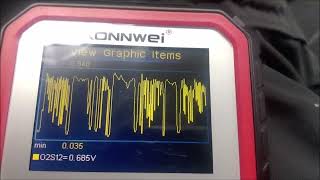
How to confirm: Use a scan tool to graph the O2 sensor voltages. The Bank 1 Sensor 2 reading should be relatively stable and steady. If it's stuck or fluctuating wildly like the upstream sensor, it's likely bad. A common DIY test is to swap the downstream sensors from Bank 1 and Bank 2 and see if the code changes to P0430 (Bank 2).
Typical fix: Replace the Bank 1, Sensor 2 (downstream, passenger side) oxygen sensor. This is a common first step due to the low cost compared to a converter.
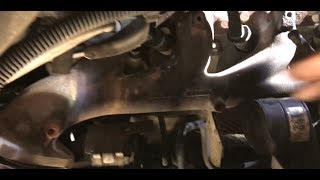
Est. part cost: $50-$150 - Exhaust Leak 🟡 Medium Probability Exhaust manifold gaskets and the flexible pipe sections are common areas for leaks to develop due to age, rust, and heat cycles. Broken or loose exhaust manifold bolts are a frequent cause on these trucks. 🎬 Watch: How to replace the passenger side exhaust manifold.
How to confirm: Visually inspect the exhaust system from the engine to the rear O2 sensor for cracks or black soot trails, which indicate a leak. An audible ticking or hissing noise that is louder when the engine is cold is also a sign. A shop can introduce smoke into the exhaust to easily spot leaks. A leak before the catalytic converter can introduce oxygen and fool the sensors.
Typical fix: Repair the leak by replacing the faulty gasket (e.g., manifold gasket) or section of pipe.
Est. part cost: $20-$300 - Underlying Engine Performance Issues ⚪ Low Probability Engine misfires (from bad spark plugs/coils), leaking fuel injectors, or excessive oil consumption can send unburned fuel or oil into the exhaust, which will destroy a catalytic converter over time. The 2007+ 6.2L engines can have issues with the AFM system causing lifter failure, misfires, and subsequent catalyst damage.
How to confirm: Check for other trouble codes related to misfires (P0300-P0308) or fuel trim (P0171, P0174). Monitor engine data and check spark plugs for signs of wear, oil, or fuel fouling.
Typical fix: Address the root cause, such as replacing spark plugs, ignition coils, fuel injectors, or addressing the cause of oil consumption (which may involve AFM system repairs).
Est. part cost: $50-$500+
Rare But Worth Checking
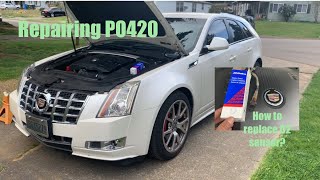
- PCM Software Calibration Issue: As noted in TSB #PIP3119P, some low-mileage vehicles may have an overly sensitive diagnostic threshold that triggers the code before the catalyst is properly broken in. In these specific cases, a dealer may need to perform a specific drive cycle or update the PCM software rather than replace parts. 🎬 Watch: A quick guide to fixing P0420 codes on a Cadillac.
Diagnosis Steps
- Scan for all DTCs. Address any misfire, fuel system, or oxygen sensor circuit codes before diagnosing the P0420.
- Thoroughly inspect the exhaust system from the passenger-side exhaust manifold to the rear catalytic converter. Look for cracks, rust holes, and black soot indicating a leak, paying close attention to manifold bolts and flange gaskets. Listen for hissing or ticking sounds, especially on a cold start.
- Use a scan tool with live data graphing capabilities. Observe the voltage of the Bank 1 Sensor 1 (upstream) and Bank 1 Sensor 2 (downstream) O2 sensors with the engine fully warmed up and running at a steady 2000 RPM.
- The upstream sensor (B1S1) should fluctuate rapidly between approximately 0.1V and 0.9V. The downstream sensor (B1S2) should hold a relatively steady voltage, typically above 0.5V-0.6V.
- If B1S2 is fluctuating in a similar pattern to B1S1, the catalytic converter is likely not working.
- If B1S2 is stuck at a low voltage (e.g., <0.2V) or responds very slowly, the sensor itself is likely faulty.
- As a confirmatory test, consider swapping the downstream (Sensor 2) O2 sensors between Bank 1 and Bank 2. Clear the codes and drive the vehicle. If the code returns as P0430 (Bank 2), you have confirmed the O2 sensor is the problem. 🎬 See how to tell if it's a bad converter or O2 sensor.
- If O2 sensors and exhaust are good, use an infrared thermometer on a fully warmed-up engine. Measure the temperature of the pipe just before the converter and just after. The outlet should be significantly hotter (at least 100°F) than the inlet. If not, the converter has failed.
- If the converter is clogged, you may notice a lack of power. A backpressure test can confirm a restriction.
Parts You'll Likely Need
- Catalytic Converter (Bank 1) — This is the component the code directly identifies as inefficient. It is often the ultimate failure point, though not always the root cause.
Trusted brands: ACDelco (OEM), MagnaFlow
Related Codes That Often Appear With This One
- P0430 — This is the identical code for Bank 2 (driver's side). If both appear, it suggests a systemic issue like contaminated fuel, a major vacuum leak, or simply that both converters have failed due to age or oil consumption.
- P0300-P0308 — These are misfire codes. An engine misfire is a primary cause of catalytic converter failure, as it dumps raw fuel into the exhaust, overheating and melting the converter's internal structure.
- P0135, P0141 — These codes indicate a fault in the heater circuit of the Bank 1 oxygen sensors. A faulty O2 sensor can directly cause an incorrect P0420 reading.
- P0171, P0174 — These 'System Too Lean' codes can indicate an exhaust leak before the upstream O2 sensor, which allows unmetered air to enter the exhaust, skewing sensor readings and potentially leading to a false P0420 code.
Technical Service Bulletins (TSBs) & Recalls
- PIP3119P: Notes that P0420/P0430 can set on new or low-mileage vehicles, or after a converter replacement, if a proper break-in drive cycle is not performed. It applies to a wide range of GM V8 vehicles from 2002-2018, including the Escalade.
Platform-Specific Known Issues
- Active Fuel Management (AFM) Oil Consumption: For 2007-2009 models with the 6.2L V8, the AFM system (which deactivates cylinders to save fuel) is a known source of increased oil consumption. This can be due to issues with the valve lifters or piston rings. The consumed oil contaminates the exhaust stream, fouling O2 sensors and poisoning the catalytic converters, leading to premature P0420/P0430 codes.
- Exhaust Manifold Bolt Leaks: The cast iron exhaust manifolds on these V8 engines are prone to developing leaks at the cylinder head gasket, often due to broken or loose manifold bolts, particularly those at the rear of the engine that are hardest to access. This leak introduces oxygen into the exhaust stream before the O2 sensors, which can trick the PCM into setting a false P0420 code.
Mechanic-Grade Diagnostic Values
- Upstream O2 Sensor (Bank 1, Sensor 1) Voltage — expected: Rapidly fluctuating between 0.1V and 0.9V on a fully warmed engine.. Failure: A flat line or very slow, lazy switching indicates a failed sensor.
- Downstream O2 Sensor (Bank 1, Sensor 2) Voltage — expected: Relatively stable and steady, typically between 0.4V and 0.8V, on a fully warmed engine with a good converter.. Failure: Fluctuating in a pattern that mimics the upstream sensor indicates a failed converter. A reading stuck near 0V can indicate an exhaust leak.
- Long-Term Fuel Trim (LTFT) — expected: Should be within +/- 10% at idle and steady RPM.. Failure: Consistently high positive trims (e.g., > +15%) suggest a vacuum or unmetered air leak (like an exhaust leak before the O2 sensor), while high negative trims suggest a rich condition (e.g., leaking injector).
- Exhaust Backpressure — expected: Less than 1.0 PSI at idle. Should not exceed 4.0 PSI during a snap-throttle test.. Failure: Pressures exceeding these thresholds indicate a clogged or restricted catalytic converter.
Hidden / Shadow Codes Worth Checking
- Mode $06, Test ID $01 (or similar): This is not a DTC, but a function in a generic OBD-II scanner that shows the raw test results from the PCM's catalyst efficiency monitor. It provides a value that can be compared against a manufacturer-specified maximum threshold. (see via Use a scan tool with Mode $06 capabilities. Navigate to the catalyst monitor test results. This allows a technician to see if the converter is borderline or has definitively failed the PCM's internal test, sometimes before a P0420 code is even set.)
Scan Tool Commands That Help
- GM Tech2 or similar professional scan tool: Propane Injection Catalyst Test — This is a definitive, though less common, test to measure true catalyst efficiency. It involves injecting a calibrated amount of propane into the engine and measuring the exhaust gas composition to directly calculate the converter's ability to oxidize hydrocarbons. It is used to conclusively prove a converter has failed when other sensor data is ambiguous.
Wiring & Ground Locations
- G103 — On the 2002-2006 models, located at the right rear of the engine block. On later models, may be on the cowl above the brake booster.. This ground is a common point for multiple engine sensors and modules. A poor connection here can introduce electrical noise or incorrect reference voltages, potentially affecting O2 sensor readings and leading to a false P0420 code.
- G105 — Located on the lower left front of the engine block (2003 models) or near the cooling fan relays (other years).. Provides a ground path for various engine components. Corrosion or a loose connection at this point can cause erratic sensor behavior that might be misdiagnosed as a component failure.
- Frame Grounds under Driver's Door — Two ground points located on the frame rail, visible when looking under the driver-side door area.. These are primary body and component grounds. On trucks in rust-prone areas, these grounds can corrode or break, causing a host of difficult-to-diagnose electrical issues, including erratic sensor readings that could trigger emissions codes like P0420.
Real Owner Repair Stories
- BobIsTheOilGuy forum user (2007 GMC Yukon Denali w/ 6.2L L92 engine, 131k miles) — High oil consumption (1 oz every 100 miles), which leads to fouling of O2 sensors and catalytic converters, triggering codes like P0420/P0430.
❌ Tried (didn't work) Initially just monitoring the issue.
✅ What actually fixed it The user identified the root cause as oil being sucked through the PCV system due to a poor valve cover design (per GM TSB 10-06-01-008M). The fix was to soak the piston rings with a solvent (Gunk Motor Medic) for 48 hours to unstick them, followed by installing an updated driver-side valve cover. Oil consumption dropped to 0.5 quarts every 8,000 miles, resolving the source of catalyst contamination. - Reddit user r/MechanicAdvice (2007 Escalade, 110k miles) — P0420 and P0430 codes present. White smoke from exhaust and occasional stalling at idle.
❌ Tried (didn't work) The user was in the process of 'throwing parts at it' without a clear diagnosis, a common mistake.
✅ What actually fixed it The final resolution was not posted, but the combination of dual catalyst codes (P0420/P0430), white smoke, and stalling strongly points to a systemic engine issue causing contamination of both converters, such as a coolant leak (head gasket) or severe oil burning, rather than two independent converter failures.
"I Checked Everything" — The Actual Cause
- In a complex case on a 2006 Escalade with lean codes (P0171/P0174) that often accompany P0420, a dealer performed multiple smoke tests on the intake which showed no leaks. After thousands of dollars in parts swapping (MAF, PCM, O2 sensors, intake gaskets), an exhaust pressure test finally revealed leaking exhaust manifolds. A leak in the exhaust manifold, before the upstream O2 sensor, can pull in unmetered air, creating a false lean signal and leading the PCM to incorrectly flag catalyst efficiency. This is missed by intake smoke tests.
OEM Part Supersession History
Unknown→ACDelco 213-4229 (GM 12609457)— Standard part evolution and updates.
Heads up: This is a 4-wire heated downstream oxygen sensor. It is cross-compatible with Denso 234-4256. Using a generic or 'universal' sensor instead of a direct-fit part is a common cause of recurring P0420 codes, as their internal heater resistance may not match OEM specifications.
Model Year Variations Within This Range
- 2007-2009: The introduction of the 6.2L V8 with Active Fuel Management (AFM) brought a new potential root cause for P0420. The AFM system can lead to increased oil consumption, particularly if the AFM pressure relief valve sprays excessive oil or if lifters begin to fail. This oil burning contaminates and destroys both O2 sensors and catalytic converters. GM issued TSBs (e.g., 10-06-01-008M) detailing fixes like installing an oil deflector or an updated valve cover to combat this.
- 2007 (early production): Some very early production 2007 Escalades with the 6.2L L92 engine were built with all the physical hardware for Active Fuel Management (AFM), but the system was not enabled in the vehicle's software. While less prone to the AFM-related oil consumption issues, they still have the associated hardware which can be a point of confusion during diagnosis.
Helpful Videos
We Have This Part in Stock


The information in this article is provided for general reference and educational purposes only. Vehicle specifications, procedures, and part compatibility can vary by production date, trim level, and region. Always consult your vehicle's factory service manual and verify part numbers before purchasing or performing repairs. Safety-critical components such as airbags, seat belts, and braking systems should be installed by a qualified professional.
- Cadillac ESCALADE:
- 🎬 Helpful Videos
- 🛍️ Shop This Part
- What's Unique About the 2002-2009 Cadillac ESCALADE
- Diagnostic Flowchart
- Symptoms You May Notice
- Most Likely Causes
- Rare But Worth Checking
- Diagnosis Steps
- Parts You'll Likely Need
- Related Codes That Often Appear With This One
- Technical Service Bulletins (TSBs) & Recalls
- Platform-Specific Known Issues
- Mechanic-Grade Diagnostic Values
- Hidden / Shadow Codes Worth Checking
- Scan Tool Commands That Help
- Wiring & Ground Locations
- Real Owner Repair Stories
- "I Checked Everything" — The Actual Cause
- OEM Part Supersession History
- Model Year Variations Within This Range
- 🎟️ Get 5% Off