

OBD-II Code P0418: Secondary Air Injection System Control Circuit 'A' Malfunction
What P0418 means, why it triggers, and how to fix it
- P0418 indicates an electrical fault in the secondary air injection pump's control circuit, most commonly caused by a failed relay or damaged wiring.
- You can safely drive with this code, but it triggers an automatic emissions test failure and forces some Toyota and GM vehicles into a power-limiting 'limp mode'.
- Always check the 40A-50A 'AIR' fuse and swap the pump relay with an identical one (like the horn relay) before buying a $400+ replacement air pump.
- If replacing a water-damaged air pump, you must also replace the one-way check valve; a stuck-open valve allows moisture in and destroys the new pump.
What Does P0418 Mean?

The Powertrain Control Module (PCM) detected an electrical fault in the Secondary Air Injection (SAI) system's control circuit. The SAI system pumps fresh air into the exhaust for 60-90 seconds on cold starts to reduce emissions and heat the catalytic converter. P0418 means the PCM is not receiving the correct voltage signal from the relay or driver module controlling the air pump. This code points specifically to an electrical command or feedback loop failure, not an airflow blockage.
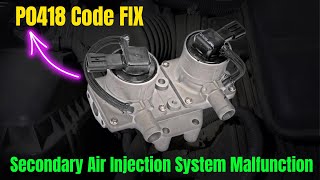
🎬 Watch: Step-by-step diagnosis of the secondary air pump circuit.Technical definition: The SAE/OBD-II definition is "Secondary Air Injection System Control 'A' Circuit Malfunction". This indicates the Powertrain Control Module (PCM) detected a voltage reading from the secondary air injection system's control circuit that differs by more than 10 percent from the manufacturer's specified range. The 'A' signifies the primary control circuit, often corresponding to Bank 1 of the engine.
Can I Drive With P0418?
Yes, But With Caution. You can drive with a P0418 code. The emissions system functions for 60-90 seconds during cold starts and does not affect core engine performance. However, a non-functional SAI system causes an automatic emissions test failure. On certain Toyota and GM models, persistent failure triggers 'limp mode,' limiting engine power. The biggest long-term risk is a stuck-open check valve allowing hot exhaust gas to flow backward, destroying the air pump.
Common Causes

- Faulty Secondary Air Injection (SAI) Pump Relay (Very Common) — This accounts for up to 50% of cases. The relay is an electronic switch that turns the air pump on and off. It fails from age or burns out when a failing pump draws excessive electrical current.
- Failed Secondary Air Injection (SAI) Pump (Common) — The electric motor in the air pump seizes or burns out. Moisture bypassing a faulty check valve causes internal rust, seizing the pump and overloading the relay and fuse.
- Wiring or Connector Issues (Common) — Engine heat, road salt, and moisture corrode or damage the wires and connectors for the SAI pump and relay, disrupting the electrical signal.
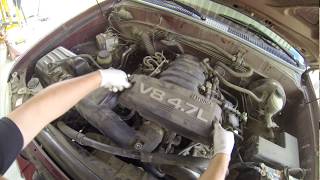
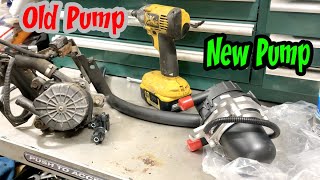
- Blown Fuse (Less Common) — The SAI system uses a dedicated high-amperage fuse (40A-50A). If the air pump fails and draws too much current, or if a short circuit occurs, this fuse blows to protect the wiring. 🎬 See how to replace the pump and troubleshoot the fuse.
- Faulty One-Way Check Valve (Less Common) — The check valve prevents hot exhaust gases and moisture from flowing back into the air pump. When stuck open, moisture enters the pump, causing it to rust, freeze, and seize.
- Clogged SAI Passages or Hoses (Rare) — Carbon buildup clogs the cylinder head ports or hoses. While this typically sets a P0411 (Incorrect Flow) code, severe blockage increases pump strain and occasionally triggers electrical faults.
- Faulty Powertrain Control Module (PCM) (Very Rare) — A faulty PCM driver circuit fails to activate the relay. Consider this only after ruling out all other electrical components.
Symptoms

- Check Engine Light is On — This is the most common and often the only symptom you will notice.
- Failed Emissions Test — The vehicle automatically fails a smog or emissions inspection if the Check Engine Light is illuminated for an active P0418 code.
- Abnormal Noise After Cold Start — A healthy air pump sounds like a vacuum cleaner for 60-90 seconds after a cold start. A failing pump produces a grinding or high-pitched whine. Complete silence indicates the pump is not running.
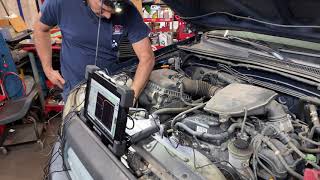
- Vehicle Stuck in 'Limp Mode' — On specific vehicles, particularly Toyota and GM models, persistent SAI system failure forces the PCM into 'limp mode,' limiting engine speed and disabling non-essential systems. 🎬 Learn how to bypass the air injection pump system.
- No Noticeable Driving Issues — Because the system is only active at startup, the car typically drives normally without any loss of power once warmed up.
Diagnostic Flowchart

Tap your situation to follow the diagnostic path that matches what you're seeing on this code.
Common Fixes & Costs
- Replace Secondary Air Injection Pump Relay — Parts: $15-$50, Labor: $50-$150, ~0.5 hr book time (DIY)
- Replace Blown Fuse — Parts: $5-$15, Labor: $0-$50, ~0.1 hr book time (DIY)
- Replace Secondary Air Injection Pump — Parts: $250-$700, Labor: $150-$500, ~2 hr book time (Intermediate)
- Repair Wiring or Connectors — Parts: $10-$50, Labor: $100-$300, ~1.5 hr book time (Intermediate)
- Replace/Reprogram Powertrain Control Module (PCM) — Parts: $500-$1200, Labor: $150-$300, ~1.5 hr book time (Advanced)
Used vs. New Parts: Buying Guide
When a used part is worth it: Buying a used Secondary Air Injection (SAI) pump is not recommended. The primary failure mode is water intrusion, and used parts often hide internal corrosion. Savings are minimal compared to the risk of premature failure.
Donor-vehicle mileage cap: roughly under 50000 miles for the part to have meaningful remaining life.
Donor quality checklist:
- Verify the donor vehicle was not scrapped for emissions-related issues.
- Avoid parts from flood-damaged vehicles or those from rust-belt states.
- Match the part number exactly; visual similarity is not enough.
Decision logic:
- If The fix is a simple relay or fuse → Always buy new; the cost is negligible.
- If The SAI pump needs replacement → Favor a new OEM or high-quality aftermarket part (e.g., Dorman, ACDelco) over a used one to ensure longevity.
- If Vehicle is very old (>15 years) and budget is the top priority → A used pump is a gamble, but serves as a temporary solution. Inspect it for signs of water damage before installation.
Warranty tradeoff: Used parts typically have a 30-90 day warranty, which is not long enough to reveal a latent defect. New aftermarket parts carry a 1-year to limited lifetime warranty. New OEM parts offer the best guarantee of quality.
Worst-case if a used part fails: 300-600 if a used pump fails after the warranty period, requiring a second replacement part plus repeat labor costs.
What Happens If You Wait — Timeline
- 0-1 month: Code P0418 sets, and the Check Engine Light illuminates. The SAI pump fails to activate on cold starts. There are no noticeable driving symptoms. (MPG impact: 0%% · Added cost: $0)
- 1-6 months: If caused by a stuck-open check valve, moisture and exhaust gases accumulate in the air pump. The pump motor corrodes or seizes. The vehicle automatically fails emissions inspections. (MPG impact: 0-1%% · Added cost: $400-$1200 (A simple relay/fuse fix now requires a full pump replacement).)
- 6-12 months: A seized pump destroys the control relay and fuse. On certain vehicles (Toyota/GM), the ECU triggers 'limp mode', severely limiting engine power and speed. (MPG impact: 1-3% (if limp mode is active)% · Added cost: $400-$1200)
- 12+ months: Continued operation with a disabled emissions component slightly increases the thermal load on the catalytic converter during cold starts, potentially reducing its long-term efficiency. (MPG impact: 1-3%% · Added cost: $1000-$2500 (Potential catalytic converter damage).)
Cost of Not Fixing It
- Immediate: Automatic failure of any OBD-II emissions or smog inspection due to the active Check Engine Light. (Added cost: 0)
- 1-6 months: Moisture or hot exhaust destroys the secondary air pump if the root cause is a bad check valve, turning a $50 relay fix into a $800 repair. (Added cost: 400-1200)
- 6+ months: The ECU triggers 'limp mode' on certain Toyota and GM models, severely limiting engine power and vehicle speed. Persistent malfunction also reduces catalytic converter lifespan. (Added cost: 1000-2500)
Diagnosis Steps
- Check for Related Codes
Use an OBD-II scanner to read all fault codes. Codes like P0410, P0411, P0419, or P2440 often appear with P0418 and pinpoint the problem area. Record the freeze frame data.
Tools: OBD-II Scanner (Beginner) - Inspect the Fuse
Locate the Secondary Air Injection system fuse (often a 40-60A fuse in the under-hood box). Visually inspect it. If blown, replace it, but expect it to blow again if the pump is seized.
Tools: Owner's Manual, Fuse Puller (Beginner) - Test the SAI Relay Function
Swap the SAI relay with an identical relay from a non-essential system (like the horn). If the problem resolves, the original relay is bad. Alternatively, listen for a 'click' from the relay when a helper turns the key to 'ON' (cold engine).
Tools: None (Beginner) - Inspect the Relay and Connectors
Visually inspect the relay and its electrical connector for corrosion, melting, or burn marks. Clean any corrosion with contact cleaner. Look closely for burnt pins on the relay socket.
Tools: Contact Cleaner (Beginner) - Test the SAI Pump Manually
Bypass the relay to test the pump. Use a fused jumper wire to apply direct battery voltage to the SAI pump's power terminal. If the pump runs, the motor is good. If it hums or does nothing, the pump is seized.
Tools: Fused Jumper Wire (Intermediate) - [PRO TIP] Test the Relay Control and Load Circuits
Check the relay socket with a multimeter. With the key off, pin 30 should have constant 12V+. With the key on (engine cold), the control pin (86) should have 12V+ and the other control pin (85) should have ground. Missing control voltages indicate a wiring or PCM fault.
Tools: Multimeter, Wiring Diagram (Advanced) - [PRO TIP] Check Pump Amperage Draw
Use an amp clamp around the pump's main power wire and command the pump on. A healthy pump draws 15-30 amps. A draw above 40 amps indicates a struggling pump that will blow the fuse. A 0 amp draw confirms an open circuit.
Tools: Amp Clamp Multimeter, Advanced Scan Tool (Advanced) - [PRO TIP] Test Pump Motor Resistance
Disconnect the SAI pump connector. Measure resistance between the motor terminals. A healthy motor reads close to 0 ohms. Infinite resistance (OL) indicates an open circuit, and exactly 0 ohms indicates a direct short. Both require pump replacement.
Tools: Multimeter (Advanced) - Inspect the Wiring
Carefully inspect the wiring harness between the PCM, relay, and air pump. Look for chafed, broken, shorted, or corroded wires, especially near hot exhaust components or sharp edges.
Tools: Flashlight, Multimeter (Advanced) - [PRO TIP] Check Air Injection Driver (AID) Signal (Toyota)
Toyota systems often use an Air Injection Driver (AID) module instead of a relay. Connect an oscilloscope to the AIDI terminal of the ECM. When commanding the system on, you should see a duty cycle waveform. A flat line indicates a faulty AID module.
Tools: Oscilloscope, Advanced Scan Tool, Wiring Diagram (Advanced)
When This Code Triggers (Freeze-Frame Conditions)
- Engine Coolant Temp: 40-80°F (5-27°C) (Cold engine, shortly after startup)
- Time Since Engine Start: 5-90 seconds (During the SAI system's active window)
- Engine RPM: 700-1200 RPM (Engine at idle or slightly elevated cold idle)
- Vehicle Speed: 0 mph (Vehicle is stationary during the initial cold start phase)
Related Codes
- P0410 — P0410 indicates a general malfunction in the SAI system, while P0418 points specifically to an electrical fault. Diagnose P0418 first; fixing the electrical issue usually resolves P0410.
- P0411 — Indicates 'Incorrect Flow Detected'. The electrical fault (P0418) prevents the pump from running, causing the incorrect flow condition. Fixing the P0418 circuit resolves both codes.
- P0419 — Stands for 'Secondary Air Injection System Control 'B' Circuit Malfunction'. Vehicles with V-engines often have two separate circuits ('A' and 'B'). P0419 is the equivalent fault for the second circuit.
- P2440 / P2442 — Indicates 'Switching Valve Stuck Open' for Bank 1 and Bank 2. A stuck-open valve allows moisture into the air pump, triggering P0418. You must replace both the valve and the pump.
Climate & Environmental Factors
- Cold Climates: Failure rates spike in cold weather. Moisture bypassing a faulty check valve freezes inside the air pump, seizing the motor on the next cold start.
- High Humidity / Heavy Rain: Moisture intrusion is a major risk. Pumps mounted in exposed locations (fender wells or under the frame) ingest water, causing internal corrosion and electrical failure.
- Road Salt (Rust Belt): Salt spray attacks electrical connectors, wiring, and the pump housing, causing high resistance, short circuits, and the P0418 code.
- Altitude: The SAI system's role is more critical at higher altitudes where air is less dense. Malfunctions have a slightly more noticeable effect on cold start emissions.
How to Talk to a Mechanic About This Code
Say this: "I have a P0418 code for the secondary air injection control circuit. Please test the electrical circuit, starting with the fuse and relay, before quoting a replacement air pump."
This signals that you understand the code points to an electrical issue and directs the mechanic to follow a logical diagnostic path instead of immediately quoting the most expensive part.
Avoid saying:
- 'My check engine light is on, can you look at it?'
- 'My car is making a weird noise at startup.'
- 'Just replace the air pump.'
Questions to ask before authorizing the repair:
- Did you test the relay and check for a blown fuse first?
- If the pump needs replacement, did you confirm the check valve is working correctly to prevent a repeat failure?
- Can you show me the failed part and explain why it failed?
- What is the warranty on the parts and labor for this repair?
Where to Take It: Dealer vs Independent vs Chain
- Dealer:
Best for: Vehicles under a powertrain or emissions warranty., Complex electrical issues on newer German vehicles (BMW, Mercedes, Audi)., Confirming if a manufacturer warranty extension or recall applies to your VIN.
Downsides: Highest labor rates, often 1.5-2x more than independent shops., Recommends replacing entire assemblies when only a smaller component failed. (Typical cost: +50% vs. baseline) - Independent Shop:
Best fit for most cases. A reputable independent shop easily diagnoses the fuse/relay/pump circuit at a significantly lower cost than a dealer.
Best for: Out-of-warranty vehicles where cost is a factor., Straightforward electrical diagnosis and part replacement (relay, pump, wiring)., Building a long-term relationship with a trusted mechanic.
Downsides: Quality varies greatly; look for ASE certifications and good reviews., Lacks access to the very latest manufacturer-specific diagnostic software. (Typical cost: +0% vs. baseline) - Chain Shop:
Use with caution. Acceptable for a simple relay swap, but AVOID for initial diagnosis of a P0418 code, as it requires methodical electrical testing.
Best for: Simple, clear-cut repairs like replacing a fuse or a standard relay if you already diagnosed it yourself.
Downsides: Technician skill varies dramatically., High pressure to upsell services; pushes for expensive pump replacements without proper diagnosis., Unlikely to perform detailed electrical circuit tracing. (Typical cost: -10% vs. baseline)
When to Walk Away From the Repair
If the estimated repair cost for the P0418 fault exceeds 40-50% of your car's private-party value, seriously consider alternatives to a full repair.
- Car worth $5000, fix is $2200: Walk away. The repair cost is nearly half the car's value. This is especially true on models like the Toyota Tundra where this is a known, expensive issue.
- Car worth $15000, fix is $800: Fix it. The repair cost is a small fraction of the vehicle's value and is necessary to pass emissions.
- Car worth $3000, fix is $250: Fix it. A simple relay or wiring repair is well worth the cost to clear the check engine light and restore value.
What Scan Tool You Need for This Code
Minimum: A scan tool with bi-directional control is highly recommended. This allows you to command the Secondary Air Injection (SAI) pump and relay on and off, which is the fastest way to test the electrical circuit.
A basic $30 code reader only tells you that code P0418 is present. It cannot actively test the components. You will guess whether the fault is the fuse, relay, wiring, or the pump itself, leading to unnecessary part replacements.
Budget: KINGBOLEN Ediag Elite / XTOOL A30M (~$90) — These Bluetooth dongles pair with your smartphone. They offer full system diagnostics and basic bi-directional control to activate the SAI pump/relay, making them excellent value for DIY diagnosis.
Mid-range: XTOOL D7 / Foxwell NT510 Elite (~$350) — These dedicated tablet scanners offer full bi-directional control, allowing you to command the SAI pump on/off to test the entire circuit. They provide live data graphing and access to all vehicle modules.
Professional: Autel MaxiCOM MK808S / Launch X431 CRP919E (~$450-550) — Provides professional-level bi-directional control, extensive live data, and advanced features like ECU coding. These tools are fast, cover a vast range of vehicles, and are ideal for a serious DIYer or independent shop.
Rent vs buy: Auto parts stores rent basic code readers for free, but these lack the essential bi-directional control needed for a proper P0418 diagnosis. Buying an affordable bi-directional tool saves you more than its cost in diagnostic fees.
How to Clear the Code After You Fix It
- Use an OBD-II scan tool to clear the P0418 fault code.
- Ensure the fuel tank is between 15% and 85% full.
- Perform a complete drive cycle to allow the vehicle's readiness monitors to run.
Drive cycle (~20 minutes): Start the engine from cold (after sitting for 8+ hours). Let it idle for 2-3 minutes. Drive for 5-10 minutes in stop-and-go city traffic. Then, drive for 5-10 minutes at a steady highway speed (55-60 mph). Allow the vehicle to cool down completely and repeat if monitors are not set.
Readiness monitors affected: Secondary Air System, Catalyst Monitor, Oxygen Sensor Monitor
Before emissions retest: drive at least 50 miles to fully set monitors.
Watch out for:
- Clearing the code without performing a drive cycle results in a 'Not Ready' status at the emissions test station, causing a failure.
- The code returns on the next cold start if the root electrical problem was not properly fixed.
- Disconnecting the battery clears the code but resets all readiness monitors, requiring an extensive drive cycle to complete.
Will This Fail Emissions / State Inspection?
Yes — this code typically fails an OBD-II emissions inspection.
- California: An active P0418 code is an automatic failure. After repair, most gasoline vehicles (2000+) must have all readiness monitors complete except for the EVAP monitor. It takes 50-100 miles of driving to set the monitors.
- New York: A vehicle automatically fails the emissions portion of the annual state inspection if the Check Engine Light is on for any reason, including P0418.
- Texas: In the 17 counties requiring emissions testing, a vehicle with an active P0418 code cannot pass the inspection required for annual registration renewal.
Most Commonly Affected Vehicles
- Toyota Tundra, Sequoia, Tacoma (2007-2014) — Extremely common failure. Air pumps located in the passenger-side fender well ingest water, shorting the motor. 2007-2012 models had a 10-year/150,000-mile warranty extension. Aftermarket bypass kits are a popular permanent fix.
- Chevrolet / GMC Silverado, Sierra, Trailblazer, Envoy (2002-2014) — Frequently experience seized air pumps that overload the relay circuit. A secondary fuse for the AIR pump is often hidden under the battery tray and is highly prone to corrosion.
- Subaru WRX, Forester, Outback, Legacy (2007-2014) — Secondary air valves (solenoids) stick open, allowing moisture to damage the pump and trigger P0418. The 2007-2009 Legacy/Outback had a warranty extension for this issue.
- BMW 3 Series (E46/E90), 5 Series (E39/E60), X3, X5 (2000-2015) — Prone to this code due to aging relays, carbon-clogged passages, and brittle vacuum lines controlling the check valve. The pump is typically in the front driver's side wheel well.
- Ford F-150, Mustang (2004-2014) — Corrosion in electrical connectors, particularly in rust-belt regions, is a primary cause. The relay is in the main under-hood fuse box, but wiring near the pump is a weak point.
- Audi/Volkswagen A4, Golf, Jetta, Passat (1999-2012) — Pump failure is usually caused by moisture intrusion from a bad 'Combi Valve' (check valve). On 1.8T and 2.0T engines, the pump sits low in the engine bay, making it vulnerable.
- Honda Accord (2005-2012) — Less common than other makes, but P0418 on an Accord almost always points directly to a faulty secondary air injection pump relay in the under-hood fuse box.
- Mercedes-Benz C-Class (W203/W204), E-Class (W211/W212) (2000-2014) — Often linked to a faulty relay in the front SAM (Signal Acquisition Module) or wiring damage near the pump. The pump is robust, but the control electronics fail frequently.
Manufacturer-Specific Notes
- Toyota: Toyota issued a warranty extension (Customer Support Program ZHA) for 2007-2012 trucks/SUVs due to high failure rates from water intrusion, covering 10 years/150,000 miles. Many owners install aftermarket bypass modules to permanently eliminate the system.
- General Motors (GM): On many GM trucks and SUVs, a secondary fuse for the AIR pump is hidden in a separate fuse block under the battery tray. This fuse is highly susceptible to corrosion from battery acid.
- Subaru: SAI valves frequently stick open, allowing moisture to destroy the pump and trigger P0418. A warranty extension (WQW-47) was issued for 2007-2009 Legacy and Outback models. Some owners opt for aftermarket block-off plates and ECU tunes.
- Audi / Volkswagen: The one-way check valve is called a 'Combi Valve'. When it fails, hot exhaust melts the plastic air pump internals. You must replace the Combi Valve anytime the SAI pump is replaced.
Real Owner Stories
2007 Toyota Tundra 5.7L with P0418 & Limp Mode
The Check Engine Light illuminated, and the truck entered 'limp mode', severely limiting speed. The owner researched the notorious SAIS failures on this model.
What they tried:
- Inspected the air pumps located in the passenger fender well, known to fail from water ingestion.
- Found both pumps seized from dust and debris ingestion due to missing protective covers.
Outcome: Facing a $2,000+ dealership quote for OEM parts, the owner installed an aftermarket Hewitt Tech bypass kit, a cost-effective and permanent solution.
Lesson: On 2nd Generation Toyota Tundras, P0418 is almost always caused by failed air pumps due to a design flaw. A bypass kit is a widely accepted fix that avoids expensive recurring failures.
2009 Toyota Tundra 4.7L - P0418 Returns After Pump Replacement
Code P0418 appeared. A former Toyota technician suggested the passenger fender air pump was the culprit.
What they tried:
- Replaced the air pump in the fender well and the associated Air Switching Valve.
- Cleared the code, but it returned the next day after 50 miles.
Outcome: The initial repair missed the root cause. The owner had to replace the second switching valve on the driver's side and inspect the second air pump located under the intake manifold.
Lesson: P0418 has multiple failure points. Replacing the most obvious failed part is not enough; a full system diagnosis is required to catch secondary failed components like check valves.
2000 Chevy Venture 3.4L with P0410 & P0418
The minivan displayed codes P0410 (general system malfunction) and P0418 (control circuit fault). The air pump was not activating.
What they tried:
- Replaced the air pump and one check valve, which were confirmed bad.
- Checked the main fuses, which were intact, but the pump still wouldn't run.
Outcome: The culprit was a hidden, heavily corroded air pump relay. Replacing the relay restored system function.
Lesson: Always suspect the control circuit first with P0418. Even if mechanical parts fail, the electrical fault must be fixed. On GM vehicles, relays and fuses are often in hidden, corrosion-prone locations.
2013 VW Jetta 2.5L at 130k miles
The check engine light came on with only P0418. The cold start felt 'less aggressive', but the air pump was still audibly running.
What they tried:
- Deduced that since the pump was running, the issue was electrical (relay/wiring) rather than a failed pump motor.
Outcome: Diagnosis focused on testing the relay and wiring circuit. The fix required replacing a corroded relay connector.
Lesson: Listen for the pump noise on a cold start. If you hear the vacuum cleaner sound, P0418 is caused by a relay or wiring issue, saving you from buying an expensive pump.
How to Prevent This Code From Triggering
- Periodically inspect and clean the one-way check valve(s) (Every 30,000-50,000 miles) — The check valve prevents moisture and hot exhaust from entering the air pump. Carbon buildup causes them to stick open, leading to pump corrosion and failure. Cleaning restores function.
- On susceptible Toyota models, install a Uni-Filter pre-filter on the pump intake (Once) — Toyota pump internal foam filters disintegrate and are ingested, seizing the pump. Adding an external, serviceable foam filter to the intake snorkel prevents this.
- Ensure the air filter housing is properly sealed (Every air filter change) — The SAI system draws fresh air from the clean side of the engine air filter housing. A cracked housing allows unfiltered, moist air directly into the pump, accelerating wear.
- Listen for the ECU 'purge cycle' at engine shutdown (Periodically) — Some newer vehicles run the pump briefly after shutdown to purge moisture. If this function stops, it is an early sign of a relay or pump issue.
- Periodically clean clogged secondary air ports (Advanced) (Every 60,000-100,000 miles, or if P0411 occurs) — In some engines (Porsche, Audi), carbon clogs the small air passages in the cylinder head, increasing backpressure and straining the pump motor.
Frequently Asked Questions
What are the most common mistakes when diagnosing P0418?
A very common mistake is replacing a failed component without addressing the root cause. For example, a seized pump will immediately destroy a new relay, and a bad check valve will ruin a new pump. Always test the full circuit and check for hidden secondary fuses, like those under the battery on GM models.
Why did my P0418 code come back after a repair?
If the code returns, the initial repair missed the underlying cause. A new air pump will fail quickly if a bad check valve still allows moisture into the system. Intermittent wiring shorts or low-quality aftermarket parts also cause repeat failures.
Can I just clear the P0418 code and keep driving?
You can clear the code with a scanner, but it returns after the next cold start until the electrical fault is repaired. The system must be fixed to permanently turn off the check engine light.
Will a P0418 code cause my car to fail an emissions test?
Yes, an active P0418 code causes an automatic failure of an emissions or smog inspection. The check engine light illuminates because the system is a required emissions control component.
What is the difference between P0418 and P0411?
P0418 points specifically to an electrical problem in the relay circuit controlling the air pump. P0411 indicates 'Incorrect Flow Detected', meaning the computer commanded the pump on but did not detect the expected airflow change. A P0418 electrical fault causes a P0411, but a P0411 is often just a clogged hose.
Can a weak battery cause a P0418 code?
Yes, a weak battery provides insufficient voltage to the system's relay, triggering a P0418 code. Ensure your battery maintains a voltage above 12.4 volts when the car is off.
How much does it cost to fix code P0418?
A professional diagnosis costs $100-$200, while a simple fuse or relay replacement runs $75-$250. Replacing the air pump itself costs between $400 and $1,200 depending on labor rates. Dealership repairs on specific models like the Toyota Tundra often exceed $2,000.
What does a bad air injection pump sound like?
A healthy air pump sounds like a loud vacuum cleaner for about 60 seconds after a cold start. A failing pump makes a high-pitched whining, grinding, or rattling sound. Complete silence indicates the pump has failed entirely or lost power.
Where is the secondary air injection relay located?
The relay is typically a standard 4-pin or 5-pin unit located in the main under-hood fuse box. On some European vehicles, it is integrated into a larger Signal Acquisition Module (SAM). Consult your owner's manual or a wiring diagram for the exact location.
Key Takeaways
- P0418 indicates an electrical fault in the secondary air injection pump's control circuit, most commonly caused by a failed relay or damaged wiring.
- You can safely drive with this code, but it triggers an automatic emissions test failure and forces some Toyota and GM vehicles into a power-limiting 'limp mode'.
- Always check the 40A-50A 'AIR' fuse and swap the pump relay with an identical one (like the horn relay) before buying a $400+ replacement air pump.
- If replacing a water-damaged air pump, you must also replace the one-way check valve; a stuck-open valve allows moisture in and destroys the new pump.
Helpful Videos

The information in this article is provided for general reference and educational purposes only. Vehicle specifications, procedures, and part compatibility can vary by production date, trim level, and region. Always consult your vehicle's factory service manual and verify part numbers before purchasing or performing repairs. Safety-critical components such as airbags, seat belts, and braking systems should be installed by a qualified professional.
- 🎬 Helpful Videos
- What Does P0418 Mean?
- Can I Drive With P0418?
- Common Causes
- Symptoms
- Diagnostic Flowchart
- Common Fixes & Costs
- Used vs. New Parts: Buying Guide
- What Happens If You Wait — Timeline
- Cost of Not Fixing It
- Diagnosis Steps
- When This Code Triggers (Freeze-Frame Conditions)
- Related Codes
- Climate & Environmental Factors
- How to Talk to a Mechanic About This Code
- Where to Take It: Dealer vs Independent vs Chain
- When to Walk Away From the Repair
- What Scan Tool You Need for This Code
- How to Clear the Code After You Fix It
- Will This Fail Emissions / State Inspection?
- Most Commonly Affected Vehicles
- Manufacturer-Specific Notes
- Real Owner Stories
- 2007 Toyota Tundra 5.7L with P0418 & Limp Mode
- 2009 Toyota Tundra 4.7L - P0418 Returns After Pump Replacement
- 2000 Chevy Venture 3.4L with P0410 & P0418
- 2013 VW Jetta 2.5L at 130k miles
- How to Prevent This Code From Triggering
- Frequently Asked Questions
- What are the most common mistakes when diagnosing P0418?
- Why did my P0418 code come back after a repair?
- Can I just clear the P0418 code and keep driving?
- Will a P0418 code cause my car to fail an emissions test?
- What is the difference between P0418 and P0411?
- Can a weak battery cause a P0418 code?
- How much does it cost to fix code P0418?
- What does a bad air injection pump sound like?
- Where is the secondary air injection relay located?
- Key Takeaways
- 🎟️ Get 5% Off