

OBD-II Code P0406: EGR Sensor Circuit High
What P0406 means, why it triggers, and how to fix it
- P0406 indicates the Exhaust Gas Recirculation (EGR) position sensor is sending a voltage signal stuck above 4.5 volts to the engine computer.
- Replacing the entire EGR valve assembly resolves this code in over 80% of cases, as the position sensor is internally integrated and fails electrically.
- Driving with a P0406 code causes an automatic emissions test failure and reduces fuel economy by 1 to 3 MPG.
- Before buying a $200+ replacement valve, unplug the sensor and test the connector with a multimeter to rule out a shorted 5-volt reference wire.
- Dodge Ram 5.7L and Jeep Wrangler 3.8L engines are notorious for this failure, requiring an OEM Mopar replacement part to prevent the code from returning.
What Does P0406 Mean?

P0406 means the Powertrain Control Module (PCM) detects a voltage signal from the Exhaust Gas Recirculation (EGR) position sensor that is stuck too high. The EGR system reduces nitrogen oxide (NOx) pollution by recirculating exhaust back into the cylinders. The position sensor tells the PCM the valve's exact position. A constant high voltage signal means the PCM cannot control the EGR system.
Technical definition: Exhaust Gas Recirculation (EGR) Sensor 'A' Circuit High. The Powertrain Control Module (PCM) sets this Diagnostic Trouble Code (DTC) when the EGR position sensor voltage remains above the maximum specified threshold (typically 4.5 to 4.8 volts) for a predetermined period.
Can I Drive With P0406?
Yes, But With Caution. You can drive your vehicle, but do not exceed a few weeks. This code causes an automatic emissions test failure, poor engine performance, stalling, and engine pinging. Ignoring the code increases combustion temperatures, causing internal engine damage and clogging the catalytic converter or Diesel Particulate Filter (DPF)—a secondary repair costing $1,000 to $4,000.
Common Causes

- Faulty EGR Position Sensor (Very Common) — The sensor, integrated into the EGR valve assembly, fails internally and sends a constant high voltage signal. This is the most frequent cause of a P0406 code.
- Clogged or Stuck EGR Valve (Common) — Carbon and soot buildup causes the valve's pintle to stick open or closed. The sensor reports a position mismatching the computer's command. Diesel vehicles are highly prone to this.
- Wiring or Connector Problem (Common) — The wiring harness is damaged, frayed, or melted. Corrosion in the connector, a poor ground connection, or a short circuit between the signal wire and the 5-volt reference wire triggers this code.
- Faulty Aftermarket Parts (Uncommon) — Low-quality aftermarket EGR valves fail prematurely, lack proper calibration, or cause the P0406 code to return immediately after installation.
- Leaking EGR Cooler (Diesel Engines) (Less Common) — An internal leak in the EGR cooler introduces coolant into the EGR system. This moisture corrodes the valve, sensor, and connectors, causing electrical shorts.
- Leaking Vacuum Lines (Uncommon) — On older Fords with DPFE systems, cracked or disconnected vacuum hoses controlling the EGR valve cause system malfunctions.
- Exhaust System Leaks (Less Common) — Leaks in the exhaust manifold or EGR tube alter system pressure, causing incorrect sensor readings.
- Faulty Powertrain Control Module (PCM) (Rare) — The vehicle's main computer has an internal fault or corrupted software. Consider this only after exhausting all other electrical tests.
Symptoms
- Check Engine Light On — This is the most common and often the only initial symptom.
- Engine Pinging or Knocking — Without proper EGR flow, combustion temperatures rise, causing a rattling sound (detonation) during acceleration or uphill driving.
- Reduced Engine Performance — The vehicle feels sluggish, hesitates during acceleration, or surges at steady speeds.
- Poor Fuel Economy — The disrupted air-fuel mixture decreases fuel efficiency by 1 to 3 MPG.
- Rough Idle or Stalling — The engine idles erratically or stalls completely when stopped.
- Failed Emissions Test — The illuminated Check Engine Light and high NOx emissions guarantee a smog check failure.
Common Fixes & Costs

- Replace EGR Valve Assembly — Parts: $120 - $450, Labor: $150 - $350, ~1.5 hr book time (Intermediate)
- Clean EGR Valve and Passages 🎬 Watch: How to clean carbon buildup from your EGR valve. — Parts: $10 - $25, Labor: $100 - $250, ~1.2 hr book time (DIY)
- Repair Wiring or Connector — Parts: $15 - $60, Labor: $120 - $400, ~2.0 hr book time (Professional)
- Replace Leaking Vacuum Hoses — Parts: $10 - $40, Labor: $20 - $100, ~0.5 hr book time (DIY)
- PCM Reprogramming or Replacement — Parts: $500 - $1200, Labor: $150 - $300, ~1.5 hr book time (Professional)
Used vs. New Parts: Buying Guide
When a used part is worth it: For a tight budget, a used OEM EGR valve from a low-mileage vehicle is viable if the part is easily accessible.
Donor-vehicle mileage cap: roughly under 70000 miles for the part to have meaningful remaining life.
Donor quality checklist:
- Match the part number exactly.
- Avoid parts from rust-belt regions.
- Verify the donor vehicle was salvaged for an accident, not engine failure.
Decision logic:
- If The EGR valve is difficult to access or the vehicle is a known problem model (e.g., Jeep 3.8L) → Buy a new OEM part to avoid paying for labor twice.
- If The vehicle is old and budget is the primary concern → A used OEM part is a reasonable gamble.
- If The price difference between a new aftermarket part and a used OEM part is minimal → Favor the new part for its warranty.
Warranty tradeoff: Salvage yards offer 30-90 day warranties. New aftermarket parts offer 1-year warranties. New OEM parts carry 1-2 year warranties.
Worst-case if a used part fails: 300-600
Cost of Not Fixing It
- 0-1 month: Failed emissions test; 5-10% drop in fuel economy; occasional engine pinging under load. (Added cost: 50-100)
- 1-6 months: Worsening engine performance, hesitation, and stalling. Increased combustion temperatures stress the catalytic converter. (Added cost: 100-300)
- 6+ months: Severe risk of catalytic converter or Diesel Particulate Filter (DPF) failure due to constant high temperatures. (Added cost: 1200-4000)
Diagnosis Steps

- Read the Code and Freeze Frame Data
Confirm P0406 is active. Note related codes (P0401, P0405) and analyze freeze frame data to see engine conditions (RPM, speed) when the fault occurred.
Tools: OBD-II Scanner (Beginner) - Visually Inspect the EGR System
Inspect the EGR valve electrical connector for corrosion, bent pins, or a loose fit. Trace the wiring harness for melting, chafing, or breaks near hot exhaust components.
Tools: Flashlight (Beginner) - Check Live Sensor Data
View the 'EGR Position Sensor Voltage' live data stream. With Key On, Engine Off (KOEO), voltage should sit under 1V. If stuck near 5V, the sensor or circuit is faulty.
Tools: OBD-II Scanner with Live Data (Intermediate) - Test the Circuit with a Multimeter
Unplug the EGR sensor. Check for a 5-volt reference and ground. Probe the signal wire; if P0406 changes to a low voltage code (P0405), the EGR valve assembly is bad. If high voltage remains, the harness has a short. 🎬 Watch: Step-by-step electrical diagnosis for Chrysler EGR codes.
Tools: Digital Multimeter (Intermediate) - Inspect for Carbon Buildup
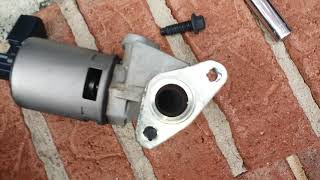
Remove the EGR valve. Inspect the valve and intake manifold passages for heavy carbon deposits that prevent the valve from moving.
Tools: Socket/Wrench Set, Gasket Scraper, EGR Cleaner (Intermediate) - Test Mechanical Function
Command the EGR valve open while idling. The engine RPM must drop or stumble. If RPM doesn't change, the valve is stuck or passages are blocked.
Tools: Bi-Directional Scan Tool (Advanced) - Wiggle Test the Harness
While monitoring EGR sensor voltage, wiggle the wiring harness at the connector and along its path. Voltage jumps indicate an intermittent short or break.
Tools: Digital Multimeter or Scan Tool with Live Data (Advanced) - Lab Scope Analysis
Graph the sensor's voltage to catch intermittent faults. A healthy sensor shows smooth transitions. A signal stuck high or full of noise indicates a failing sensor.
Tools: Automotive Oscilloscope (Lab Scope) (Professional) - Live Data PID Analysis
Monitor 'EGR Commanded' vs. 'EGR Actual'. If the PCM commands a change but the sensor voltage (Actual) does not respond, the sensor, wiring, or valve has failed.
Tools: Advanced OBD-II Scanner with Live Data PIDs (Advanced) - Sensor Resistance Test
For non-integrated sensors, measure resistance between the signal and ground terminals. A reading near zero ohms indicates a shorted sensor. Consult the service manual for exact specifications.
Tools: Digital Multimeter, Vehicle Service Manual (Advanced)
When This Code Triggers (Freeze-Frame Conditions)
- Engine Coolant Temp: 180-210°F (The engine must be fully warmed up to enable the EGR monitor.)
- RPM: 1500-2500 (The code sets during steady-state cruising, not at idle.)
- Engine Load: 20-50% (Light to moderate engine load, typical of highway cruising.)
- Vehicle Speed: 40-60 mph (The EGR monitor runs during steady highway driving.)
Related Codes
- P0401 — Insufficient EGR Flow. Suggests the valve is physically stuck closed or passages are blocked with carbon.
- P0404 — EGR Control Circuit Range/Performance. A general performance code for erratic sensor readings, whereas P0406 specifically indicates a stuck high voltage.
- P0405 — EGR Sensor A Circuit Low. The direct opposite of P0406. If unplugging the sensor changes P0406 to P0405, the wiring is intact and the valve assembly is faulty.
- P0403 — EGR Control Circuit Malfunction. Points to an electrical fault in the control solenoid rather than the position sensor. Often requires replacing the entire assembly.
Climate & Environmental Factors
- Cold Weather: Moisture in the EGR system or vacuum lines freezes, causing the valve to stick or sensors to malfunction upon startup.
- High Humidity / Salt Belt Regions: Accelerates corrosion on electrical connector pins and wiring. Moisture intrusion creates a short to voltage, directly causing P0406.
How to Clear the Code After You Fix It
- Use an OBD-II scan tool to clear the P0406 code.
- Perform a complete drive cycle to allow emissions monitors to run and set to 'Ready'.
Drive cycle (~20 minutes): 1) Cold start, idle for 3 minutes. 2) Drive at a steady 40-60 mph for 10 minutes. 3) Coast (decelerate without braking) for 10 seconds. 4) Perform 5 minutes of stop-and-go city driving.
Readiness monitors affected: EGR System Monitor, Catalyst Monitor, O2 Sensor Monitor
Before emissions retest: drive at least 50 miles to fully set monitors.
Watch out for:
- Clearing the code resets all readiness monitors to 'Not Ready', guaranteeing an emissions test failure.
- The code returns immediately if the root cause (e.g., bad wiring, faulty aftermarket part) was not fixed.
Will This Fail Emissions / State Inspection?
Yes — this code typically fails an OBD-II emissions inspection.
- California: An illuminated Check Engine Light is an automatic failure. All OBD readiness monitors must be set to 'Ready' before re-testing.
- New York: The NYS DMV inspection includes an OBD-II scan. P0406 causes an immediate failure.
- Texas: In emissions-testing counties, P0406 results in an OBD inspection failure.
Most Commonly Affected Vehicles
- Dodge Ram 1500 (5.7L Hemi) (2007-2013) — Extremely common issue resolved by replacing the EGR valve assembly. Aftermarket parts fail quickly; use an OEM Mopar part. 🎬 See this walkthrough for replacing the Hemi 5.7L EGR valve.
- Jeep Wrangler (JK) (2007-2011) — Frequent failure on the 3.8L V6. Replacement is notoriously difficult due to firewall proximity. Technicians often remove the passenger-side fender liner for access.
- Chrysler Town & Country / Dodge Grand Caravan (2008-2016) — The 3.6L and 3.8L engines frequently set P0406 due to a faulty EGR valve.
- Chevrolet / GMC Colorado, Canyon (2.8L Duramax Diesel) (2016-2021) — Per TSB PIP5416D, wiring harness chafing near the A/C compressor or serpentine belt causes this code.
- Volkswagen Golf, Passat, Jetta (TDI) (2005-2015) — Common on TDI diesels due to heavy carbon buildup or a leaking EGR cooler. Many are covered by the 'Dieselgate' extended emissions warranty.
- Honda Fit (2015-2020) — Points to a high voltage condition when the sensor exceeds 4.88 volts. Diagnosis often leads to PCM software updates.
- Hyundai Santa Fe (2.2L Diesel) (2010-2012) — Sets when sensor voltage exceeds 4.8V for over 2.5 seconds, pointing to an internal actuator failure.
- Ford F-150 (2004-2010) — Related to the DPFE sensor and connecting hoses, which crack, clog with carbon, or fill with condensation.
Manufacturer-Specific Notes
- Chrysler/Dodge/Jeep: On 3.8L and 5.7L engines, the cause is almost always a failed EGR valve assembly. Non-OEM parts frequently cause the code to return.
- Ford: Points to a problem with the DPFE sensor or its rubber hoses, which crack or fill with water.
- Chevrolet / GMC: TSB PIP5416D identifies wiring harness chafing near the A/C compressor on 2.8L diesels as a known cause.
- Volkswagen (TDI Models): The 'Dieselgate' Extended Emissions Warranty covers the entire EGR system for up to 10 years/120,000 miles. Check dealer coverage before paying for repairs.
- Diesel Vehicles (General): Produce significantly more soot, making them highly susceptible to clogged EGR valves, coolers, and intake passages.
Frequently Asked Questions
Can I just clean the EGR valve instead of replacing it?
Sometimes. If moderate carbon buildup prevents the valve from moving, cleaning the passages solves the problem. However, if the internal electrical sensor failed, cleaning does nothing and you must replace the entire valve assembly.
What is the most common misdiagnosis for P0406?
A common mistake is replacing the EGR valve without performing basic circuit tests. The fault is often a shorted wire or corroded connector, which a new valve cannot fix. Always check for 5V reference, ground, and signal wire integrity first.
Will P0406 cause my car to fail an emissions test?
Yes, absolutely. An illuminated check engine light is an automatic failure in all testing regions. The malfunctioning EGR system also causes high NOx emissions, guaranteeing a tailpipe test failure.
I replaced my EGR valve and the P0406 code came back. What now?
If a new EGR valve doesn't fix the code, suspect a defective aftermarket part or an underlying wiring short. Re-check all wiring harnesses for melted insulation or chafing. Use an OEM part if the replacement was a budget brand.
What happens if I ignore the P0406 code?
Ignoring the code reduces fuel economy and causes harmful engine pinging under load. Over 6 to 12 months, elevated combustion temperatures stress the catalytic converter. For diesel vehicles, it clogs the Diesel Particulate Filter (DPF), resulting in a $2,000+ repair.
How much does it cost to fix P0406?
A professional diagnostic costs $75 to $150. Replacing the EGR valve ranges from $270 to $800 for parts and labor. Cleaning costs $125 to $300, while a wiring repair runs $135 to $450.
Will P0406 clear itself?
No, P0406 will not clear itself. It indicates a hard electrical fault in the EGR circuit. You must diagnose and repair the underlying issue before clearing the code with a scan tool.
What's the difference between P0406 and P0405?
They are exact opposites. P0406 means the EGR sensor circuit voltage is stuck too high (often above 4.5V). P0405 means the voltage is stuck too low (near 0V), indicating a short to ground or an open circuit.
Key Takeaways
- P0406 indicates the Exhaust Gas Recirculation (EGR) position sensor is sending a voltage signal stuck above 4.5 volts to the engine computer.
- Replacing the entire EGR valve assembly resolves this code in over 80% of cases, as the position sensor is internally integrated and fails electrically.
- Driving with a P0406 code causes an automatic emissions test failure and reduces fuel economy by 1 to 3 MPG.
- Before buying a $200+ replacement valve, unplug the sensor and test the connector with a multimeter to rule out a shorted 5-volt reference wire.
- Dodge Ram 5.7L and Jeep Wrangler 3.8L engines are notorious for this failure, requiring an OEM Mopar replacement part to prevent the code from returning.
Helpful Videos

The information in this article is provided for general reference and educational purposes only. Vehicle specifications, procedures, and part compatibility can vary by production date, trim level, and region. Always consult your vehicle's factory service manual and verify part numbers before purchasing or performing repairs. Safety-critical components such as airbags, seat belts, and braking systems should be installed by a qualified professional.
- 🎬 Helpful Videos
- What Does P0406 Mean?
- Can I Drive With P0406?
- Common Causes
- Symptoms
- Common Fixes & Costs
- Used vs. New Parts: Buying Guide
- Cost of Not Fixing It
- Diagnosis Steps
- When This Code Triggers (Freeze-Frame Conditions)
- Related Codes
- Climate & Environmental Factors
- How to Clear the Code After You Fix It
- Will This Fail Emissions / State Inspection?
- Most Commonly Affected Vehicles
- Manufacturer-Specific Notes
- Frequently Asked Questions
- Can I just clean the EGR valve instead of replacing it?
- What is the most common misdiagnosis for P0406?
- Will P0406 cause my car to fail an emissions test?
- I replaced my EGR valve and the P0406 code came back. What now?
- What happens if I ignore the P0406 code?
- How much does it cost to fix P0406?
- Will P0406 clear itself?
- What's the difference between P0406 and P0405?
- Key Takeaways
- 🎟️ Get 5% Off