

OBD-II Code P0402: Excessive Exhaust Gas Recirculation Flow
The Ultimate Guide to Diagnosing and Fixing P0402 — Causes, Pro-Level Fixes, and Costs
- Code P0402 indicates excessive exhaust gas recirculation, which suffocates the engine at idle and causes immediate rough running, stalling, and a 5-15% drop in fuel economy.
- A carbon-clogged, stuck-open EGR valve is the primary culprit across most vehicles, requiring a $10-$25 DIY cleaning or a $150-$350 professional replacement.
- On 1997-2010 Ford vehicles, a failed DPFE sensor falsely triggers P0402; test the sensor's voltage (target 0.5V-1.1V KOEO) before spending money on a new EGR valve.
- For 2023-2024 GM 6.6L Duramax trucks, P0402 is a known software glitch requiring a free dealer ECM reflash under recall N242438501, not a hardware replacement.
What Does P0402 Mean?

The Powertrain Control Module (PCM) detects too much exhaust gas recirculating into the engine through the EGR system. Excess exhaust gas at idle displaces oxygen, disrupting the air-fuel mixture and causing severe engine performance issues.
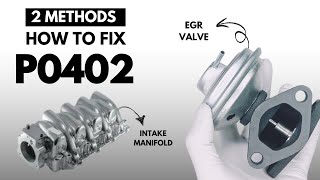
Technical definition: The SAE/OBD-II definition for P0402 is "Exhaust Gas Recirculation 'A' Flow Excessive Detected." 🎬 Watch: A mechanic explains the common causes and fixes for P0402. The PCM determines via sensors (MAP, DPFE, or EGR temperature) that the exhaust gas volume flowing through the EGR system exceeds the commanded amount for current engine conditions.
Can I Drive With P0402?
Yes, But With Caution. You can drive for 100-200 miles, but rough idling and stalling pose immediate safety hazards in traffic. Long-term driving causes excessive carbon buildup, engine overheating, and catalytic converter damage costing $800 to $2,500.
Common Causes

- EGR Valve Stuck Open (Very Common) — Carbon and soot from the exhaust build up over time, causing the EGR valve's pintle or diaphragm to stick open. This forces exhaust into the engine constantly, even at idle when the valve must be closed.
- Faulty EGR Flow Sensors (DPFE/MAP/Temp) (Common) — Sensors measuring EGR flow fail from heat and moisture. Ford's DPFE sensor frequently sends false high-flow voltage signals. 🎬 Watch: How to fix Ford P0402 codes using two simple DIY methods. A faulty MAP or EGR Temperature sensor also provides incorrect data, tricking the computer into falsely triggering P0402.
- Engine Computer (ECM/PCM) Software Anomaly (Common) — On 2023-2024 Chevrolet/GMC Duramax and some Ford/Ram trucks, overly sensitive diagnostic parameters incorrectly set the code. A manufacturer Technical Service Bulletin (TSB) software update resolves this without replacing parts.
- Faulty EGR Control Solenoid (Common) — The electronic solenoid managing vacuum supply to the EGR valve shorts or fails, commanding the valve to open excessively or at incorrect times.
- Restricted Exhaust System (Uncommon) — A clogged catalytic converter creates excessive exhaust backpressure. This pressure physically forces the EGR valve pintle off its seat, leaking exhaust into the intake manifold.
- System Leaks (Vacuum Lines or EGR Cooler) (Uncommon) — Cracked vacuum hoses on older vehicles cause the valve to stick open. On diesel engines (Ram EcoDiesel, Cummins), a cracked EGR cooler alters system pressures and triggers the code.
Symptoms

- Check Engine Light is On — The PCM illuminates the light immediately after logging the P0402 fault during a failed system test.
- Rough Idle and Low-Speed Stalling — Exhaust gas dilutes the air-fuel mixture at idle, causing the engine to shake, surge, or stall completely at stops.
- Poor Acceleration or Hesitation — The engine feels sluggish and stumbles during acceleration due to the oxygen-deprived air-fuel ratio.
- Reduced Fuel Economy — The inefficient combustion process forces the engine to burn 5-15% more fuel to maintain power.
- Emissions Test Failure and Visible Smoke — The vehicle produces visible exhaust smoke and automatically fails state smog inspections.
Diagnostic Flowchart

Tap your situation to follow the diagnostic path that matches what you're seeing on this code.
Common Fixes & Costs
- Clean EGR Valve and Intake Passages — Parts: $10-$25, Labor: $120-$200, ~1.5 hr book time (DIY)
- Replace DPFE Sensor (Ford) — Parts: $40-$150, Labor: $50-$100, ~0.5 hr book time (DIY)
- Replace EGR Valve — Parts: $75-$450, Labor: $100-$350, ~1.5 hr book time (Intermediate)
- Reprogram Engine Control Module (ECM) — Parts: $0, Labor: $100-$300, ~1.0 hr book time (Professional)
- Replace EGR Cooler — Parts: $300-$800, Labor: $400-$1000, ~4.5 hr book time (Professional)
Used vs. New Parts: Buying Guide
When a used part is worth it: For a simple, mechanically operated EGR valve on an older, high-mileage vehicle, a used OEM part from a low-mileage donor is a budget-friendly option.
Donor-vehicle mileage cap: roughly under 60000 miles for the part to have meaningful remaining life.
Donor quality checklist:
- Verify the donor vehicle was not scrapped for engine or emissions-related failures.
- Visually inspect the used valve for heavy carbon buildup or physical damage.
- Ensure the part number matches exactly; electronic EGR valves are not interchangeable.
Decision logic:
- If The part is an electronic sensor like a DPFE. → Always buy new. Used sensors are a major gamble and have a high failure rate.
- If The vehicle is less than 10 years old or the new part costs less than $150. → Buy a new aftermarket or OEM part. The savings from a used part are not worth the risk.
- If The part is a complex electronic EGR valve or EGR cooler. → Strongly favor new. These parts have high failure rates due to heat and soot.
Warranty tradeoff: Used parts from a salvage yard typically have a 30-90 day warranty. New aftermarket parts offer a 1-year to limited lifetime warranty. OEM parts carry a 1-2 year warranty.
Worst-case if a used part fails: $200-$500 if a used part fails shortly after installation, requiring repeat labor costs.
What Happens If You Wait — Timeline
- 0-1 month: Check Engine Light illuminates. A rough or surging idle becomes noticeable when warm. The engine occasionally stalls when coming to a stop. (MPG impact: 3-8%% · Added cost: $10-$40 in wasted fuel.)
- 1-4 months: Stalling at low speeds becomes frequent. Engine hesitation is pronounced during acceleration. Soot builds up heavily on intake valves and piston tops. (MPG impact: 8-15%% · Added cost: $50-$150 in wasted fuel.)
- 4-8 months: Constant hot exhaust gas and improper air-fuel mixtures overheat the catalytic converter. Engine knocking (detonation) occurs under load due to carbon hot spots. (MPG impact: 15-20%% · Added cost: $800-$2,500 for a now-necessary catalytic converter replacement.)
- 8+ months: Severe drivability issues make the vehicle unreliable. The catalytic converter melts or clogs, causing extreme power loss and risking internal engine damage. (MPG impact: 20-30%% · Added cost: $2,500+ for catalytic converter and potential engine component repairs.)
Cost of Not Fixing It
- 0-1 month: Noticeable rough idle, potential stalling at stops, and a 5-15% reduction in fuel economy. (Added cost: $20-$60 in wasted fuel.)
- 1-6 months: Increased carbon buildup on intake valves. The constant rich condition overheats the catalytic converter, leading to reduced efficiency and failure. (Added cost: $800-$2,500 for catalytic converter replacement.)
- 6+ months: Severe engine performance degradation. Risk of internal engine damage due to sustained improper combustion temperatures and detonation. (Added cost: $2,500+ for potential engine and catalytic converter repairs.)
Diagnosis Steps
- Read the Code and Analyze Freeze Frame Data
Use an OBD-II scanner to confirm P0402. Analyze freeze frame data (RPM, speed, load) to see exactly when the code triggered. A fault at idle strongly indicates a physically stuck-open valve.
Tools: OBD-II Scanner (Beginner) - Check for Technical Service Bulletins (TSBs)
Search for P0402 TSBs for your specific year, make, and model. Manufacturers frequently release software updates to fix overly sensitive diagnostic logic on newer Ford, GM, and Ram trucks.
Tools: Internet access (Beginner) - Analyze Scan Tool Live Data PIDs
Monitor live data at idle. 'EGR_CMD' (Commanded EGR) must be 0%. If 'DPFE_V' is over 1.5V or 'EGR_POS' shows above 0%, the valve is stuck open or the sensor has failed.
Tools: Advanced OBD-II Scan Tool (Advanced) - Pro Tip: Test the DPFE Sensor (Ford)
For Ford vehicles, back-probe the DPFE sensor's signal wire with Key On, Engine Off (KOEO). Voltage must be 0.5V to 1.1V. If voltage is high (>1.5V) at idle or ignores manual vacuum changes, replace the sensor.
Tools: Multimeter, T-pins for back-probing (Advanced) - Visually Inspect the EGR System
Look for cracked, disconnected, or brittle vacuum hoses connected to the EGR valve and solenoid. Inspect wiring and electrical connectors for corrosion or damage.
Tools: Flashlight (Beginner) - Test the EGR Valve Mechanically
With the engine off, manually push the EGR valve's diaphragm; it must move smoothly and snap closed. With the engine idling, apply vacuum to the valve port with a hand pump. A functioning valve opens and causes the engine to stumble, confirming clear passages.
Tools: Hand vacuum pump, basic hand tools (Intermediate) - Clean the EGR Valve and Passages
Remove the EGR valve and throttle body. Use EGR cleaner and small brushes to scrub carbon buildup from the pintle, seat, and intake manifold ports. Honda vehicles require removing a specific manifold cover plate.
Tools: Socket/wrench set, gaskets, EGR/throttle body cleaner, brushes (Intermediate) - Test EGR Position Sensor Voltage
Back-probe the position sensor signal wire. KOEO voltage must be 0.5V-1.0V. Manually apply vacuum to open the valve; voltage must smoothly increase to ~4.5V. Erratic or stuck voltage means a failed sensor.
Tools: Multimeter, Hand Vacuum Pump (Advanced) - Check Induction System Leak Indicator (GM Duramax)
For 2024+ GM trucks, use a GDS2 scanner. Command EGR to 0% and check the 'Induction System Leak Indicator' (ISLI) PID. A reading below 0.95 confirms a stuck-open EGR valve or pre-turbo air leak.
Tools: GDS2 or equivalent professional scan tool (Advanced) - Check for Exhaust Backpressure
Measure backpressure at the front oxygen sensor port. Pressure exceeding 1.5-2.0 PSI at 2500 RPM indicates a clogged catalytic converter forcing the EGR valve open.
Tools: Exhaust backpressure gauge (Advanced)
When This Code Triggers (Freeze-Frame Conditions)
- Engine Coolant Temp: 180-210°F (82-99°C) (The engine must reach full operating temperature; the EGR monitor ignores cold engines.)
- RPM: 500-850 RPM (at idle) or 1500-2500 RPM (cruising) (Sets at idle when flow must be zero, or during steady-state cruising tests.)
- Vehicle Speed: 25-60 mph (EGR monitor tests run during steady highway or city driving, excluding rapid acceleration.)
- Engine Load: 20-60% (Detected under light to moderate engine load when the EGR system is active.)
Related Codes
- P0401 — Means 'EGR Flow Insufficient Detected.' If P0401 and P0402 appear simultaneously, it points to a faulty flow sensor (like a Ford DPFE) sending contradictory signals to the computer.
- P0400 — Means 'EGR Flow Malfunction.' A general code indicating a problem with EGR performance. P0402 is the specific version indicating flow is 'excessive'.
- P0101 — Indicates a Mass Air Flow (MAF) sensor problem. A faulty MAF reports lower-than-actual airflow, causing the PCM to perceive normal EGR flow as 'excessive', falsely triggering P0402.
- P0403, P0404, P0405, P0406 — Point specifically to electrical circuit faults. P0403 is a control circuit fault; P0405/P0406 indicate position sensor circuit problems. Diagnose wiring or sensors before assuming a mechanical failure.
Climate & Environmental Factors
- Humidity and Moisture: High humidity accelerates moisture buildup in the EGR system. Moisture enters the Ford DPFE sensor housing, causing corrosion and electronic failure, which falsely triggers P0402.
- Cold Weather: Moisture in the EGR system or vacuum lines freezes in cold weather, causing the valve to stick or actuators to fail temporarily.
- Altitude: High altitude does not directly cause P0402. The PCM uses BARO and MAP sensors to adjust for altitude changes. Failures at altitude indicate a pre-existing marginal component.
How to Talk to a Mechanic About This Code
Say this: "I have a P0402 code with a rough idle and I'd like to schedule a diagnostic. Before replacing the EGR valve, could you please test the EGR flow or position sensor and check for any software-related TSBs for my vehicle?"
This signals you know that a bad sensor or a software glitch are common causes, not just a stuck valve. It encourages proper diagnosis instead of immediately replacing the most expensive part.
Avoid saying:
- 'Just fix whatever's wrong'
- 'My check engine light is on, can you look at it?' (too vague — invites upsell)
- 'Whatever you recommend'
Questions to ask before authorizing the repair:
- Did the EGR valve fail a mechanical test, or was it just stuck with carbon?
- What were the live data readings for the EGR commanded percentage and the actual position/flow sensor voltage at idle?
- Did you check for a software update TSB from the manufacturer?
- What is the warranty on this specific repair and the new part?
Where to Take It: Dealer vs Independent vs Chain
- Dealer:
Best for: Vehicles under warranty, Newer vehicles with software-related TSBs (e.g., 2023-2024 GM Duramax), Complex electronic EGR systems on German makes (BMW, Mercedes)
Downsides: Higher labor rates, typically 30-60% more than independent shops., May recommend replacing an entire assembly when only a cleaning or smaller part is needed. (Typical cost: +50% vs. baseline) - Independent Shop:
Best fit for most P0402 repairs. An experienced independent mechanic is highly familiar with carbon buildup, sensor failures (like Ford's DPFE), and clogged passages.
Best for: Most out-of-warranty vehicles, Common P0402 issues like a stuck valve or a bad sensor on domestic/Japanese cars, Cost-sensitive repairs
Downsides: Quality varies, so check reviews and ASE certifications., May lack the latest software tools for brand-new models. (Typical cost: +0% vs. baseline) - Chain Shop:
Acceptable for a straightforward, pre-diagnosed sensor or valve replacement. AVOID for initial diagnosis of intermittent or complex P0402 issues.
Best for: Simple, clear-cut part replacements like an easily accessible sensor.
Downsides: Technician skill varies dramatically., High pressure to upsell can lead to replacing parts without proper diagnosis. (Typical cost: -10% vs. baseline)
When to Walk Away From the Repair
If the estimated repair cost exceeds 40-50% of the car's private-party value (from a source like Kelley Blue Book), seriously consider selling or trading it in instead of repairing.
- Car worth $5000, fix is $800: Fix it — The repair cost is well below the threshold and significantly less than replacing the vehicle.
- Car worth $3000, fix is $1200: Borderline — The repair is 40% of the car's value. Get a second opinion and assess the car's overall health before proceeding.
- Car worth $2500, fix is $1800: Walk away — The repair cost is not economically viable. The money is better put toward a replacement vehicle.
What Scan Tool You Need for This Code
Minimum: A scanner that can read and clear codes, and critically, display live sensor data and freeze frame data.
A $20 code reader only tells you the P0402 code exists. It cannot show live data (like EGR position or sensor voltage) needed to determine if the cause is a stuck valve or a bad sensor, leading to wasted money on parts.
Budget: BlueDriver Pro (~$100) — Connects to your smartphone and provides freeze frame data and live data graphing for crucial PIDs like 'Commanded EGR' and 'EGR Error %', enough to diagnose a stuck valve versus a sensor issue.
Mid-range: Foxwell NT510 Elite (~$180) — Offers manufacturer-specific diagnostics and bidirectional controls. Allows you to command the EGR valve to open and close directly from the tool to test its mechanical function.
Professional: Autel MaxiCOM MK808 / MK808S (~$500) — Provides full bidirectional control for the EGR system, along with access to all vehicle modules and special functions. Professional-level equipment for complex diagnostics.
Rent vs buy: If this is a one-time diagnosis, many auto parts stores (like AutoZone) have a free loaner tool program. Buy a scanner only if you plan to perform your own diagnostics more than once or twice a year.
How to Clear the Code After You Fix It
- Use an OBD-II scan tool to clear the P0402 code.
- Perform the specific EGR drive cycle for the vehicle.
- Check readiness monitors to confirm the EGR monitor has run and passed.
Drive cycle (~20 minutes): 1) Cold start and idle for 5 minutes to reach closed loop. 2) Drive at a steady 40-60 mph for 2-8 minutes. 3) Perform several cycles of smooth acceleration to 55 mph followed by coasting down completely. 4) Idle for 2-3 minutes.
Readiness monitors affected: EGR System, Catalyst, O2 Sensor
Before emissions retest: drive at least 50 miles to fully set monitors.
Watch out for:
- Disconnecting the battery clears the code but resets all readiness monitors to 'Not Ready', guaranteeing an emissions test failure.
- Failing to follow the manufacturer-specific drive cycle prevents the EGR monitor from running, even after hundreds of miles.
- The code returns immediately if the underlying mechanical or electrical fault is not repaired.
Will This Fail Emissions / State Inspection?
Yes — this code typically fails an OBD-II emissions inspection.
- California: An illuminated Check Engine Light is an automatic failure. After repair, all readiness monitors must be set to 'Ready' before passing the smog check.
- New York: A P0402 code causes an automatic failure of the NYS vehicle inspection. The underlying issue must be repaired and the code cleared.
- Texas: In counties requiring emissions testing, an active Check Engine Light is an automatic failure. You cannot pass until the fault is repaired and readiness monitors are set.
Most Commonly Affected Vehicles
- Ford F-150, F-Super Duty, Maverick, Focus, Escape (1997-2024) — Extremely prone to P0402. On 1997-2010 trucks, the cause is almost always a failed DPFE sensor. For 2022+ Maverick Hybrids, check for software updates per TSBs.
- Chevrolet / GMC Silverado / Sierra HD with 6.6L Duramax Engine (2023-2024) — A software anomaly causes P0402 on brand-new trucks. GM issued TSB 23-NA-066 and recall N242438501 to reprogram the ECM under warranty. Do not replace parts.
- Dodge / Ram Ram 1500 (3.0L EcoDiesel), Ram 2500/3500 (6.7L Cummins) (2014-2020) — EcoDiesel engines trigger P0402 due to sticking EGR valves and software issues requiring a PCM reflash. Cracked EGR coolers are a known issue under recall NHTSA 19V-757.
- Honda Accord, Civic, Odyssey, CR-V (1998-2007) — Famous for P0402 caused by heavy carbon clogging the EGR passages inside the intake manifold. The intake manifold must be removed to clean the internal ports.
- Toyota Camry, Avalon, Solara (1997-2006) — P0402 is caused by a faulty EGR valve or a malfunctioning EGR vacuum switching valve (VSV) controlling the vacuum supply.
- Volkswagen / Audi Jetta, Golf, Passat, A3 (TDI Models) (2005-2016) — TDI diesels are highly prone to P0402 due to a sticking EGR valve from heavy soot buildup, electronic valve failures, or a clogged EGR cooler.
- BMW 335d, 535d, X5 xDrive35d (Diesel Models) (2007-2015) — P0402 is triggered by a faulty electronic EGR valve or a clogged EGR cooler. The complexity of these systems requires professional diagnosis.
- Mercedes-Benz E-Class, GL-Class, Sprinter (BlueTEC Diesel Models) (2006-2016) — Commonly affected by heavy soot causing the EGR valve to stick open. Issues with the EGR cooler and associated electronic sensors are frequent causes.
Manufacturer-Specific Notes
- Ford: The most common cause of P0402 is a failed DPFE sensor, not the EGR valve. Always test this sensor first. Check for software-update TSBs on newer models like the Maverick Hybrid.
- General Motors (Chevrolet/GMC): On 2023-2024 Duramax diesels, P0402 is caused by a software issue. A dealer must perform an ECM software update per recall N242438501, covered under emissions warranty.
- Dodge / Ram / Chrysler (FCA): On 3.0L EcoDiesels, P0402 links to software problems requiring a dealer PCM reflash. These engines also suffer from cracking EGR coolers (Recall VB1) causing coolant loss.
- Honda: EGR passages inside the intake manifold notoriously clog with carbon. The intake manifold must be removed and internal ports manually cleaned to permanently fix the issue.
Real Owner Stories
2001 Ford F-150 4.6L with hesitation and P0402
Owner experienced periodic hesitation, slow acceleration, and a drop in MPG, triggering code P0402.
What they tried:
- Tested the DPFE sensor, EGR solenoid, and EGR valve, all of which appeared to be working correctly.
Outcome: Owner removed the throttle body and discovered the two small ports leading to the EGR valve chamber were completely clogged with carbon. After a thorough cleaning of the throttle body and its passages, the engine's idle and acceleration improved significantly, and the code was resolved.
Lesson: On older Fords and Hondas, EGR passages inside the throttle body or intake manifold clog with carbon. Even if the EGR valve functions, blocked ports cause flow issues. Thorough cleaning is the true fix.
2024 GMC Sierra 3500 6.6L Duramax with P0402 at <300 miles
Check Engine Light appeared on a brand new truck with extremely low mileage. Some owners also reported erratic shifting.
What they tried:
- Taking the vehicle to the dealership for diagnosis.
Outcome: The issue was identified as a software anomaly. The fix was reprogramming the Engine Control Module (ECM) per GM Technical Service Bulletin #23-NA-066 and recall N242438501. This was a no-cost warranty repair.
Lesson: For 2023-2024 GM Duramax vehicles, always check for TSBs before assuming a part has failed. A software glitch mimics hardware failure, requiring a simple warranty-covered reflash.
2001 Ford Ranger with P0401, then P0402 after repair
Initially had a P0401 (Insufficient Flow) code. Owner replaced the EGR valve and the DPFE sensor to fix it.
What they tried:
- Replaced EGR valve.
- Replaced DPFE sensor.
Outcome: Immediately after replacing the DPFE sensor, the code switched to P0402 (Excessive Flow) and the truck developed a rough idle and began stalling. The new aftermarket DPFE sensor was faulty, sending incorrect voltage signals.
Lesson: When a problem worsens immediately after replacing a sensor, the new part is the primary suspect. Aftermarket DPFE sensors have high failure rates. Getting opposite codes like P0401 and P0402 points directly to erratic sensor data.
How to Prevent This Code From Triggering
- Perform regular highway driving (Weekly) — Sustained driving at higher RPMs and temperatures burns off soft carbon deposits from the EGR valve and intake passages, preventing severe buildup.
- Use high-quality fuel with detergents (Every fill-up) — Top-tier fuels contain additives that keep fuel injectors clean, leading to complete combustion and reducing unburnt fuel and soot in the exhaust.
- Use a quality fuel system cleaner additive (Every 3,000-5,000 miles) — Additives with Polyether Amine (PEA) dissolve existing carbon deposits in the fuel system and reduce new formations that clog the EGR system.
- Avoid extended idling (Daily habit) — Long periods of idling, especially in diesels, contribute heavily to soot accumulation because exhaust gas temperatures are too low to burn it off.
- Perform periodic intake system cleaning (Every 30,000-60,000 miles) — Professional decarbonization or DIY aerosol intake cleaners remove varnish and carbon from the intake manifold, reducing deposits that interfere with EGR operation.
Frequently Asked Questions
Can I drive my car with a P0402 code?
Yes, you can drive for short distances, but it is not recommended. The engine runs rough, stalls at stops, and gets poor gas mileage, creating safety hazards in traffic. Ignoring it causes heavy carbon buildup and destroys the catalytic converter.
Will a P0402 code clear itself?
No, P0402 is a hard fault that will not clear itself. You must repair the underlying mechanical, electrical, or software problem first. After the repair, clear the code with an OBD-II scan tool.
Is it better to clean or replace the EGR valve?
Cleaning the EGR valve is a cost-effective first step and solves the problem if it is stuck with carbon. However, if the valve's diaphragm is ruptured or internal electronics have failed, replacement is mandatory.
How much does it cost to fix a P0402 code?
A DIY repair costs between $20 for cleaning supplies and $200 for a new sensor or valve. A professional repair ranges from $250 to $800, depending on the cause and vehicle model. This includes a standard $100-$150 diagnostic fee.
Will a P0402 code cause me to fail an emissions test?
Yes. An illuminated Check Engine Light is an automatic failure in most states. Excessive EGR flow directly increases emissions, guaranteeing a tailpipe test failure.
What are the most common misdiagnosis mistakes for P0402?
The most common mistake is replacing the EGR valve without testing the DPFE sensor on Fords. Mechanics also overlook restricted catalytic converters causing backpressure or fail to check for manufacturer TSBs requiring simple software updates.
Why would my car show both P0401 (Insufficient Flow) and P0402 (Excessive Flow)?
Getting these opposite codes together is almost always caused by a faulty EGR flow sensor, like the Ford DPFE. The sensor fails and sends erratic, illogical voltage signals to the computer. The problem is the sensor reporting false data, not the actual physical flow.
Can a bad oxygen sensor cause a P0402 code?
While not a direct cause, a faulty oxygen sensor contributes to a P0402 code. The ECU uses O2 sensor data to monitor the air-fuel ratio and confirm EGR flow effects. Incorrect O2 data leads the ECU to misinterpret EGR performance and trigger the code.
Key Takeaways
- Code P0402 indicates excessive exhaust gas recirculation, which suffocates the engine at idle and causes immediate rough running, stalling, and a 5-15% drop in fuel economy.
- A carbon-clogged, stuck-open EGR valve is the primary culprit across most vehicles, requiring a $10-$25 DIY cleaning or a $150-$350 professional replacement.
- On 1997-2010 Ford vehicles, a failed DPFE sensor falsely triggers P0402; test the sensor's voltage (target 0.5V-1.1V KOEO) before spending money on a new EGR valve.
- For 2023-2024 GM 6.6L Duramax trucks, P0402 is a known software glitch requiring a free dealer ECM reflash under recall N242438501, not a hardware replacement.
Helpful Videos
![How to Fix P0402 Engine Code in 3 Minutes [2 DIY Methods / Only $4.26]](https://img.youtube.com/vi/57B5b9uANus/mqdefault.jpg)
![How to Fix FORD P0402 Engine Code in 3 Minutes [2 DIY Methods / Only $4.26]](https://img.youtube.com/vi/HP6dn5ZenCE/mqdefault.jpg)



The information in this article is provided for general reference and educational purposes only. Vehicle specifications, procedures, and part compatibility can vary by production date, trim level, and region. Always consult your vehicle's factory service manual and verify part numbers before purchasing or performing repairs. Safety-critical components such as airbags, seat belts, and braking systems should be installed by a qualified professional.
- 🎬 Helpful Videos
- What Does P0402 Mean?
- Can I Drive With P0402?
- Common Causes
- Symptoms
- Diagnostic Flowchart
- Common Fixes & Costs
- Used vs. New Parts: Buying Guide
- What Happens If You Wait — Timeline
- Cost of Not Fixing It
- Diagnosis Steps
- When This Code Triggers (Freeze-Frame Conditions)
- Related Codes
- Climate & Environmental Factors
- How to Talk to a Mechanic About This Code
- Where to Take It: Dealer vs Independent vs Chain
- When to Walk Away From the Repair
- What Scan Tool You Need for This Code
- How to Clear the Code After You Fix It
- Will This Fail Emissions / State Inspection?
- Most Commonly Affected Vehicles
- Manufacturer-Specific Notes
- Real Owner Stories
- 2001 Ford F-150 4.6L with hesitation and P0402
- 2024 GMC Sierra 3500 6.6L Duramax with P0402 at <300 miles
- 2001 Ford Ranger with P0401, then P0402 after repair
- How to Prevent This Code From Triggering
- Frequently Asked Questions
- Can I drive my car with a P0402 code?
- Will a P0402 code clear itself?
- Is it better to clean or replace the EGR valve?
- How much does it cost to fix a P0402 code?
- Will a P0402 code cause me to fail an emissions test?
- What are the most common misdiagnosis mistakes for P0402?
- Why would my car show both P0401 (Insufficient Flow) and P0402 (Excessive Flow)?
- Can a bad oxygen sensor cause a P0402 code?
- Key Takeaways
- 🎟️ Get 5% Off