

P0401 on 2010-2014 VW Golf Wagon 2.0L TDI: EGR Insufficient Flow Causes & Fixes
On the 2.0L TDI diesel engine (CJAA), code P0401 almost always means the low-pressure EGR filter is clogged with soot. This is a symptom of a cracked Diesel Particulate Filter (DPF). The definitive diagnostic is checking the tailpipe for black soot. Before paying for any repairs, check if your vehicle is covered by the 'Dieselgate' Extended Emissions Warranty, as the entire DPF and EGR system are included. The correct fix involves replacing both the DPF and the low-pressure EGR filter/pipe.
- P0401 on a 2.0L TDI Golf Wagon is not a typical EGR valve problem; it's a symptom of a failed Diesel Particulate Filter (DPF).
- The diagnosis is straightforward: a clogged low-pressure EGR filter and/or soot in the tailpipe points directly to a cracked DPF.
- A temporary fix is to clean or replace the low-pressure EGR filter, but the code will return until the DPF is replaced.
- Before paying for any repairs, check with a Volkswagen dealer about potential coverage under the TDI Extended Emissions Warranty.
What's Unique About the 2010-2014 Volkswagen GOLF WAGON
The 2010-2014 VW Golf Wagon with the 2.0L TDI engine (engine code CJAA) uses a dual-loop EGR system with both high-pressure and low-pressure circuits. The P0401 code specifically points to a problem in the low-pressure EGR system, which recirculates exhaust *after* it has been filtered by the Diesel Particulate Filter (DPF). This design means the most common cause for P0401 is unique: a cracked DPF allows soot to pass through and clog a small, mesh EGR filter located downstream, leading to the "insufficient flow" error. This failure pattern is confirmed by VW's own technical service bulletins.
Diagnostic Flowchart
Tap your situation to follow the diagnostic path that matches what you're seeing on this vehicle.
Symptoms You May Notice
- Check Engine Light is on.
- Black soot present inside the exhaust tailpipe (the most definitive symptom of the root cause).
- Typically no other noticeable driving symptoms like power loss or rough idle.
- Possible reduced fuel economy.
- In some cases, rough idle or hesitation may occur.
- Replacing only the high-pressure EGR valve. While this valve can fail, the P0401 code on the CJAA engine almost always relates to the low-pressure system.
- Cleaning or replacing only the low-pressure EGR filter. This will clear the code temporarily, but it will return quickly if the DPF is cracked and continues to send soot downstream.
- Attempting to 'clean' the DPF. A cracked DPF cannot be repaired by cleaning or a forced regeneration; it must be replaced.
Most Likely Causes
- Cracked Diesel Particulate Filter (DPF) 🔴 High Probability This is the root cause of the clogged EGR filter in the vast majority of P0401 cases on this engine. The internal ceramic filter element cracks over time due to thermal stress, allowing soot to bypass the filter.
How to confirm: The primary confirmation is a simple 'soot test': wipe the inside of the exhaust tailpipe with a finger or a clean cloth. If it comes out covered in black soot, the DPF is cracked. A healthy DPF on a TDI results in a clean tailpipe. This test is even recommended in official VW TSBs. The presence of code P2002 alongside P0401 is also a strong confirmation.
Typical fix: Replace the Diesel Particulate Filter (DPF). This must be done along with replacing or thoroughly cleaning the low-pressure EGR filter to permanently resolve the issue. After replacement, an adaptation for the new DPF must be performed using a diagnostic tool like VCDS.
Est. part cost: $1200-$2000 - Clogged Low-Pressure EGR Filter 🔴 High Probability This is a guaranteed symptom, not the root cause. This filter is designed to catch any particles that make it past the DPF. When the DPF cracks, it allows excessive soot to pass through, which quickly overwhelms and clogs this fine mesh filter, directly causing the P0401 insufficient flow code.
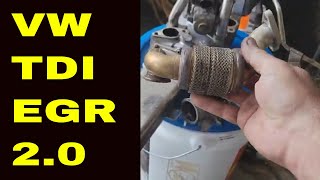
How to confirm: Remove the low-pressure EGR pipe/filter assembly (located after the DPF) and visually inspect for heavy soot buildup. If it's clogged, water or air will flow through it very slowly or not at all. However, if the tailpipe is sooty, this part is guaranteed to be clogged.
Typical fix: Replace the low-pressure EGR filter/pipe. This is a temporary fix that will fail again quickly if the root cause (cracked DPF) is not also addressed.
Est. part cost: $80-$150 - Clogged or Sticking High-Pressure EGR Valve ⚪ Low Probability While a common issue on other diesel engines, it is a very unlikely cause of a P0401 code on the CJAA engine, as this code specifically points to the low-pressure circuit. Misdiagnosing this as the cause is a common mistake.
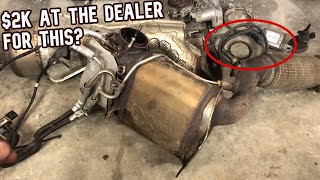
How to confirm: Remove the EGR valve and inspect for carbon buildup that would prevent the valve pintle from moving freely. A scan tool can also be used to command the valve open and closed 🎬 See how the EGR valves work and where they're located. to check its response.
Typical fix: Clean the EGR valve and passages with a carbon cleaner or replace the EGR valve assembly if it's damaged or fails tests.
Est. part cost: $250-$400
Rare But Worth Checking
- Failed EGR Temperature or Pressure Sensor: A faulty sensor can send incorrect data to the ECM, leading it to misinterpret the EGR flow rate. This is less common than mechanical blockages but worth considering if the EGR passages are clean.
- Failed Exhaust Flap Actuator: The exhaust flap helps create the pressure differential needed for EGR flow. If it malfunctions, it can contribute to a P0401 code, though this is not the primary cause.
Diagnosis Steps
- CRITICAL FIRST STEP: Check your vehicle's eligibility for the 'Dieselgate' Extended Emissions Warranty by contacting a VW dealer with your VIN. This repair is very expensive, and the entire DPF and EGR system are covered components. This could make the repair free of charge.
- Read the fault codes with an OBD-II scanner. Note if P2002 or P2463 are present alongside P0401, as this strongly points to the DPF.
- Perform the 'soot test': Inspect the inside of the exhaust tailpipe. The presence of black, greasy soot is a definitive indicator of a failed/cracked DPF. A healthy TDI tailpipe should be clean.
- If soot is present, the diagnosis is confirmed. The DPF is cracked and the low-pressure EGR filter is clogged. Both parts require replacement.
- If the tailpipe is surprisingly clean, the diagnosis is less certain. 🎬 Watch this diagnostic walkthrough for P0401 and related codes. Proceed to remove and inspect the low-pressure EGR filter pipe for blockages.
- If the filter is clean, further diagnostics on the high-pressure EGR valve, sensors, and exhaust flap would be necessary, but this is a very unlikely scenario for this specific code and engine.
Parts You'll Likely Need
- Low-Pressure EGR Filter Pipe
(OEM #1K0253120 / 1K0253120B)— This is the part that gets clogged by soot from a cracked DPF, directly causing the P0401 code. It must be replaced or cleaned when the DPF is replaced.
Trusted brands: Volkswagen (OEM)
OEM price range: $100-$150
Aftermarket price range: $70-$120 - Diesel Particulate Filter (DPF)
(OEM #1K0254708GX)— A cracked DPF is the root cause of the P0401 code in most cases. Replacing it is essential for a permanent fix.
Trusted brands: Volkswagen (OEM)
OEM price range: $1200-$2000
Aftermarket price range: $600-$1200 - EGR Cooler / Valve Assembly
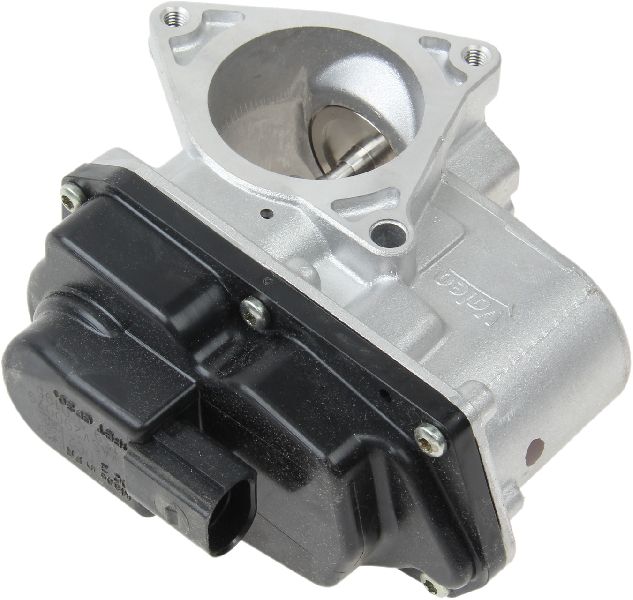
(OEM #03L131512DQ)— This is the complete assembly containing the high-pressure EGR valve and cooler. It is often replaced as a unit if found to be clogged or leaking, though it's not the primary cause of P0401 on this engine and should not be replaced for this code unless diagnosed separately.
Trusted brands: Volkswagen (OEM), BorgWarner (Wahler), Pierburg
OEM price range: $450-$600
Aftermarket price range: $250-$450
Related Codes That Often Appear With This One
- P2002 — Stands for 'Particulate Trap Bank 1: Efficiency Below Threshold'. This code directly indicates a failing DPF and is frequently seen with P0401, confirming that the cracked DPF is the source of both problems.
- P2463 — Stands for 'Diesel Particulate Filter - Soot Accumulation'. This code often appears with P0401 because a cracked DPF (the root cause of P0401) can also lead to efficiency problems and soot accumulation warnings. The official VW TSB mentions these two codes can appear together.
Technical Service Bulletins (TSBs) & Recalls
- V011609_2034898 / 01-16-01 / 26-16-01: This TSB, referenced by multiple numbers over its revisions, directly addresses P0401 on the CJAA engine. It states the cause can be high soot loads restricting the EGR filter. Crucially, it instructs technicians to check for soot in the tailpipe and, if found, to replace the DPF and low-pressure EGR filter as a pair.
Platform-Specific Known Issues
- 'Dieselgate' Emissions Warranty is CRITICAL: Many of these vehicles received an extended emissions warranty as part of the emissions scandal settlement. This warranty covers the *entire* exhaust gas after-treatment system (including the DPF) and the *entire* EGR system (including all valves, coolers, and filters). The warranty period is the greater of 10 years/120,000 miles from the original in-service date, or 4 years/48,000 miles from the date of the emissions modification. It is essential to check with a VW dealer to see if this expensive repair is covered under warranty before spending any money.
- As per Volkswagen TSB #2034898 (also listed as V011609, 01-16-01, etc.), the official diagnostic procedure for P0401 is to check the tailpipe for soot. If soot is present, the TSB directs the technician to replace both the DPF and the low-pressure EGR filter together.
Mechanic-Grade Diagnostic Values
- DPF Differential Pressure Sensor (G450) Voltage — expected: Approximately 0.7-0.8V with key on, engine off. At idle, should be low (e.g., 7-8 hPa). Rises with engine load.. Failure: Voltage that is stuck high (e.g., 5V) or low (0V), or readings that do not change with engine RPM, indicate a faulty sensor or clogged passages. A reading of -1hPa or 1hPa at rest could indicate a sensor issue.
- High Pressure EGR Valve Adaptation Test (VCDS) — expected: The deviation in mass air flow between 'EGR ON' and 'EGR OFF' must be at least 100.0 mg/str.. Failure: A deviation less than 100.0 mg/str indicates a blockage or a malfunctioning high-pressure EGR valve.
Scan Tool Commands That Help
- VCDS (VAG-COM): Reset Learned Values for Low-Pressure EGR Valve — After replacing the low-pressure EGR filter pipe or diagnosing flow issues. This is found in [01-Engine] -> [Adaptation - 10] -> Channel 118.
- VCDS (VAG-COM): Reset Learned Values for High-Pressure EGR Valve — After replacing or cleaning the high-pressure EGR valve assembly. This is found in [01-Engine] -> [Adaptation - 10] -> Channel 123.
- VCDS (VAG-COM): DPF Differential Pressure Sensor Adaptation — After replacing the DPF Differential Pressure Sensor (G450), an adaptation must be performed to calibrate the new sensor to the ECM.
- VCDS (VAG-COM): DPF Replacement Adaptation — This is a critical step after replacing the DPF. It resets the soot mass values in the ECM to zero, informing the control module that a new, clean filter has been installed.
Wiring & Ground Locations
- Main Engine/Transmission Ground — A primary ground strap connects the transmission case to the chassis. A poor connection here can cause a wide range of electrical issues.. While not a direct cause, a weak ground can affect sensor readings, including those for the DPF pressure sensor and EGR temperature sensors, potentially leading to incorrect diagnostics.
- G652 — Transmission/engine ground connection.. This is a key ground point for the engine block. Ensuring it is clean and tight is fundamental for all engine sensor operations.
- G18 — Ground connection on the engine block.. Another critical engine ground point. A faulty connection could interfere with the proper operation of various engine management sensors.
- Ground Point on Firewall / Bulkhead — Located on the firewall, often behind the battery.. This is a common grounding point for various components in the engine bay. Corrosion or looseness can lead to sporadic electronic faults.
Real Owner Repair Stories
- Ross-Tech Forums user (2012 VW Jetta TDI (CJAA)) — P0401 code, surging, EGTs spiking to 1350°F, soot in tailpipes.
✅ What actually fixed it The user confirmed the DPF was compromised due to soot in the tailpipe. As a temporary fix to pass inspection, they replaced only the clogged low-pressure EGR filter with a clean used one for $40. This cleared the code and improved drivability, but the user acknowledged the root cause (cracked DPF) was not addressed. - Ross-Tech Forums user (2012 VW TDI Sportwagen (CJAA), 190k miles) — Persistent Check Engine Light with codes P0401 (EGR Insufficient Flow) and P2002 (DPF Efficiency Below Threshold). No drivability issues noticed by the owner.
❌ Tried (didn't work) Resetting the codes with a basic scanner; the light returned in 10-15 minutes.
✅ What actually fixed it The forum diagnosis, confirmed by multiple experts and VW TSBs, is that the combination of P0401 and P2002 on a CJAA with soot in the tailpipe confirms a cracked DPF. The correct repair is to replace both the DPF and the low-pressure EGR filter. - Reddit r/tdi user (2014 VW Jetta DSG (CJAA), 246,000 kms) — Check Engine Light with P0401 after a long drive.
✅ What actually fixed it A VW dealer technician in the comments confirmed the diagnosis: P0401 by itself might be just the clogged low-pressure EGR filter. However, if P2002 is also present, it necessitates replacement of the DPF, the low-pressure EGR filter, and likely the high-pressure EGR valve as well (confirm with flow test). The user confirmed the root cause is a cracked DPF allowing soot to clog the downstream filter.
OEM Part Supersession History
1K0253120 / 1K0253120A→1K0253120B— Part revision/update. The newer version is a pipe with a mesh filter inside, while some older versions may have been a canister style. They are functionally interchangeable.1K0254706LX→1K0254708GX— This is a remanufactured part number for the DPF assembly. The 'X' at the end signifies a remanufactured part that requires a core return.
Heads up: Ensure you are ordering the correct part for your vehicle's emissions standard and model year. A core charge is typically required.
Helpful Videos
Used OEM Parts in Stock
New Aftermarket Parts Available





The information in this article is provided for general reference and educational purposes only. Vehicle specifications, procedures, and part compatibility can vary by production date, trim level, and region. Always consult your vehicle's factory service manual and verify part numbers before purchasing or performing repairs. Safety-critical components such as airbags, seat belts, and braking systems should be installed by a qualified professional.
- Volkswagen GOLF WAGON:
- 🎬 Helpful Videos
- 🛍️ Shop This Part
- What's Unique About the 2010-2014 Volkswagen GOLF WAGON
- Diagnostic Flowchart
- Symptoms You May Notice
- Most Likely Causes
- Rare But Worth Checking
- Diagnosis Steps
- Parts You'll Likely Need
- Related Codes That Often Appear With This One
- Technical Service Bulletins (TSBs) & Recalls
- Platform-Specific Known Issues
- Mechanic-Grade Diagnostic Values
- Scan Tool Commands That Help
- Wiring & Ground Locations
- Real Owner Repair Stories
- OEM Part Supersession History
- 🎟️ Get 5% Off