

P0401 on 2014-2020 Ram 3500 6.7L Cummins: EGR Performance Causes and Fixes
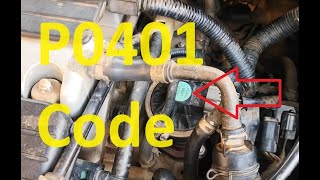
On a Ram 3500 with the 6.7L Cummins, P0401 almost always means the EGR system is clogged with soot. The most likely culprit is a plugged EGR cooler, followed by a sticking EGR valve. A reliable fix requires removing and cleaning or replacing the clogged components. Before starting any repair, owners should check with a dealer if their VIN is covered under Ram's Emissions Warranty Extension XQ1, which may cover the entire job.
- P0401 on a 6.7L Cummins almost always points to a soot-clogged EGR system.
- The EGR cooler is the most likely component to be completely blocked and should be inspected before replacing any other parts.
- Simply replacing the EGR valve is not a complete fix; the entire system (cooler, valve, passages) must be inspected and cleaned.
- Before paying for repairs, check with a Ram dealer to see if your truck is covered under the Emissions Warranty Extension XQ1.
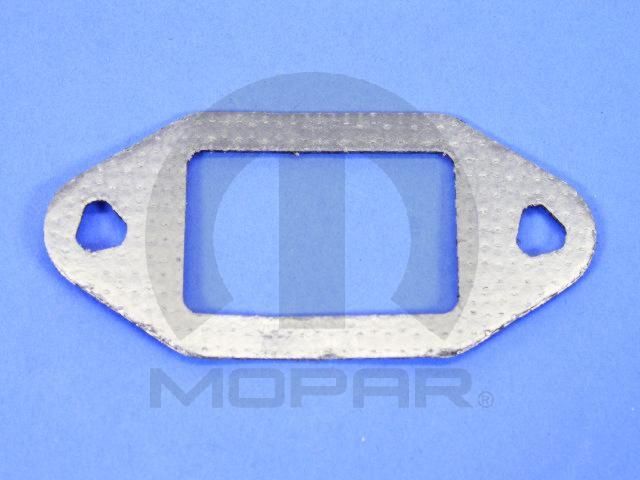
- Always use new gaskets when reassembling the EGR system to prevent future leaks.
What's Unique About the 2014-2020 Ram 3500

The 6.7L Cummins engine is known for producing significant amounts of soot. This soot combines with oil vapor from the crankcase ventilation (CCV) system to create a thick, tar-like sludge. This sludge is particularly effective at clogging the small passages of the EGR cooler and the EGR valve, making P0401 a very common and almost expected maintenance issue on these trucks. The problem is so well-documented that Ram has issued multiple Technical Service Bulletins (TSBs) and even a warranty extension (XQ1) that may cover these components. A neglected CCV filter can accelerate this process by allowing 🎬 Watch: How to change your CCV filter to prevent soot buildup. more oil vapor into the intake tract.
Diagnostic Flowchart

Tap your situation to follow the diagnostic path that matches what you're seeing on this vehicle.
Generation note: This range covers the end of the Fourth Generation (2014-2018) and the start of the Fifth Generation (2019-2020) Ram 3500. While both use a 6.7L Cummins engine, there are differences in the EGR system components and part numbers between generations, particularly the EGR cooler. However, the root cause of P0401—soot clogging—is common to both.
Symptoms You May Notice

- Check Engine Light is on
- Reduced engine power, feeling 'gutless', or entering 'limp mode'.
- Decreased fuel economy
- Engine knocking or pinging during acceleration
- Rough idle or stalling
- Noticeable exhaust or burning coolant smell in the cab, which could indicate an external or internal EGR system leak.
- Replacing only the EGR valve without inspecting the EGR cooler. The cooler is the most common point of restriction, and replacing just the valve will not fix the code if the cooler is plugged.
- Assuming a sensor is faulty before cleaning it. EGR sensors are often just covered in soot and can be cleaned to restore function.
- Replacing EGR parts when the root cause is a boost leak. If P0299 or P2281 are also present, a boost leak test should be performed first.
Most Likely Causes

- Clogged EGR Cooler 🔴 High Probability The 6.7L Cummins produces heavy soot that mixes with CCV oil vapor, creating a sludge that builds up and completely restricts the small passages inside the EGR cooler. This is the most common failure point for this code, and TSB 9003758 specifically directs technicians to check for this.
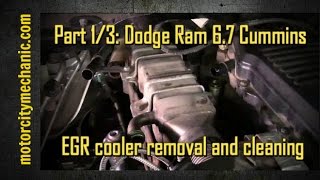
How to confirm: Remove the EGR cooler and visually inspect the internal passages. On a truck with P0401, they will almost certainly be visibly blocked with thick, black soot. If the soot is wet or has a white, crusty residue, the cooler is also leaking coolant internally. A professional video by Dave's Auto Center shows this exact failure and inspection process.
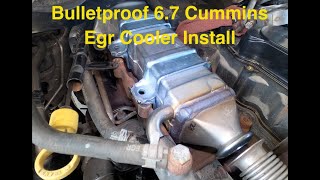
Typical fix: Replacement of the EGR cooler is the most reliable fix. While some owners attempt to clean it by soaking in solvents like Purple Power, this is often a temporary solution and may not clear hardened deposits. Always replace all associated gaskets.
Est. part cost: $400-$2600 - Sticking or Clogged EGR Valve 🟡 Medium Probability The same soot and sludge that clogs the cooler also builds up on the EGR valve's plunger and seat, causing it to stick closed and preventing flow. The electronic actuator can also fail.
How to confirm: Remove the EGR valve and inspect it for heavy carbon buildup. Manually actuate the valve to see if it moves freely. A capable scan tool (like AlfaOBD) can be used to command the valve open and closed while monitoring its position sensor to check for proper response, as discussed by users on the Turbo Diesel Register forum.
Typical fix: Thoroughly clean the valve with a suitable solvent and a brush. However, if cleaning doesn't work or the actuator has failed, it must be replaced. Many owners on forums report that replacing the valve without addressing a clogged cooler leads to the code returning quickly.
Est. part cost: $250-$650 - Clogged EGR Passages or Crossover Tube 🟡 Medium Probability Soot can accumulate in the intake horn, crossover tubes, and passages leading to and from the EGR components, creating a bottleneck that contributes to the insufficient flow code.
How to confirm: When the EGR valve and cooler are removed for inspection, visually inspect all connecting tubes and the intake manifold ports for significant soot buildup.
Typical fix: Physically scrape and clean out the soot and carbon from all accessible passages. This should be considered a mandatory step when replacing either the valve or cooler to ensure the new parts can function correctly.
Est. part cost: $0 (if cleaning), $50-$150 (for gaskets)
Rare But Worth Checking
- Faulty EGR Temperature or Pressure Sensor: The sensors that monitor EGR flow can become coated in soot or pitted, leading to incorrect readings that trigger P0401 even if flow is adequate. A user on DodgeForum.com reported fixing a persistent P0401 by replacing a pitted EGR temp sensor after cleaning the valve and cooler didn't work.
- Leaking EGR Cooler or Gaskets: An internal coolant leak in the EGR cooler can cause issues, and external leaks at gaskets can disrupt pressure, sometimes triggering flow codes. Look for white smoke (steam) from the exhaust, a coolant smell, or visible soot streaks around EGR components.
- PCM Software Issue: Several TSBs for Ram trucks, including #18-130-22 and #18-056-22, involve a PCM software update to correct the logic for monitoring the EGR system and prevent false codes. It's worth checking with a dealer if your vehicle's software is up to date.
- Intake Air System Leak: TSB #1813022 links P0401 with P2281 (Air Leak Between MAF and Throttle Body). A significant boost leak from a loose clamp or cracked hose can alter system pressures enough to trigger an EGR performance code.
Diagnosis Steps
- Check for Warranty: Before any work, contact a Ram dealer with your VIN to check for coverage under the Emissions Warranty Extension XQ1, which may cover the EGR cooler and valve replacement.
- Scan the PCM for P0401 and any other related codes. Note any codes like P24A5, P0402, or P2281.
- Visually inspect the entire EGR system, including the crossover tube, for soot streaks that would indicate an external exhaust leak.
- Using a capable scan tool (e.g., AlfaOBD), command the EGR valve to open and close while monitoring its position sensor data to check for actuator response.
- Remove the engine cover and EGR valve. Inspect the valve for heavy soot buildup and test its mechanical movement by hand.
- While the valve is off, inspect the intake manifold port and crossover tube for heavy carbon blockage. Clean thoroughly.
- If the valve and passages are not the primary issue, remove the EGR cooler for inspection. It is highly likely to be severely restricted or completely blocked with soot.
- Check the inside of the cooler for wetness or white, crusty deposits, which indicate an internal coolant leak requiring immediate replacement.
- If a sensor fault is suspected (especially with code P040B), remove and inspect the EGR temperature sensor for soot buildup or pitting.
- After cleaning or replacing components, reassemble with a new, complete gasket kit, clear the codes, and perform a test drive to confirm the fix.
Parts You'll Likely Need
- EGR Cooler
(OEM #2013-2018 Pickups: 68620418AA (replaces 68224582AA). 2019-2020 Pickups: 68444764AA. Chassis Cabs use different parts like 68444084AA.)— This is the most common failure point on the 6.7L Cummins for code P0401 due to its tendency to clog with soot.
Trusted brands: Mopar, Dorman, Bullet Proof Diesel, Standard Motor Products (SMP)
OEM price range: $1800-$2600
Aftermarket price range: $400-$900
Related Codes That Often Appear With This One
- P24A5 — Stands for 'EGR Cooler Bypass Bank 1 Control Stuck'. This code is very commonly seen with P0401 and points directly to a failure within the EGR cooler assembly, as noted in TSBs like #18-023-21.
- P0402 — Stands for 'EGR Flow Excessive'. A sticking EGR valve can cause both codes, as it may be stuck closed at times (P0401) and stuck open at others (P0402). TSB #1813022 notes this relationship.
- P2281 — Stands for 'Air Leak Between MAF and Throttle Body'. TSB #1813022 notes this can appear with P0401, as a severe EGR restriction or a boost leak can confuse the PCM's diagnostic logic.
- P0299 — Stands for 'Turbocharger/Supercharger Underboost'. A clogged EGR system can affect exhaust flow, and a boost leak can trigger both P0299 and P0401.
Technical Service Bulletins (TSBs) & Recalls
- TSB #9003758: Explicitly directs technicians to investigate if the EGR Cooler is plugged with soot when a P0401 code is present, confirming it as the primary suspect.
- TSB #18-130-22 (supersedes #18-023-21): For 2016 models, this bulletin involves a PCM software update to address P0401 along with other codes like P2281 (Air Leak), P0402 (Excessive Flow), and P049D (Learning Limit).
- TSB #18-056-22: For 2019 models, involves a PCM flash to address a list of DTCs that includes P0401, suggesting a software update may be required.
- TSB #18-023-21: For 2016 models, this TSB involves a software update for the PCM and addresses a long list of potential DTCs including P0401 and P24A5 (EGR Cooler Bypass Bank 1 Control Stuck).
Platform-Specific Known Issues
- Impact of Driving Style: Trucks that are frequently idled, driven for short trips, or operated without heavy loads tend to experience EGR clogging more quickly. These operating conditions don't allow the exhaust to get hot enough for long enough to burn off soot deposits, leading to faster accumulation in the cooler and valve.
- CCV System Maintenance: The Crankcase Ventilation (CCV) filter is designed to separate oil vapor from crankcase gases. The service interval is every 67,500 miles. If this filter is not maintained, excess oil vapor is routed into the intake, where it mixes with EGR soot to form the thick sludge that causes the P0401 code. Timely CCV filter replacement is a key preventative measure.
Mechanic-Grade Diagnostic Values
- EGR Valve Motor Control Wires Resistance — expected: 13,000-14,000 Ohms (can be as high as 30,000 Ohms). Failure: A reading significantly outside this range, or an open/short circuit, indicates a problem with the motor windings or wiring.
- EGR Temperature Sensor Signal Circuit Voltage (Key On, Sensor Disconnected) — expected: 5.0 Volts. Failure: Voltage below 5.0V suggests a problem with the ECM's 5V reference circuit or a short in the wiring.
- Mass Airflow (MAF) Rate at Idle (with EGR valve unplugged) — expected: Approximately 37 g/s. Failure: If the MAF rate remains much lower after unplugging the EGR valve, it indicates the valve is physically stuck open, as unplugging it should command it to close.
Scan Tool Commands That Help
- AlfaOBD: EGR Valve Position Command & Actual Position Monitoring — Used to actively command the EGR valve to open and close while watching the live data for the position sensor. This verifies if the actuator motor is responding to commands and if the sensor is reading the movement, helping to distinguish a mechanical jam from an electrical failure.
- AlfaOBD: Stationary Desoot (Forced Regeneration) — While not a direct fix for P0401, if the EGR issue is contributing to DPF loading, a forced regeneration can be initiated after repairs to clean the DPF. The engine coolant must be over 140°F to start the procedure.
- wiTECH (Dealer Tool): EGR System Test — This is a comprehensive, guided diagnostic routine that automatically commands the EGR valve through its range of motion while monitoring system response (pressure/temperature) to determine if flow is sufficient. It is the manufacturer's primary tool for diagnosing P0401.
Wiring & Ground Locations
- EGR Valve Actuator Motor Pins — At the EGR valve electrical connector.. The two motor control wires have their polarity reversed by the PCM to open and close the valve, similar to a window switch. Checking for resistance (approx. 13-14k Ohms) across these pins can quickly verify the health of the motor windings without removing the valve.
- EGR Temperature Sensor Signal Circuit (K935) — Runs from the EGR temperature sensor to the ECM C1 harness connector.. An open or short to voltage in this circuit can cause false temperature readings, leading the ECM to incorrectly diagnose an EGR flow issue. Service manuals provide steps to measure resistance (should be <10.0 ohms) along this wire to check for continuity.
- EGR Pressure Sensor 5V Reference Circuit — Shared 5-volt reference circuit from the ECM that powers multiple sensors.. A shorted EGR pressure sensor can pull down the entire 5V reference circuit, causing multiple seemingly unrelated sensor codes along with P0401. A technician diagnosed this by unplugging sensors one by one until the 5V reference returned to normal.
Real Owner Repair Stories
- DodgeForum.com user (2013 Ram 2500 6.7L Cummins) — Recurring P0401 code, intermittent 'gutless' feeling, even after cleaning the EGR valve and cooler.
❌ Tried (didn't work) Cleaning the EGR valve, Cleaning the EGR cooler, Replacing the MAP sensor, Replacing the MAF sensor, Replacing the exhaust pressure sensor
✅ What actually fixed it Replacing the EGR temperature sensor. The owner noted that upon inspection, the old sensor's tip was darkened and pitted on the side facing the exhaust stream, likely causing inaccurate readings. - Diesel Truck Resource Forums user (2016 Ram 6.7L with 247k miles) — Loss of power on acceleration, P2493 (EGR Cooler Bypass Control Circuit Range/Performance) code appeared after a major EGR system cleaning.
❌ Tried (didn't work) Dealer professionally cleaned the entire EGR system (cooler, valve, crossover pipes), Replaced MAP sensor, Replaced turbo actuator
✅ What actually fixed it The user's issue began after a thorough cleaning. While the final fix for P2493 isn't stated for this user, the initial problem causing power loss was a completely carbon-caked crossover pipe between the EGR bypass and the EGR valve, which is a direct cause for P0401.
OEM Part Supersession History
68224582AA→68620418AA— Standard part update/revision by the manufacturer.
Heads up: These parts are for the 4th Gen (2013-2018) pickup models and are not compatible with the 5th Gen (2019+) trucks, which use a different design.
Model Year Variations Within This Range
- 2019-2020 (5th Gen): The EGR cooler (68444764AA) and EGR temperature sensor (68444792AA) are different parts from the 2014-2018 models. While the failure mode (soot clogging) is the same, the components are not interchangeable.
- 2014-2018 (4th Gen): The EGR cooler for this generation is part number 68224582AA, which was later superseded by 68620418AA. Chassis Cab models may use different part numbers than the pickup models.
Helpful Videos

We Have This Part in Stock


The information in this article is provided for general reference and educational purposes only. Vehicle specifications, procedures, and part compatibility can vary by production date, trim level, and region. Always consult your vehicle's factory service manual and verify part numbers before purchasing or performing repairs. Safety-critical components such as airbags, seat belts, and braking systems should be installed by a qualified professional.
- Ram 3500:
- 🎬 Helpful Videos
- 🛍️ Shop This Part
- What's Unique About the 2014-2020 Ram 3500
- Diagnostic Flowchart
- Symptoms You May Notice
- Most Likely Causes
- Rare But Worth Checking
- Diagnosis Steps
- Parts You'll Likely Need
- Related Codes That Often Appear With This One
- Technical Service Bulletins (TSBs) & Recalls
- Platform-Specific Known Issues
- Mechanic-Grade Diagnostic Values
- Scan Tool Commands That Help
- Wiring & Ground Locations
- Real Owner Repair Stories
- OEM Part Supersession History
- Model Year Variations Within This Range
- 🎟️ Get 5% Off