

P0401 on 2018-2019 Ford F-150 2.7L EcoBoost: Causes and Fixes for Insufficient EGR Flow
On the 2018-2019 F-150 with the 2.7L EcoBoost, code P0401 is most often caused by a cracked EGR tube, which creates a loud exhaust leak noise. If there's no loud noise, the cause is likely a carbon-clogged EGR valve or passages. The tube replacement costs around $100-$150 for the part, and it is critical to replace both gaskets.
- For a 2018-2019 F-150 2.7L, a loud exhaust leak noise combined with a P0401 code almost certainly means the EGR inlet tube has broken.
- If you hear the leak, inspect the tube immediately to prevent the hot exhaust from melting the plastic turbo inlet pipe, which would create a more costly repair.
- If there is no loud noise, the cause is likely carbon buildup. Start by removing and thoroughly cleaning the EGR valve and passages before buying a new valve.
- The code P04FA often appears alongside P0401 and points to the same set of problems.
- When replacing the EGR tube, make sure to get new gaskets for both ends to ensure a proper seal.
What's Unique About the 2018-2019 Ford F-150

Unlike many older Ford vehicles that used a vacuum-operated DPFE sensor system, the 2.7L EcoBoost in the 2018-2019 F-150 uses a modern, electronically controlled low-pressure EGR system. A very common and platform-specific failure is the EGR inlet tube cracking at the weld near the cylinder head flange. This specific failure results in a loud exhaust leak and can cause secondary damage by melting nearby plastic components, like the turbo inlet tube, if not addressed.
Symptoms You May Notice
- Check Engine Light is on
- Loud exhaust leak noise, sometimes described as sounding like a Harley-Davidson 🎬 Watch: Hear the specific sound of a broken EGR tube or a 'stock car' (specific to a broken EGR tube).
- Rough or uneven idle.
- Engine knocking or 'pinging' during acceleration.
- Reduced engine power and sluggish acceleration
- Decreased fuel economy.
- Smell of exhaust fumes in the engine bay
- Replacing the EGR valve when the actual problem is a clogged passage or a broken EGR tube.
- Replacing an oxygen sensor, as engine knocking or performance issues can sometimes be mistaken for a fuel/air mixture problem.
- Replacing only the EGR tube without also replacing the melted turbo inlet tube, leading to a massive vacuum leak after the initial repair.
Most Likely Causes

- Broken EGR Inlet Tube 🔴 High Probability A weld on the EGR inlet tube where it bolts to the cylinder head is a known weak point on 2018 and newer 2.7L EcoBoost engines. Vibration and heat cycles cause the weld to fail, creating a large exhaust leak.
How to confirm: Listen for a loud exhaust leak from the driver's side of the engine bay, just above and behind the alternator. Visually inspect the EGR tube for a crack or complete break at the flange. The tube is often hidden, but the noise is a clear giveaway. Check the adjacent plastic turbo inlet tube for melting.
Typical fix: The EGR inlet tube must be replaced. It is also critical to replace the gaskets on both ends of the tube to ensure a proper seal. The replacement tube may only come with one gasket, so an extra one often needs to be ordered.
Est. part cost: $100 - $150 - Clogged EGR Valve or Passages 🟡 Medium Probability Direct injection engines like the EcoBoost are prone to carbon buildup over time. Soot from the exhaust can accumulate and restrict or completely block flow through the EGR valve and its associated passages. This is more likely if the broken tube is not the cause.
How to confirm: If there is no exhaust leak noise, remove the EGR valve and inspect it and the connecting ports for heavy, tar-like carbon deposits. If the valve moves freely but the ports are blocked, the passages are the issue.
Typical fix: Remove the EGR valve and thoroughly clean it and the mounting passages with a dedicated EGR/intake cleaner and brushes. If the valve is stuck internally or fails electronically, it should be replaced.
Est. part cost: $85 - $297 for a new valve if cleaning is not successful. - Faulty EGR Pressure/Temperature Sensor ⚪ Low Probability Sensors are electronic components that can fail over time. While not as common as the broken tube or clogging, a faulty sensor can send incorrect data to the PCM, leading to a P0401 code.
How to confirm: Diagnosis requires a capable scan tool to monitor the sensor's live data to see if it responds correctly when the EGR valve is commanded open. A visual inspection of the sensor's wiring and connector for damage is also recommended. TSB 19-2257 addresses a similar code, P0471, caused by a faulty exhaust pressure sensor.
Typical fix: Replace the faulty sensor. For the 2.7L, there is a related TSB (19-2257) for code P0471 that advises replacing the exhaust pressure sensor with an updated part (JT4Z-9J460-A).
Est. part cost: $50 - $100
Rare But Worth Checking
- Failed EGR Valve (Electronic Failure): The electronically controlled EGR valve itself can fail internally without being physically clogged. This is less common than clogging but can still occur, often triggering code P04FA alongside P0401.
Diagnosis Steps
- Scan for trouble codes. Note if any other codes, especially P04FA, are present with P0401.
- Start the engine and listen carefully on the driver's side for a loud exhaust leak noise. If a loud ticking or leak is present, immediately suspect a broken EGR tube.
- If a leak is heard, carefully inspect the EGR inlet tube for cracks or a complete break, especially at the flange where it bolts to the cylinder head. Also check the nearby plastic turbo inlet tube for any signs of melting.
- If no leak is heard, the next step is to inspect for blockages. Remove the engine cover and air intake assembly to access the EGR system.
- Remove the EGR valve. Inspect the valve itself and the intake ports for heavy carbon buildup.
- If significant carbon is found, thoroughly clean the valve and passages using intake/EGR cleaner and brushes. Ensure the valve pintle moves freely after cleaning. 🎬 See how to properly clean your EGR valve and passages If it remains stuck, the valve needs replacement.
- If the passages are clean and the tube is intact, inspect the wiring and connectors for the EGR valve and its associated sensors for any damage or corrosion.
- If no physical faults are found, more advanced diagnostics with a scan tool are needed to monitor sensor data and command the EGR valve to check for electronic faults.
Parts You'll Likely Need

- EGR Cooler Inlet Tube
(OEM #JT4Z-9D477-B (may be superseded by RL3Z-9D477-A))— This is the most common failure point specific to the 2018+ 2.7L EcoBoost, causing a loud leak and the P0401 code. It is known to crack at the weld.
Trusted brands: Motorcraft
OEM price range: $100-$150
Aftermarket price range: $70-$120 - EGR Valve
(OEM #JL3Z-9D475-A)— This part is replaced if it is internally stuck, clogged with carbon beyond cleaning, or fails electronically.
Trusted brands: Motorcraft, Standard Motor Products
OEM price range: $160-$297
Aftermarket price range: $85-$225 - EGR Tube Gasket
(OEM #JT4Z-9E933-A)— A new gasket is required when replacing the EGR tube to prevent leaks. The replacement tube may only come with one gasket, so an extra one often needs to be ordered to seal the other end.
Trusted brands: Motorcraft
OEM price range: $10-$20
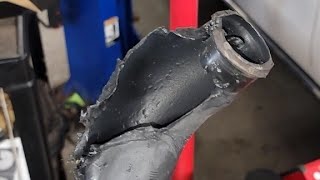
Aftermarket price range: $5-$15 - Turbocharger Inlet Pipe — Frequently melts due to the hot exhaust gas leak from the broken EGR tube. If it is melted or deformed, it must be replaced to prevent a massive unmetered air leak into the engine. 🎬 Watch: Replacing a melted turbo inlet tube and EGR pipe
Trusted brands: Motorcraft
OEM price range: $80-$120
Aftermarket price range: $50-$90
Related Codes That Often Appear With This One
- P04FA — This code, for 'EGR 'A' Control Position Sensor Performance,' often appears with P0401 because if the EGR valve is stuck, clogged, or its position sensor fails, the sensor's readings will not match what the PCM expects, triggering both codes.
Technical Service Bulletins (TSBs) & Recalls

- TSB 18-2326: This bulletin notes that vehicles built on or before 10-Oct-2018 may exhibit an illuminated malfunction indicator lamp with DTC P0401 stored in the powertrain control module, alongside other codes like P06EA and P0315a.
- TSB 19-2257: While not for P0401 directly, this TSB addresses a related code (P0471 - Exhaust Pressure Sensor Range/Performance) on 2018-2019 F-150s with the 2.7L engine by recommending the replacement of the exhaust pressure sensor with an updated part (JT4Z-9J460-A), indicating potential sensor issues in the system.
- TSB 20-2207: Addresses white/blue smoke on startup for 2018-2020 2.7L models. While for a separate issue, the repair procedure requires removing and reinstalling the EGR system, and it helpfully lists the part numbers for the two different EGR gaskets (JT4Z-9E464-C and JT4Z-9E933-A) needed for any EGR service.
Platform-Specific Known Issues
- A known issue for 2018 and newer F-150s with the 2.7L EcoBoost is the EGR inlet tube breaking at the weld. This causes a loud exhaust leak and can melt the plastic turbo inlet tube if not repaired promptly.
Scan Tool Commands That Help
- Ford IDS (Integrated Diagnostic System): EGR System Test — This is a bidirectional test used to command the EGR valve to open and close while monitoring sensor feedback. It helps determine if a failure is due to a stuck valve, a faulty sensor, or a blockage without having to first remove parts.
Wiring & Ground Locations
- PCM Grounds — On the firewall of the engine bay. Depending on the specific build, there may be one or two ground points.. The EGR valve and its related sensors are controlled by the Powertrain Control Module (PCM). A poor ground connection at these points can cause erratic sensor readings or improper valve operation, potentially triggering a P0401 code.
- Harness Chafe Point — Where the engine wiring harness runs around the passenger side of the engine block, near the bottom.. In some cases, wires related to the charging system and other engine sensors in this bundle can chafe through, causing shorts or open circuits. While not directly linked to P0401 in sources, a damaged wire for the EGR valve or sensor in this harness could cause an electrical fault leading to the code.
OEM Part Supersession History
JT4Z-9D477-B→RL3Z-9D477-A— The original EGR inlet tube (JT4Z-9D477-B) was prone to cracking at a weld. The superseding part RL3Z-9D477-A is the updated replacement from Ford to address this failure point.JT4Z-9D477-A→RL3Z-9D477-A— This was an earlier part number also replaced by the current RL3Z-9D477-A.
Model Year Variations Within This Range
- 2018+: The 2018 model year F-150 introduced the second-generation 2.7L EcoBoost. This engine featured significant updates, including the addition of port fuel injection (dual injection) and a new high-pressure EGR system, which is the subject of this P0401 fault. First-generation (2015-2017) engines had a different EGR setup and did not suffer from the same EGR tube weld failure.
Diagnostic Flowchart
Other Known Issues on This Vehicle
Issues unrelated to this code that are worth knowing about as an owner of this generation:
- Leaking Composite Oil Pan 🔴 High — Very common on 2018-2019 models built before May 21, 2019. The original RTV sealant fails, causing oil seepage. (Ref: TSB 19-2189 advises replacing the original pan and RTV seal with an updated oil pan that uses a more reliable press-in-place gasket.)
- Harsh or Delayed Shifting (10R80 Transmission) 🟠 Medium — Common complaint across many Ford models with the 10-speed automatic transmission. Can manifest as harsh engagements or clunky shifts. (Ref: Multiple TSBs exist, including 22-2428, which address the issue through software updates (reprogramming) or, in some cases, valve body replacement.)
- White/Blue Smoke from Exhaust on Cold Start 🟠 Medium — Affects some 2018-2020 F-150s with the 2.7L EcoBoost. Caused by oil seeping into the left-side turbocharger housing after a cold soak. (Ref: TSB 20-2207 instructs technicians to replace the left-side turbocharger oil supply tube with a revised part (JU7Z-9T516-A) to correct the oil intrusion.)
- Cam Phaser Rattle on Cold Start (3.5L EcoBoost) 🔴 High — While not for the 2.7L, this is a very prominent issue for the sibling 3.5L EcoBoost engine in the same F-150 chassis, worth noting for platform owners. (Ref: TSB 20-2315 (and its successors) details the replacement of the VCT (cam phaser) units.)
Used vs. New Parts: Buying Guide for This Vehicle
When a used part is the smart pick: For this specific repair, sourcing used parts is generally not recommended. The primary failure part, the EGR inlet tube, fails due to a design flaw (weak weld), so a used part carries the same risk of failure. An EGR valve from a junkyard is also risky due to potential for heavy carbon buildup, which is not always visible externally.
Donor-vehicle mileage cap: roughly under 30000 miles for the part to have meaningful remaining life.
What to inspect on the donor part:
- If considering a used EGR valve, look for a donor vehicle with the lowest possible mileage.
- Inspect the valve's ports for excessive, thick carbon deposits before purchase.
- Avoid any EGR tube that shows signs of rust or discoloration near the welds, as this indicates heat stress.
OEM-only on this vehicle (don't cheap out):
- EGR Cooler Inlet Tube: Given the known weld failure, it is critical to use the newest OEM superseded part (RL3Z-9D477-A) to ensure you have the revised design.
Aftermarket brands forum-validated for this vehicle:
- Standard Motor Products (SMP): Often cited as a reliable OEM-equivalent for electronic sensors and valves, including the EGR valve and related sensors.
Brands owners have reported issues with on this vehicle:
- Unbranded, 'white-box' parts: For critical emissions components like the EGR valve and sensors, unbranded parts from online marketplaces can have inconsistent quality and may fail prematurely or not meet OEM calibration standards, causing the code to return.
Real Owner Stories
Aggregated from forums and TSBs cited above. Mileages and costs reflect what owners reported in those sources.
2018 Ford F-150 2.7L EcoBoost
Symptoms: Check engine light on with codes P04FA and P0401.
What fixed it: Discussion suggests replacing the EGR sensor or the entire EGR valve assembly.
Source hint: Reddit thread titled 'Check engine codes P04FA and P0401 on 2018 f150 2.7'
2018 Ford F-150 2.7L EcoBoost
Symptoms: Code P04FA ('EGR A Control Temperature Too High') triggered by carbon buildup.
What fixed it: Replaced the EGR temperature sensor.
Source hint: f150forum.com thread titled '2018 2.7 P04FA Fix'
2018 Ford F-150 2.7L EcoBoost
Symptoms: Loud exhaust leak noise from the driver's side of the engine bay, just above and behind the alternator; Check Engine Light on.
What fixed it: Replacement of the EGR inlet tube and both gaskets due to a failed weld at the flange.
Source hint: vehicle_specific_issues
Ford F-150 Owner Report
Symptoms: An owner reported that after three days of a dealer repair, the P0401 code returned. The PFE sensor, which controls the valve, was replaced but did not initially resolve the issue.
Source hint: NHTSA ODI #763013
Related OBD-II Codes
Frequently Asked Questions
Why does my 2018 F-150 2.7L EcoBoost sound like a Harley-Davidson or a stock car when the Check Engine Light came on?
I have code P0401 and P0471 on my 2019 F-150. Is there a specific TSB for this?
Can a broken EGR tube cause other damage to my 2.7L EcoBoost engine bay?
What parts do I need to fix the common EGR tube failure on a 2018 F-150 2.7L?
My 2.7L EcoBoost has a rough idle and P0401, but I don't hear an exhaust leak. What is the likely cause?
Helpful Videos
Used OEM Parts in Stock


New Aftermarket Parts Available


The information in this article is provided for general reference and educational purposes only. Vehicle specifications, procedures, and part compatibility can vary by production date, trim level, and region. Always consult your vehicle's factory service manual and verify part numbers before purchasing or performing repairs. Safety-critical components such as airbags, seat belts, and braking systems should be installed by a qualified professional.
- Ford F-150:
- 🎬 Helpful Videos
- 🛍️ Shop This Part
- What's Unique About the 2018-2019 Ford F-150
- Symptoms You May Notice
- Most Likely Causes
- Rare But Worth Checking
- Diagnosis Steps
- Parts You'll Likely Need
- Related Codes That Often Appear With This One
- Technical Service Bulletins (TSBs) & Recalls
- Platform-Specific Known Issues
- Scan Tool Commands That Help
- Wiring & Ground Locations
- OEM Part Supersession History
- Model Year Variations Within This Range
- Diagnostic Flowchart
- Other Known Issues on This Vehicle
- Used vs. New Parts: Buying Guide for This Vehicle
- Real Owner Stories
- 2018 Ford F-150 2.7L EcoBoost
- 2018 Ford F-150 2.7L EcoBoost
- 2018 Ford F-150 2.7L EcoBoost
- Ford F-150 Owner Report
- Related OBD-II Codes
- Frequently Asked Questions
- 🎟️ Get 5% Off