

OBD-II Code P0384: Glow Plug Control Circuit 'B' High
The Ultimate 2026 Guide: What P0384 means, why it triggers, and how to fix it for good
- Code P0384 triggers when the Powertrain Control Module detects voltage exceeding the manufacturer's specified limit in the glow plug control circuit, causing hard starts below 50°F.
- A failed Glow Plug Control Module (GPCM) or a stuck relay causes over 70% of P0384 codes, making it the primary target for diagnosis.
- Test the GPCM supply voltage and perform a ground circuit voltage drop test before spending $200-$500 replacing glow plugs, as the plugs themselves rarely cause a 'Circuit High' code.
- Fixing P0384 immediately prevents up to $4,000 in secondary damage, including premature starter failure, battery drain, and a clogged Diesel Particulate Filter (DPF).
What Does P0384 Mean?
P0384 means your Powertrain Control Module (PCM) detects excessively high voltage in the glow plug control circuit. This system heats the engine's cylinders so your diesel engine can start in cold weather. The PCM triggers this code when the detected voltage exceeds the manufacturer's specified maximum limit for a set duration.
Technical definition: The SAE/OBD-II definition is 'Glow Plug Control Module 1 Control Circuit High'. This indicates the PCM registers voltage from the glow plug control circuit exceeding the expected threshold. This is almost always caused by a short to power, a failed-on relay, or an internally shorted Glow Plug Control Module.
🎬 See this quick breakdown of the P0384 circuit high definition.Can I Drive With P0384?
Yes, But With Caution. Yes, but limit driving to essential trips. Expect hard starting in cold weather, which severely strains the starter motor and battery. Unburnt fuel from difficult starts washes oil from cylinder walls, accelerating internal engine wear. Prolonged driving causes premature carbon buildup and damages the Diesel Particulate Filter (DPF), a repair costing upwards of $1,500. The extra starting strain guarantees premature starter failure, adding $400-$1,100 to your bill.
Common Causes
- Faulty Glow Plug Control Module (GPCM) or Relay (Very Common) — The module or its relay fails internally, becoming stuck in the 'on' position or developing a short circuit that sends continuous high voltage to the PCM's monitoring circuit.
- Damaged, Shorted, or Corroded Wiring/Connectors (Common) — The wiring harness leading to the GPCM frays and shorts to a power source. Corroded connectors create high resistance, disrupting normal voltage and triggering a 'high circuit' reading.
- Failing Alternator or Voltage Regulator (Less Common) — A faulty voltage regulator creates voltage spikes across the entire electrical system. The GPCM is highly sensitive to input voltage, and a system-wide spike forces it to report a high voltage condition.
- Poor Ground Connection for the Control Module (Less Common) — A loose or corroded ground strap creates a voltage differential, tricking the PCM into believing the circuit voltage is higher than it actually is.
- Failed Glow Plugs (Less Common) — While more common for 'low' circuit codes, an internally shorted glow plug alters the circuit's overall resistance, occasionally triggering P0384 if it forces the control module to react abnormally.
- Aftermarket Remote Starters or Alarms (Rare) — Improperly installed aftermarket electronics interfere with the glow plug control circuit, causing voltage feedback that the PCM interprets as a high voltage fault.
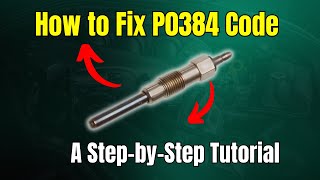
- Faulty Powertrain Control Module (PCM) (Rare) — An internal PCM fault causes it to misinterpret signals from the glow plug circuit. Exhaust all other possibilities before suspecting the PCM. 🎬 Watch: A step-by-step tutorial on how to fix the P0384 code.
Symptoms
- Hard Starting or No Start in Cold Weather — The engine cranks for an extended period before starting, or fails to start entirely when temperatures drop below 50°F.
- Check Engine Light and Flashing Glow Plug Light — The PCM illuminates the Check Engine Light. The coil-shaped glow plug indicator on the dashboard flashes or stays illuminated permanently.
- Rough Idle on Startup — When the engine starts, it runs roughly, misfires, and sounds excessively loud until reaching operating temperature.
- White or Gray Smoke from Exhaust on Startup — Excessive white or gray smoke pours from the tailpipe upon starting, caused by unburnt fuel from cold cylinders.
- Dead Batteries — If the GPCM relay is stuck 'on', it continuously draws power, completely draining the vehicle's batteries overnight.
Diagnostic Flowchart
Tap your situation to follow the diagnostic path that matches what you're seeing on this code.
Common Fixes & Costs
- Replace Glow Plug Control Module (GPCM) or Relay — Parts: $100 - $400, Labor: $100 - $300, ~1.2 hr book time
- Repair Wiring or Connectors — Parts: $10 - $50, Labor: $150 - $400, ~2.5 hr book time (Professional)
- Clean or Repair Ground Connection — Parts: $5 - $20, Labor: $50 - $150, ~0.8 hr book time
- Replace Glow Plugs — Parts: $100 - $250, Labor: $200 - $500, ~2.5 hr book time
- Diagnostic Service — Parts: $0, Labor: $125 - $250, ~1.5 hr book time
DIY vs Professional
- Replace Glow Plug Control Module (GPCM) or Relay — Beginner:
Tools: Basic socket set, ratchet, owner's manual. - Repair Wiring or Connectors — Beginner:
Tools: Multimeter, wire strippers, crimpers, heat shrink tubing, wiring diagrams. - Clean or Repair Ground Connection — Beginner:
Tools: Socket set, wire brush, sandpaper, dielectric grease. - Replace Glow Plugs — Beginner:
Tools: Torque wrench, deep sockets, extensions, penetrating oil, compressed air.
Used vs. New Parts: Buying Guide
When a used part is worth it: A used OEM Glow Plug Control Module (GPCM) from a low-mileage donor vehicle is cost-effective for older vehicles where new OEM parts are discontinued. It is vastly superior to cheap, unbranded aftermarket modules.
Donor-vehicle mileage cap: roughly under 80000 miles for the part to have meaningful remaining life.
Donor quality checklist:
- Verify the donor vehicle was not scrapped for electrical fires or engine issues.
- Match the part number exactly. Superseded numbers require dealer programming.
- Inspect the connector pins on the used module for melting or green corrosion.
Decision logic:
- If The vehicle is less than 10 years old and the part is available new from the OEM → Buy new OEM. This ensures compatibility and provides a warranty.
- If Budget is the primary concern and the vehicle is older → Purchase a new part from a reputable aftermarket brand (e.g., Bosch, Standard Motor Products) rather than risking a used module.
- If The GPCM requires programming to the vehicle's VIN → Buy a new or professionally refurbished module that includes programming support. Used modules are often permanently locked to the donor vehicle.
Warranty tradeoff: Salvage yard parts offer a 30-90 day warranty. New aftermarket parts offer 1-year to limited lifetime warranties. New OEM parts carry a 1-2 year warranty.
Worst-case if a used part fails: $250 - $600. If a cheap aftermarket module fails, you pay for the replacement part plus the labor to install it twice.
What Happens If You Wait — Timeline
- 0-1 month: Check Engine Light illuminates with code P0384. In warm climates, symptoms are negligible. In cool weather, the engine cranks for an extra 1-2 seconds before starting. (MPG impact: 0-2%% · Added cost: $0)
- 1-3 months: Hard starting becomes consistent below 50°F (10°C). The starter motor and battery endure severe strain. Rough idling and white smoke occur for the first minute after a cold start. (MPG impact: 2-5%% · Added cost: $400 - $1100 (Risk of premature starter or battery failure))
- 3-9 months: The ECU inhibits DPF regeneration due to the active powertrain fault. Incomplete combustion accelerates soot production, rapidly loading the DPF. Engine performance feels sluggish. (MPG impact: 5-10%% · Added cost: $1500 - $4000 (Risk of a clogged DPF requiring professional cleaning or replacement))
- 9+ months: Catastrophic failure risk peaks. If caused by a stuck-on relay, glow plugs overheat, swell, and break off into the cylinder, destroying the engine. Otherwise, the vehicle fails to start entirely. (MPG impact: 10-15%% · Added cost: $3000 - $8000+ (Potential for major engine repair))
Cost of Not Fixing It
- 0-1 month: Hard starting below 50°F. Increased strain on the starter motor and battery reduces their lifespan. (Added cost: $0 - $500 (if starter or battery fails prematurely))
- 1-6 months: DPF regeneration is inhibited. The ECU prevents regen cycles, leading to rapid soot buildup, reduced engine performance, and a clogged DPF. (Added cost: $1500 - $4000 (for professional DPF cleaning or replacement))
- 6+ months: Catastrophic engine damage. A stuck-on relay causes glow plug tips to overheat, break off, and fall into the cylinder, destroying the piston and valves. (Added cost: $3000 - $8000+ (for engine repair or replacement))
Diagnosis Steps
- Read Codes and Freeze Frame Data
Use an OBD-II scanner to confirm P0384. Document freeze-frame data to see the engine's exact state (temperature, voltage) when the code triggered. Note any accompanying codes.
Tools: OBD-II Scanner (Beginner) - Test Battery and Charging System
With the engine off, battery voltage must be ~12.6V. While running, it must be 13.5-14.8V. Readings above 14.8V confirm a faulty voltage regulator causing spikes that trigger P0384.
Tools: Digital Multimeter (Beginner) - Thorough Visual Inspection
Inspect all wiring and connectors for the GPCM, relay, and glow plugs. Look for melted plastic, corrosion, or frayed wires. Verify the module's ground wire is tight and rust-free.
Tools: Flashlight, Mirror (Beginner) - Check Fuses and Relays
Inspect all glow plug system fuses. A blown fuse confirms a short circuit. Swap the glow plug relay with an identical non-critical relay to test for a stuck-on condition.
Tools: Owner's Manual, Fuse Puller (Beginner) - Test the GPCM Supply Voltage
With the ignition on, measure voltage at the GPCM's main supply pin. It must be stable between 11.5V and 13.5V. Spiking voltage confirms a charging system issue; low voltage confirms a wiring drop.
Tools: Digital Multimeter, Vehicle-Specific Wiring Diagram (Intermediate) - Test the GPCM Control Circuit for a Short to Power
With the key off, disconnect the GPCM connector. Check for voltage on the control circuit wire coming from the PCM. It must be 0V. Any voltage confirms a short to power in the wiring harness.
Tools: Digital Multimeter, Vehicle-Specific Wiring Diagram (Advanced) - Test the Glow Plug Driver Resistance
Disconnect the GPCM harness. Measure resistance between each glow plug driver output pin on the GPCM and the module's ground pin. A reading under 5 ohms confirms an internally shorted GPCM.
Tools: Digital Multimeter, GPCM Pinout Diagram (Advanced) - Test the Glow Plug Resistance
Disconnect the electrical connector from each glow plug. A good glow plug reads between 0.4 and 2.0 ohms. 'OL' means the plug is open; zero means it is shorted.
Tools: Digital Multimeter, Sockets/Wrenches (Intermediate) - Pro Tip: Perform a Voltage Drop Test on the Ground Circuit
Connect the multimeter's black lead to the negative battery terminal and the red lead to the GPCM's ground pin. Command the glow plugs on. A reading above 0.2 volts confirms excessive ground resistance.
Tools: Digital Multimeter, Alligator Clips (Advanced) - Pro Tip: Analyze the Control Signal with an Oscilloscope
Use an oscilloscope to view the Pulse-Width Modulated (PWM) command signal from the PCM to the GPCM. A flat line at 5V or 12V instead of a pulse confirms a short or a failed PCM driver.
Tools: Oscilloscope, Wiring Diagram (Professional)
When This Code Triggers (Freeze-Frame Conditions)
- Engine Coolant Temp: Below 40°F (5°C) (During a cold start attempt where glow plug pre-heating is required.)
- RPM: 0 (Key On, Engine Off) or 150-300 (Cranking) (The fault is detected before the engine starts or during prolonged cranking.)
- System Voltage: >14.8V (A voltage spike from the charging system triggers the code instantly.)
- Glow Plug Command: ON (The fault logs when the PCM commands the glow plugs to activate and sees excessive voltage on the monitor circuit.)
Related Codes
- P0380 — P0380 is a generic code for 'Glow Plug Circuit A Malfunction.' P0384 is specific to a 'high voltage' condition in circuit 'B'. If both are present, address P0384 first as it pinpoints the exact electrical state.
- P0382 — P0382 is a general fault for Circuit 'B'. P0384 specifies the voltage is too high. Address P0384 first.
- P0670-P0678 — These codes point to a fault in a specific cylinder's glow plug (e.g., P0671 for cylinder 1). P0384 alone indicates a main controller or wiring issue. If seen together, a shorted individual plug may be crashing the main controller.
- P0381 — Refers to a fault in the dashboard indicator light circuit. A severe fault in the main GPCM (triggering P0384) forces the PCM to log an indicator circuit code as well.
Climate & Environmental Factors
- Cold Climates: P0384 is functionally critical in cold weather. While the electrical fault exists regardless of temperature, the primary symptom—hard starting—only manifests when ambient temperatures drop and the engine requires pre-heating.
- High Humidity / Salt Belt Regions: Heavy road salt usage accelerates corrosion on the GPCM connector, wiring harness, and chassis ground connections, leading to the high resistance that triggers P0384.
- High Altitude: Thinner air at high altitudes makes cold starting inherently more difficult for diesel engines. A borderline glow plug system that functions at sea level will fail to start the engine at altitude.
How to Talk to a Mechanic About This Code
Say this: "I have a P0384 code on my diesel and it's having trouble starting. I'd like to schedule a diagnostic appointment. Please test the Glow Plug Control Module, the relay, and the related wiring for shorts or high voltage. I want to rule out a control system issue before replacing the glow plugs."
This signals to the shop that you understand P0384 is a 'circuit' code, not a 'glow plug' code. It directs them to perform a proper electrical diagnosis instead of blindly replacing the glow plugs.
Avoid saying:
- 'My truck is hard to start, can you fix it?'
- 'My glow plug light is on, I probably need new glow plugs.'
- 'Just do whatever it takes to fix the check engine light.'
Questions to ask before authorizing the repair:
- What specific electrical tests did you perform to condemn the faulty part?
- Did you perform a voltage drop test on the GPCM ground and power circuits?
- Can you show me the failed part and explain why it's bad?
- Is the replacement part an OEM or aftermarket component, and what is the warranty?
Where to Take It: Dealer vs Independent vs Chain
- Dealer:
Recommended if your vehicle has a known TSB or requires module programming, but it is the most expensive option.
Best for: Vehicles under warranty, Vehicles with known Technical Service Bulletins (TSBs) for P0384, Complex German brands (BMW, Mercedes) where the GPCM requires programming
Downsides: Highest labor rates, May recommend replacing an entire module when only a software update is needed (Typical cost: +50% vs. baseline) - Independent Shop:
Best overall fit. An independent diesel specialist is the most cost-effective and knowledgeable choice for diagnosing P0384.
Best for: Out-of-warranty common trucks (Ford, GM, Ram), Shops that specialize exclusively in diesel repair
Downsides: Quality varies widely; ensure they are a reputable diesel specialist, May lack access to the latest manufacturer software updates (Typical cost: +0% vs. baseline) - Chain Shop:
AVOID. These shops are not equipped for the specific electrical diagnosis that P0384 requires. The risk of misdiagnosis is extremely high.
Best for: Selling you parts you don't need
Downsides: Technicians lack the specialized diesel and advanced electrical diagnostic skills required, High pressure to sell parts leads to misdiagnosis (e.g., selling glow plugs for a module problem) (Typical cost: -10% vs. baseline)
When to Walk Away From the Repair
Take the vehicle to a diesel specialist if the estimated repair cost exceeds 40-50% of the car's private-party value.
- Car worth $8000, fix is $900: Fix it. This is a common and expected repair for an older diesel truck and is well below the threshold.
- Car worth $7000, fix is $2800: Borderline. This suggests a complex repair on a European model (e.g., BMW GPCM replacement). Get a second opinion from an independent specialist.
- Car worth $4000, fix is $2500: Walk away. The repair cost is over 60% of the vehicle's value. This indicates a major electrical issue or a seized glow plug requiring engine work.
What Scan Tool You Need for This Code
Minimum: A scanner that reads manufacturer-specific codes and views live data for the glow plug control module.
A basic $20 code reader only shows the P0384 code. It cannot test the system. Proper diagnosis requires viewing live voltage data from the GPCM and commanding the glow plug system on/off to test circuit integrity.
Budget: BlueDriver Pro (~$100) — Reads and clears the code, provides freeze-frame data, and graphs live voltage data from the GPCM to identify voltage spikes.
Mid-range: Foxwell NT809 / Autel MaxiCOM MK808S (~$300-450) — Offers bidirectional control. This allows you to command the glow plug relay or GPCM on/off from the scan tool, letting you safely test for voltage at the plugs without sitting in the driver's seat.
Professional: Autel MaxiSys MS906Pro / Launch X431 Series (~$600-1200) — Provides dealer-level bidirectional control, module programming, and ECU coding. Required if the fix involves a software update or programming a new GPCM.
Rent vs buy: Auto parts store loaner tools are basic code readers and fail to provide a proper P0384 diagnosis. Investing in a midrange scanner with bidirectional controls pays for itself by preventing misdiagnosis.
How to Clear the Code After You Fix It
- Perform the necessary repairs with the battery disconnected.
- Reconnect the battery.
- Use a quality OBD-II scan tool to clear the diagnostic trouble codes.
Drive cycle (~30 minutes): 1. Cold start (after sitting 8+ hours). 2. Idle for 3 minutes. 3. Drive at a steady 55 mph for 15 minutes. 4. Perform several slow decelerations without braking. 5. Drive in stop-and-go traffic for 10 minutes. 6. Allow the engine to cool completely. Repeat if necessary.
Readiness monitors affected: Comprehensive Component Monitor (CCM), Misfire Monitor
Before emissions retest: drive at least 100 miles to fully set monitors.
Watch out for:
- Disconnecting the battery clears the code but resets all emissions monitors to 'Not Ready', guaranteeing an emissions test failure.
- The code returns immediately upon the next cold start if the underlying electrical short or bad module is not fixed.
Will This Fail Emissions / State Inspection?
Yes — this code typically fails an OBD-II emissions inspection.
- California: An active P0384 code triggers an automatic smog check failure. After repair, a full drive cycle must be completed to set all readiness monitors before re-testing.
- New York: The NYS DMV inspection includes an OBD-II scan. A Check Engine Light with code P0384 results in an immediate failure.
- Texas: In the 17 Texas counties requiring emissions testing, a vehicle with P0384 stored fails the OBD-II portion of the inspection.
Most Commonly Affected Vehicles
- Ford F-250/F-350 Super Duty (Power Stroke) (2003-2010, 2023-2025) — 6.0L and 6.4L engines suffer notorious GPCM failures. 2023-2025 6.7L models have active TSBs for PCM calibration issues causing false P0384 codes.
- Chevrolet / GMC Silverado/Sierra 2500/3500 HD (Duramax) (2001-2010) — The glow plug controller is a frequent failure point on early Duramax engines, though access is relatively easy.
- Dodge / Ram 2500/3500 (Cummins) (2007-2018) — Issues stem from the grid heater relay and its wiring. The main engine harness connector near the firewall also develops poor connections.
- Volkswagen Jetta / Golf / Beetle (TDI) (1999-2006) — The glow plug wiring harness insulation becomes brittle from heat, cracking and causing direct shorts to ground.
- Jeep Liberty (CRD) (2005-2006) — Failures of the glow plug module and original ceramic glow plugs are common. Owners must upgrade to steel-sheathed plugs to prevent engine damage.
- BMW X5, 335d, 535d (Diesel) (2009-2018) — The glow plug control unit fails frequently. Its location under the intake manifold makes replacement highly labor-intensive.
- Hyundai / Kia Tucson, Santa Fe, Sorento (CRDi) (2010-2016) — The Glow Plug Control Unit (GCU) is a known failure point. The issue is almost always the unit itself rather than the plugs.
- Mercedes-Benz Sprinter, E-Class, GL-Class (BlueTEC/CDI) (2007-2016) — The glow plug controller module fails constantly, setting a high circuit code and often storing codes for multiple individual glow plugs simultaneously.
Manufacturer-Specific Notes
- Ford: For 2023-2025 F-Super Duty vehicles, Ford issued TSB 25-2515 and SSM 53487. P0384 is caused by a PCM calibration error or a stuck relay (Part No. F8OZ-14N089-AA). The fix requires reprogramming the PCM/TCM or replacing the relay.
- General Motors (Chevrolet/GMC): GM has multiple Special Coverage programs (N232430460, N212338290, 15388) extending glow plug warranties up to 15 years/150,000 miles on specific 3.0L and 6.6L engines. Check your VIN with a dealer before paying out of pocket.
- Ram (Cummins): FCA TSBs (18-001-25, 18-037-16) require PCM software updates to eliminate false diagnostic faults. Ensure the PCM software is current before replacing hardware.
- Modern Diesels with DPF: Glow plugs activate during DPF regeneration to raise exhaust gas temperatures. A P0384 fault prevents the ECU from initiating regeneration, leading directly to a clogged DPF.
Real Owner Stories
2006 VW Jetta TDI with 180K miles - Misdiagnosis leads to frustration.
Check Engine Light and flashing glow plug light illuminated. The car had intermittent hard starting on cooler mornings. The owner feared engine damage.
What they tried:
- Replaced all four glow plugs based on the code's name—the problem persisted.
- Tested the new glow plugs with a multimeter and confirmed they were good (0.8 ohms).
- Inspected the glow plug wiring harness, a known failure point on this model.
Outcome: The owner found brittle insulation on the wiring harness shorting to ground. Replacing the harness cleared the code permanently. Total cost: $75 for the harness and one hour of DIY labor.
Lesson: Never replace parts based solely on the code name. For a 'Circuit High' code like P0384, the fault lies in the control system (module, relay, or wiring), not the glow plugs themselves. Visual inspection is mandatory.
2005 Ford F-250 6.0L Power Stroke - Classic GPCM Failure.
Truck experienced a sudden no-start condition in 40°F weather. Batteries were strong, engine cranked normally, but wouldn't fire. The glow plug light behaved erratically.
What they tried:
- Scanned codes and found P0384.
- Performed a visual inspection and found intact wiring.
- Tested voltage at the Glow Plug Control Module (GPCM): found proper battery voltage going in, but zero voltage coming out to the glow plugs during the pre-heat cycle.
Outcome: Diagnosed a faulty GPCM, a notorious issue on 6.0L engines. Replaced the GPCM with a new Motorcraft unit (Part No. AP63406) in under 30 minutes. The truck started immediately.
Lesson: On vehicles with known component weaknesses (like the 6.0L GPCM), target that component first. Testing voltage in and out of the module provides a definitive diagnosis.
2012 Mercedes-Benz Sprinter - A Stuck Relay Drains the Battery.
Van batteries were completely dead overnight. After jump-starting, the positive battery cable was extremely hot near the glow plug relay. A P0384 code was stored.
What they tried:
- Disconnected and charged the batteries.
- Used a multimeter to check for a parasitic draw, finding a massive current draw with the key off.
- Isolated the draw to the glow plug circuit by pulling fuses.
Outcome: The glow plug relay was stuck 'on', powering the glow plugs continuously and draining the batteries. This melted all the glow plugs. The owner replaced the relay and a full set of plugs to resolve the issue.
Lesson: A dead battery combined with a P0384 code strongly indicates a stuck-on relay or control module. This requires immediate repair, as it destroys a new set of glow plugs in minutes.
How to Prevent This Code From Triggering
- Test Battery and Alternator Annually (Once per year, before winter) — A weak battery or failing alternator causes voltage spikes that destroy the sensitive electronics inside the Glow Plug Control Module (GPCM).
- Apply Dielectric Grease to GPCM and Glow Plug Connectors (Whenever connectors are disconnected) — Dielectric grease seals out moisture and prevents corrosion. Corrosion creates high resistance, leading to erratic voltage readings and P0384 faults.
- Replace Glow Plugs as a Set at Recommended Intervals (Every 80,000 - 100,000 miles) — Replacing glow plugs proactively ensures even heating and prevents a single failing plug from overworking the control module.
- Ensure GPCM Ground Connection is Clean and Tight (During any under-hood service) — A poor ground connection creates a voltage differential, tricking the PCM into reading a high circuit voltage. Cleaning the ground strap prevents false codes.
- Avoid Frequent Short Trips in Cold Weather (Daily habit) — Cold starts place maximum demand on the glow plug system. Allowing the engine to reach full operating temperature reduces high-load pre-heating cycles, extending module life.
Frequently Asked Questions
What is the most common misdiagnosis for a P0384 code?
The most common mistake is replacing the glow plugs without testing the electrical system. A 'Circuit High' code like P0384 almost always points to a faulty glow plug control module, a stuck relay, or a wiring short. Replacing the plugs wastes time and money without fixing the root cause.
Can a bad battery cause a P0384 code?
Yes. A failing battery or faulty alternator causes voltage instability across the vehicle. The glow plug control module is highly sensitive to voltage spikes, which the PCM misinterprets as a high-voltage circuit fault.
Can the P0384 code clear itself?
No. P0384 indicates a hard electrical fault that requires physical repair. The code remains active in the PCM until the underlying short or module failure is fixed and the code is manually cleared with a scan tool.
What does 'Circuit B' mean in the context of P0384?
'Circuit B' typically refers to the specific control circuit wiring between the Powertrain Control Module (PCM) and the Glow Plug Control Module (GPCM). It distinguishes the low-voltage control side from the high-amperage output side that powers the plugs.
What does a flashing glow plug light mean when I have a P0384 code?
A flashing glow plug light indicates a critical, active fault in the pre-heating system. It warns the driver that the GPCM is malfunctioning and the system is disabled to prevent electrical fires or engine damage.
Is it safe to drive with the glow plug light on?
Limit driving to essential trips to a repair shop. Driving with an active P0384 code risks a no-start condition and places severe strain on the starter and battery. Unburnt fuel from poor combustion also damages the expensive Diesel Particulate Filter (DPF).
How much does it cost to diagnose a P0384 code?
Repair shops typically charge a diagnostic fee equal to one hour of labor, ranging from $125 to $250. This fee covers the specialized electrical testing required to pinpoint the fault and is often credited toward the final repair cost.
Key Takeaways
- Code P0384 triggers when the Powertrain Control Module detects voltage exceeding the manufacturer's specified limit in the glow plug control circuit, causing hard starts below 50°F.
- A failed Glow Plug Control Module (GPCM) or a stuck relay causes over 70% of P0384 codes, making it the primary target for diagnosis.
- Test the GPCM supply voltage and perform a ground circuit voltage drop test before spending $200-$500 replacing glow plugs, as the plugs themselves rarely cause a 'Circuit High' code.
- Fixing P0384 immediately prevents up to $4,000 in secondary damage, including premature starter failure, battery drain, and a clogged Diesel Particulate Filter (DPF).
Helpful Videos

The information in this article is provided for general reference and educational purposes only. Vehicle specifications, procedures, and part compatibility can vary by production date, trim level, and region. Always consult your vehicle's factory service manual and verify part numbers before purchasing or performing repairs. Safety-critical components such as airbags, seat belts, and braking systems should be installed by a qualified professional.
- 🎬 Helpful Videos
- What Does P0384 Mean?
- Can I Drive With P0384?
- Common Causes
- Symptoms
- Diagnostic Flowchart
- Common Fixes & Costs
- DIY vs Professional
- Used vs. New Parts: Buying Guide
- What Happens If You Wait — Timeline
- Cost of Not Fixing It
- Diagnosis Steps
- When This Code Triggers (Freeze-Frame Conditions)
- Related Codes
- Climate & Environmental Factors
- How to Talk to a Mechanic About This Code
- Where to Take It: Dealer vs Independent vs Chain
- When to Walk Away From the Repair
- What Scan Tool You Need for This Code
- How to Clear the Code After You Fix It
- Will This Fail Emissions / State Inspection?
- Most Commonly Affected Vehicles
- Manufacturer-Specific Notes
- Real Owner Stories
- 2006 VW Jetta TDI with 180K miles - Misdiagnosis leads to frustration.
- 2005 Ford F-250 6.0L Power Stroke - Classic GPCM Failure.
- 2012 Mercedes-Benz Sprinter - A Stuck Relay Drains the Battery.
- How to Prevent This Code From Triggering
- Frequently Asked Questions
- What is the most common misdiagnosis for a P0384 code?
- Can a bad battery cause a P0384 code?
- Can the P0384 code clear itself?
- What does 'Circuit B' mean in the context of P0384?
- What does a flashing glow plug light mean when I have a P0384 code?
- Is it safe to drive with the glow plug light on?
- How much does it cost to diagnose a P0384 code?
- Key Takeaways
- 🎟️ Get 5% Off