

P0369 on 2017 Honda Ridgeline: Causes and Fixes for Camshaft Sensor Circuit
On a 2017 Honda Ridgeline, code P0369 is most often caused by a mechanical issue—excessive camshaft end play—that damages the sensor. Simply replacing the sensor won't fix it; the repair requires addressing the mechanical wear, often by replacing the camshaft, thrust cover, and sensor together. This is a complex job best left to a professional.
- P0369 on a 2017 Ridgeline is a serious code, usually indicating a mechanical engine problem, not just a sensor failure.
- Diagnosis MUST include measuring camshaft end play. Simply replacing the sensor is a common misdiagnosis and will not solve the underlying issue.
- The correct, manufacturer-recommended repair involves replacing the camshaft, camshaft thrust cover, and the camshaft position sensor together.
- Due to the complexity and need for special tools, this repair is not recommended for DIYers and should be handled by a qualified technician.
What's Unique About the 2017-2017 Honda RIDGELINE
For the 2017 Ridgeline and other Hondas with the J35Y6 engine, P0369 is a well-documented issue that is rarely just a bad sensor. Honda has issued Technical Service Bulletins (TSBs) acknowledging that the root cause is mechanical. An out-of-spec camshaft thrust cover wears prematurely, allowing the camshaft to move side-to-side (excessive end play). This movement causes the camshaft's reluctor wheel to physically strike and damage the camshaft position sensor, leading to the intermittent signal fault. The TSB specifically warns that if only the thrust cover is replaced, "the camshaft will just machine the thrust cover again, resulting in further excessive end play."
Diagnostic Flowchart
Tap your situation to follow the diagnostic path that matches what you're seeing on this vehicle.
Symptoms You May Notice
- Check Engine Light (MIL) is on, may be steady or flashing
- Engine enters reduced power mode ('limp mode')
- Engine may hesitate, stumble, or stall, especially during acceleration
- Rough or unstable idle
- Multiple warning lights on the dashboard (Emissions, Power Steering, etc.) may appear simultaneously
- Replacing only the camshaft position sensor without measuring camshaft end play. If the mechanical wear is the root cause, the new sensor will eventually be damaged and the code will return.
- Replacing only the camshaft thrust cover. The TSB explicitly warns that the camshaft will 'machine the new thrust cover again', leading to a repeat failure.
Most Likely Causes
- Excessive Camshaft End Play 🔴 High Probability Honda TSBs ATS161201 and A18010I confirm the camshaft thrust cover's surface can be out of specification, leading to premature wear and excessive camshaft movement.
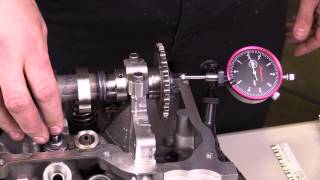
How to confirm: A technician must measure the camshaft end play using a dial indicator. 🎬 Watch: How to measure camshaft end play with a dial indicator. The service limit for end play (thrust clearance) is 0.30 mm (0.0118 in). Readings above this confirm the mechanical failure. Physical inspection of the old sensor will likely show scrape marks, plastic shavings, or other signs of impact.
Typical fix: The TSB-mandated fix is to replace the affected camshaft (Bank 1 rear), the camshaft thrust cover, and the damaged CMP sensor as a set. The camshaft pulley should also be inspected for damage and replaced if necessary.
Est. part cost: $250-$800 - Failed Camshaft Position Sensor (CMP) 🟡 Medium Probability The sensor often fails as a direct result of the excessive camshaft end play, where it is physically damaged by the camshaft reluctor wheel. It is almost always a symptom, not the root cause, on this vehicle for this code. It can also fail on its own due to heat and age, but this is far less common.
How to confirm: If camshaft end play is confirmed to be within the 0.30 mm spec, the sensor's signal can be tested with an oscilloscope. A simpler method is to swap it with a known-good sensor and see if the code returns.
Typical fix: Replace the Bank 1 exhaust camshaft position sensor. This should only be done after confirming camshaft end play is within specification.
Est. part cost: $30-$90 - Wiring or Connector Issue ⚪ Low Probability
How to confirm: Visually inspect the wiring harness and connector for the Bank 1 'B' CMP sensor for any signs of damage, corrosion, or looseness. Use a multimeter to check for proper voltage (typically 5V reference) and ground at the connector.
Typical fix: Repair the damaged section of the wiring harness or clean/replace the connector.
Est. part cost: $10-$50
Rare But Worth Checking
- PCM Software Glitch: While more common on other Honda models like the Accord for this code, it's worth noting that software updates can sometimes resolve intermittent sensor codes. However, for the 2017 Ridgeline, the mechanical TSB is the primary focus.
- Timing Belt/Chain Issue: If the timing belt has slipped a tooth, it can throw off the correlation between the crank and cam sensors, potentially triggering this code. This is unlikely unless recent timing belt service was performed incorrectly.
Diagnosis Steps
- Read the fault codes with an OBD-II scanner to confirm P0369 is present.
- Visually inspect the wiring harness and connector for the Bank 1 exhaust camshaft position sensor (rear bank). Look for any signs of fraying, melting, or corrosion.
- Remove the sensor and inspect it for physical damage, such as scrape marks, cracks, or plastic shavings, which strongly indicate contact with the camshaft.
- Crucially, measure the camshaft end play using a dial indicator. This step is mandatory for this vehicle and code. Compare the measurement to Honda's service limit of 0.30 mm (0.0118 in).
- If end play is excessive (greater than 0.30 mm), proceed with the TSB-recommended repair: replacing the rear camshaft, thrust cover, and sensor.
- While performing the repair, inspect the camshaft pulley for any signs of damage from being contacted and replace it if necessary.
- If end play is within specification, test the sensor's circuit for correct voltage and ground.
- If the circuit is good, test the sensor itself. An oscilloscope is the best tool, but swapping with a known-good sensor is a practical alternative.
- After repairs are complete, clear the code and perform a test drive to ensure the issue is resolved.
Parts You'll Likely Need
- Camshaft Assembly (Rear/Bank 1) — Required when excessive end play is the root cause, as the original camshaft contributes to the wear problem. Must be replaced with the thrust cover. Part number should be verified with a dealer using the vehicle's VIN.
Trusted brands: Genuine Honda
OEM price range: $400-$700
Aftermarket price range: $300-$500 - Camshaft Thrust Cover
(OEM #12230-P8A-A00)— The original cover's surface roughness is out of spec, causing the wear that leads to excessive end play. It must be replaced with the camshaft.
Trusted brands: Genuine Honda
OEM price range: $10-$20
Aftermarket price range: $5-$15 - Camshaft Position Sensor (Bank 1, Sensor 'B')
(OEM #37510-5A2-A01)— This sensor is often physically damaged by the camshaft due to excessive end play and must be replaced as part of the complete repair.
Trusted brands: Denso, NGK/NTK, Genuine Honda
OEM price range: $60-$90
Aftermarket price range: $30-$60 - Camshaft Pulley — The TSB recommends inspecting the pulley for damage caused by the excessive camshaft movement. If it is damaged, it must be replaced.
Trusted brands: Genuine Honda
OEM price range: $50-$100
Technical Service Bulletins (TSBs) & Recalls
- A18010I: Servicenews article regarding reduced engine power, DTC P0369, and excessive camshaft end play.
- ATS161201: Tech Line Summary Article identifying the cause as out-of-spec camshaft thrust cover surface roughness and recommending replacement of the camshaft, thrust cover, and sensor. It also warns against replacing the cover alone.
Platform-Specific Known Issues
- NHTSA TSB #ATS161201 & #A18010I: Honda issued these bulletins for the 2017 Ridgeline and 2016-2017 Pilot due to reports of reduced engine power and DTC P0369. The investigation found that "the camshaft thrust cover surface roughness is out of spec." The official recommendation states: "replace the affected camshaft and camshaft thrust cover together, along with the damaged CMP sensor." The TSB also warns techs that replacing the thrust cover alone will result in a repeat failure.
Mechanic-Grade Diagnostic Values
- CMP Sensor 'B' Connector Voltage (Key On, Engine Off) — expected: Approximately 5V on the power (reference) wire and 5V on the signal wire, relative to chassis ground.. Failure: Readings significantly different from 5V point to a wiring issue or a problem with the PCM's 5V reference circuit.
- CMP Sensor 'B' Ground Circuit Test (Key On, Engine Off) — expected: Approximately 12.6V (battery voltage) when measuring between the ground pin on the sensor connector and the battery's positive terminal.. Failure: A reading significantly lower than battery voltage indicates a poor or open ground connection for the sensor circuit.
- CMP Sensor 'B' Signal Circuit Resistance — expected: Below 3.0 Ohms between the sensor harness connector and the PCM harness connector.. Failure: Resistance above 3.0 Ohms indicates high resistance or an open in the signal wire.
Scan Tool Commands That Help
- Honda HDS (or equivalent professional scan tool): Cam/Crank Relearn Procedure — This procedure must be performed any time the camshaft position sensor, crankshaft position sensor, flywheel, or timing components have been replaced. Failure to perform the relearn can cause other DTCs, such as a misfire code, to set.
Wiring & Ground Locations
- Bank 1 Location — The cylinder bank located closer to the firewall (rear of the engine bay).. P0369 specifically refers to an issue on Bank 1, so correctly identifying this bank is the first step in locating the correct sensor ('B' sensor, exhaust cam) and wiring.
- Engine Ground (G1/G2) — General Honda documentation shows primary engine grounds are typically located on the transmission housing and the engine block itself.. The CMP sensor circuit requires a stable ground reference to function. A compromised main engine ground strap can introduce electrical noise or voltage drops, potentially triggering an intermittent sensor code like P0369.
Real Owner Repair Stories
- Reddit user Chuck_Lechero9778 in r/hondapilot (Honda Pilot (shares same engine and TSB as 2017 Ridgeline)) — P0369 code triggered.
❌ Tried (didn't work) Self-diagnosis was attempted, but the user lacked the specific tools for the mechanical repair.
✅ What actually fixed it The vehicle was taken to a repair shop. The final fix was replacing the camshaft, as the original was described as being made of 'inferior metal' that had worn. This aligns perfectly with the official Honda TSB.
OEM Part Supersession History
37510-5A2-A01→37510-5A2-A01 (current)— No supersession found. This part number appears to be consistent for the affected model years and beyond.12230-P8A-A00→12230-P8A-A00 (current)— No formal part number supersession was found. However, TSB ATS161201 states the 'surface roughness is out of spec' on the original part, implying a running change in manufacturing or quality control was implemented to correct the issue without changing the part number itself.
Heads up: Using a New Old Stock (NOS) part manufactured before the TSB could potentially lead to a repeat failure.
Helpful Videos
We Have This Part in Stock



The information in this article is provided for general reference and educational purposes only. Vehicle specifications, procedures, and part compatibility can vary by production date, trim level, and region. Always consult your vehicle's factory service manual and verify part numbers before purchasing or performing repairs. Safety-critical components such as airbags, seat belts, and braking systems should be installed by a qualified professional.
- Honda RIDGELINE:
- 🎬 Helpful Videos
- 🛍️ Shop This Part
- What's Unique About the 2017-2017 Honda RIDGELINE
- Diagnostic Flowchart
- Symptoms You May Notice
- Most Likely Causes
- Rare But Worth Checking
- Diagnosis Steps
- Parts You'll Likely Need
- Technical Service Bulletins (TSBs) & Recalls
- Platform-Specific Known Issues
- Mechanic-Grade Diagnostic Values
- Scan Tool Commands That Help
- Wiring & Ground Locations
- Real Owner Repair Stories
- OEM Part Supersession History
- 🎟️ Get 5% Off