

P0353 on 2021-2024 Ford Bronco: Ignition Coil 'C' Circuit Malfunction Causes and Fixes
This code indicates a fault in the ignition coil circuit for cylinder #3. On the 2.3L EcoBoost Bronco, this is often due to a faulty ignition coil, a known issue acknowledged by Ford in TSBs. However, TSBs 24-2406 and SSM 52342 also warn that the PCM may misreport the failing cylinder, so a power balance test may be needed. Replacing the coil and spark plug for the correct cylinder is the most common fix.
- P0353 on a 2021-2024 Bronco 2.3L means there's an electrical fault with the ignition coil circuit for cylinder #3.
- The most common cause is a failed ignition coil, followed by a worn spark plug.
- Crucially, Ford TSBs warn that the PCM can misreport the cylinder, so P0353 might not actually be cylinder 3. A professional power balance test may be required.
- A DIY 'swap test' of the ignition coil is a good first diagnostic step, but may be inconclusive due to the potential PCM mapping error.
- Driving with this code can damage the catalytic converter, so prompt repair is recommended.
What's Unique About the 2021-2024 Ford BRONCO
The 2021-2024 Ford Bronco with the 2.3L EcoBoost engine has a documented history of ignition system issues. Ford has issued Technical Service Bulletins (TSBs) #TSB 24-2406 and #SSM 52342 acknowledging that these vehicles may exhibit various ignition coil-related DTCs, including P0353. Crucially, these TSBs state the PCM may have "incorrect cylinder to DTC mapping," meaning a P0353 code might actually indicate a problem on a different cylinder. This makes diagnosis more complex than on other vehicles and may require a dealer-level power balance test to identify the true source of the misfire.
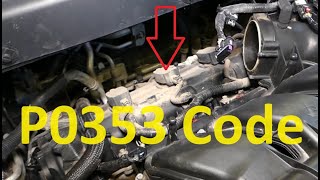
🎬 Watch: Understanding Ford ignition coil malfunction codes and symptoms.Diagnostic Flowchart
Tap your situation to follow the diagnostic path that matches what you're seeing on this vehicle.
Symptoms You May Notice
- Check Engine Light (MIL) is on
- Flashing Check Engine Light (indicates an active, severe misfire)
- Rough idle or engine shaking
- Engine misfiring, especially under load
- Noticeable loss of power and acceleration
- Reduced fuel economy
- Strong smell of unburnt fuel from the exhaust
- Replacing only the spark plug without testing the coil.
- Replacing the catalytic converter due to misfire symptoms without addressing the root ignition problem.
- Replacing the ignition coil on cylinder 3 when, due to the PCM mapping issue described in TSBs, the actual fault is on a different cylinder.
Most Likely Causes
- Faulty Ignition Coil 🔴 High Probability Ford has issued TSBs #TSB 24-2406 and #SSM 52342 for ignition system DTCs on the 2.3L EcoBoost Bronco, indicating a known weakness in the ignition components. The coil is the most frequent point of failure for this code family.
How to confirm: The easiest method is to swap the ignition coil from cylinder 3 with another cylinder (e.g., cylinder 2). Clear the codes and drive. If the code changes to P0352, the coil is bad. However, due to the PCM mapping issue noted in TSBs, if the code P0353 returns, the fault could still be a coil on a different cylinder. A power balance test is the definitive diagnostic method.
Typical fix: Replace the faulty ignition coil. It is also highly recommended to replace the corresponding spark plug at the same time.
Est. part cost: $40-$80 - Worn or Fouled Spark Plug 🟡 Medium Probability A worn spark plug increases resistance, forcing the ignition coil to work harder, which can lead to coil failure. It can also be a primary cause of a misfire on its own. Forum users on Bronco6G have reported P0353 appearing after a DIY spark plug change, sometimes due to a faulty new plug or improper installation.
How to confirm: Remove the spark plug from the suspect cylinder and inspect it for wear, carbon buildup, oil fouling, or damage to the electrode or ceramic insulator.
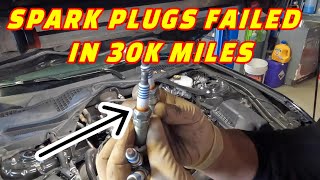
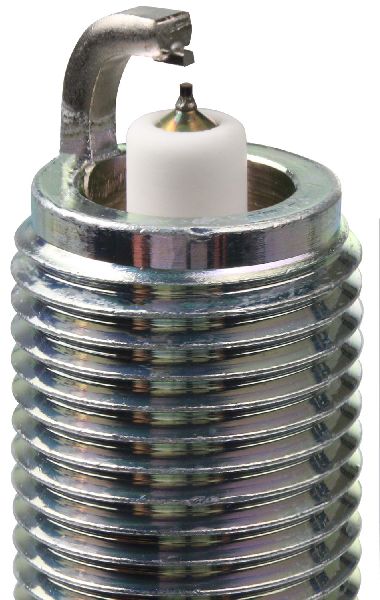
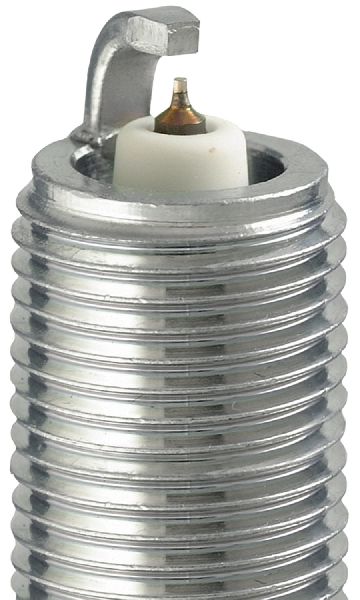
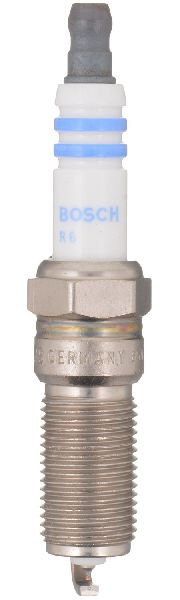
Typical fix: Replace the spark plug. It's best practice to replace all four spark plugs at the same time 🎬 See this walkthrough on replacing spark plugs on the 2.3L engine. for even performance.
Est. part cost: $10-$25 per plug - Damaged Wiring or Connector ⚪ Low Probability Engine vibrations and heat can cause wiring to chafe or connectors to become brittle. On Bronco forums, owners have discovered rodent damage to the coil wiring harness, which can cause this code. A user on a Ford truck forum found a loose connector was the cause of their P0353 code.
How to confirm: Visually inspect the wiring harness and connector for the cylinder 3 ignition coil. Look for any signs of melting, corrosion, chafing, loose pins, or chewed wires. Use a multimeter to check for proper voltage and ground at the connector.
Typical fix: Repair the damaged section of the wiring harness or replace the pigtail connector.
Est. part cost: $15-$40 for a connector
Rare But Worth Checking
- PCM Software Issue: TSB 24-2406 and SSM 52342 specifically mention that incorrect cylinder-to-DTC mapping within the PCM could be a cause. The TSB states that even with the mapping error, a real ignition fault exists. The fix involves using a Ford diagnostic tool (FDRS) to run a power balance test to find the correct cylinder, fixing the hardware, and then potentially updating the PCM software.
- Faulty Powertrain Control Module (PCM): This is a very rare cause. The PCM's internal coil driver circuit can fail, but all other possibilities should be exhausted before condemning the PCM.
Diagnosis Steps
- Read the DTCs with an OBD-II scanner to confirm P0353 and any other related codes.
- CRITICAL FIRST STEP FOR THIS PLATFORM: Due to TSBs 24-2406/SSM 52342, recognize that P0353 may not point to cylinder 3. If you do not have access to a Ford FDRS tool for a power balance test, proceed with caution.
- Locate cylinder 3 on the 2.3L EcoBoost engine. It is the third cylinder from the front of the engine.
- Visually inspect the ignition coil connector and wiring for all cylinders for any obvious damage, melting, corrosion, or rodent damage.
- Perform a 'swap test': Unplug and unbolt the ignition coils from cylinder 3 and cylinder 2. Swap their positions.
- Clear the codes and start the engine. Let it run for a few minutes.
- Re-scan for codes. If the code has moved to P0352 ('Ignition Coil B'), the ignition coil you moved from cylinder 3 is faulty and needs replacement.
- If the code P0353 returns, the problem could be in the wiring to cylinder 3, the spark plug, OR it could be a faulty coil on a different cylinder that the PCM is misreporting as cylinder 3.
- If the coil swap test is inconclusive, inspect the spark plug for cylinder 3. Replace if it is worn, fouled, or damaged.
- If hardware checks on cylinder 3 don't resolve the issue, the next step is a professional diagnosis with a power balance test to identify the true failing cylinder as per Ford's TSB.
- If all hardware checks out, the issue may be the PCM software itself, which requires a dealer visit for reprogramming.
Parts You'll Likely Need
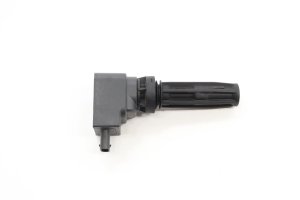
- Ignition Coil
(OEM #DG-576)— This is the most frequent failure point for P0353, especially on this platform given the TSBs.
Trusted brands: Motorcraft, NGK, Denso, Bosch
OEM price range: $60-$90
Aftermarket price range: $40-$70 - Spark Plug
(OEM #SP-594 (Motorcraft CYFS-12Y-PCT))— A worn spark plug can cause the coil to fail, and it's best practice to replace them together to ensure a complete repair.
Trusted brands: Motorcraft, NGK, Champion
OEM price range: $15-$25
Aftermarket price range: $10-$20 - Ignition Coil Connector Pigtail
(OEM #WPT1339)— In cases of rodent damage or heat-related brittleness, the connector itself may need to be spliced in.
Trusted brands: Motorcraft, Dorman, Standard Motor Products
OEM price range: $25-$45
Aftermarket price range: $15-$30
Related Codes That Often Appear With This One
- P0303 — P0303 means 'Cylinder 3 Misfire Detected'. P0353 is the specific electrical fault that is causing the misfire, so these codes almost always appear together.
- P0351, P0352, P0354 — These are codes for other ignition coils. Seeing multiple coil codes simultaneously could point to a systemic issue like a wiring harness problem, a bad ground, or the PCM software issue mentioned in TSB 24-2406.
- P0300 — This indicates a 'Random Misfire Detected'. If the problem is intermittent or affecting multiple cylinders, you might see this code alongside the more specific P0353.
Technical Service Bulletins (TSBs) & Recalls
- TSB 24-2406: Addresses MIL illumination with various ignition system DTCs (including P0353) on 2.3L EcoBoost models, pointing to a potential PCM software issue requiring a power balance test and possible update.
- SSM 52342: Also notes MIL illumination with ignition DTCs like P0353 on 2021-2024 Broncos with the 2.3L EcoBoost. It explicitly states the cause may be 'incorrect cylinder to DTC mapping' and advises a power balance test to find the true faulty cylinder before starting pinpoint tests.
Platform-Specific Known Issues
- Ford TSB 24-2406 & SSM 52342: The most critical issue for this platform. Both bulletins state that on 2021-2024 Broncos with the 2.3L engine, the PCM may have 'incorrect cylinder to DTC mapping'. This means a P0353 code for cylinder 3 could be triggered by a fault on a different cylinder. Ford directs technicians to use the FDRS scan tool to perform a power balance test to find the actual misfiring cylinder before replacing parts.
- Owner Experience on Bronco6G.com: A user reported getting code P0353 immediately after changing their spark plugs. The community advised checking that the coil connector was fully seated and swapping coils to diagnose, highlighting that even new parts can be faulty or installation can be tricky.
Mechanic-Grade Diagnostic Values
- Ignition Coil Primary Resistance — expected: 0.5 to 2.0 Ohms. Failure: A reading outside this range (e.g., infinite for an open circuit, or zero for a short) indicates a bad coil.
- Ignition Coil Connector - Power Pin Voltage (Key On, Engine Off) — expected: Battery Voltage (approx. 12V). Failure: Low or no voltage points to a problem in the power supply circuit, such as a blown fuse or wiring issue.
- Ignition Coil Connector - Ground Pin — expected: Good continuity to chassis ground (near 0 Ohms). Failure: High resistance indicates a poor ground connection, which is a common cause of ignition problems.
- Ignition Coil Driver Circuit (Signal Wire) — expected: A pulsing ground signal or Hertz reading when the engine is cranking/running. This is best observed with an oscilloscope or a multimeter with a frequency (Hz) function.. Failure: No signal indicates a problem with the PCM or the wiring between the PCM and the coil. A constant ground or voltage indicates a shorted circuit or failed PCM driver.
Scan Tool Commands That Help
- Ford FDRS (Ford Diagnostic & Repair System) or equivalent high-level scan tool: Power Balance Test — This is the most crucial diagnostic step for this specific vehicle and code, as mandated by Ford's TSBs. It graphically displays the power contribution of each cylinder. A technician can then use the tool to disable individual fuel injectors and observe the RPM drop. If disabling a cylinder causes no change in RPM, that cylinder is the source of the misfire. This test definitively identifies the misfiring cylinder, bypassing the potential 'incorrect cylinder to DTC mapping' issue where the PCM reports P0353 for a fault on a different cylinder.
Wiring & Ground Locations
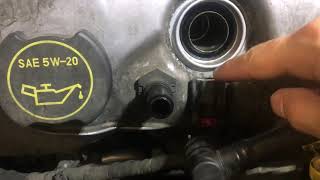
- Ignition Coil Connector Pinout — On top of the ignition coil for each cylinder.. The connector has two pins. One receives battery voltage, and the other is the driver circuit controlled by the PCM. A technician noted that when re-pinning these Ford connectors, the thicker of the two wires is the power wire and belongs on the left side when viewing the connector from the top with the locking tab oriented upwards. Incorrectly wiring the connector can damage the coil or PCM.
- Main Engine/PCM Grounds — Typically bolted to the engine block, cylinder head, or chassis near the engine bay. Common Ford ground points are designated G1xx (e.g., G104, G105).. A poor ground connection for the engine or PCM can cause a wide range of electrical issues, including erratic ignition coil performance and false DTCs. All ground points should be inspected to ensure they are clean, tight, and free of corrosion before suspecting a more complex PCM failure.
Real Owner Repair Stories
- Reddit user on r/Ford (2006 Ford Explorer V8 (Note: Different vehicle, but identical diagnostic logic for P0353)) — Check Engine Light with code P0353.
❌ Tried (didn't work) Replaced all spark plugs., Swapped the spark plug from the suspect cylinder with another., Swapped the ignition coil from the suspect cylinder (#3) with another.
✅ What actually fixed it The user concluded the issue was in the wiring going to the coil or the PCM driver itself, as the P0353 code did not move with the coil or plug. This demonstrates the correct diagnostic path when the most common part swaps fail to resolve the issue.
OEM Part Supersession History
DG-574, JX6Z12029A, JX6Z12029B→DG-576— Standard part evolution and consolidation. Ford often updates parts to improve reliability or streamline manufacturing.
Heads up: DG-576 is the current, correct replacement for the earlier part numbers on this application.
Model Year Variations Within This Range
- 2021-2024: No significant variations have been documented in relation to the P0353 code for the 2.3L EcoBoost engine within this model year range. The relevant TSBs apply to all years from 2021-2024.
Helpful Videos

Used OEM Parts in Stock


New Aftermarket Parts Available


The information in this article is provided for general reference and educational purposes only. Vehicle specifications, procedures, and part compatibility can vary by production date, trim level, and region. Always consult your vehicle's factory service manual and verify part numbers before purchasing or performing repairs. Safety-critical components such as airbags, seat belts, and braking systems should be installed by a qualified professional.
- Ford BRONCO:
- 🎬 Helpful Videos
- 🛍️ Shop This Part
- What's Unique About the 2021-2024 Ford BRONCO
- Diagnostic Flowchart
- Symptoms You May Notice
- Most Likely Causes
- Rare But Worth Checking
- Diagnosis Steps
- Parts You'll Likely Need
- Related Codes That Often Appear With This One
- Technical Service Bulletins (TSBs) & Recalls
- Platform-Specific Known Issues
- Mechanic-Grade Diagnostic Values
- Scan Tool Commands That Help
- Wiring & Ground Locations
- Real Owner Repair Stories
- OEM Part Supersession History
- Model Year Variations Within This Range
- 🎟️ Get 5% Off