

OBD-II Code P0344: Camshaft Position Sensor 'A' Circuit Intermittent
The Ultimate Guide to Diagnosing and Fixing P0344
- P0344 indicates an intermittent camshaft position sensor signal, causing immediate risks like sudden engine stalling at highway speeds.
- Inspect the sensor's wiring harness and connector first; damaged pigtails and loose grounds cause over 30% of P0344 codes.
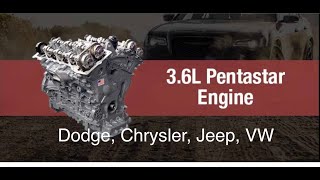
- Owners of 2011-2014 Chrysler, Dodge, and Jeep 3.6L V6 vehicles must check TSB 18-023-14, as a $150 PCM software update is the required fix.
- Never install discount aftermarket camshaft sensors; use only OEM or top-tier brands like Bosch or NTK to prevent the code from returning within 500 miles.
- Driving with an active P0344 code dumps unburnt fuel into the exhaust, destroying a $1,500 catalytic converter in as little as 3 months.
What Does P0344 Mean?

P0344 means your car's Powertrain Control Module (PCM) is receiving an inconsistent signal from the bank 1 camshaft position sensor. This sensor tells the computer the exact rotational position of the camshaft to perfectly time fuel injection and ignition spark. When this signal cuts out, the PCM loses track of engine timing, causing immediate drivability problems and potential engine damage.
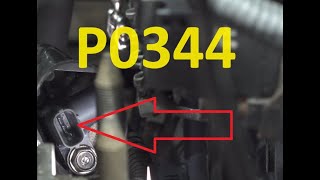
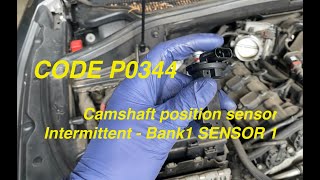
Technical definition: The official SAE/ISO definition for P0344 is "Camshaft Position Sensor 'A' Circuit Intermittent (Bank 1 or Single Sensor)." This indicates 🎬 Watch: A quick overview of P0344 causes and common fixes. the Powertrain Control Module (PCM) detects the bank 1 camshaft position sensor signal is temporarily lost or erratic when a stable, continuous signal is expected.
Can I Drive With P0344?
yes_but_not_recommended. While you can technically drive with a P0344 code, it is strongly discouraged. The primary risk is sudden engine stalling, which is extremely dangerous in traffic or at highway speeds. Continuing to drive with an intermittent signal causes raw fuel to enter the exhaust, destroying the catalytic converter—a repair costing between $800 and $2,500. Limit driving to a short trip to a repair shop.
Common Causes

- Faulty Camshaft Position Sensor (Very Common) — The sensor itself is the most frequent culprit. Internal electronic components fail from years of heat cycles and engine vibration, causing the signal to cut in and out.
- Damaged Wiring or Poor Connection (Very Common) — Wires fray from rubbing against engine components, melt from exhaust heat, or connector pins corrode. This physically interrupts the signal, triggering the intermittent code.
- Use of Low-Quality Aftermarket Sensor (Common) — Cheap aftermarket camshaft sensors have a massive failure rate out-of-the-box or fail shortly after installation. Using an OEM part is mandatory to avoid repeat repairs.
- Engine Control Module (PCM) Software Issue (Common) — The PCM's software is sometimes overly sensitive. Chrysler/Dodge/Jeep issued TSBs with software updates to correct this and prevent false P0344 codes on 3.6L engines.
- Poor Ground Connection (Less Common) — A corroded main engine-to-chassis ground strap causes severe electrical interference, disrupting the sensor's low-voltage signal. This is highly documented on Jeep Wranglers.
- Weak Battery or Faulty Alternator (Less Common) — Low system voltage or excessive AC ripple from a failing alternator creates electrical 'noise' that interferes with the cam sensor signal. Ford issued TSB 06-19-12 specifically for this.
- Damaged Tone Ring or Reluctor Wheel (Rare) — The sensor reads a toothed wheel on the camshaft. If this wheel is cracked, missing teeth, or loose, the sensor cannot generate a consistent signal.
- Stretched Timing Chain or Belt (Rare) — If the timing chain stretches or jumps a tooth, the physical correlation between the camshaft and crankshaft is incorrect. This usually sets P0016 but sometimes manifests as P0344 first.
- Low Engine Oil Level or Pressure (Rare) — On VVT engines, extremely low oil pressure prevents cam phasers from operating correctly. The PCM misinterprets this sluggish mechanical response as a sensor fault, especially on cold starts.
- Faulty Crankshaft Position Sensor (Rare) — The PCM compares signals from the cam and crank sensors. An erratic crankshaft sensor signal causes the PCM to misinterpret data and incorrectly flag the camshaft circuit.
- Faulty Starter Motor (Very Rare) — A failing starter draws excessive voltage or creates massive electromagnetic interference during cranking, disrupting the camshaft sensor signal and setting the code.
Symptoms

- Check Engine Light is On — An illuminated Malfunction Indicator Lamp (MIL) is the first and most consistent sign of a problem.
- Engine Stalling or Hesitation — The engine stalls without warning at idle or low speeds. You experience severe hesitation when accelerating as the PCM loses the timing signal.
- Difficulty Starting the Engine — The engine cranks for an extended period before starting, or cranks but fails to start entirely.
- Rough Idle and Misfiring — The engine runs erratically, shakes, or misfires, creating a noticeable vibration throughout the cabin.
- Traction Control Light On — On Dodge, Chrysler, and Jeep vehicles, an engine timing fault automatically disables the traction/stability control system, illuminating its warning light as a safety precaution.
- Reduced Engine Power / Limp Mode — The vehicle feels sluggish. The PCM intentionally limits engine power and RPM to prevent internal damage.
Diagnostic Flowchart
Tap your situation to follow the diagnostic path that matches what you're seeing on this code.
Common Fixes & Costs
- Replace Camshaft Position Sensor
— Parts: $40 - $150, Labor: $100 - $300, ~1.2 hr book time
(DIY)
Dodge/Chrysler/Jeep (3.6L Pentastar): OEM
Ford F-150 (5.0L, approx. 2011-2017): OEM
Ford F-150 (5.0L, approx. 2018+): OEM - Repair Wiring or Replace Connector Pigtail — Parts: $15 - $50, Labor: $130 - $260, ~1.5 hr book time (Intermediate)
- Update Powertrain Control Module (PCM) Software — Parts: $0, Labor: $150 - $250, ~1 hr book time (Professional)
- Clean or Repair Engine Ground Connection — Parts: $0 - $10, Labor: $50 - $100, ~0.5 hr book time (DIY)
- Replace Timing Chain and Components — Parts: $400 - $1,200, Labor: $1,000 - $2,500, ~18 hr book time (Professional)
Used vs. New Parts: Buying Guide
When a used part is worth it: Buying a used camshaft position sensor is never recommended. It is a low-cost electronic component where age and heat cycles cause failure. The risk of a used part failing immediately is extremely high.
Donor-vehicle mileage cap: roughly under 20000 miles for the part to have meaningful remaining life.
Donor quality checklist:
- If forced to buy used, choose a part from the newest, lowest-mileage vehicle possible.
- Ensure the part number is an exact match.
- Avoid parts from engines showing oil leaks or extreme heat damage.
Decision logic:
- If The part is a camshaft position sensor. → Buy a new OEM or top-tier aftermarket (Bosch, Denso, NTK) part. Cost savings are negligible compared to repeat labor costs.
- If The part is an expensive ECU/PCM. → A professionally refurbished and warrantied unit is a cost-effective alternative to a new dealer part.
Warranty tradeoff: Used sensors have a 30-day warranty that does not cover labor. New high-quality aftermarket sensors offer 1-year to lifetime warranties. New OEM parts carry a 1-2 year warranty.
Worst-case if a used part fails: $150-300 if a used sensor fails, requiring repeat diagnostic and labor fees.
What Happens If You Wait — Timeline
- 0-1 month: Check Engine Light appears intermittently. You experience occasional difficulty starting or a slight hesitation at idle, but no severe drivability issues. (MPG impact: 0-5%% · Added cost: $0)
- 1-3 months: Engine stalling at stoplights becomes frequent. Rough idle is obvious, fuel economy drops, and the vehicle fails emissions testing. (MPG impact: 5-15%% · Added cost: $50-150 in wasted fuel)
- 3-6 months: Stalling becomes a severe safety hazard. Incorrect timing forces unburnt fuel into the exhaust, overheating and melting the catalytic converter substrate. The car enters 'limp mode'. (MPG impact: 10-20%% · Added cost: $200-500 in wasted fuel and early catalytic converter damage)
- 6+ months: Catastrophic failure of the catalytic converter occurs, requiring immediate replacement. Constant stalling causes premature wear on the starter motor and battery. (MPG impact: 15-25%+% · Added cost: $1000 - $3000)
Cost of Not Fixing It
- Immediate: Risk of sudden engine stalling in traffic. Reduced fuel economy and poor engine performance. (Added cost: Negligible)
- 1-3 months: Unburnt fuel overheats the catalytic converter. The vehicle fails emissions inspections. (Added cost: $0)
- 3-6+ months: Catastrophic failure of the catalytic converter, triggering P0420 and requiring expensive replacement. (Added cost: $1000 - $3000)
Diagnosis Steps

- Analyze Scan Tool Data
Use an OBD-II scanner to confirm P0344 and check for related codes (e.g., P0340, P0016, C121C). Review freeze frame data to see engine conditions (RPM, temperature) when the fault occurred to help reproduce the issue.
Tools: OBD-II Scanner (Beginner) - Perform a Thorough Visual Inspection
Inspect the camshaft position sensor, its connector, and the visible wiring harness. Look for melted plastic, chafed wires, or green corrosion inside the connector. Ensure the sensor is securely mounted.
Tools: Flashlight, Inspection Mirror (Beginner) - Perform a 'Wiggle Test'
While monitoring the sensor's signal with a scan tool or oscilloscope, carefully wiggle the wiring harness at the connector and along its path. If the signal drops out or the engine stumbles, you found the intermittent open or short.
Tools: OBD-II Scanner (Live Data) or Oscilloscope (Intermediate) - Check Battery and Ground Connections
Verify the battery has 12.4-12.6V with the engine off. Locate the main engine-to-chassis ground strap and ensure it is tight and free of corrosion. A poor ground is a primary cause of electrical gremlins.
Tools: Multimeter, Wrench Set, Wire Brush (Beginner) - Test the Sensor Circuit at the Connector
Disconnect the sensor. With the key on, engine off (KOEO), use a multimeter to test the connector terminals. For a 3-wire sensor, verify a 5V or 12V reference wire, a solid ground wire (<0.1V), and a signal wire.
Tools: Multimeter, Vehicle-Specific Wiring Diagram (Intermediate) - Swap Sensors (If Applicable)
If your engine has two accessible, identical camshaft sensors (Bank 1 and Bank 2), swap them. Clear codes and drive. If the code changes to the other bank (e.g., P0369), the sensor itself is definitively faulty.
Tools: Basic Hand Tools (Intermediate) - Scope the Sensor Signal (Advanced)
Connect a lab scope to the sensor's signal wire. A good Hall-effect sensor produces a clean 0V to 5V square wave. An intermittent fault shows as a sudden drop-out or distorted waveform. This is the only definitive way to see the interruption.
Tools: Oscilloscope (Lab Scope) (Advanced) - Test Sensor Resistance (Advanced)
Disconnect the sensor and measure resistance. A 2-wire magnetic sensor typically reads 200-1000 Ohms. A 3-wire Hall-effect sensor reads around 850 Ohms. Zero ohms indicates a short; infinite (OL) indicates an open circuit.
Tools: Multimeter, Vehicle-Specific Service Manual (Advanced) - Test Alternator AC Ripple (Advanced)
Set a multimeter to AC voltage. With the engine running at 1500 RPM and headlights on, probe the battery terminals. A reading above 0.5V (500mV) AC indicates failing alternator diodes creating electrical interference.
Tools: Multimeter with AC Voltage setting (Advanced) - Inspect the Tone Ring (Advanced)
If wiring and sensor tests pass, remove the valve cover to inspect the mechanical tone ring. Check for broken teeth, excessive rust, or looseness on the camshaft.
Tools: Hand Tools, Borescope (optional) (Advanced)
When This Code Triggers (Freeze-Frame Conditions)
- Engine State: Varies (Fault occurs during cranking, at idle, or during steady-state cruising.)
- Engine RPM: 600-900 RPM or 1500-2500 RPM (Most common at low RPM (idle) or during light-load highway cruising.)
- Engine Coolant Temp: Operating Temperature (190°F - 210°F) (Intermittent failures are frequently triggered by heat expansion after the engine fully warms up.)
- Engine Load: Low (< 40%) (The fault triggers under steady throttle, rarely during heavy acceleration.)
Related Codes
- P0340 — P0340 indicates a constant, 'hard' failure in the sensor circuit (a completely broken wire), while P0344 signifies an intermittent failure. P0344 often precedes P0340.
- P0341 — P0341 means the sensor's signal is out of the expected performance range due to a mechanical issue like a stretched timing chain. P0344 points to an electrical signal completely disappearing.
- P0016 / P0018 — These indicate a correlation problem between the crankshaft and camshaft. Seeing these alongside P0344 strongly suggests a serious mechanical timing issue rather than a sensor fault.
- C121C — This traction control code is a common companion to P0344 on Chrysler/Jeep vehicles. The engine fault makes torque data unreliable, so the stability system disables itself as a precaution.
Climate & Environmental Factors
- Cold Weather: Low temperatures make aging wiring insulation brittle and prone to cracking. It also thickens engine oil, delaying cam phaser response on startup and triggering intermittent codes.
- High Humidity / Moisture: Moisture penetrates failing connector seals, causing corrosion and signal shorts. Ford identified moisture in engine oil from repeated short trips as a unique cause on hybrid models.
- Engine Bay Heat: Prolonged high temperatures degrade the sensor's internal electronics, causing it to fail as it heats up. Heat also makes plastic connectors fragile and prone to snapping.
How to Talk to a Mechanic About This Code
Say this: "I have a P0344 code with intermittent stalling. I want to authorize one hour of diagnostic time to identify the cause. Please check for applicable TSBs, test the sensor circuit including wiring and grounds, and do not replace the sensor without confirming it is the root cause."
This signals you understand P0344 is often a circuit or software issue, not just a bad sensor. It directs the shop to perform a proper diagnosis, saving you from paying for unnecessary parts.
Avoid saying:
- 'My car is stalling, just fix it.'
- 'My check engine light is on, can you look at it?'
- 'I think it's the cam sensor, just replace it.'
Questions to ask before authorizing the repair:
- Did you find the intermittent fault? Was it the sensor, the wiring, or something else?
- If you recommend a sensor, did you confirm the circuit has proper voltage and ground?
- Is there a Technical Service Bulletin (TSB) for this code on my vehicle?
- What is the warranty on the parts and labor for this repair?
Where to Take It: Dealer vs Independent vs Chain
- Dealer:
Recommended if a known TSB applies to your vehicle or if initial diagnosis at an independent shop fails.
Best for: Vehicles under warranty., Chrysler/Dodge/Jeep vehicles where a PCM software update (TSB) is the required fix., Complex electrical issues on German brands (BMW, Audi) requiring specialized tools.
Downsides: Highest labor rates, typically 1.5-2x more than independent shops., Will only install expensive OEM parts. (Typical cost: +50% vs. baseline) - Independent Shop:
Best overall fit for most P0344 scenarios, provided you choose a reputable shop with strong diagnostic capabilities.
Best for: Out-of-warranty vehicles., Diagnosing common causes like bad wiring, faulty grounds, or sensor replacement., Vehicles like Ford or GM where known issues (alternator ripple) are common knowledge.
Downsides: Quality varies; look for shops with ASE-certified technicians specializing in electrical diagnostics., May lack proprietary software for PCM flashing. (Typical cost: +0% vs. baseline) - Chain Shop:
Avoid for initial diagnosis of an intermittent fault. Acceptable only if you are certain the sensor itself is the problem.
Best for: Simple, easily accessible sensor replacements where the diagnosis is already 100% certain.
Downsides: Technicians are often ill-equipped for complex intermittent electrical diagnosis., High pressure to upsell leads to unnecessary part replacements. (Typical cost: -10% vs. baseline)
When to Walk Away From the Repair
If the estimated repair cost exceeds 40-50% of the car's private-party value, seriously consider selling or trading in the vehicle.
- Car worth $5000, fix is $300: Fix it. This is a minor repair cost relative to the car's value.
- Car worth $8000, fix is $2500: Borderline. Get a second opinion before authorizing a major job like a timing chain replacement.
- Car worth $3000, fix is $2200: Walk away. The repair cost is over 70% of the car's value. It is not economically sensible to proceed.
What Scan Tool You Need for This Code
Minimum: An OBD-II scanner with the ability to graph live data.
A basic $20 code reader only shows the P0344 code. To diagnose an intermittent fault, you must watch the camshaft sensor's signal in real-time to see when it drops out. This requires live data graphing.
Budget: BlueDriver Pro or Foxwell NT301 (~$90) — Connects to your smartphone and provides live data graphing for the cam sensor signal. This visually confirms the signal is dropping out.
Mid-range: Innova 5610 or XTOOL D7 (~$350) — Offers bidirectional controls to test circuits and records live data, which is crucial for capturing an intermittent fault that occurs while driving.
Professional: Autel MaxiCOM MK808S / MP900BT (~$500-800) — Provides full bidirectional control, extensive live data graphing, and ECU coding/relearn functions necessary after sensor replacement on some vehicles.
How to Clear the Code After You Fix It
- Use an OBD-II scan tool to formally clear the P0344 code.
- Do not disconnect the battery as a substitute for clearing the code with a scanner.
- Perform a complete OBD-II drive cycle to reset readiness monitors.
Drive cycle (~30 minutes): 1) Cold start (engine off for 8 hours). 2) Idle for 3 minutes with A/C and defroster on. 3) Drive 15 minutes in stop-and-go city traffic. 4) Drive 10 minutes at a steady 55 mph on the highway. 5) Allow the vehicle to cool down.
Readiness monitors affected: Catalyst Monitor, Evaporative System Monitor, Oxygen (O2) Sensor Monitor, Misfire Monitor
Before emissions retest: drive at least 50 miles to fully set monitors.
Watch out for:
- Clearing the code without performing a drive cycle leaves readiness monitors 'incomplete', resulting in an automatic emissions test failure.
- The code returns immediately if the underlying intermittent electrical fault was not permanently fixed.
Will This Fail Emissions / State Inspection?
Yes — this code typically fails an OBD-II emissions inspection.
- California: An active P0344 code is an automatic smog check failure. After repair, a full drive cycle must be completed to set all readiness monitors before re-testing.
- New York: The NYS DMV inspection includes an OBD-II scan. An illuminated Check Engine Light for P0344 results in immediate failure.
- Texas: In emissions-testing counties, a vehicle with P0344 fails the OBD inspection. The Check Engine Light must be off and monitors set to 'Ready'.
Most Commonly Affected Vehicles
- Dodge / Chrysler Grand Caravan, Town & Country, Journey, Avenger (2011-2017) — Extremely common on the 3.6L Pentastar V6. For 2011-2014 models, a PCM software update (TSB 18-023-14) is the required fix. The sensor is located under the intake manifold.
- Jeep Wrangler (JK), Grand Cherokee (2012-2018) — A known issue on JK Wranglers is a faulty wiring harness retainer allowing wires to chafe on the cylinder head. Cleaning the main engine ground connection is another frequent fix.
- Ford F-150 (5.4L 3V, 5.0L) (2004-2020) — On 2004-2010 5.4L 3V engines, TSB 06-19-12 points to electrical interference from a failing alternator. On 5.0L engines, wiring harness damage near the connector is common.
- Chevrolet / GMC Silverado, Sierra, Tahoe, Yukon (2007-2018) — Often caused by a faulty sensor, but check for interference from the alternator circuit. Active Fuel Management (AFM) lifter issues sometimes contribute to erratic timing.
- Honda Civic, Accord, Odyssey, Pilot (2006-2015) — Typically a straightforward sensor failure. Always check the associated fuse first, as a blown fuse in the sensor circuit triggers this code.
- BMW 3-Series (E90), 5-Series (E60) (2006-2013) — Common on N52 and N54 engines. The code points to the intake camshaft sensor, which is highly sensitive to oil contamination from leaking valve cover gaskets.
- Ford Focus (2011-2018) — Frequently reported due to a simple sensor failure or a poor connection at the harness plug.
- Dodge Ram 1500 (2009-2018) — On the 5.7L HEMI, causes range from a bad sensor to wiring issues. Extremely low oil levels trigger this code on cold starts by affecting the VVT system.
Manufacturer-Specific Notes

- Chrysler / Dodge / Jeep: For 2011-2014 models with the 3.6L Pentastar, a PCM software update (TSB 18-023-14) is a very common fix. The original software was too sensitive and incorrectly set P0344.
- Ford: On 4.6L and 5.4L 3V engines, TSB 06-19-12 points to the alternator creating excessive AC ripple that interferes with the cam sensor signal.
- Jeep: On JK Wranglers (2012-2018), a poor main engine ground connection causes P0344. Cleaning the ground point on the engine block is a highly effective fix.
- GM / Chevrolet: On V8 engines with Active Fuel Management (AFM), internal mechanical issues with lifters lead to camshaft position codes. Electrical interference from a failing alternator is also a root cause.
- Audi / Volkswagen: On 2.0T engines, P0344 is related to a failing VVT solenoid or a stretched timing chain. Check timing chain stretch via a scan tool before replacing sensors.
Real Owner Stories
2015 Jeep Wrangler JKU with 85K miles
P0344 code, Check Engine Light, and Traction Control light appeared only when driving on bumpy dirt roads, causing the engine to shake. It ran perfectly on smooth highways.
What they tried:
- Replaced both camshaft position sensors for Bank 1 and Bank 2.
Outcome: Replacing sensors failed. The actual problem was a poor ground connection. Cleaning the main engine ground straps and battery terminals resolved the intermittent signal loss triggered by vibration.
Lesson: If a fault is triggered by physical movement or vibration, the root cause is a loose connection or chafed wire, not the sensor. Always check grounds first.
2011 Chrysler Town & Country (3.6L V6)
Vehicle intermittently stalled and entered 'limp mode' with no throttle response, accompanied by P0344 and the traction control light.
What they tried:
- Replaced the Bank 1 camshaft position sensor.
Outcome: The new sensor did not fix the issue. The solution was a PCM software update (reflash) performed by a dealership for $150. This is a known issue covered by a Technical Service Bulletin for early 3.6L Pentastar engines.
Lesson: For 2011-2014 Chrysler/Dodge/Jeep products, a PCM reflash is often the required fix. Replacing the sensor first wastes time and money.
2017 Jeep Compass (2.4L MultiAir)
Car threw P0344 and P0340 codes. The owner noticed the sensor's wiring harness was brittle and exposed near the connector.
What they tried:
- Attempted a temporary tape fix on the wiring, which failed.
Outcome: The owner spliced in a new $20 connector pigtail. This permanently fixed the issue. Excess engine heat and moisture from a leaking coolant reservoir had destroyed the original connector.
Lesson: Wiring and connectors exposed to engine heat fail just as often as the sensor itself. A new pigtail is a cheap, permanent repair.
2005 Ford F-150 (5.4L 3V) with 210K miles
After a DIY timing chain replacement, the truck immediately threw P0340 and P0344 codes that were not present before the repair.
What they tried:
- Swapped cam position sensors and disconnected the alternator wiring to rule out electrical interference.
Outcome: The new aftermarket cam phaser was not seated correctly and shifted during torqueing. Replacing it with a properly aligned OEM phaser resolved the codes.
Lesson: If P0344 appears immediately after a timing job, the cause is a mechanical timing error (misaligned phaser, chain off by a tooth), not a new electrical fault.
How to Prevent This Code From Triggering
- Use only OEM or top-tier aftermarket sensors (Bosch, Denso, NTK) (At time of replacement) — Camshaft sensors are highly sensitive. Discount aftermarket parts have a massive failure rate out-of-the-box, leading to immediate repeat repairs.
- Perform regular oil changes with manufacturer-specified oil (Per vehicle's maintenance schedule) — Engines with Variable Valve Timing (VVT) rely on clean, pressurized oil to operate cam phasers. Dirty or low oil causes sluggish phaser response, which the PCM misinterprets as a sensor fault.
- Inspect and secure wiring harnesses (During any under-hood maintenance) — Engine vibration and heat destroy wiring. Ensure harnesses are clipped in place and not rubbing against hot engine components. Use high-temperature wire loom in vulnerable areas.
- Maintain the battery and electrical ground connections (Annually) — A weak battery or corroded ground strap causes low system voltage and electrical 'noise' that interferes with the low-voltage camshaft sensor signal.
- Address engine oil leaks promptly (As soon as they are noticed) — Oil leaking from valve cover gaskets seeps into electrical connectors, degrading rubber seals and fouling the connection, causing intermittent signal loss.
Frequently Asked Questions
What does the 'A' and 'Bank 1' in the code mean?
'Bank 1' refers to the side of the engine containing cylinder #1. 'A' refers to the intake camshaft sensor, distinguishing it from the exhaust sensor ('B').
I replaced the sensor but the code came back. What now?
First, ensure you used a high-quality OEM or top-tier aftermarket sensor. If so, the problem is likely in the wiring, connector, or a vehicle-specific issue like a PCM software update. Perform a careful 'wiggle test' of the harness to locate hidden wire breaks.
Can a low oil level cause a P0344 code?
Yes, particularly on engines with Variable Valve Timing (VVT). Low oil pressure causes VVT cam phasers to respond slowly. The PCM misinterprets this sluggish mechanical response as an intermittent electrical sensor signal.
Why did my traction control light come on with the P0344 code?
Traction and stability control systems rely on accurate torque data from the engine. When the PCM detects a critical timing fault like P0344, it cannot trust the engine's output. It disables the traction system for safety and illuminates the warning light.
Is it better to use a cheap aftermarket sensor or an OEM one?
Professionals overwhelmingly recommend using an OEM part or a top-tier brand like Bosch, Denso, or NTK. Cheaper sensors have a high out-of-the-box failure rate. Using them often causes the code to return immediately, wasting time and money.
What is the difference between P0344 and P0340?
Both point to a problem in the same circuit, but P0340 indicates a continuous fault where the signal is entirely dead. P0344 indicates an intermittent fault where the signal drops out and returns. An intermittent P0344 problem often degrades into a hard P0340 fault over time.
Does a new camshaft sensor need a 'relearn' procedure?
On many modern vehicles, the PCM requires a calibration procedure to learn the new sensor's characteristics. This sometimes happens automatically over several drive cycles. However, some vehicles require a professional scan tool to initiate the relearn immediately.
Could a bad starter cause a P0344 code?
Yes, a failing starter creates a significant voltage drop or electromagnetic interference (EMI) during engine cranking. This electrical noise disrupts the clean signal the PCM expects from the camshaft sensor. The computer logs this disruption as an intermittent fault code.
Key Takeaways
- P0344 indicates an intermittent camshaft position sensor signal, causing immediate risks like sudden engine stalling at highway speeds.
- Inspect the sensor's wiring harness and connector first; damaged pigtails and loose grounds cause over 30% of P0344 codes.
- Owners of 2011-2014 Chrysler, Dodge, and Jeep 3.6L V6 vehicles must check TSB 18-023-14, as a $150 PCM software update is the required fix.
- Never install discount aftermarket camshaft sensors; use only OEM or top-tier brands like Bosch or NTK to prevent the code from returning within 500 miles.
- Driving with an active P0344 code dumps unburnt fuel into the exhaust, destroying a $1,500 catalytic converter in as little as 3 months.
Helpful Videos


The information in this article is provided for general reference and educational purposes only. Vehicle specifications, procedures, and part compatibility can vary by production date, trim level, and region. Always consult your vehicle's factory service manual and verify part numbers before purchasing or performing repairs. Safety-critical components such as airbags, seat belts, and braking systems should be installed by a qualified professional.
- 🎬 Helpful Videos
- What Does P0344 Mean?
- Can I Drive With P0344?
- Common Causes
- Symptoms
- Diagnostic Flowchart
- Common Fixes & Costs
- Used vs. New Parts: Buying Guide
- What Happens If You Wait — Timeline
- Cost of Not Fixing It
- Diagnosis Steps
- When This Code Triggers (Freeze-Frame Conditions)
- Related Codes
- Climate & Environmental Factors
- How to Talk to a Mechanic About This Code
- Where to Take It: Dealer vs Independent vs Chain
- When to Walk Away From the Repair
- What Scan Tool You Need for This Code
- How to Clear the Code After You Fix It
- Will This Fail Emissions / State Inspection?
- Most Commonly Affected Vehicles
- Manufacturer-Specific Notes
- Real Owner Stories
- 2015 Jeep Wrangler JKU with 85K miles
- 2011 Chrysler Town & Country (3.6L V6)
- 2017 Jeep Compass (2.4L MultiAir)
- 2005 Ford F-150 (5.4L 3V) with 210K miles
- How to Prevent This Code From Triggering
- Frequently Asked Questions
- What does the 'A' and 'Bank 1' in the code mean?
- I replaced the sensor but the code came back. What now?
- Can a low oil level cause a P0344 code?
- Why did my traction control light come on with the P0344 code?
- Is it better to use a cheap aftermarket sensor or an OEM one?
- What is the difference between P0344 and P0340?
- Does a new camshaft sensor need a 'relearn' procedure?
- Could a bad starter cause a P0344 code?
- Key Takeaways
- 🎟️ Get 5% Off